Within Populations
Could Loch Ness Feed a Monster Population?
Loch Ness can look mysterious while still having food limits that constrain how much large predator biomass it could support.
On this page
- The loch as a bounded ecosystem
- Fish biomass and predator energy demands
- Why habitat size matters more than mystery
Page outline Jump by section
Introduction
The question is not whether Loch Ness looks mysterious. It does. The loch is deep, dark, and vast by British standards. The more important ecological question is whether it could support a hidden population of large animals over many generations. Within cryptozoology, this shifts the discussion from eyewitness reports to energy budgets. Any breeding population of large creatures would require a continuous food supply, and that food supply can be estimated from the biology of the loch itself. The central finding from ecological studies is that Loch Ness is a large body of water but a relatively unproductive one. Its size creates an impression of abundance, yet the amount of biological production available to feed large predators is constrained by nutrient levels, plankton growth, and fish biomass. As a result, the loch’s mystery does not automatically translate into the capacity to support a substantial population of large unknown animals.[ResearchGate+2lochnessproject.com]researchgate.netlow in the turbid water, but increased as nutrients and biomass declined.Read more…
The loch as a bounded ecosystem
Loch Ness contains an enormous volume of water and is among Scotland’s largest freshwater lochs by volume. However, ecological carrying capacity depends less on water volume than on how much new biological material is produced within the system. A giant empty warehouse is still empty if little enters it; similarly, a large lake can have limited productivity.[NatureScot]nature.scotfreshwater lochsScotFreshwater lochs7 Jan 2026 — Our five largest lochs – Lochs Awe, Lomond, Morar, Ness and Shiel – together hold about a third of…
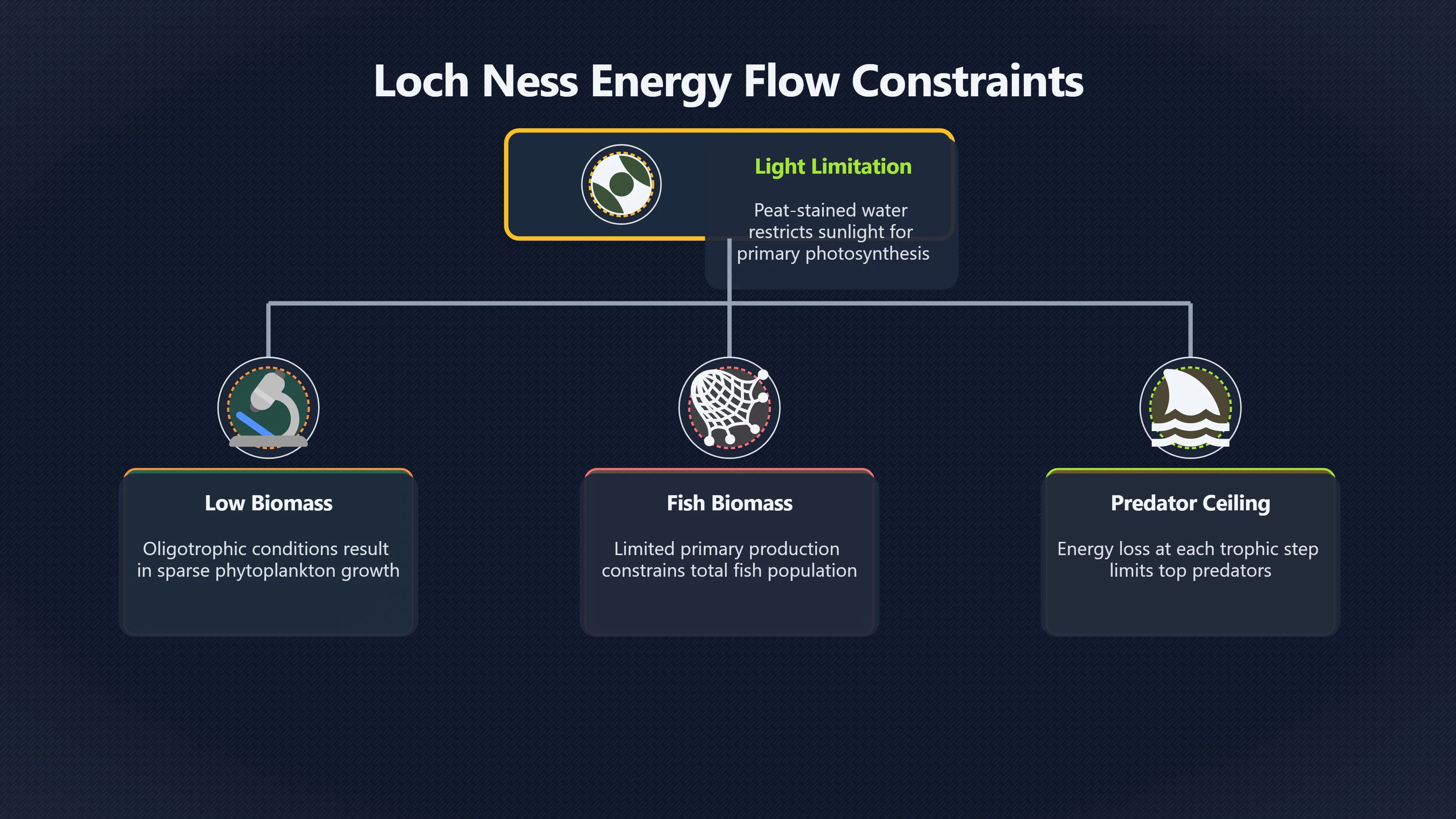
Limnological research consistently describes Loch Ness as oligotrophic, meaning nutrient-poor. Studies of phytoplankton—the microscopic algae that form the base of aquatic food webs—have found unusually low biomass and production. The loch’s dark, peat-stained water further limits light penetration, restricting photosynthesis and reducing the energy entering the ecosystem.[ResearchGate+2ResearchGate]researchgate.netlow in the turbid water, but increased as nutrients and biomass declined.Read more…
This matters because every higher trophic level depends on the levels below it. A food web begins with primary production, passes through plankton and small aquatic organisms, then to fish, and finally to top predators. If productivity is modest at the bottom of the food chain, it constrains what can exist at the top.
Fish biomass and predator energy demands
The ecological challenge becomes clearer when predator requirements are considered. Large animals require substantial amounts of food, and populations require even more. A single large predator might be difficult to detect; a breeding population must consume enough prey year after year to replace deaths and sustain reproduction.
Ecologists have long applied predator–prey and biomass calculations to the Loch Ness question. One frequently cited analysis estimated that a self-sustaining predator population would need multiple individuals and that the total biomass of such predators would be constrained by the available fish biomass. The conclusion was not that monsters were impossible in principle, but that any population would have to be relatively small because the food base itself is limited.[courses.seas.harvard.edu]courses.seas.harvard.eduJuly 8, 2000 — The growth efficiency of many aquatic predators is around 10%. If the monsters are similarly efficient and if a major part…
The logic follows a familiar ecological pattern:<div class="content-enhancement content-enhancement--insight-grid" markdown="1">
- Fish production sets the upper limit on predator production.
- Predators convert only a fraction of consumed energy into growth and reproduction.
- A stable breeding population requires enough food not only for adults but also for juveniles and unsuccessful years.
- Larger body size generally means higher absolute food requirements.</div>
Because energy is lost at every trophic step, top predators represent only a small fraction of total ecosystem biomass. This principle applies whether the predator is a pike, a seal, a crocodile, or a hypothetical unknown species.[courses.seas.harvard.edu]courses.seas.harvard.eduJuly 8, 2000 — The growth efficiency of many aquatic predators is around 10%. If the monsters are similarly efficient and if a major part…
Some Loch Ness analyses have attempted to estimate the number or mass of hypothetical creatures that the loch could support. The exact figures vary depending on assumptions about size, metabolism, and diet, but the general conclusion remains consistent: any population of very large animals would be tightly constrained by available prey resources.[courses.seas.harvard.edu+2JSTOR Daily]courses.seas.harvard.eduJuly 8, 2000 — The growth efficiency of many aquatic predators is around 10%. If the monsters are similarly efficient and if a major part…
Why a breeding population raises the burden of proof
A recurring misunderstanding in discussions of the Loch Ness Monster is the difference between one animal and a population.
A lone animal could, in theory, survive for a period without requiring many companions. But a species persisting across decades or centuries requires enough individuals to reproduce. Once that assumption is introduced, food demand multiplies. Instead of feeding one large creature, the ecosystem must support many animals of different ages and sizes over generations.
This is where the ecological burden of proof becomes important. If sightings over many decades are interpreted as evidence of a long-term species, then the claim implies:<div class="content-enhancement content-enhancement--phrase-pills" markdown="1">
- Multiple breeding adults.
- Juveniles and immature individuals.
- Continuous prey consumption.
- Population turnover through births and deaths.</div>
Each of those processes should leave ecological traces. A population large enough to remain viable would represent a measurable component of the loch’s food web.[upi.com+2Tortoise Media]upi.comResearch shows Loch Ness monster unlikely to be too29 Dec 1993 — New research on the ecology of Loch Ness shows the popular monster… They also estimated that any group of predators w…
The issue is not merely visibility. It is whether the ecosystem can energetically support what the claim requires.
Why habitat size matters more than mystery
Loch Ness is often described as an ideal hiding place because of its depth, dark water, and limited underwater visibility. Those characteristics can make observation difficult, but they do not create food.
From an ecological perspective, habitat size and habitat productivity are different concepts. A large, dark lake may conceal objects or animals more effectively than a clear, shallow one. Yet if nutrient levels remain low and fish production remains limited, the carrying capacity for large predators does not automatically increase.[ResearchGate+2lochnessproject.com]researchgate.netlow in the turbid water, but increased as nutrients and biomass declined.Read more…
This distinction helps explain why many biologists regard food supply as a stronger constraint than the loch’s mysterious appearance. The darkness of the water can affect detectability; it does not alter the fundamental energy available to support animal biomass.
Environmental DNA surveys have also reinforced the picture of a known aquatic community rather than revealing evidence for a large unknown vertebrate population. While such studies cannot prove that every reported sighting has an ordinary explanation, they have not uncovered genetic evidence for a substantial hidden population of large animals.[The Independent]independent.co.ukThe IndependentLoch Ness monster theory 'is plausible', scientist says21 Aug 2019 — One theory about the Loch Ness monster is “plausible”…
The ecological takeaway
Loch Ness remains an unusual and compelling place, but ecology places firm limits on what it can support. The loch is a bounded ecosystem with relatively low productivity, modest plankton abundance, and a finite fish resource base. Those limits matter because any long-lived monster species would require not just habitat but energy.
See on Amazon</a></div></div></article><article class="fr-book-card"><a class="fr-book-cover" href="https://www.amazon.com/s?k=The+Loch+Ness+Monster+by+Steuart+Campbell&i=stripbooks&tag=searcht-20" target="_blank" rel="sponsored noopener noreferrer" aria-label="Open The Loch Ness Monster on Amazon"><span class="fr-book-cover-fallback">Book</span><img class="fr-book-cover-thumb" src="https://books.google.com/books/content?id=eTHXAAAAMAAJ&printsec=frontcover&img=1&zoom=1&source=gbs_api" alt="Cover for The Loch Ness Monster" loading="lazy" decoding="async" fetchpriority="low" referrerpolicy="no-referrer" onerror="this.hidden=true;this.closest('.fr-book-cover').classList.add('fr-book-cover-placeholder');"></a><div class="fr-book-info"><h4 class="fr-book-title"><a href="https://www.amazon.com/s?k=The+Loch+Ness+Monster+by+Steuart+Campbell&i=stripbooks&tag=searcht-20" target="_blank" rel="sponsored noopener noreferrer" title="The Loch Ness Monster">The Loch Ness Monster</a></h4><p class="fr-book-author">By Steuart Campbell</p><p class="fr-book-desc">Directly examines whether the monster hypothesis fits available evidence.</p><div class="fr-book-actions"><a href="https://www.amazon.com/s?k=The+Loch+Ness+Monster+by+Steuart+Campbell&i=stripbooks&tag=searcht-20" class="fr-amazon-btn" target="_blank" rel="sponsored noopener noreferrer">
See on Amazon</a></div></div></article><article class="fr-book-card"><a class="fr-book-cover" href="https://www.amazon.com/s?k=The+Serengeti+Rules+by+Sean+B.+Carroll&i=stripbooks&tag=searcht-20" target="_blank" rel="sponsored noopener noreferrer" aria-label="Open The Serengeti Rules on Amazon"><span class="fr-book-cover-fallback">Book</span><img class="fr-book-cover-thumb" src="https://books.google.com/books/content?id=AgpsDQAAQBAJ&printsec=frontcover&img=1&zoom=1&edge=curl&source=gbs_api" alt="Cover for The Serengeti Rules" loading="lazy" decoding="async" fetchpriority="low" referrerpolicy="no-referrer" onerror="this.hidden=true;this.closest('.fr-book-cover').classList.add('fr-book-cover-placeholder');"></a><div class="fr-book-info"><h4 class="fr-book-title"><a href="https://www.amazon.com/s?k=The+Serengeti+Rules+by+Sean+B.+Carroll&i=stripbooks&tag=searcht-20" target="_blank" rel="sponsored noopener noreferrer" title="The Serengeti Rules">The Serengeti Rules</a></h4><p class="fr-book-author">By Sean B. Carroll</p><p class="fr-book-desc">Shows how ecosystems regulate animal populations.</p><div class="fr-book-actions"><a href="https://www.amazon.com/s?k=The+Serengeti+Rules+by+Sean+B.+Carroll&i=stripbooks&tag=searcht-20" class="fr-amazon-btn" target="_blank" rel="sponsored noopener noreferrer">
See on Amazon</a></div></div></article><article class="fr-book-card"><a class="fr-book-cover" href="https://www.amazon.com/s?k=Ecology%3A+The+Economy+of+Nature+%28Canadian+Edition%29+by+Robert+E.+Ricklefs&i=stripbooks&tag=searcht-20" target="_blank" rel="sponsored noopener noreferrer" aria-label="Open Ecology: The Economy of Nature (Canadian Edition) on Amazon"><span class="fr-book-cover-fallback">Book</span><img class="fr-book-cover-thumb" src="https://books.google.com/books/content?id=4LnHoAEACAAJ&printsec=frontcover&img=1&zoom=1&source=gbs_api" alt="Cover for Ecology: The Economy of Nature (Canadian Edition)" loading="lazy" decoding="async" fetchpriority="low" referrerpolicy="no-referrer" onerror="this.hidden=true;this.closest('.fr-book-cover').classList.add('fr-book-cover-placeholder');"></a><div class="fr-book-info"><h4 class="fr-book-title"><a href="https://www.amazon.com/s?k=Ecology%3A+The+Economy+of+Nature+%28Canadian+Edition%29+by+Robert+E.+Ricklefs&i=stripbooks&tag=searcht-20" target="_blank" rel="sponsored noopener noreferrer" title="Ecology: The Economy of Nature (Canadian Edition)">Ecology: The Economy of Nature (Canadian Edition)</a></h4><p class="fr-book-author">By Robert E. Ricklefs, Rick Relyea et al.</p><p class="fr-book-desc">Explains carrying capacity, food webs, and energy limits.</p><div class="fr-book-actions"><a href="https://www.amazon.com/s?k=Ecology%3A+The+Economy+of+Nature+%28Canadian+Edition%29+by+Robert+E.+Ricklefs&i=stripbooks&tag=searcht-20" class="fr-amazon-btn" target="_blank" rel="sponsored noopener noreferrer">
See on Amazon</a></div></div></article></div><div class="fr-section-footer"><div class="fr-browse-links" aria-label="Browse more on Amazon"><span class="fr-browse-links-label">Browse more on Amazon:</span><a class="fr-browse-more" href="https://www.amazon.com/s?k=Abominable+Science%21&i=stripbooks&tag=searcht-20" target="_blank" rel="sponsored noopener noreferrer">Abominable Science!</a><a class="fr-browse-more" href="https://www.amazon.com/s?k=The+Loch+Ness+Monster&i=stripbooks&tag=searcht-20" target="_blank" rel="sponsored noopener noreferrer">The Loch Ness Monster</a><a class="fr-browse-more" href="https://www.amazon.com/s?k=The+Serengeti+Rules&i=stripbooks&tag=searcht-20" target="_blank" rel="sponsored noopener noreferrer">The Serengeti Rules</a></div><p class="fr-disclosure">As an Amazon Associate I earn from qualifying purchases.</p></div></div></section>
Amazon book picks
Further Reading
Books and field guides related to Could Loch Ness Feed a Monster Population?. Use these as the next step if you want deeper reading beyond the article.
The Loch Ness Monster
Directly examines whether the monster hypothesis fits available evidence.
Ecology: The Economy of Nature (Canadian Edition)
Explains carrying capacity, food webs, and energy limits.
eBay marketplace picks
Marketplace Samples
Live-tested eBay searches with available results related to this page.

Endnotes
1.
Source: researchgate.net
Link:https://www.researchgate.net/publication/229645112Light_limitation_of_phytoplankton_development_in_an_oligotrophic_lake-_Loch_Ness_Scotland
2.
Source: lochnessproject.com
Link:https://www.lochnessproject.com/EXPLORE_LOCH_NESS/underwater/underwater_loch_ness%20index.htm
3.
Source: researchgate.net
Link:https://www.researchgate.net/publication/230062662_The_horizontal_distribution_of_plankton_in_a_deep_oligotrophic_lake-Loch_Ness_Scotland
4.
Source: Wikipedia
Title: Loch Ness
Link:https://en.wikipedia.org/wiki/Loch_Ness
5.
Source: lochnessproject.com
Link:https://www.lochnessproject.com/FIELDWORKGROUNDTRUTH/FIELD%20STUDIES/Loch%20Ness%20Field%20Studies.htm
6.
Source: courses.seas.harvard.edu
Link:https://courses.seas.harvard.edu/climate/eli/Courses/EPS281r/Sources/Misc/population-density-Loch-Ness-monsters.pdf
7.
Source: upi.com
Title: Research shows Loch Ness monster unlikely to be too
Link:https://www.upi.com/Archives/1993/12/29/Research-shows-Loch-Ness-monster-unlikely-to-be-too-monstrous/6146757141200/
8.
Source: daily.jstor.org
Title: nessiteras rhombopteryx the loch ness monster
Link:https://daily.jstor.org/nessiteras-rhombopteryx-the-loch-ness-monster/
9.
Source: researchgate.net
Link:https://www.researchgate.net/publication/390620130_The_Loch_Ness_Monster_If_It%27s_Real_Could_It_Be_an_Eel
10.
Source: Wikipedia
Link:https://en.wikipedia.org/wiki/Loch
11.
Source: research-repository.griffith.edu.au
Link:https://research-repository.griffith.edu.au/bitstreams/d000750f-54c1-49d8-ae8c-517bbfd42b18/download
12.
Source: researchgate.net
Link:https://www.researchgate.net/publication/235917640_Stock_assessment_of_the_Arctic_charr_Salvelinus_alpinus_population_of_Loch_Ness_UK
13.
Source: researchgate.net
Link:https://www.researchgate.net/publication/330528804_Global_baselines_and_benchmarks_for_fish_biomass_Comparing_remote_reefs_and_fisheries_closures
14.
Source: lochnessproject.org
Link:https://www.lochnessproject.org/ARCHIVE%20ROOM/papershtml/LOCH_NESS_scottish_naturalist.HTM
15.
Source: nature.scot
Title: freshwater lochs
Link:https://www.nature.scot/landscapes-and-habitats/habitat-types/lochs-rivers-and-wetlands/freshwater-lochs
16.
Source: tortoisemedia.com
Title: Tortoise Media The Loch Ness monster doesn’t exist
Link:https://www.tortoisemedia.com/2023/08/25/the-loch-ness-monster-doesnt-exist-so-why-are-people-still-looking-for-it
17.
Source: independent.co.uk
Link:https://www.independent.co.uk/news/science/loch-ness-monster-theory-lake-where-is-explained-proof-a9072546.html
18.
Source: merriam-webster.com
Link:https://www.merriam-webster.com/dictionary/loch
19.
Source: dictionary.cambridge.org
Link:https://dictionary.cambridge.org/dictionary/english/loch
Additional References
20.
Source: hero.epa.gov
Link:https://hero.epa.gov/reference/763677/
21.
Source: fish.gov.au
Link:https://fish.gov.au/Archived-Reports/2014/Documents/2014_refs/Pikitch%20et%20al%202012%20-%20Little%20Fish%2C%20Big%20Impact.pdf
22.
Source: facebook.com
Link:https://www.facebook.com/groups/470765477828717/posts/1282136980024892/
23.
Source: reddit.com
Link:https://www.reddit.com/r/Cryptozoology/comments/hj8vcz/would_[nessie
24.
Source: visitscotland.com
Link:https://www.visitscotland.com/things-to-do/landscapes-nature/lochs
25.
Source: pmc.ncbi.nlm.nih.gov
Title: PMCReservoir ecosystems support large pools of fish biomass
Link:https://pmc.ncbi.nlm.nih.gov/articles/PMC11043325/
26.
Source: thefishsite.com
Title: new research finds fish biomass increases even when food energy are constant
Link:https://thefishsite.com/articles/new-research-finds-fish-biomass-increases-even-when-food-energy-are-constant
27.
Source: isaacscience.org
Link:https://isaacscience.org/questions/how_many_monsters_in_loch_ness
28.
Source: seelochlomond.co.uk
Link:https://www.seelochlomond.co.uk/discover/top-10-lochs
29.
Source: pmc.ncbi.nlm.nih.gov
Link:https://pmc.ncbi.nlm.nih.gov/articles/PMC4520681/
Topic Tree