Within Lazarus Taxa
Where Lost Animals Actually Hide
Real rediscoveries usually come from deep water, remote islands, alpine terrain or nocturnal breeding sites where detection is genuinely hard.
On this page
- Deep sea and underwater search limits
- Islands, sea stacks and remote mountains
- Why refuge logic does not scale to every cryptid
Page outline Jump by section
Introduction
One of the strongest lessons from Lazarus taxa is that animals do not usually survive because they are magically elusive. They survive because they occupy refuges that are genuinely difficult for humans to search. Deep-water habitats, isolated sea stacks, remote mountain valleys and secretive breeding sites can create long gaps in the scientific record without requiring anything extraordinary. In cryptozoology, this matters because real rediscoveries show how species can remain undetected for decades or even centuries. At the same time, the places where Lazarus taxa are found are usually very specific, limited and biologically plausible. The same refuge logic that explains a hidden seabird colony or deep-sea fish does not automatically support claims about large, widespread unknown animals.
Deep Sea and Underwater Search Limits
The ocean remains one of the most convincing examples of a refuge environment. Large areas of the deep sea are rarely visited, difficult to survey and expensive to study. A species living in deep underwater caves, steep submarine slopes or narrow depth bands can be effectively invisible to most scientific sampling.
The coelacanth is the classic example. Before its rediscovery in 1938, the lineage was known only from fossils and was widely believed extinct. Modern populations occupy deep marine habitats, often associated with underwater caves and volcanic slopes at depths beyond routine observation. Researchers have documented coelacanths sheltering in cave systems during daylight hours, behaviour that further reduces detectability. Their habitat combines several obstacles at once: depth, limited geographic distribution and low population density.[Natural History Museum+2Frontiers]nhm.ac.ukThese are organisms thatNatural History MuseumCoelacanths: The fish that 'outdid' the Loch Ness MonsterCoelacanths are sometimes called a Lazarus taxon opens in…
Importantly, the coelacanth’s rediscovery did not occur because the fish was hiding in a mysterious unexplored ocean basin. It survived in a specific ecological niche where few people looked and where conventional surveys were historically limited. Modern conservation agencies still note that its deep-water habitat makes population assessment difficult.[Wikipedia]WikipediaMarch 22, 2002 — Because of their remote deep sea habitat, the conservation status of living coelacanths is difficult to characterize. Th…
This illustrates a key mechanism behind many Lazarus taxa: the animal is not impossible to find, but the search effort required is far greater than most people assume.
Islands, Sea Stacks and Remote Mountains
Isolation is another powerful refuge mechanism. Small islands, inaccessible cliffs and rugged mountain terrain often contain species that occupy tiny ranges. If those places are rarely visited, a species can disappear from scientific records while remaining biologically present.
The Lord Howe Island stick insect demonstrates this dramatically. Believed extinct after invasive rats devastated its original habitat, the species survived on Ball’s Pyramid, a steep volcanic sea stack in the Tasman Sea. Researchers eventually discovered a tiny population living on a narrow, difficult-to-access terrace high above the ocean. The refuge was not vast wilderness; it was an extremely specific location that few people could safely reach.[ResearchGate+2PubMed]researchgate.netOpen source on researchgate.net.
The significance of Ball’s Pyramid is not merely that it was remote. It was remote, dangerous to access and capable of excluding predators that had eliminated the species elsewhere. Such refuges often function as biological islands within islands, preserving remnants of populations after extinction across the rest of their former range.[ResearchGate]researchgate.netOpen source on researchgate.net.
Mountain systems can create similar effects. Deep valleys, isolated plateaus and fragmented alpine habitats frequently hold small populations separated from better-studied regions. In these environments, a species may persist undetected because survey coverage is incomplete rather than because the animal is exceptionally secretive.
Hidden Breeding Sites and Nocturnal Lives
Some Lazarus taxa become”lost” not because adults are hard to find, but because their breeding sites are extraordinarily difficult to locate.
The Bermuda petrel, or cahow, was considered extinct for centuries before breeding pairs were rediscovered in 1951 on tiny rocky islets in Bermuda. The birds spend much of their lives at sea and return to land primarily for nesting. Their colonies occupied small, isolated locations that escaped sustained observation. The rediscovered population consisted of only a handful of nesting pairs on remote islets.[BirdLife DataZone+2atlanticconservationpartnership.org]datazone.birdlife.orgestablished active nest sites. Bermuda PetrelBirdLife DataZoneBermuda Petrel Pterodroma cahow Species FactsheetIn 1951, 18 pairs were rediscovered breeding on suboptimal rocky islets…
Nocturnal behaviour compounded the problem. The birds return to breeding sites under cover of darkness and nest in burrows, making visual detection difficult even when humans are nearby. Modern monitoring projects continue to reveal aspects of their behaviour that were poorly understood for decades after rediscovery.[The Verge]theverge.comThe Verge Hacking Go Pros to help save the Atlantic's rarest birdJeremy Madeiros, lead warden of the protected 15-acre Nonsuch Island habitat, works alongside filmmaker and self-taught tech developer Je…
This pattern appears repeatedly among rediscovered species:<div class="content-enhancement content-enhancement--insight-grid" markdown="1">
- Breeding occurs only during a short seasonal window.
- Nesting sites are hidden underground, in cliffs or on isolated islets.
- Adults spend most of their lives away from the areas where surveys occur.
- Populations are small enough that encounters become statistically unlikely.</div>
The resulting absence of records can look like extinction when it is actually a failure to observe a highly localised life cycle.
Why Refuge Logic Works
The common factor across these examples is not mystery but probability.
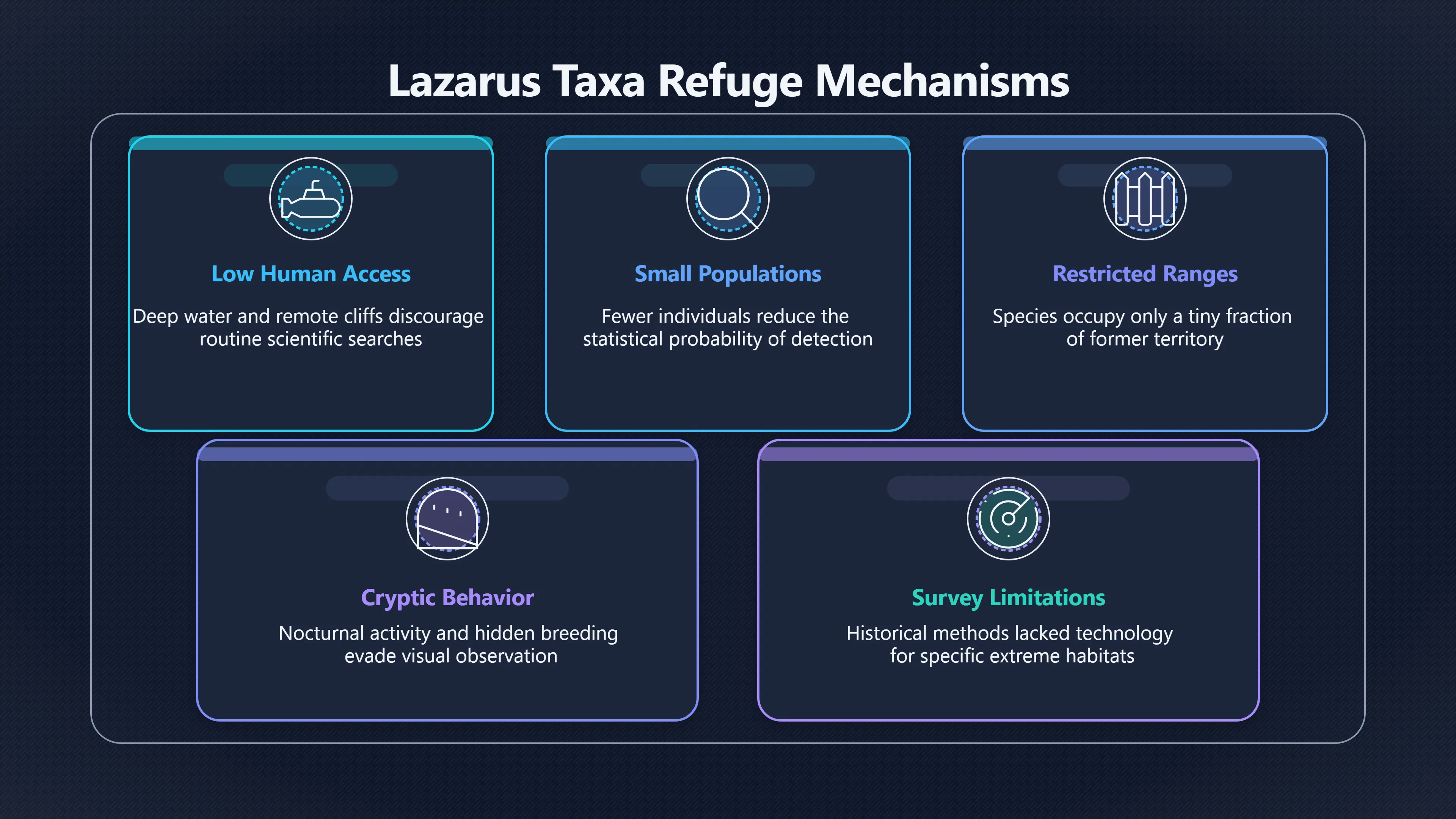
A refuge becomes effective when several conditions overlap:<div class="content-enhancement content-enhancement--step-flow" markdown="1">
- Low human access – deep water, cliffs, caves or remote terrain discourage routine searches.
- Small populations – fewer animals mean fewer opportunities for detection.
- Restricted ranges – surviving individuals occupy only a fraction of their former distribution.
- Cryptic behaviour – nocturnal activity, seasonal emergence or hidden breeding reduces encounters.
- Limited survey technology – historical methods may have been inadequate for the habitat.</div>
When all five factors occur together, long gaps in observation become plausible. A species can remain biologically present while effectively absent from scientific records.
Why Refuge Logic Does Not Scale to Every Cryptid
The rediscovery of real animals is often cited as evidence that any unknown creature might still be hiding somewhere. The actual pattern is much narrower.
Lazarus taxa are usually rediscovered in habitats that sharply limit detection and often involve animals with small populations, restricted ranges or specialised lifestyles. Coelacanths inhabit deep marine environments. The Lord Howe Island stick insect survived on a remote sea stack. Cahows nested on tiny offshore islets and returned mainly at night. These are highly constrained scenarios.[Natural History Museum+2ResearchGate]nhm.ac.ukThese are organisms thatNatural History MuseumCoelacanths: The fish that 'outdid' the Loch Ness MonsterCoelacanths are sometimes called a Lazarus taxon opens in…
The logic becomes weaker when applied to large terrestrial animals that would require extensive populations, broad territories and regular interactions with human infrastructure. A hidden colony of insects on an isolated cliff and a large unknown mammal spread across populated regions present very different detection problems.
Real rediscoveries therefore support a specific conclusion: animals can survive unnoticed when habitat, behaviour and survey limitations create genuine refuges. They do not show that any creature can remain hidden indefinitely. The lesson from Lazarus taxa is not that extinction claims are always wrong, but that the strongest survival cases are built on identifiable refuges where absence of evidence is genuinely understandable.
Amazon book picks
Further Reading
Books and field guides related to Where Lost Animals Actually Hide. Use these as the next step if you want deeper reading beyond the article.
The Ends of the Earth
Provides perspective on isolated environments, though indirectly.
eBay marketplace picks
Marketplace Samples
Live-tested eBay searches with available results related to this page.


Endnotes
1.
Source: Wikipedia
Link:https://en.wikipedia.org/wiki/Coelacanth
2.
Source: researchgate.net
Link:https://www.researchgate.net/publication/226062899Rediscovery_of_the%27extinct%27_Lord_Howe_Island_stick-insect_Dryococelus_australis_Montrouzier_Phasmatodea_and_recommendations_for_its_conservation
3.
Source: datazone.birdlife.org
Title: established active nest sites. Bermuda Petrel
Link:https://datazone.birdlife.org/species/factsheet/bermuda-petrel-pterodroma-cahow
4.
Source: atlanticconservationpartnership.org
Title: cahow recovery project
Link:https://atlanticconservationpartnership.org/conservation-research/cahow-recovery-project/
5.
Source: Wikipedia
Title: Bermuda petrel
Link:https://en.wikipedia.org/wiki/Bermuda_petrel
6.
Source: Wikipedia
Title: Lazarus taxon
Link:https://en.wikipedia.org/wiki/Lazarus_taxon
7.
Source: youtube.com
Title: Lazarus: Animals Who Came Back From The Dead
Link:https://www.youtube.com/watch?v=5KMvxYL9MXc
8.
Source: youtube.com
Title: Lazarus Taxa
Link:https://www.youtube.com/watch?v=SR5-YcsVJlE
9.
Source: youtube.com
Title: Rediscovery | When Can We Be Sure A Species Is Truly Extinct?
Link:https://www.youtube.com/watch?v=ZWm8ja2B0ss
10.
Source: nhm.ac.uk
Title: These are organisms that
Link:https://www.nhm.ac.uk/discover/coelacanths-the-fish-that-outdid-the-loch-ness-monster.html
11.
Source: frontiersin.org
Link:https://www.frontiersin.org/journals/marine-science/articles/10.3389/fmars.2021.755275/full
12.
Source: pubmed.ncbi.nlm.nih.gov
Link:https://pubmed.ncbi.nlm.nih.gov/28988864/
13.
Source: theverge.com
Title: The Verge Hacking Go Pros to help save the Atlantic’s rarest bird
Link:https://www.theverge.com/tech/642950/gopro-hack-bird-conservation-bermuda-cahow
Additional References
14.
Source: facebook.com
Link:https://www.facebook.com/WoodsHoleOcean/posts/off-the-coast-of-bermuda-another-generation-of-cahow-chicks-are-preparing-for-a-/1332963928879115/
15.
Source: borea.mnhn.fr
Link:https://borea.mnhn.fr/sites/default/files/pdfs/A17-29Cupello.pdf
16.
Source: facebook.com
Link:https://www.facebook.com/WildlifePhotographerOfTheYear/posts/up-close-and-personal-until-1938-it-was-thought-coelacanths-had-been-extinct-for/1419448826204837/
17.
Source: facebook.com
Title: exciting news from bermuda a cahow bermudas national bird hatched on nonsuch isl
Link:https://www.facebook.com/bermudatourism/posts/exciting-news-from-bermuda-a-cahow-bermudas-national-bird-hatched-on-nonsuch-isl/1379781774184179/
18.
Source: ecosphere-documents-production-public.s3.amazonaws.com
Link:https://ecosphere-documents-production-public.s3.amazonaws.com/sams/public_docs/species_nonpublish/2761.pdf
19.
Source: thewildepisode.com
Title: lord howe island stick insect the lazarus stick
Link:https://thewildepisode.com/2018/03/13/lord-howe-island-stick-insect-the-lazarus-stick/
20.
Source: frederic-38110.medium.com
Title: the return of the stick insect 890ff34d1360
Link:https://frederic-38110.medium.com/the-return-of-the-stick-insect-890ff34d1360
21.
Source: wired.com
Title: welcome back lord howe island stick insect
Link:https://www.wired.com/story/welcome-back-lord-howe-island-stick-insect
22.
Source: critter.science
Link:https://critter.science/lazarus-species-rediscovered-life/
23.
Source: fisheries.noaa.gov
Title: african coelacanth
Link:https://www.fisheries.noaa.gov/species/african-coelacanth
Topic Tree