Within Okapi
Why the Okapi Could Stay Hidden
Dense rainforest, limited outside access, and elusive behaviour made delayed okapi recognition plausible without lowering proof standards.
On this page
- Habitat conditions that mattered
- Why modern surveys are still difficult
- Where the analogy stops working
Page outline Jump by section
Introduction
The okapi is often cited in cryptozoology discussions as proof that a large animal can remain unknown to outside science for a surprisingly long time. The strongest reason this example works is not that the animal was magical or invisible, but that it lived in one of the most difficult environments on Earth for nineteenth-century zoological exploration: the Ituri rainforest of north-eastern Congo. Dense vegetation, limited transport routes, sparse colonial infrastructure, and the okapi’s own behaviour combined to make delayed scientific recognition plausible. At the same time, the okapi case demonstrates an important limit. The forest conditions explain why European institutions lacked specimens before 1900, but they do not reduce the standard of evidence required for scientific acceptance. Once specimens became available, the animal was rapidly incorporated into zoology.[UNESCO World Heritage Centre+2Tetrapod Zoology]whc.unesco.orgUNESCO World Heritage CentreOkapi Wildlife ReserveThe Okapi Wildlife Reserve occupies about one-fifth of the Ituri forest in the north-ea…
Habitat Conditions That Mattered
Why European Science Lacked a Specimen
The key historical question is not why nobody knew about the okapi. Local communities in and around the Ituri region clearly did. The more precise question is why European museums and zoologists lacked physical specimens until the turn of the twentieth century.[Tetrapod Zoology]tetzoo.comTetrapod ZoologyThe Discovery of the Okapi, Part 112 Apr 2023 — The first instance of European awareness of the Okapi* came in 1890 when…
Several factors converged:
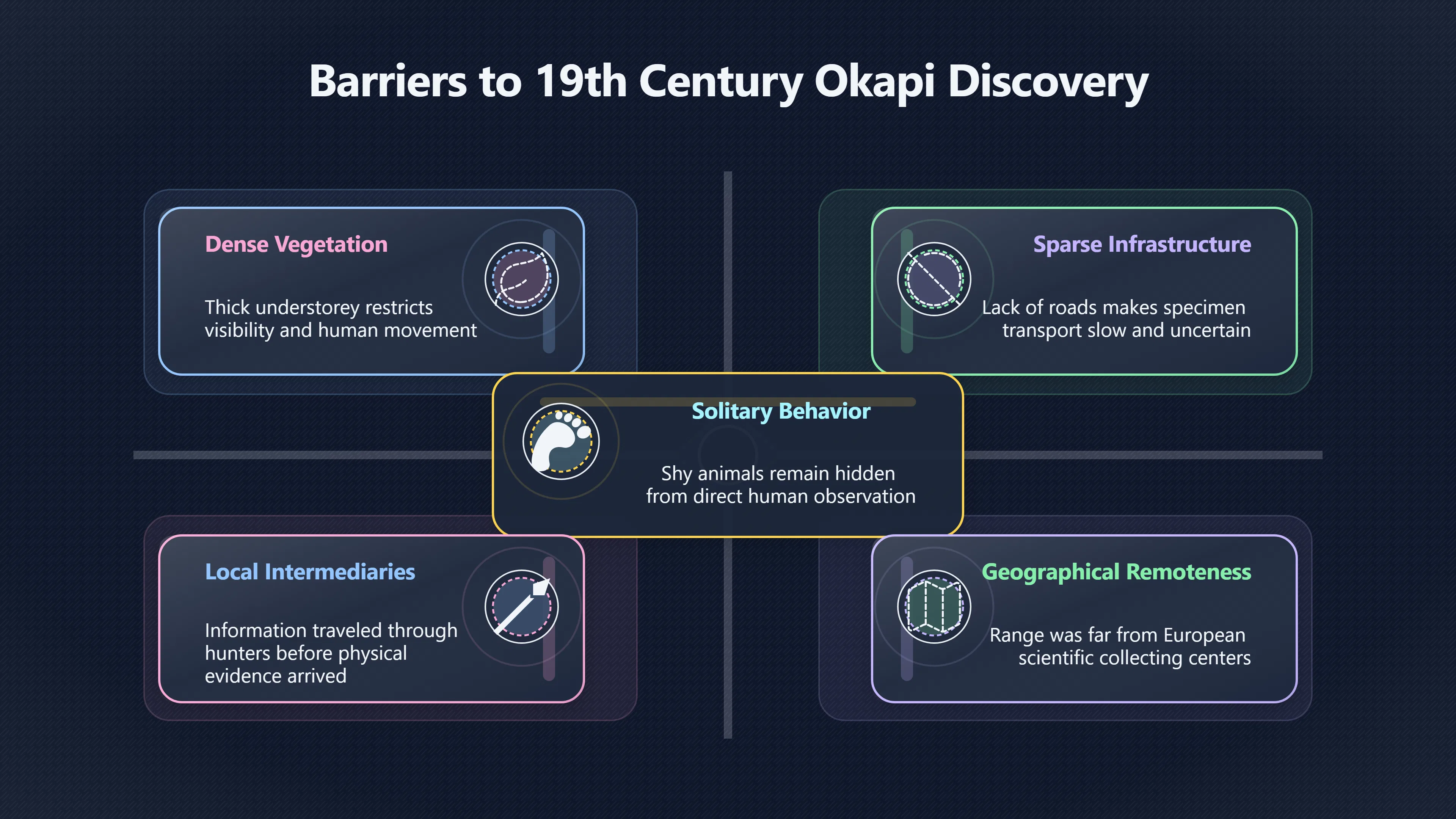
- Geographical remoteness: The okapi’s range was concentrated in a difficult-to-access rainforest region far from the main centres of European scientific collecting.[UNESCO World Heritage Centre]whc.unesco.orgUNESCO World Heritage CentreOkapi Wildlife ReserveThe Okapi Wildlife Reserve occupies about one-fifth of the Ituri forest in the north-ea…
- Limited infrastructure: Much of the Congo Basin remained roadless or poorly connected, making the transport of specimens slow and uncertain.[arXiv]arxiv.orgOpen source on arxiv.org.
- Low detectability: The animal’s solitary habits and preference for dense forest reduced the chances of direct encounters.[IUCN Portals]portals.iucn.orgIUCN PortalsOkapi (Okapia johnstoni)by NF Kümpel · 2015 · Cited by 17 — The okapi is rarely observed directly in the wild state, because…
- Dependence on local intermediaries: Information about the animal often reached outsiders through hunters, traders, and local forest peoples before physical evidence did.[Tetrapod Zoology]tetzoo.comTetrapod ZoologyThe Discovery of the Okapi, Part 112 Apr 2023 — The first instance of European awareness of the Okapi* came in 1890 when…
When specimens finally reached zoologists, acceptance followed quickly. In other words, the delay arose largely from difficulties in obtaining verifiable material, not from an inability of science to recognise a real animal once evidence became available.[Tetrapod Zoology]tetzoo.comTetrapod ZoologyThe Discovery of the Okapi, Part 112 Apr 2023 — The first instance of European awareness of the Okapi* came in 1890 when…
Why Modern Surveys Are Still Difficult
Where the Analogy Stops Working
The okapi remains one of the strongest examples showing that a real animal can be poorly known outside its native region for a long time. Dense rainforest conditions, limited access, and elusive behaviour created a genuine information barrier between local knowledge and international science.[Tetrapod Zoology]tetzoo.comTetrapod ZoologyThe Discovery of the Okapi, Part 112 Apr 2023 — The first instance of European awareness of the Okapi* came in 1890 when…
However, the analogy has limits when applied to modern cryptozoological claims. The okapi occupied a vast, under-surveyed rainforest and was documented through a chain that eventually produced skins, skulls, and other physical evidence suitable for scientific examination. Its existence became accepted because evidence accumulated, not because mystery persisted.[Tetrapod Zoology]tetzoo.comTetrapod ZoologyThe Discovery of the Okapi, Part 112 Apr 2023 — The first instance of European awareness of the Okapi* came in 1890 when…
That distinction matters. The Ituri Forest provides a plausible explanation for delayed recognition, but it does not justify lowering evidential standards. The okapi case shows that difficult habitats can conceal animals from outside institutions for a time. It does not show that long-term absence of verifiable evidence should be treated as evidence in itself. The lesson for cryptozoology is therefore twofold: environmental conditions can make discovery genuinely difficult, yet scientific confirmation still depends on testable, physical documentation.[IUCN Portals]portals.iucn.orgIUCN PortalsOkapi (Okapia johnstoni)by NF Kümpel · 2015 · Cited by 17 — The okapi is rarely observed directly in the wild state, because…
Amazon book picks
Further Reading
Books and field guides related to Why the Okapi Could Stay Hidden. Use these as the next step if you want deeper reading beyond the article.
King Leopold's Ghost
Provides historical context for exploration and knowledge of central African regions.
The Beasts That Hide from Man
Covers hidden-animal narratives and their evidential basis.
Congo Journey
Illustrates the practical difficulties of moving through Congo rainforest environments.
eBay marketplace picks
Marketplace Samples
Live-tested eBay searches with available results related to this page.
Endnotes
1.
Source: whc.unesco.org
Link:https://whc.unesco.org/en/list/718/
2.
Source: portals.iucn.org
Link:https://portals.iucn.org/library/sites/library/files/documents/2015-046.pdf
3.
Source: arxiv.org
Link:https://arxiv.org/abs/1602.01436
4.
Source: researchgate.net
Link:https://www.researchgate.net/figure/An-okapi-in-its-natural-habitat-photographed-in-northern-Virunga-National-Park-by-camera_fig1_295908918
5.
Source: researchgate.net
Link:https://www.researchgate.net/publication/271227387_Enhancing_knowledge_of_an_endangered_and_elusive_species_the_okapi_using_non-invasive_genetic_techniques
6.
Source: researchgate.net
Link:https://www.researchgate.net/publication/295908918_Okapi_Okapia_johnstoni_Conservation_Strategy_and_Status_Review
7.
Source: tetzoo.com
Link:https://tetzoo.com/blog/2023/4/11/the-discovery-of-the-okapi-part-1
8.
Source: okapiconservation.org
Link:https://www.okapiconservation.org/the-okapi
9.
Source: nationalgeographic.com
Link:https://www.nationalgeographic.com/animals/mammals/facts/okapi
10.
Source: Wikipedia
Link:https://en.wikipedia.org/wiki/Okapi
11.
Source: Wikipedia
Title: Okapi Conservation Project
Link:https://en.wikipedia.org/wiki/Okapi_Conservation_Project
12.
Source: synchronicityearth.org
Link:https://www.synchronicityearth.org/partner/okapi-conservation-project/
13.
Source: naturalworldheritagesites.org
Title: Okapi Wildlife Reserve
Link:https://www.naturalworldheritagesites.org/sites/okapi-wildlife-reserve
14.
Source: dublinzoo.ie
Link:https://www.dublinzoo.ie/conservation/okapi-conservation-project/
Additional References
15.
Source: facebook.com
Link:https://www.facebook.com/columbuszoo/posts/for-years-the-okapi-was-considered-a-myth-because-of-the-difficulty-in-spotting-/10156036951762106/
16.
Source: facebook.com
Link:https://www.facebook.com/DublinZoo/posts/into-the-world-of-forests-and-stripes-incredible-footage-of-okapi-in-the-wild-ta/816187683881653/
17.
Source: marylandzoo.org
Link:https://www.marylandzoo.org/animal/okapi/
18.
Source: Wikipedia
Link:https://en.wikipedia.org/wiki/Okapi_Wildlife_Reserve
19.
Source: linkedin.com
Link:https://www.linkedin.com/posts/rhettayersbutler_in-the-depths-of-the-democratic-republic-activity-7246054849132277760-4JGo
20.
Source: facebook.com
Link:https://www.facebook.com/wildnet/posts/the-elusive-okapiknown-alternatively-as-the-forest-giraffe-and-the-ghost-of-the-/1409465291206205/
21.
Source: facebook.com
Link:https://www.facebook.com/LAZoo/posts/the-endangered-okapi-is-found-in-the-dense-tropical-ituri-forest-located-in-the-/710356784456251/
22.
Source: drctourism.com
Link:https://drctourism.com/how-okapi-[tourism
23.
Source: instagram.com
Title: Meet the okapi, the only living relative of giraffes!
Link:https://www.instagram.com/p/DZsxAFenyzV/?hl=en
24.
Source: facebook.com
Title: George the okapi has the most boopable nose!
Link:https://www.facebook.com/BrevardZoo/posts/george-the-okapi-has-the-most-boopable-nose-did-you-know-okapis-are-also-known-a/1038632751643934/
Topic Tree