Within Prehistoric Claims
Why One Hidden Survivor Is Not Enough
A real prehistoric survivor would need more than sightings; it would leave feeding signs, young, remains, DNA and repeated encounters.
On this page
- Why a population is required
- What large animals leave behind
- Why negative searches still matter
Page outline Jump by section
Introduction
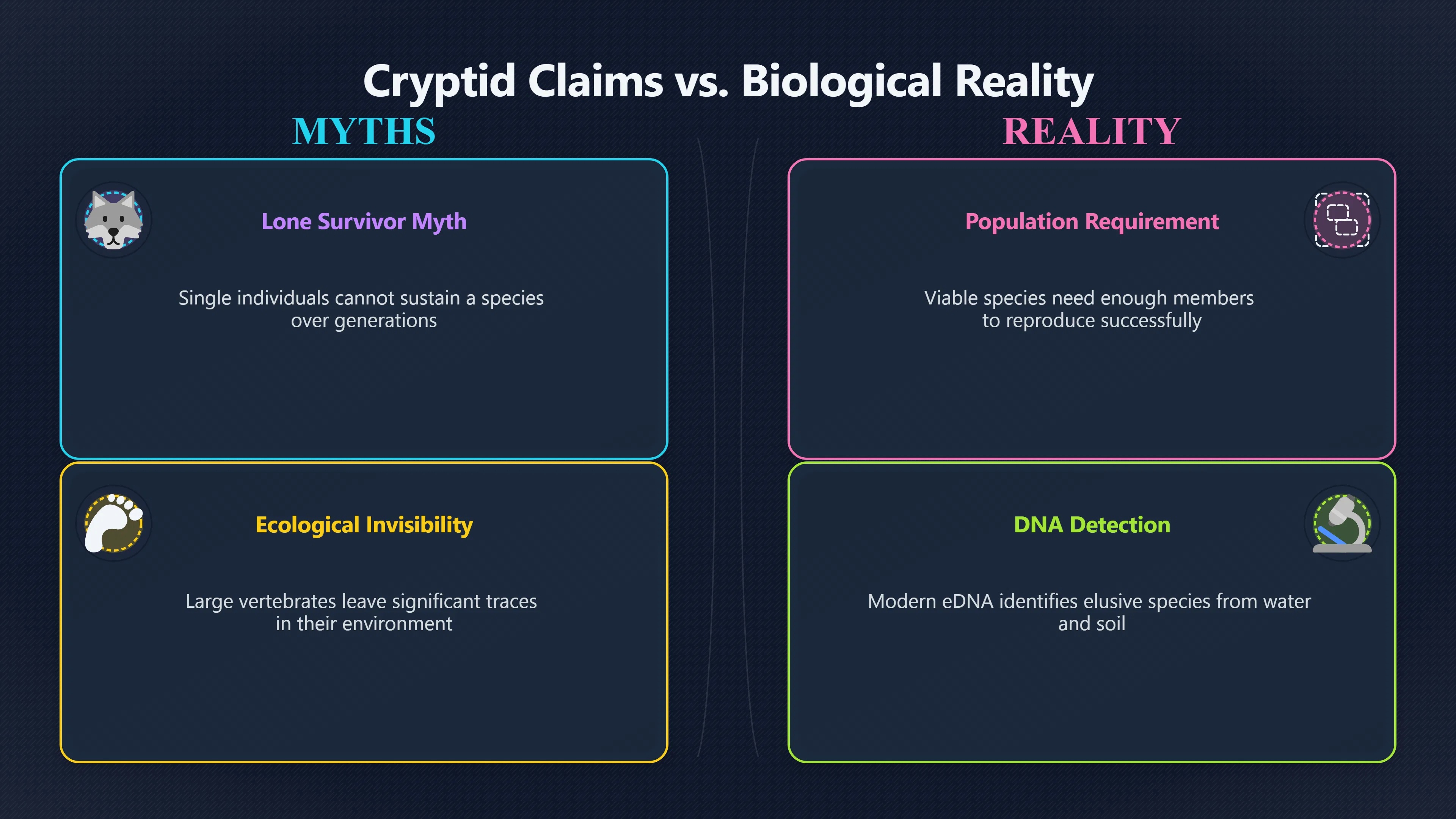
One of the biggest weaknesses in claims that a prehistoric animal has survived unnoticed into modern times is that a single sighting is not enough. A long-term survivor would almost certainly require a breeding population, and breeding populations leave evidence. Animals reproduce, die, feed, migrate, shed DNA, leave tracks and interact with their environment. The larger the animal, the harder those traces are to hide. This creates a fundamental problem for many cryptozoological claims. Reports often focus on an individual creature—a lone plesiosaur in a lake, a surviving dinosaur in a remote swamp, or a giant unknown primate in a forest. Zoology, however, does not work through isolated individuals persisting indefinitely. For a species to survive across generations, there must be enough animals to reproduce successfully and maintain a viable population. Once that requirement is accepted, the question changes from “Could one animal be hidden?” to “Where are all the traces of the population?”[Reddit]reddit.comIt's mind-blowing to realize the clearest proof of Nessie was…January 28, 2025 — Mostly because the idea of a breeding populatio…
Why a Population Is Required
A species cannot persist for centuries or millennia through a single individual. Even if an isolated animal somehow survived for an unusually long time, it would eventually die without descendants. Any claim that a prehistoric lineage remains alive today therefore implies repeated reproduction over many generations.
In conservation biology, small populations face serious challenges including inbreeding, demographic instability and random environmental events. While the exact number required varies by species, a sustainable population generally involves far more than a handful of individuals. A hidden population of large reptiles, mammals or marine predators would therefore consist of numerous animals spread across a habitat, not a single elusive specimen.
This has important consequences for cryptid claims. Every additional individual increases the chance of discovery. A population must produce young animals, breeding behaviour, feeding activity and deaths. Even if adults are rarely observed, juveniles, carcasses or other evidence should occasionally appear.
The logic applies equally to famous claims involving surviving dinosaurs, plesiosaurs or giant unknown mammals. The question is not merely whether one animal could avoid observation. It is whether an entire reproducing population could do so for decades while leaving virtually no verifiable physical evidence.
What Large Animals Leave Behind
Large vertebrates alter their environments in detectable ways. Wildlife researchers often identify species without ever seeing the animals directly because traces accumulate naturally over time.
Typical evidence includes:
-
Footprints and trackways.<div class="content-enhancement content-enhancement--insight-grid" markdown="1">
- Scat, hair, feathers or shed skin.
- Feeding damage on prey or vegetation.
- Nests, dens, burrows or breeding sites.
- Carcasses and skeletal remains.
- Bite marks, teeth or shed antlers.
- Environmental DNA left in water, soil, snow or air.</div>
Modern wildlife monitoring increasingly relies on such indirect evidence. Researchers routinely identify elusive species from traces found in snow, water samples, feeding sites and other environmental sources. Even rare carnivores can be detected through genetic material left behind in tracks, saliva or waste.[PubMed]pubmed.ncbi.nlm.nih.govFingerprinting snow tracks of three large carnivore speciesby M De Barba · 2024 · Cited by 17 — We present successful individual ge…
This is important because many cryptid survival claims involve animals that would rank among the largest vertebrates in their ecosystems. A large aquatic reptile, giant primate or surviving dinosaur would not be ecologically invisible. Such animals would consume substantial amounts of food, compete with existing species and generate physical evidence simply through daily activity.
Death Creates Evidence Too
A common response is that dead animals are difficult to find in nature. This is true to a degree. Scavengers, decomposition and environmental conditions can remove carcasses surprisingly quickly.
However, populations produce deaths continuously. Over years and decades, numerous individuals would die from disease, injury, predation, accidents and old age. Even if most remains disappeared, some bones, teeth, tissue or partial skeletons would be expected to enter museum collections, wash ashore, become trapped in sediments or be encountered by local people.
This pattern is seen repeatedly with known species. Rare animals may be difficult to observe alive, yet scientists still recover remains, roadkill, skeletal material, genetic samples or other physical evidence. The near-complete absence of such material is therefore significant when evaluating claims of large prehistoric survivors.
The DNA Problem
Modern biodiversity surveys have changed what counts as a reasonable expectation of evidence. Animals constantly shed genetic material through skin cells, mucus, saliva, hair and faeces. This environmental DNA, or eDNA, can often be detected from water, soil, snow or air samples without seeing the animal itself.[World Wildlife Fund]worldwildlife.orgOpen source on worldwildlife.org.
Researchers now use eDNA to detect endangered, invasive and highly elusive species across a wide range of habitats. Studies have shown its value for identifying fish, reptiles, amphibians, mammals and birds, including species that are difficult to observe directly.[BioComm+2PMC]biocomm.spbu.ruAquatic environmental DNA: Applications for assessment…by S Galkina · 2024 — In this article we provide an overview of the use…
For aquatic cryptids, this creates a particularly strong challenge. A population of large animals living permanently in a lake or river would be expected to shed genetic material into the water. While eDNA methods have limitations and cannot prove absolute absence, they have become sensitive enough to detect many rare and low-density species.[Frontiers]frontiersin.orgFrontiersEnvironmental DNA: State-of-the-art of its application for…by S Ramírez-Amaro · 2022 · Cited by 44 — This detection will depe…
As a result, the continued lack of verified DNA matching an unknown large vertebrate becomes increasingly difficult to reconcile with claims of a long-established breeding population.
Why Negative Searches Still Matter
Critics are sometimes accused of arguing from ignorance: “You cannot prove something does not exist.” Strictly speaking, that is true. Science rarely proves absolute absence.
Yet repeated failure to find expected evidence can still be meaningful.
If a hypothetical species should produce tracks, carcasses, feeding signs, DNA and repeated observations, then systematic searches that fail to recover those traces reduce the plausibility of the claim. This is especially true when the habitat has been surveyed extensively.
The distinction is between absence of evidence in places where evidence would be unlikely and absence of evidence where evidence should be abundant. A tiny animal living in an unexplored environment may escape detection for years. A large breeding population of prehistoric survivors in a well-studied lake, forest or wetland faces a much higher evidential burden.
Negative results therefore do not function as proof of impossibility. Instead, they help test predictions. If a proposed population should leave discoverable traces and those traces consistently fail to appear despite modern surveys, the survival hypothesis becomes progressively weaker.
Why One Hidden Survivor Is Not Enough
Cryptozoological stories often concentrate on the mystery of a single extraordinary animal. From a biological perspective, however, a lone survivor solves almost nothing. A species survives through populations, not individuals.
Once a breeding population is assumed, the evidential expectations multiply. There should be young animals, feeding evidence, deaths, genetic traces and recurring encounters across generations. Modern ecology has become increasingly effective at detecting exactly these kinds of signs, even for rare and elusive species.[British Ecological Society+2Notre Dame News]britishecologicalsociety.orgBritish Ecological Society Fishing for Mammals: How DNA from rivers couldBritish Ecological SocietyFishing for Mammals: How DNA from rivers could…March 11, 2020 — 11 Mar 2020 — Environmental DNA provided a s…
For claims involving surviving prehistoric animals, the central challenge is therefore not merely the lack of a clear photograph or captured specimen. It is the absence of the broader ecological footprint that a real, reproducing population would be expected to leave behind.
eBay marketplace picks
Marketplace Samples
Live-tested eBay searches with available results related to this page.




Endnotes
1.
Source: reddit.com
Link:https://www.reddit.com/r/Cryptozoology/comments/1iby6j0/its_mindblowing_to_realize_the_clearest_proof_of/
2.
Source: pubmed.ncbi.nlm.nih.gov
Link:https://pubmed.ncbi.nlm.nih.gov/38099394/
3.
Source: worldwildlife.org
Link:https://www.worldwildlife.org/our-work/wildlife/wildlife-technology/environmental-dna/
4.
Source: biocomm.spbu.ru
Link:https://biocomm.spbu.ru/article/view/18760
5.
Source: pmc.ncbi.nlm.nih.gov
Link:https://pmc.ncbi.nlm.nih.gov/articles/PMC9168342/
6.
Source: frontiersin.org
Link:https://www.frontiersin.org/journals/marine-science/articles/10.3389/fmars.2022.1004674/full
7.
Source: britishecologicalsociety.org
Title: British Ecological Society Fishing for Mammals: How DNA from rivers could
Link:https://www.britishecologicalsociety.org/fishing-for-mammals-how-dna-from-rivers-could-revolutionise-mammal-detection-on-land/
8.
Source: news.nd.edu
Title: researchers improve method to identify aquatic species using environmental dna
Link:https://news.nd.edu/news/researchers-improve-method-to-identify-aquatic-species-using-environmental-dna/
9.
Source: frontiersin.org
Link:https://www.frontiersin.org/journals/conservation-science/articles/10.3389/fcosc.2025.1671488/full
Additional References
10.
Source: axios.com
Link:https://www.axios.com/2017/12/15/rare-species-are-leaving-behind-traces-of-dna-1513302736
11.
Source: facebook.com
Link:https://www.facebook.com/sinmaldynohayperreo/posts/this-is-why-weve-never-found-bigfoot-bones-challenges-everything-you-believesee-/1459331605552902/
12.
Source: nathab.com
Title: environmental dna is revolutionizing wildlife conservation
Link:https://www.nathab.com/blog/environmental-dna-is-revolutionizing-wildlife-conservation
13.
Source: researchgate.net
Link:https://www.researchgate.net/publication/390134611_Aquatic_environmental_DNA_Applications_for_assessment_and_monitoring_vertebrate
14.
Source: academia.edu
Link:https://www.academia.edu/127664029/Seawater_environmental_DNA_reflects_seasonality_of_a_coastal_fish_community
15.
Source: facebook.com
Link:https://www.facebook.com/swissinfo/posts/creatures-like-the-yeti-in-the-himalayas-the-loch-ness-monster-in-scotland-and-b/1143856894456843/
16.
Source: instagram.com
Link:https://www.instagram.com/reel/DYtIkjjmvHn/
17.
Source: instagram.com
Title: Episode 69: Killer Kryptids
Link:https://www.instagram.com/p/Cyb1CzHyMqd/
18.
Source: youtube.com
Link:https://www.youtube.com/watch?v=9vO4aLOUF6M
19.
Source: researchgate.net
Title: (PDF) Environmental DNA
Link:https://www.researchgate.net/publication/283267157Environmental_DNA-_a_review_of_the_possible_applications_for_the_detection_of_invasive_species
Topic Tree