Within Okapi
Was the Okapi Really a Former Cryptid?
Calling the okapi a former cryptid can help explain discovery, but it can also smuggle in bad analogies.
On this page
- What the label gets right
- What the label distorts
- How to use the analogy responsibly
Page outline Jump by section
Introduction
The okapi is frequently described as a “former cryptid”, and in one limited sense that label captures something real. Before European zoologists formally described the animal in 1901, reports of a strange forest mammal from central Africa circulated among explorers and naturalists. To outsiders, accounts of an animal that seemed part zebra, part horse, and part giraffe sounded improbable. Yet the animal turned out to be real.[Tetrapod Zoology]tetzoo.comthe discovery of the okapi part 1Tetrapod ZoologyThe Discovery of the Okapi, Part 1Apr 12, 2023 — The story of the Okapi's discovery has been told several times (Lankeste… The problem is that the phrase “former cryptid” often does more than describe a historical transition from rumour to recognised species. It can encourage a misleading narrative in which the okapi becomes proof that any modern cryptid might eventually be vindicated. The okapi’s story is valuable for cryptozoology debates, but mainly because it reveals how myths, misunderstandings, local knowledge, and scientific evidence interacted—not because it provides a universal template for unknown-animal claims.[Tetrapod Zoology+2Wikipedia]tetzoo.comthe discovery of the okapi part 1Tetrapod ZoologyThe Discovery of the Okapi, Part 1Apr 12, 2023 — The story of the Okapi's discovery has been told several times (Lankeste…
What the Label Gets Right
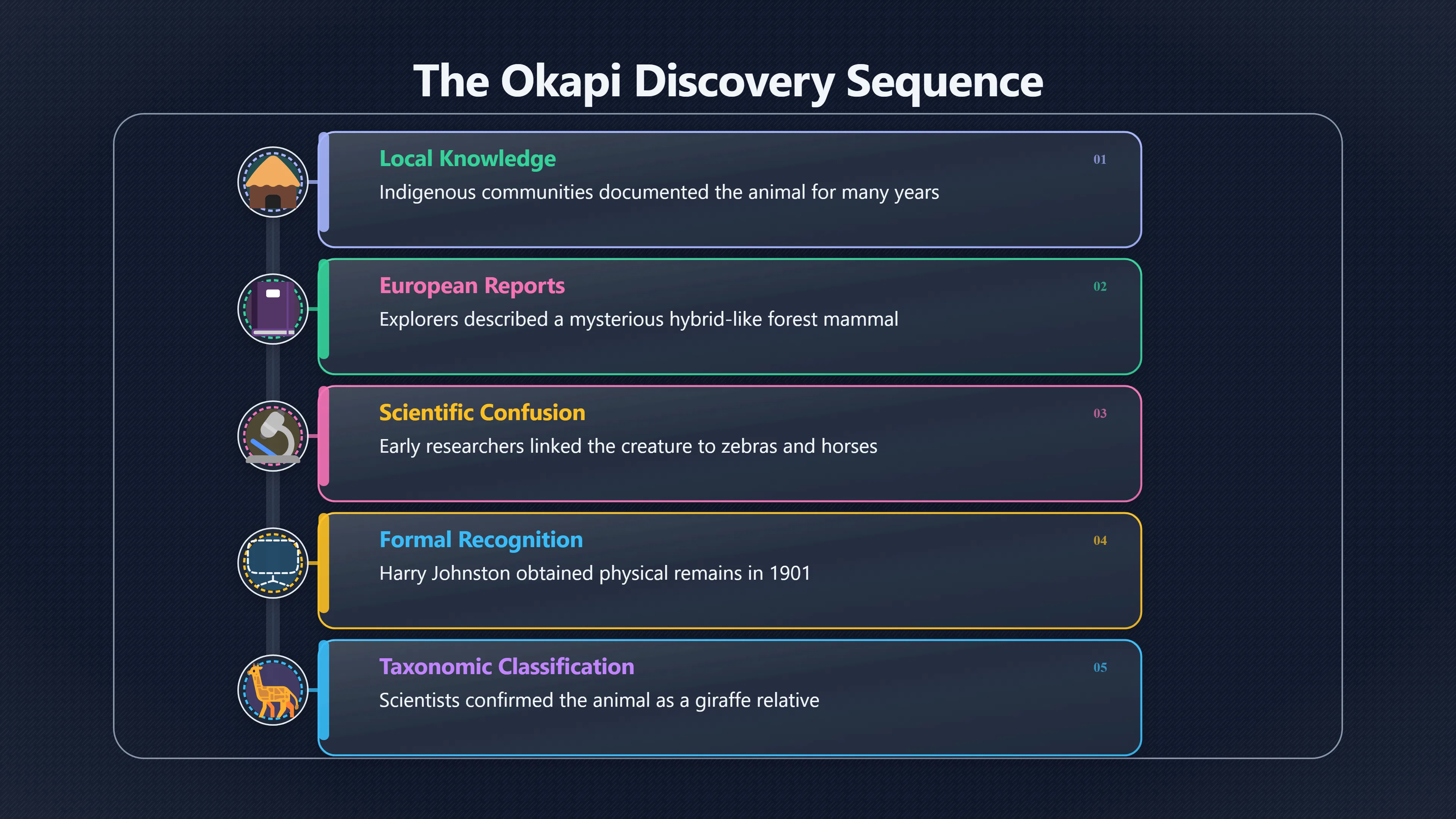
Calling the okapi a former cryptid captures the fact that there was a period when many outsiders doubted reports of the animal. European descriptions often portrayed it as a mysterious “African unicorn” or a bizarre hybrid-like creature. Its unusual appearance encouraged speculation, and early attempts to classify it were confused enough that it was initially linked to zebras and horses before being recognised as a giraffe relative.[Wikipedia+2IU Blogs]WikipediaOpen source on wikipedia.org.
The label also reflects an important historical lesson: scientific institutions do not possess complete knowledge at every moment. The okapi demonstrates that large animals can remain poorly documented by outside researchers, especially in difficult terrain where local communities possess much deeper ecological knowledge than visiting scientists. Accounts from people living in the Congo forests preceded formal zoological recognition by many years.[Tetrapod Zoology+2Wikipedia]tetzoo.comthe discovery of the okapi part 1Tetrapod ZoologyThe Discovery of the Okapi, Part 1Apr 12, 2023 — The story of the Okapi's discovery has been told several times (Lankeste…
This is one reason the okapi became such a powerful symbol within cryptozoology. The animal was embraced by leading cryptozoologists and eventually became the emblem of the International Society of Cryptozoology. To supporters, it represented a genuine case in which reports dismissed by outsiders ultimately corresponded to a real species.[Cryptid Archives]cryptidarchives.fandom.comCryptid Archives Okapi | Encyclopaedia of CryptozoologyCryptid ArchivesOkapi | Encyclopaedia of Cryptozoology - FandomThe okapi is considered a former cryptid, as it had been reported by Europ…
What the Label Distorts
The difficulty begins when “former cryptid” is treated as a straightforward equivalent of modern cryptids such as Bigfoot, the Loch Ness Monster, or other highly disputed creatures.
First, the okapi was never purely a creature of folklore. It was a living animal known to local populations throughout its range. The central mystery was not whether the animal existed at all, but why European science lacked specimens and an accepted taxonomic description. In that sense, the okapi was hidden from particular scientific networks, not from humanity.[Tetrapod Zoology+2Wikipedia]tetzoo.comthe discovery of the okapi part 1Tetrapod ZoologyThe Discovery of the Okapi, Part 1Apr 12, 2023 — The story of the Okapi's discovery has been told several times (Lankeste…
Second, many popular retellings exaggerate the degree of scientific disbelief. The story is often told as if zoologists stubbornly rejected overwhelming evidence until a dramatic revelation occurred. In reality, once skins, skulls, and other physical remains became available, researchers quickly moved from speculation to classification. There was confusion about what the animal was, but comparatively little delay in accepting that it existed once material evidence could be examined.[Wikipedia]WikipediaOpen source on wikipedia.org.
Third, the mythmaking surrounding the okapi often strips away the colonial and social context of its discovery. Cryptozoological retellings sometimes focus on a lone explorer solving a mystery animal puzzle. Modern reassessments instead emphasise the role of Indigenous and local African knowledge, without which the animal would not have entered European scientific literature in the first place.[Tetrapod Zoology]tetzoo.comthe discovery of the okapi part 1Tetrapod ZoologyThe Discovery of the Okapi, Part 1Apr 12, 2023 — The story of the Okapi's discovery has been told several times (Lankeste…
The result is a simplified narrative: mysterious beast reported, sceptics laugh, cryptid proven real. That version is memorable, but it leaves out the mechanisms that actually mattered.
How the Okapi Became a Mythmaking Tool
The okapi occupies a special place in cryptozoological rhetoric because it functions as an analogy rather than merely a historical case.
Writers defending the possibility of undiscovered animals often invoke a short list of examples: the okapi, coelacanth, giant panda, and Komodo dragon. These examples are presented as reminders that scientific knowledge can be incomplete. Bernard Heuvelmans and other foundational cryptozoological authors used precisely this strategy, arguing that recent zoological discoveries justified continued investigation of unknown-animal reports.[Wikipedia]WikipediaOn the Track of Unknown AnimalsOn the Track of Unknown Animals
The persuasive force of the argument comes from a simple pattern:
- The okapi was once doubted.
- The okapi proved real.[youtube.com]youtube.comReal Cryptids: OKAPI! | Lindsay NikoleOne of these real cryptids is the okapi the kind of half horse half zebra looking animal from centr…
- Therefore other disputed creatures might also prove real.</div>
As a rhetorical device, this is effective. As evidence, it is weaker than it first appears.
The analogy works only at a very general level: sometimes reports of unknown animals correspond to real animals. It does not follow that all disputed reports have equal plausibility, nor that every cryptid occupies the same evidential position the okapi once occupied. A comparison is meaningful only if the circumstances are similar.
Why the Analogy Often Breaks Down
The okapi’s discovery involved a large mammal living in a real habitat, known to local communities, represented by physical traces, and ultimately confirmed through specimens. The key question was identification and collection, not the suspension of established biological expectations.[Tetrapod Zoology]tetzoo.comthe discovery of the okapi part 1Tetrapod ZoologyThe Discovery of the Okapi, Part 1Apr 12, 2023 — The story of the Okapi's discovery has been told several times (Lankeste…
Many famous cryptids differ in important ways:
- They are reported across vast areas without corresponding specimen evidence.
- Claims often involve populations that would be difficult to hide under modern ecological monitoring.
- Descriptions may be inconsistent across witnesses and regions.
- Proposed animals sometimes conflict with what is known about habitat requirements, breeding populations, or evolutionary history.[Wikipedia]WikipediaOpen source on wikipedia.org.
Because of these differences, critics argue that invoking the okapi can create a false equivalence. The existence of one formerly unrecognised species does not automatically raise the probability of every later claim. Each case must be evaluated on its own evidence.
This does not make the okapi irrelevant. Rather, it changes what lesson should be drawn from it.
How to Use the Analogy Responsibly
A responsible use of the okapi analogy begins with modest conclusions.
The okapi shows that:[ebsco.com]ebsco.comCryptozoology | Science | Research StartersWhile often labeled as pseudoscience, proponents argue that the discovery of previously unknow…
- Local ecological knowledge can contain valuable information.
- Scientific institutions can overlook real organisms.
- Unknown species can be discovered even in relatively recent history.
- Early reports may contain errors while still pointing toward a genuine animal.[Tetrapod Zoology+2Wikipedia]tetzoo.comthe discovery of the okapi part 1Tetrapod ZoologyThe Discovery of the Okapi, Part 1Apr 12, 2023 — The story of the Okapi's discovery has been told several times (Lankeste…
The okapi does not show that:
- Eyewitness testimony alone is sufficient.
- Lack of evidence is evidence of a hidden animal.
- Every cryptid claim deserves equal credibility.
- Discovery of one unknown species validates unrelated claims.[Wikipedia]WikipediaOpen source on wikipedia.org.
Viewed this way, the okapi is less a triumphant “I told you so” story and more a caution against oversimplification. It reminds sceptics that scientific knowledge has limits, while reminding believers that successful animal discoveries ultimately depended on evidence that could be collected, compared, and tested. The value of the okapi in cryptozoology is therefore not that it proves cryptids are real, but that it reveals how easily genuine zoological discoveries can be transformed into myths about discovery itself.[Tetrapod Zoology+2Wikipedia]tetzoo.comthe discovery of the okapi part 1Tetrapod ZoologyThe Discovery of the Okapi, Part 1Apr 12, 2023 — The story of the Okapi's discovery has been told several times (Lankeste…
Amazon book picks
Further Reading
Books and field guides related to Was the Okapi Really a Former Cryptid?. Use these as the next step if you want deeper reading beyond the article.
Abominable Science!
Directly addresses how alleged cryptids differ from verified zoological discoveries.
The Beasts That Hide from Man
Explores animals once considered mysterious and the evidence behind them.
Still Life with Woodpecker
The okapi features prominently in popular culture discussions surrounding the animal.
eBay marketplace picks
Marketplace Samples
Live-tested eBay searches with available results related to this page.


Endnotes
1.
Source: Wikipedia
Link:https://en.wikipedia.org/wiki/Okapi
2.
Source: Wikipedia
Title: International Society of Cryptozoology
Link:https://en.wikipedia.org/wiki/International_Society_of_Cryptozoology
3.
Source: Wikipedia
Title: On the Track of Unknown Animals
Link:https://en.wikipedia.org/wiki/On_the_Track_of_Unknown_Animals
4.
Source: Wikipedia
Link:https://en.wikipedia.org/wiki/Cryptozoology
5.
Source: tetzoo.com
Title: the discovery of the okapi part 1
Link:https://tetzoo.com/blog/2023/4/11/the-discovery-of-the-okapi-part-1
6.
Source: ebsco.com
Link:https://www.ebsco.com/research-starters/science/cryptozoology
7.
Source: blogs.iu.edu
Title: seven cryptids species
Link:https://blogs.iu.edu/sciu/2020/12/12/seven-cryptids-species/
8.
Source: cryptidarchives.fandom.com
Title: Cryptid Archives Okapi | Encyclopaedia of Cryptozoology
Link:https://cryptidarchives.fandom.com/wiki/Okapi
9.
Source: tetzoo.com
Title: the discovery of the okapi part 2
Link:https://tetzoo.com/blog/2023/4/28/the-discovery-of-the-okapi-part-2
10.
Source: cryptidz.fandom.com
Link:https://cryptidz.fandom.com/wiki/Okapi
11.
Source: creation.com
Link:https://creation.com/en/articles/okapi
12.
Source: londonzoo.org
Link:https://www.londonzoo.org/whats-here/animals/okapi
13.
Source: youtube.com
Link:https://www.youtube.com/watch?v=aHaF0RqvWRk
Additional References
14.
Source: reddit.com
Link:https://www.reddit.com/r/Cryptozoology/comments/1leqfcv/okapi/
15.
Source: chegg.com
Link:https://www.chegg.com/homework-help/questions-and-answers/following-real-animal-mistakenly-used-cryptozoologists-justify-beliefs-existence-cryptids–q129065876
16.
Source: instagram.com
Title: Actually, their closest living relative is the giraffe. These
Link:https://www.instagram.com/reel/DXuUTXaH1jl/?hl=en
17.
Source: sczarn.medium.com
Title: The mythical creature that came to life | by Sarah
Link:https://sczarn.medium.com/the-mythical-creature-that-came-to-life-4764f9c8e8cb
18.
Source: reddit.com
Title: the okapi was discovered in 1901 in the congo
Link:https://www.reddit.com/r/interestingasfuck/comments/ezd53u/the_okapi_was_discovered_in_1901_in_the_congo/
19.
Source: jimconnors.net
Link:https://jimconnors.net/interesting-things-with-jc/2025/10/28/vnypbyk5y3bhtady5nrdn0cmh8n4td
20.
Source: okapi.uni-frankfurt.de
Link:https://okapi.uni-frankfurt.de/index.php?title=OKAPI%3A%C3%9Cber_OKAPI
21.
Source: youtube.com
Title: Mysterious Bedtime Stories: The Legends of Cryptids (2-Hour Sleep Story)
Link:https://www.youtube.com/watch?v=SelRlneqDDs
22.
Source: facebook.com
Link:https://www.facebook.com/groups/WildGreenMemesForEcologicalFiends/posts/2624035587825675/
23.
Source: instagram.com
Title: Bre LB6AHOy5
Link:https://www.instagram.com/p/BreLB6AHOy5/
Topic Tree