Within e DNA
What If the Animal Is Unknown?
eDNA can flag known lineages well, but unknown or poorly catalogued animals may return broad or unresolved matches.
On this page
- How DNA reads become species names
- Why database gaps matter
- What broad lineage matches can still reveal
Page outline Jump by section
Introduction
Environmental DNA (eDNA) can only identify an organism by comparing recovered genetic fragments against reference sequences from organisms that have already been catalogued. This creates an important limitation for cryptozoological investigations: if a lake contains a genuinely unknown animal, there may be no exact sequence in any database to match it. In that situation, eDNA does not simply return a species name. Instead, the result may be assigned to a broader taxonomic group such as a genus, family, or order, or it may remain unclassified altogether. The strength of eDNA is therefore greatest when searching for known lineages, while its ability to recognise truly unknown creatures depends heavily on the completeness and quality of reference libraries.[MDPI]mdpi.comAre Genetic Reference Libraries Sufficient for…by CL Jerde · 2021 · Cited by 30 — However, eDNA metabarcoding's main weakness is t…
How DNA Reads Become Species Names
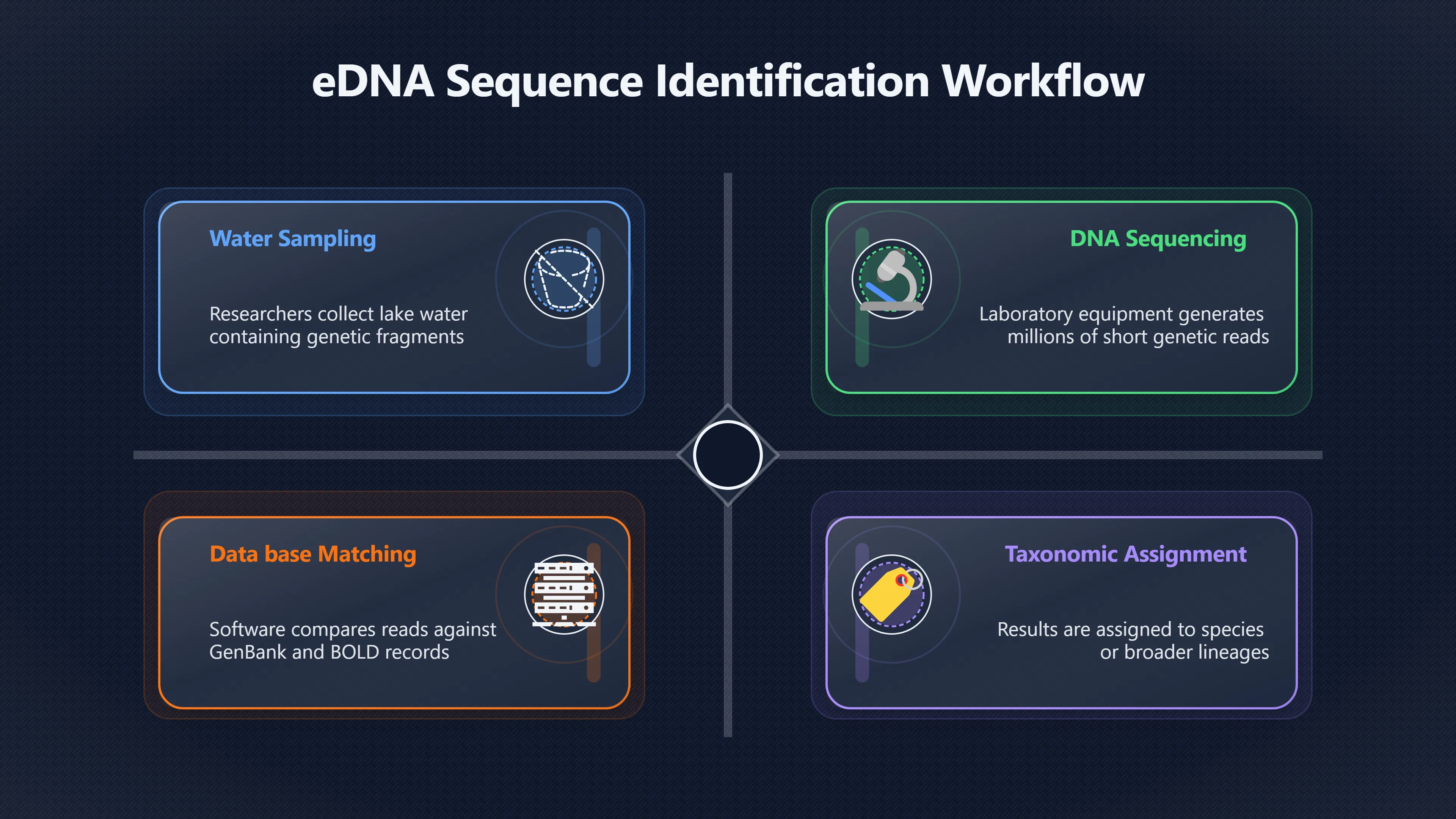
When researchers sequence DNA recovered from lake water, they generate thousands or millions of short genetic reads. Those reads are then compared with large reference collections such as GenBank and the Barcode of Life Data System (BOLD), which contain DNA barcodes from known organisms. BOLD alone now contains millions of barcode records representing more than a million species.[arXiv]arxiv.orgBOLD v4: A Centralized Bioinformatics Platform for DNA-based Biodiversity DataApril 8, 2024…
The assignment process is essentially a matching exercise. If a recovered sequence closely matches a known species in the reference database, software can assign that read to species level. If no exact match exists, the identification becomes less specific. A sequence might be recognised only as belonging to a particular genus, family, or higher taxonomic group. In some cases, researchers can conclude only that the DNA belongs somewhere within a broad branch of the tree of life.[naturemetrics.com]naturemetrics.comReport Interpretation GuideA species-level assignment will be given if reference databases contain an exact DNA match. A higher taxonomic…
For a lake-monster investigation, this distinction is crucial. Detecting DNA from a known eel, trout, or amphibian is relatively straightforward when reference sequences exist. Detecting an animal never previously sampled by science is much harder because the system has nothing definitive against which to compare the sequence.[MDPI]mdpi.comAre Genetic Reference Libraries Sufficient for…by CL Jerde · 2021 · Cited by 30 — However, eDNA metabarcoding's main weakness is t…
Why Database Gaps Matter
What Would a Truly Unknown Animal Look Like in the Data?
A genuinely undescribed lake-dwelling vertebrate would not necessarily appear in eDNA results as “unknown monster”. Instead, its DNA would likely be interpreted through its nearest known relatives.
Imagine a hypothetical animal closely related to eels but distinct enough to represent an undescribed species. Its DNA might produce results indicating membership within the eel lineage while failing to match any recognised eel species precisely. Researchers could therefore infer that the organism belongs somewhere within that group without being able to assign a formal species name.[naturemetrics.com]naturemetrics.comReport Interpretation GuideA species-level assignment will be given if reference databases contain an exact DNA match. A higher taxonomic…
The further an organism is from known species, the weaker and broader the assignment becomes. Depending on the marker used, the result might be classified only as:<div class="content-enhancement content-enhancement--metric" markdown="1">
- A species complex
- A genus[thebiodiversityconsultancy.com]thebiodiversityconsultancy.comFigure 1: Simplified eDNA process www.thebiodiversityconsultancy.com. Reporting…Read more…
- A family
- An order
- An unclassified vertebrate lineage</div>
This is one reason modern eDNA studies increasingly report confidence levels and assignment thresholds rather than treating every match as equally certain.[Archimer]archimer.ifremer.frA Confidence Scoring Procedure for eDNA Metabarcoding…by R Rozanski · 2025 · Cited by 5 — Here, we present a modular procedure…
What Broad Lineage Matches Can Still Reveal
Even when species-level identification fails, broad taxonomic matches can still provide useful evidence.
If repeated lake surveys consistently recovered DNA belonging to a vertebrate lineage not otherwise known from the ecosystem, researchers would have a specific biological signal worth investigating. The finding would not prove the existence of a cryptid, but it would narrow the search considerably. Instead of asking whether an unknown animal exists at all, investigators could focus on determining which branch of life the mystery organism belongs to.[PubMed Central]pmc.ncbi.nlm.nih.govPub Med Central Fine-Grained Assignment of Unknown Marine e DNAby S Villon · 2026 — In this study, we propose a deep learning-based approach designed to improve taxonomic assignment at higher level…
This is one of the reasons eDNA remains valuable for lake-monster research despite database limitations. The method can potentially reveal:
- Whether detected DNA resembles fish, amphibians, reptiles, mammals, or another major group.
- Whether unusual sequences recur across locations and sampling periods.
- Whether unexplained signals cluster around a known evolutionary lineage.
The Loch Ness Example and Its Limits
The Real Challenge for Future Lake-Monster Searches
The greatest obstacle for eDNA-based cryptozoology may not be collecting DNA from water but interpreting unusual sequences once they are found. Modern sequencing technology can recover enormous amounts of genetic information, yet the value of that information remains tied to the reference libraries available for comparison. Researchers continue to emphasise that database completeness, sequence quality, regional coverage, and taxonomic accuracy are among the most important factors determining what eDNA can reveal.[Wiley Online Library+2Springer]onlinelibrary.wiley.comWiley Online LibraryPersistent Gaps and Errors in Reference Databases…by A De Santiago · 2025 · Cited by 12 — High-throughput environm…
As reference databases grow, the space for genuinely unexplained DNA signals becomes smaller. At the same time, any persistent sequence that cannot be linked to known organisms becomes more scientifically interesting. For future lake-monster investigations, the most persuasive eDNA anomaly would not be a dramatic species name appearing from nowhere, but a reproducible genetic signal that repeatedly falls outside the expectations of an increasingly complete catalogue of life.[Nature+2arXiv]nature.comA taxonomically reliable DNA barcode reference library for…by M Christodoulou · 2025 · Cited by 4 — DNA-based approaches, such a…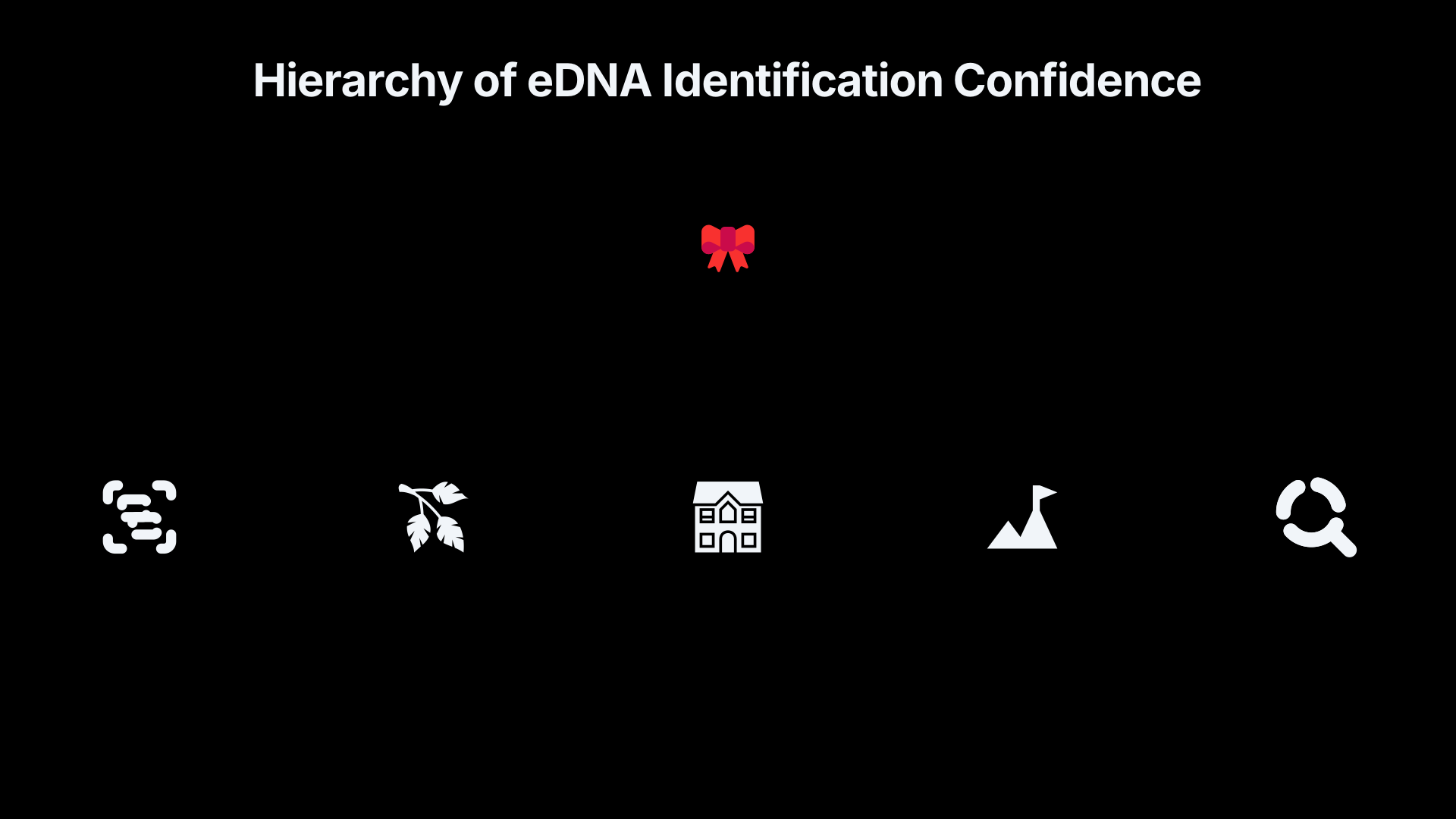
Amazon book picks
Further Reading
Books and field guides related to What If the Animal Is Unknown?. Use these as the next step if you want deeper reading beyond the article.
Abominable Science!
Frames how evidence is evaluated when investigating unknown creatures.
eBay marketplace picks
Marketplace Samples
Live-tested eBay searches with available results related to this page.


Endnotes
1.
Source: mdpi.com
Link:https://www.mdpi.com/2073-4441/13/13/1767
2.
Source: naturemetrics.com
Link:https://www.naturemetrics.com/report-interpretation-guide
3.
Source: arxiv.org
Link:https://arxiv.org/abs/2404.05696
4.
Source: onlinelibrary.wiley.com
Link:https://onlinelibrary.wiley.com/doi/full/10.1002/edn3.70080
5.
Source: mdpi.com
Link:https://www.mdpi.com/2077-1312/8/7/538
6.
Source: onlinelibrary.wiley.com
Link:https://onlinelibrary.wiley.com/doi/full/10.1002/ece3.71544
7.
Source: mdpi.com
Link:https://www.mdpi.com/2079-7737/10/11/1092
8.
Source: eurekalert.org
Link:https://www.eurekalert.org/news-releases/1130893
9.
Source: biorxiv.org
Link:https://www.biorxiv.org/content/10.1101/2021.10.22.465527.full
10.
Source: onlinelibrary.wiley.com
Link:https://onlinelibrary.wiley.com/doi/full/10.1111/mec.70340
11.
Source: nature.com
Link:https://www.nature.com/articles/s41598-026-41937-x
12.
Source: nature.com
Link:https://www.nature.com/articles/s41597-025-05500-z
13.
Source: emea.illumina.com
Title: loch ness edna
Link:https://emea.illumina.com/company/news-center/feature-articles/loch-ness-edna.html
14.
Source: link.springer.com
Title: Is the DNA barcode database fit for purpose?
Link:https://link.springer.com/article/10.1007/s11756-025-01999-0
15.
Source: onlinelibrary.wiley.com
Link:https://onlinelibrary.wiley.com/doi/10.1002/edn3.70280
16.
Source: onlinelibrary.wiley.com
Link:https://onlinelibrary.wiley.com/doi/10.1002/rra.3610
17.
Source: biorxiv.org
Title: However, we also
Link:https://www.biorxiv.org/content/10.1101/2022.11.17.513905v1.full-text
18.
Source: biorxiv.org
Link:https://www.biorxiv.org/content/10.1101/576553v1.full.pdf
19.
Source: pmc.ncbi.nlm.nih.gov
Title: Pub Med Central Fine-Grained Assignment of Unknown Marine e DNA
Link:https://pmc.ncbi.nlm.nih.gov/articles/PMC12897059/
20.
Source: pubmed.ncbi.nlm.nih.gov
Link:https://pubmed.ncbi.nlm.nih.gov/36478393/
21.
Source: archimer.ifremer.fr
Link:https://archimer.ifremer.fr/doc/00944/105621/118401.pdf
22.
Source: pmc.ncbi.nlm.nih.gov
Link:https://pmc.ncbi.nlm.nih.gov/articles/PMC9205523/
23.
Source: pmc.ncbi.nlm.nih.gov
Link:https://pmc.ncbi.nlm.nih.gov/articles/PMC12269782/
24.
Source: pmc.ncbi.nlm.nih.gov
Link:https://pmc.ncbi.nlm.nih.gov/articles/PMC9835706/
25.
Source: pmc.ncbi.nlm.nih.gov
Link:https://pmc.ncbi.nlm.nih.gov/articles/PMC12627918/
Additional References
26.
Source: researchgate.net
Link:https://www.researchgate.net/publication/363063003_DNA_Barcode_Gap_Analysis_for_Multiple_Marker_Genes_for_Phytoplankton_Species_Biodiversity_in_Mediterranean_Aquatic_Ecosystems
27.
Source: researchgate.net
Link:https://www.researchgate.net/publication/403137490Guidance_and_best_practices_for_species_identification_using_eDNA_metabarcoding-_When_do_you_call_a_cod_a_cod
28.
Source: researchgate.net
Link:https://www.researchgate.net/publication/393622098_A_taxonomically_reliable_DNA_barcode_reference_library_for_North_Sea_macrobenthos
29.
Source: thebiodiversityconsultancy.com
Link:https://www.thebiodiversityconsultancy.com/fileadmin/uploads/tbc/Documents/Resources/eDNA-and-biodiversity-risk-briefing-note.pdf
30.
Source: facebook.com
Title: Using e DNA to monitor biodiversity in Loch Rannoche DNA
Link:https://www.facebook.com/groups/rannoch/posts/3688015771334765/
31.
Source: researchgate.net
Title: Gap-analysis for high impact species
Link:https://www.researchgate.net/figure/Gap-analysis-for-high-impact-species-Barcode-coverage-of-each-searched-marker-in_fig3_343613365
32.
Source: youtube.com
Title: How to Use the NCBI’s Bioinformatics Tools and Databases
Link:https://www.youtube.com/watch?v=QLcmEqBayr0
33.
Source: youtube.com
Link:https://www.youtube.com/watch?v=neIQ3KNBXN8
34.
Source: youtube.com
Title: DNA Metabarcoding of e DNA/e RNA (Bioinformatics S14E1)
Link:https://www.youtube.com/watch?v=3Negf-s719A
35.
Source: otago.ac.nz
Link:https://www.otago.ac.nz/news/newsroom/first-edna-study-of-loch-ness-points-to-something-fishy
Topic Tree