Within Museums
When Cryptids Enter the Art Museum
The Bates cryptozoology exhibition treated rumored animals as a museum problem about absence, classification, spectacle and fraud.
On this page
- Curiosity cabinets and taxonomy
- Artists, fraud and spectacle
- Why absence becomes display material
Page outline Jump by section
Introduction
When cryptids enter an art museum, the question is no longer whether Bigfoot, the Loch Ness Monster or the thylacine survives somewhere beyond human knowledge. Instead, the museum itself becomes the subject. How should an institution dedicated to classification, evidence and public trust display creatures that may not exist, may be misidentified, or may survive only as stories and desires? One of the clearest explorations of this problem was the 2006 exhibition Cryptozoology: Out of Time Place Scale, organised by the Bates College Museum of Art and later shown at the H&R Block Artspace. Rather than arguing for or against cryptids, the exhibition treated cryptozoology as a lens through which to examine taxonomy, spectacle, fraud, longing and institutional authority. In doing so, it transformed museum doubt into a display object in its own right.[Bates College]bates.eduCollege Cryptozoology: Out of Time Place Scale | Museum of ArtBates CollegeCryptozoology: Out of Time Place Scale | Museum of ArtApril 16, 2010 — Often considered a marginalized science or a farcical…
Curiosity Cabinets and Taxonomy
Artists, Fraud and Spectacle
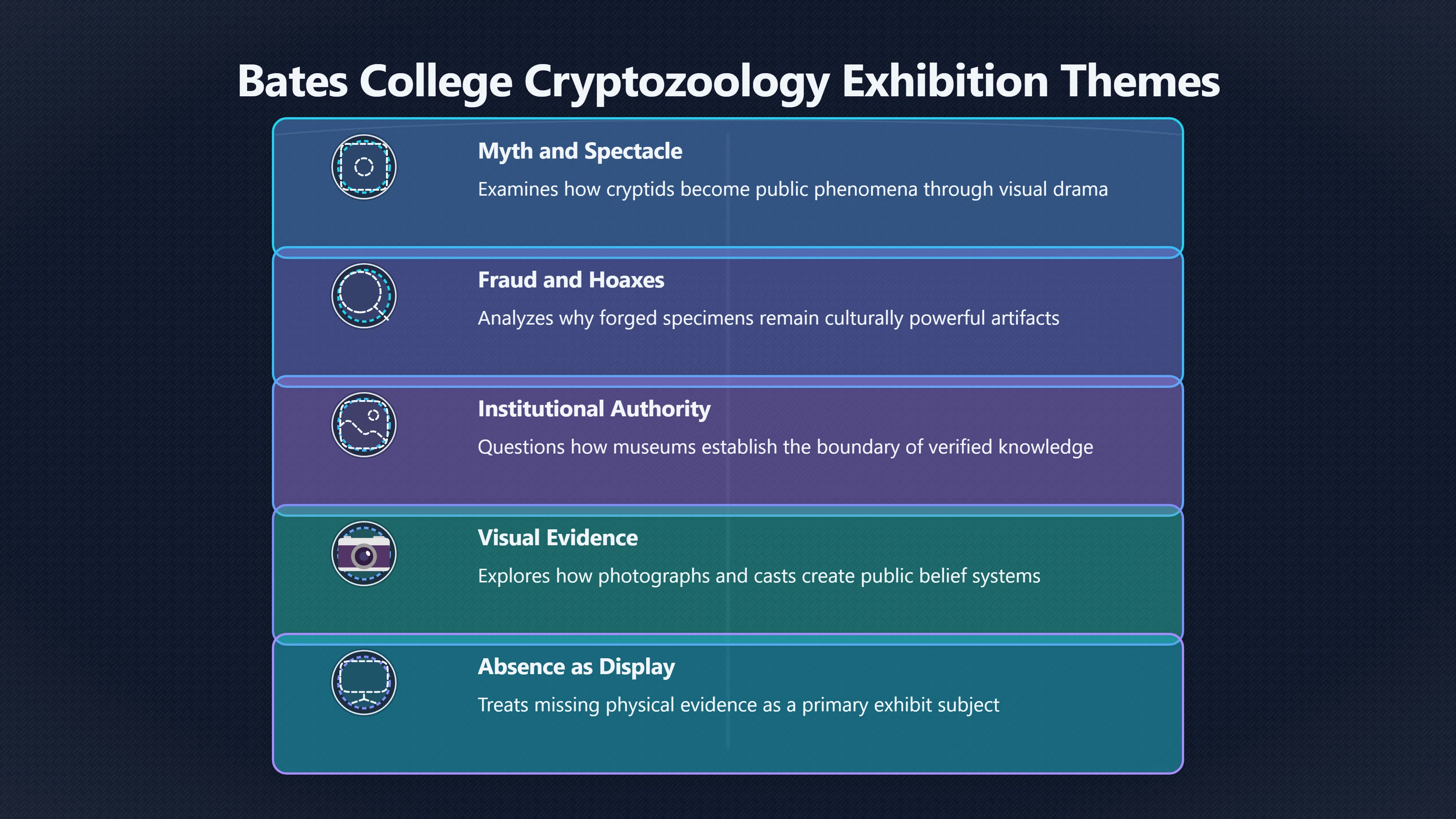
The curators repeatedly emphasised three themes beneath cryptozoology’s surface: myth, spectacle and fraud. They argued that these themes are not merely side issues but central forces shaping how cryptids become public phenomena.[Bates College]bates.educryptozoology exhibitBates College'Cryptozoology' transcends Nessie, yeti in exploring hidden…14 Jun 2006 — “Then, underneath those big ideas were ideas th…
Fraud occupied a particularly important place. Cryptozoology has long been associated with hoaxes, fabricated evidence and disputed claims. Rather than treating fraud as a reason to dismiss the topic, the exhibition examined why forged specimens and dubious artefacts remain culturally powerful. A fake specimen can still reveal something about public desire, curiosity and belief.[Bates College]bates.educryptozoology exhibitBates College'Cryptozoology' transcends Nessie, yeti in exploring hidden…14 Jun 2006 — “Then, underneath those big ideas were ideas th…
Artists in the exhibition explored this territory through taxidermy, fabricated creatures, reconstructed animals and pseudo-scientific presentations. Sarina Brewer’s reimagined Feejee Mermaid referenced the famous nineteenth-century attraction popularised by showman P. T. Barnum, while other works blurred the distinction between documentation and invention. Visitors were often left uncertain whether they were viewing evidence, parody, institutional critique or some combination of all three.[artpapers.org]artpapers.orgCryptozoology: Out of Time Place ScaleThe exhibition was appropriately launched at the Bates College Museum of Art in Lewiston, Maine [Ju…
This uncertainty was deliberate. Cryptozoology depends heavily on visual encounters—photographs, glimpses, casts and alleged specimens. The Bates project argued that contemporary art similarly investigates how images create authority and belief. In both fields, viewers must decide how much confidence to place in what they see.[Bates College]bates.eduCollege Cryptozoology: Out of Time Place Scale | Museum of ArtBates CollegeCryptozoology: Out of Time Place Scale | Museum of ArtApril 16, 2010 — Often considered a marginalized science or a farcical…
Why Absence Becomes Display Material
The most distinctive contribution of cryptozoology-themed art exhibitions is their treatment of absence as an exhibit.
Natural-history museums traditionally display physical evidence: bones, skins, fossils or preserved organisms. Cryptozoological subjects frequently lack such material confirmation. Instead of seeing absence as a problem to conceal, Cryptozoology: Out of Time Place Scale made absence visible. The exhibition highlighted creatures known only through rumours, disputed sightings or historical traces, alongside species once thought mythical or extinct but later accepted by science. Examples such as the coelacanth and giant squid complicated easy distinctions between impossibility and discovery.[Bates College]bates.eduCollege Cryptozoology: Out of Time Place Scale | Museum of ArtBates CollegeCryptozoology: Out of Time Place Scale | Museum of ArtApril 16, 2010 — Often considered a marginalized science or a farcical…
This strategy transformed the exhibition from a display about monsters into a display about uncertainty. The visitor encountered not a resolved narrative but a series of unresolved questions:<div class="content-enhancement content-enhancement--insight-grid" markdown="1">
- What qualifies as evidence?
- Who decides when a claim becomes legitimate knowledge?
- How do museums handle objects that are desired but unavailable?
- What happens when stories persist despite the absence of proof?</div>
Museum Authority Under Examination
A key governance issue running through the exhibition concerned institutional authority. Museums are often perceived as neutral repositories of verified knowledge. Cryptozoology exposes how fragile that perception can be because it sits precisely at the boundary between accepted and disputed claims.
The Bates project explicitly connected cryptozoology to broader debates about objectivity. Exhibition materials described the field as a place where evidence is constantly accumulated, questioned, classified and sometimes discarded. The resulting process resembles the work of museums and archives, which continually decide what deserves preservation and interpretation.[Bates College]bates.eduCollege Cryptozoology: Out of Time Place Scale | Museum of ArtBates CollegeCryptozoology: Out of Time Place Scale | Museum of ArtApril 16, 2010 — Often considered a marginalized science or a farcical…
Critics noted that the exhibition functioned partly as institutional critique. By presenting cryptozoological material within a respected art-museum setting, it encouraged visitors to reflect on how authority is produced through display techniques, architectural settings, labels and curatorial decisions. The exhibition did not claim that cryptids exist. Instead, it asked how institutions establish the difference between knowledge, speculation and belief.[artpapers.org]artpapers.orgCryptozoology: Out of Time Place ScaleThe exhibition was appropriately launched at the Bates College Museum of Art in Lewiston, Maine [Ju…
The result was a museum experience built around doubt rather than certainty. Visitors were not asked to choose between belief and scepticism. They were asked to observe how those positions are created, negotiated and displayed.
A Distinct Place in Cryptozoology Culture
See on Amazon</a></div></div></article><article class="fr-book-card"><a class="fr-book-cover" href="https://www.amazon.com/s?k=The+Museum+by+Samuel+J+Redman&i=stripbooks&tag=searcht-20" target="_blank" rel="sponsored noopener noreferrer" aria-label="Open The Museum on Amazon"><span class="fr-book-cover-fallback">Book</span><img class="fr-book-cover-thumb" src="https://books.google.com/books/content?id=Xm5IEAAAQBAJ&printsec=frontcover&img=1&zoom=1&edge=curl&source=gbs_api" alt="Cover for The Museum" loading="lazy" decoding="async" fetchpriority="low" referrerpolicy="no-referrer" onerror="this.hidden=true;this.closest('.fr-book-cover').classList.add('fr-book-cover-placeholder');"></a><div class="fr-book-info"><h4 class="fr-book-title"><a href="https://www.amazon.com/s?k=The+Museum+by+Samuel+J+Redman&i=stripbooks&tag=searcht-20" target="_blank" rel="sponsored noopener noreferrer" title="The Museum">The Museum</a></h4><p class="fr-book-author">By Samuel J Redman</p><p class="fr-book-desc">Helps frame how institutions present contested subjects.</p><div class="fr-book-actions"><a href="https://www.amazon.com/s?k=The+Museum+by+Samuel+J+Redman&i=stripbooks&tag=searcht-20" class="fr-amazon-btn" target="_blank" rel="sponsored noopener noreferrer">
See on Amazon</a></div></div></article><article class="fr-book-card"><a class="fr-book-cover fr-book-cover-placeholder" href="https://www.amazon.com/s?k=Mysterious+creatures+%3A+a+guide+to+cryptozoology.+2.+%5BN+-+Z%5D+by+George+M.+Eberhart&i=stripbooks&tag=searcht-20" target="_blank" rel="sponsored noopener noreferrer" aria-label="Open Mysterious creatures : a guide to cryptozoology. 2. [N - Z] on Amazon"><span class="fr-book-cover-fallback">Book</span></a><div class="fr-book-info"><h4 class="fr-book-title"><a href="https://www.amazon.com/s?k=Mysterious+creatures+%3A+a+guide+to+cryptozoology.+2.+%5BN+-+Z%5D+by+George+M.+Eberhart&i=stripbooks&tag=searcht-20" target="_blank" rel="sponsored noopener noreferrer" title="Mysterious creatures : a guide to cryptozoology. 2. [N - Z]">Mysterious creatures : a guide to cryptozoology. 2. [N - Z]</a></h4><p class="fr-book-author">By George M. Eberhart</p><p class="fr-book-desc">Supports discussion of taxonomy and classification of alleged creatures.</p><div class="fr-book-actions"><a href="https://www.amazon.com/s?k=Mysterious+creatures+%3A+a+guide+to+cryptozoology.+2.+%5BN+-+Z%5D+by+George+M.+Eberhart&i=stripbooks&tag=searcht-20" class="fr-amazon-btn" target="_blank" rel="sponsored noopener noreferrer">
See on Amazon</a></div></div></article><article class="fr-book-card"><a class="fr-book-cover fr-book-cover-placeholder" href="https://www.amazon.com/s?k=Cabinets+of+Curiosities+by+Lynn+Maranda&i=stripbooks&tag=searcht-20" target="_blank" rel="sponsored noopener noreferrer" aria-label="Open Cabinets of Curiosities on Amazon"><span class="fr-book-cover-fallback">Book</span></a><div class="fr-book-info"><h4 class="fr-book-title"><a href="https://www.amazon.com/s?k=Cabinets+of+Curiosities+by+Lynn+Maranda&i=stripbooks&tag=searcht-20" target="_blank" rel="sponsored noopener noreferrer" title="Cabinets of Curiosities">Cabinets of Curiosities</a></h4><p class="fr-book-author">By Lynn Maranda, Carol E. (Carol Elizabeth) Mayer et al.</p><p class="fr-book-desc">Explores collecting, spectacle, monsters, and museum-like presentation.</p><div class="fr-book-actions"><a href="https://www.amazon.com/s?k=Cabinets+of+Curiosities+by+Lynn+Maranda&i=stripbooks&tag=searcht-20" class="fr-amazon-btn" target="_blank" rel="sponsored noopener noreferrer">
See on Amazon</a></div></div></article></div><div class="fr-section-footer"><div class="fr-browse-links" aria-label="Browse more on Amazon"><span class="fr-browse-links-label">Browse more on Amazon:</span><a class="fr-browse-more" href="https://www.amazon.com/s?k=Abominable+Science%21&i=stripbooks&tag=searcht-20" target="_blank" rel="sponsored noopener noreferrer">Abominable Science!</a><a class="fr-browse-more" href="https://www.amazon.com/s?k=The+Museum&i=stripbooks&tag=searcht-20" target="_blank" rel="sponsored noopener noreferrer">The Museum</a><a class="fr-browse-more" href="https://www.amazon.com/s?k=Mysterious+creatures+%3A+a+to+cryptozoology.+2.+%5BN+Z%5D+books&i=stripbooks&tag=searcht-20" target="_blank" rel="sponsored noopener noreferrer">Mysterious creatures : a to cryptozoology. 2. [N Z] books</a></div><p class="fr-disclosure">As an Amazon Associate I earn from qualifying purchases.</p></div></div></section>
Amazon book picks
Further Reading
Books and field guides related to When Cryptids Enter the Art Museum. Use these as the next step if you want deeper reading beyond the article.
Abominable Science!
Provides context for how cryptids move between science, skepticism, and culture.
Mysterious creatures : a guide to cryptozoology. 2. [N - Z]
Supports discussion of taxonomy and classification of alleged creatures.
Cabinets of Curiosities
Explores collecting, spectacle, monsters, and museum-like presentation.
eBay marketplace picks
Marketplace Samples
Live-tested eBay searches with available results related to this page.
Endnotes
1.
Source: bates.edu
Title: College Cryptozoology: Out of Time Place Scale | Museum of Art
Link:https://www.bates.edu/museum/exhibitions/y2006/cryptozoology/
2.
Source: bates.edu
Title: cryptozoology exhibit
Link:https://www.bates.edu/news/2006/06/14/cryptozoology-exhibit/
3.
Source: artpapers.org
Link:https://www.artpapers.org/cryptozoology-out-of-time-place-scale/
4.
Source: bates.edu
Title: cryptozoology 2
Link:https://www.bates.edu/news/2005/10/27/cryptozoology-2/
5.
Source: bates.edu
Title: cryptozoology symposium out of time place scale
Link:https://www.bates.edu/museum/2010/04/19/cryptozoology-symposium-out-of-time-place-scale/
6.
Source: store.bates.edu
Title: cryptozoology out of time place scale
Link:https://store.bates.edu/products/cryptozoology-out-of-time-place-scale
7.
Source: Wikipedia
Link:https://en.wikipedia.org/wiki/Cryptozoology
Additional References
8.
Source: kcai.edu
Link:https://kcai.edu/artspace/artspace-exhibitions/cryptozoology-out-of-time-place-scale/
9.
Source: absolutearts.com
Link:https://www.absolutearts.com/artsnews/2006/06/23/34000.html
10.
Source: youtube.com
Title: Cryptozoology Museum: Portland’s CREEPIEST Tourist Attraction
Link:https://www.youtube.com/watch?v=hTRQy9R7qXw
11.
Source: youtube.com
Title: International Cryptozoology Museum
Link:https://www.youtube.com/watch?v=gVvO9sEloP8
12.
Source: youtube.com
Title: Cryptozoology Museum | Travel Channel
Link:https://www.youtube.com/watch?v=qzd-Xf-CrWQ
13.
Source: youtube.com
Title: International Cryptozoology Museum
Link:https://www.youtube.com/watch?v=camXhM9usPk
14.
Source: youtube.com
Title: International Cryptozoology Museum now open in Bangor
Link:https://www.youtube.com/watch?v=PqZoLTNaHto
Topic Tree