Within Isc Professionalisat
Why Clues Were Not Enough
Tracks, testimony, photos, and hair could start an investigation, but zoology required stronger proof before accepting a new animal.
On this page
- What counted as indirect cryptid evidence
- How zoology validates new animals
- Why the ISC was stuck in the middle
Page outline Jump by section
Introduction
The central methodological problem facing cryptozoology was not a lack of reports. It was a lack of proof. For decades, investigators collected footprints, eyewitness accounts, photographs, casts, hairs, sounds, and folklore traditions suggesting the existence of animals unknown to science. The International Society of Cryptozoology (ISC), founded in 1982, attempted to treat such material as legitimate zoological evidence rather than dismissing it outright. Yet the society ran into a barrier that ultimately limited its acceptance within mainstream biology: the evidence that generated cryptozoological interest was usually indirect, whereas zoology generally requires direct, verifiable, and reproducible evidence before recognising a new species.[ResearchGate]researchgate.netResearch Gate(PDF) A Review of Cryptozoology: Towards a ScientificResearchGate(PDF) A Review of Cryptozoology: Towards a Scientific…December 18, 2015 — Cryptozoology is still generally considered a no… This “proof gap” was not merely a disagreement about belief. It reflected different evidentiary standards. Cryptozoologists often argued that clues should justify investigation. Zoologists generally agreed with that principle but maintained that investigation and acceptance were separate stages. Tracks might justify a search. Hair might justify laboratory testing. Testimony might identify locations worth surveying. None of these, by themselves, normally establish the existence of a new species.[Sage Journals]journals.sagepub.comSage Journals Heuvelmans the Heretic and Hidden AnimalsSage JournalsHeuvelmans the Heretic and Hidden Animals - Floe Foxon…21 Mar 2024 — Cryptozoology seeks to study 'hidden animals' by se…
The ISC found itself caught between these positions. It wanted to professionalise the study of hidden animals by collecting and evaluating evidence systematically. Yet most of the creatures that attracted public attention remained supported primarily by evidence that zoologists regarded as preliminary rather than decisive. This mismatch between investigative evidence and taxonomic proof became one of the most important obstacles to cryptozoology’s scientific ambitions.[scholarworks.iu.edu]scholarworks.iu.eduof Pop Goes the Cryptid: The Evolution of Cryptozoology…by SA Hill · 2026 — The International Society of Cryptozoology (ISC) formed in…
What Counted as Indirect Cryptid Evidence?
Cryptozoological investigations typically relied on several recurring categories of evidence. None was inherently worthless. Indeed, zoologists routinely use similar clues in wildlife research. The problem was that such evidence rarely demonstrated the existence of an entirely unknown large animal beyond reasonable doubt.
Eyewitness testimony
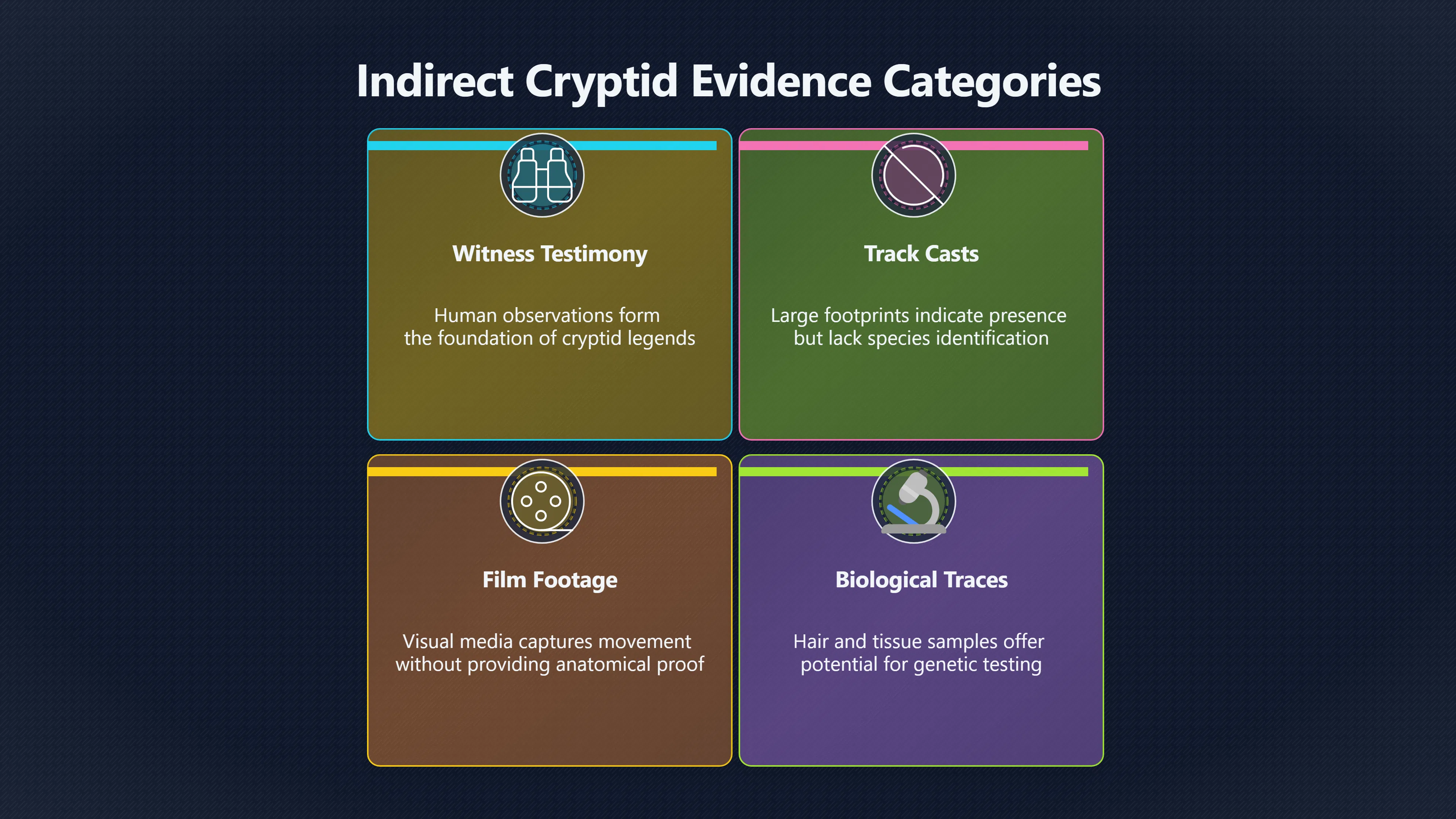
Witness reports formed the foundation of many famous cryptid traditions. Bigfoot sightings in North America, reports of the Yeti in the Himalayas, and alleged encounters with unknown lake creatures often depended heavily on human observation.
From a zoological perspective, testimony can provide useful leads but remains vulnerable to misidentification, memory distortion, expectation effects, poor viewing conditions, and cultural influences. Wildlife biology frequently uses observations to guide surveys, but the observation itself is not treated as proof that a new species exists.[Sage Journals]journals.sagepub.comSage Journals Heuvelmans the Heretic and Hidden AnimalsSage JournalsHeuvelmans the Heretic and Hidden Animals - Floe Foxon…21 Mar 2024 — Cryptozoology seeks to study 'hidden animals' by se…
Cryptozoologists such as Bernard Heuvelmans argued that recurring witness descriptions across different regions could indicate a biological reality behind legends. Critics responded that consistency alone does not establish existence because narratives can spread culturally and influence subsequent reports.[Cryptozoological Reference Library]cryptozoologicalreferencelibrary.wordpress.comCryptozoological Reference Library Heuvelmans, B1988). The sources and method of…August 11, 2020 — by B HEUVELMANS · Cited by 26 — The purpose of the present paper is to assist all…
Tracks and footprint casts
Footprints became especially important in Bigfoot investigations. Researchers collected casts showing unusually large tracks, dermal ridge patterns, and anatomical features that some investigators interpreted as evidence of an unknown primate.
Tracks are valuable ecological evidence because they indicate an animal’s presence even when the animal itself is absent. However, they are also difficult to authenticate conclusively. Tracks can degrade, be misinterpreted, or be deliberately fabricated. Without an associated specimen, zoologists generally regard footprints as suggestive rather than definitive.[Tetrapod Zoology]tetzoo.comcomments on an interview with jeff meldrumHancock House, Surrey, B.C. & Blaine, WA. Loxton, D. & Prothero, D. R. 2013. Abominable Science! Columbia University…Read more…
The issue was not that tracks lacked information. Rather, they lacked the ability to resolve alternative explanations completely. A footprint can indicate that something made a track. It does not automatically identify the species responsible.
Photographs and films
Images occupy a particularly controversial position in cryptozoology because some of the field’s most famous cases revolve around photographs.
The famous 1967 Patterson–Gimlin film, often cited in Bigfoot discussions, illustrates the problem. The footage has been analysed repeatedly, producing arguments both for and against authenticity. Yet decades of debate have not yielded scientific consensus. The film remains evidence that something appeared on camera; it has not become evidence accepted by zoology as demonstrating a new species.[ResearchGate]researchgate.netResearch Gate(PDF) A Review of Cryptozoology: Towards a ScientificResearchGate(PDF) A Review of Cryptozoology: Towards a Scientific…December 18, 2015 — Cryptozoology is still generally considered a no…
Photography can document unusual observations, but images alone often lack the anatomical, genetic, and ecological information necessary to establish a new taxon. Ambiguity in scale, resolution, perspective, and context frequently prevents decisive conclusions.
Hair, tissue, faeces, and other biological traces
Among indirect evidence categories, biological samples appeared to offer the greatest promise because they could potentially be tested scientifically.
Hair samples attributed to Bigfoot, Yeti, Almasty, Orang Pendek, and other alleged unknown primates were collected for decades. The development of modern genetic techniques created an opportunity to evaluate such claims directly.[Royal Society Publishing]royalsocietypublishing.orgRoyal Society PublishingGenetic analysis of hair samples attributed to yeti, bigfoot and…by BC Sykes · 2014 · Cited by 49 — Genetic an…
Yet laboratory testing repeatedly demonstrated how difficult it was to convert cryptozoological clues into proof. When geneticist Bryan Sykes and colleagues conducted a systematic DNA analysis of purported anomalous primate hair samples, nearly all were identified as belonging to known animals. Samples attributed to Bigfoot and related creatures were traced to bears, horses, cows, raccoons, dogs, wolves, porcupines, tapirs, and humans rather than unknown primates.[Christian Science Monitor+3PMC+3PubMed]pmc.ncbi.nlm.nih.govKeywords: yeti, almasty, bigfoot, sasquatch, mitochondrial DNA. 1. Introduction. Despite several…Read more…
The study did not prove that cryptids do not exist. Instead, it demonstrated a recurring pattern: evidence initially interpreted as supporting unknown animals often resolved into known biological sources once subjected to rigorous analysis.[PMC]pmc.ncbi.nlm.nih.govKeywords: yeti, almasty, bigfoot, sasquatch, mitochondrial DNA. 1. Introduction. Despite several…Read more…
How Zoology Validates New Animals
The proof gap becomes clearer when examining how zoology actually confirms new species.
Contrary to a common misconception, scientists do not reject unknown animals because they are unusual. Zoology discovers thousands of new species regularly. What matters is the quality and reproducibility of evidence.[OUP Academic]academic.oup.comOUP AcademicHow to describe a new species in zoology and avoid mistakesby MF Braby · 2024 · Cited by 60 — When designating a holotype, th…
Traditionally, species descriptions rely upon physical specimens that can be examined by other researchers. The International Code of Zoological Nomenclature centres species names around type specimens, particularly holotypes, which serve as permanent reference points for scientific study.[code.iczn.org]code.iczn.orgArticle 73Name-bearing types fixed in the original publication…A holotype is the single specimen upon which a new nominal species-group taxon is…
A holotype allows future scientists to verify anatomical features, compare specimens, test hypotheses, and reassess classifications. This process creates a durable chain of evidence rather than relying on interpretation alone.[code.iczn.org]code.iczn.orgArticle 73Name-bearing types fixed in the original publication…A holotype is the single specimen upon which a new nominal species-group taxon is…
Modern taxonomy increasingly incorporates DNA sequencing, ecological information, imaging, and other data sources. Nevertheless, the underlying principle remains similar: claims should be independently testable and available for scrutiny by other researchers.[PMC]pmc.ncbi.nlm.nih.govTightening the requirements for species diagnoses would help…by FE Rheindt · 2023 · Cited by 48 — Future species descriptions must…
Interestingly, zoological nomenclature does not absolutely require a preserved specimen in every circumstance. Scholars have noted that the Code technically allows descriptions under exceptional conditions without one. However, taxonomists consistently emphasise that photographs or DNA sequences alone are generally weaker forms of evidence and should not replace specimens when specimens can reasonably be obtained.[repository.naturalis.nl]repository.naturalis.nlAttaching Names to Biological Species: The Use and Value…March 10, 2021 — by R Sluys · 2021 · Cited by 30 — The International Code of…
This distinction is crucial. Cryptozoological evidence often generated hypotheses. Zoological standards demanded evidence robust enough to survive independent verification.
Why the ISC Was Stuck in the Middle
The International Society of Cryptozoology attempted to occupy a difficult position between outright scepticism and unquestioning belief.
Its founders argued that hidden animals should be investigated scientifically. Bernard Heuvelmans explicitly insisted that cryptozoology concerned flesh-and-blood animals rather than supernatural entities. Roy Mackal and other ISC figures similarly sought to frame the discipline as a branch of zoological inquiry.[cryptozoologicalreferencelibrary.files.wordpress.com]cryptozoologicalreferencelibrary.files.wordpress.comHeuvelmans 1982.pdfCryptozoology is not an arcane or occult zoology, as some, in an attempt to discredit it, have suggested…
In principle, this approach aligned with standard scientific practice. Many legitimate discoveries begin with fragmentary evidence. Tracks, local reports, unusual specimens, and indigenous knowledge have occasionally contributed to the discovery of previously undocumented animals. Cryptozoologists frequently cited such cases to justify continued investigation of controversial reports.[Academia]academia.eduA Review of Cryptozoology: Towards a Scientific Approach…January 1, 2015 — This chapter proposes a scientifically acceptable d…
The problem was that the transition from clue to confirmation rarely occurred in major cryptid cases.
The ISC could publish analyses of reports, evaluate tracks, compare witness accounts, and discuss possible biological explanations. However, without specimens, repeatable observations, or genetic confirmation, its strongest cases remained permanently stuck at the level of possibility. Mainstream zoologists could acknowledge that the clues were interesting while simultaneously concluding that the evidence remained insufficient.[ResearchGate]researchgate.netResearch Gate(PDF) A Review of Cryptozoology: Towards a ScientificResearchGate(PDF) A Review of Cryptozoology: Towards a Scientific…December 18, 2015 — Cryptozoology is still generally considered a no…
This created a structural dilemma. If the society applied strict zoological standards, many celebrated cryptid cases failed to meet them. If it relaxed those standards, it risked losing scientific credibility. The resulting tension affected the field’s reputation and complicated efforts to establish cryptozoology as a recognised scientific discipline.[ResearchGate]researchgate.netResearch Gate(PDF) A Review of Cryptozoology: Towards a ScientificResearchGate(PDF) A Review of Cryptozoology: Towards a Scientific…December 18, 2015 — Cryptozoology is still generally considered a no…
The Lasting Significance of the Proof Gap
The proof gap remains one of the most important concepts for understanding cryptozoology. It explains why many scientists do not dismiss tracks, testimony, photographs, or biological traces outright, yet still decline to accept the existence of the animals those clues supposedly represent.
See on Amazon</a></div></div></article><article class="fr-book-card"><a class="fr-book-cover" href="https://www.amazon.com/s?k=Hunting+Monsters+by+Darren+Naish&i=stripbooks&tag=searcht-20" target="_blank" rel="sponsored noopener noreferrer" aria-label="Open Hunting Monsters on Amazon"><span class="fr-book-cover-fallback">Book</span><img class="fr-book-cover-thumb" src="https://books.google.com/books/content?id=mN2oCwAAQBAJ&printsec=frontcover&img=1&zoom=1&edge=curl&source=gbs_api" alt="Cover for Hunting Monsters" loading="lazy" decoding="async" fetchpriority="low" referrerpolicy="no-referrer" onerror="this.hidden=true;this.closest('.fr-book-cover').classList.add('fr-book-cover-placeholder');"></a><div class="fr-book-info"><h4 class="fr-book-title"><a href="https://www.amazon.com/s?k=Hunting+Monsters+by+Darren+Naish&i=stripbooks&tag=searcht-20" target="_blank" rel="sponsored noopener noreferrer" title="Hunting Monsters">Hunting Monsters</a></h4><p class="fr-book-author">By Darren Naish</p><p class="fr-book-desc">Explains why indirect clues rarely satisfy zoological standards.</p><div class="fr-book-actions"><a href="https://www.amazon.com/s?k=Hunting+Monsters+by+Darren+Naish&i=stripbooks&tag=searcht-20" class="fr-amazon-btn" target="_blank" rel="sponsored noopener noreferrer">
See on Amazon</a></div></div></article><article class="fr-book-card"><a class="fr-book-cover" href="https://www.amazon.com/s?k=On+the+Track+of+Unknown+Animals+by+Bernard+Heuvelmans&i=stripbooks&tag=searcht-20" target="_blank" rel="sponsored noopener noreferrer" aria-label="Open On the Track of Unknown Animals on Amazon"><span class="fr-book-cover-fallback">Book</span><img class="fr-book-cover-thumb" src="https://books.google.com/books/content?id=OYudQgAACAAJ&printsec=frontcover&img=1&zoom=1&source=gbs_api" alt="Cover for On the Track of Unknown Animals" loading="lazy" decoding="async" fetchpriority="low" referrerpolicy="no-referrer" onerror="this.hidden=true;this.closest('.fr-book-cover').classList.add('fr-book-cover-placeholder');"></a><div class="fr-book-info"><h4 class="fr-book-title"><a href="https://www.amazon.com/s?k=On+the+Track+of+Unknown+Animals+by+Bernard+Heuvelmans&i=stripbooks&tag=searcht-20" target="_blank" rel="sponsored noopener noreferrer" title="On the Track of Unknown Animals">On the Track of Unknown Animals</a></h4><p class="fr-book-author">By Bernard Heuvelmans</p><p class="fr-book-desc">Illustrates the investigative approach that relied heavily on indirect evidence.</p><div class="fr-book-actions"><a href="https://www.amazon.com/s?k=On+the+Track+of+Unknown+Animals+by+Bernard+Heuvelmans&i=stripbooks&tag=searcht-20" class="fr-amazon-btn" target="_blank" rel="sponsored noopener noreferrer">
See on Amazon</a></div></div></article><article class="fr-book-card"><a class="fr-book-cover fr-book-cover-placeholder" href="https://www.amazon.com/s?k=The+Demon-haunted+World+by+Carl+Sagan&i=stripbooks&tag=searcht-20" target="_blank" rel="sponsored noopener noreferrer" aria-label="Open The Demon-haunted World on Amazon"><span class="fr-book-cover-fallback">Book</span></a><div class="fr-book-info"><h4 class="fr-book-title"><a href="https://www.amazon.com/s?k=The+Demon-haunted+World+by+Carl+Sagan&i=stripbooks&tag=searcht-20" target="_blank" rel="sponsored noopener noreferrer" title="The Demon-haunted World">The Demon-haunted World</a></h4><p class="fr-book-author">By Carl Sagan</p><p class="fr-book-desc">Explains how evidence should be weighed before accepting claims.</p><div class="fr-book-actions"><a href="https://www.amazon.com/s?k=The+Demon-haunted+World+by+Carl+Sagan&i=stripbooks&tag=searcht-20" class="fr-amazon-btn" target="_blank" rel="sponsored noopener noreferrer">
See on Amazon</a></div></div></article></div><div class="fr-section-footer"><div class="fr-browse-links" aria-label="Browse more on Amazon"><span class="fr-browse-links-label">Browse more on Amazon:</span><a class="fr-browse-more" href="https://www.amazon.com/s?k=Abominable+Science%21&i=stripbooks&tag=searcht-20" target="_blank" rel="sponsored noopener noreferrer">Abominable Science!</a><a class="fr-browse-more" href="https://www.amazon.com/s?k=Hunting+Monsters&i=stripbooks&tag=searcht-20" target="_blank" rel="sponsored noopener noreferrer">Hunting Monsters</a><a class="fr-browse-more" href="https://www.amazon.com/s?k=On+the+Track+of+Unknown+Animals&i=stripbooks&tag=searcht-20" target="_blank" rel="sponsored noopener noreferrer">On the Track of Unknown Animals</a></div><p class="fr-disclosure">As an Amazon Associate I earn from qualifying purchases.</p></div></div></section>
Amazon book picks
Further Reading
Books and field guides related to Why Clues Were Not Enough. Use these as the next step if you want deeper reading beyond the article.
Abominable Science!
Focuses heavily on the strengths and weaknesses of reported evidence.
On the Track of Unknown Animals
Illustrates the investigative approach that relied heavily on indirect evidence.
The Demon-haunted World
Explains how evidence should be weighed before accepting claims.
eBay marketplace picks
Marketplace Samples
Live-tested eBay searches with available results related to this page.
Endnotes
1.
Source: researchgate.net
Title: Research Gate(PDF) A Review of Cryptozoology: Towards a Scientific
Link:https://www.researchgate.net/publication/288975639_A_Review_of_Cryptozoology_Towards_a_Scientific_Approach_to_the_Study_of_Hidden_Animals
2.
Source: cryptozoologicalreferencelibrary.files.wordpress.com
Link:https://cryptozoologicalreferencelibrary.files.wordpress.com/2020/08/heuvelmans-1982.pdf
3.
Source: scholarworks.iu.edu
Link:https://scholarworks.iu.edu/journals/index.php/cl/article/view/41746/44352
4.
Source: cryptozoologicalreferencelibrary.wordpress.com
Title: Cryptozoological Reference Library Heuvelmans, B
Link:https://cryptozoologicalreferencelibrary.wordpress.com/wp-content/uploads/2020/08/heuvelmans-1988.pdf
5.
Source: pmc.ncbi.nlm.nih.gov
Link:https://pmc.ncbi.nlm.nih.gov/articles/PMC4100498/
6.
Source: pmc.ncbi.nlm.nih.gov
Title: PMCMolecular analysis of’anomalous primate’ hair samples
Link:https://pmc.ncbi.nlm.nih.gov/articles/PMC4100509/
7.
Source: academic.oup.com
Link:https://academic.oup.com/zoolinnean/article/202/4/zlae043/7664331
8.
Source: code.iczn.org
Title: Article 73
Link:https://code.iczn.org/types-in-the-species-group/article-73-name-bearing-types-fixed-in-the-original-publication-holotypes-and-syntypes/
9.
Source: iczn.org
Link:https://www.iczn.org/the-code/the-code-online/
10.
Source: pmc.ncbi.nlm.nih.gov
Link:https://pmc.ncbi.nlm.nih.gov/articles/PMC10443861/
11.
Source: repository.naturalis.nl
Link:https://repository.naturalis.nl/pub/800037/Attaching-Names-to-Biological-Species-1-.pdf
12.
Source: academia.edu
Link:https://www.academia.edu/20109683/A_Review_of_Cryptozoology_Towards_a_Scientific_Approach_to_the_Study_of_Hidden_Animals_
13.
Source: researchgate.net
Link:https://www.researchgate.net/publication/263583915_Correction_to_Genetic_analysis_of_hair_samples_attributed_to_yeti_bigfoot_and_other_anomalous_primates
14.
Source: researchgate.net
Title: Winston 1999 Describing species
Link:https://www.researchgate.net/profile/Guanyang_Zhang_zhangguanyang/post/Where_can_I_find_some_rules_and_guidelines_to_write_a_species_synonymic_history/attachment/59d61d9779197b807797835b/AS%3A271750846189569%401441801859153/download/Winston_1999_Describing-species.pdf
15.
Source: researchgate.net
Link:https://www.researchgate.net/publication/263711067Molecular_analysis_of%27anomalous_primate%27_hair_samples_A_commentary_on_Sykes_et_al
16.
Source: journals.sagepub.com
Title: Sage Journals Heuvelmans the Heretic and Hidden Animals
Link:https://journals.sagepub.com/doi/10.1177/03080188241233107
17.
Source: tetzoo.com
Title: comments on an interview with jeff meldrum
Link:https://tetzoo.com/blog/2021/4/23/comments-on-an-interview-with-jeff-meldrum
18.
Source: royalsocietypublishing.org
Link:https://royalsocietypublishing.org/doi/abs/10.1098/rspb.2014.0161
19.
Source: pubmed.ncbi.nlm.nih.gov
Link:https://pubmed.ncbi.nlm.nih.gov/24990672/
20.
Source: csmonitor.com
Title: Bigfoot hair samples undergo DNA analysis Big mammals yes. Bigfoot no
Link:https://www.csmonitor.com/Science/2014/0701/Bigfoot-hair-samples-undergo-DNA-analysis-Big-mammals-yes.-Bigfoot-no
21.
Source: sci.news
Title: Bigfoot, Yeti?
Link:https://www.sci.news/genetics/science-bigfoot-yeti-hair-samples-match-dna-paleolithic-polar-bear-known-mammals-02044.html
22.
Source: Wikipedia
Link:https://en.wikipedia.org/wiki/Cryptozoology
Additional References
23.
Source: time.com
Title: dna analysis debunks bigfoot myth points to unknown bear species
Link:https://time.com/2948745/dna-analysis-debunks-bigfoot-myth-points-to-unknown-bear-species/
24.
Source: ksj.mit.edu
Link:https://ksj.mit.edu/tracker-archive/bigfoot-hair-analysis-how-to-write-a-smart-story-about-a-stupid-topic/
25.
Source: forum.inaturalist.org
Title: description of a new species a method or just i need help
Link:https://forum.inaturalist.org/t/description-of-a-new-species-a-method-or-just-i-need-help/19785
26.
Source: skepticalinquirer.org
Link:https://skepticalinquirer.org/2024/12/fringe-zoology-the-inconvenience-of-disappearing-evidence/
27.
Source: science.org
Title: bigfoot samples analyzed lab
Link:https://www.science.org/content/article/bigfoot-samples-analyzed-lab
28.
Source: csmonitor.com
Title: How genetic sequencing is stomping on the Bigfoot myth
Link:https://www.csmonitor.com/Science/2014/0702/How-genetic-sequencing-is-stomping-on-the-Bigfoot-myth
29.
Source: foxnews.com
Link:https://www.foxnews.com/outkick-culture/bigfoot-neanderthal-human-hybrid-man-claims-found-remains
30.
Source: facebook.com
Link:https://www.facebook.com/groups/etymologyofsnakes/posts/578152838329706/
31.
Source: deseret.com
Link:https://www.deseret.com/2014/7/2/20467935/tested-bigfoot-hair-samples-came-from-animals-like-bears-wolves-cows-raccoons/
32.
Source: facebook.com
Link:https://www.facebook.com/groups/monstertalkgroupmail/posts/1644808358871312/
Topic Tree