Within Proof
Why Mystery DNA Is Not Proof
A novel DNA result can raise a serious question, but it still needs a reliable specimen, clean sampling and comparison with known animals.
On this page
- What DNA can identify well
- How contamination and partial sequences mislead claims
- Why DNA still needs a physical voucher
Page outline Jump by section
Introduction
In cryptozoology, a surprising DNA result is often presented as a potential breakthrough: a hair sample that does not match known animals, an environmental DNA signal from an unexpected species, or a genetic sequence that appears unlike anything in a reference database. Such findings can be scientifically interesting, but they are not, by themselves, proof of a new animal species. Modern taxonomy relies heavily on genetics, yet species discovery is rarely based on DNA alone. An unusual sequence may reflect contamination, poor sampling, database errors, hybridisation, or ordinary variation within a known species. To demonstrate that a genuinely new species exists, researchers normally need a physical specimen or other verifiable voucher material, reliable genetic data, and careful comparison with known animals. In other words, mystery DNA can raise an important question, but it does not settle it.[PMC+2OUP Academic]pmc.ncbi.nlm.nih.govTightening the requirements for species diagnoses would help…by FE Rheindt · 2023 · Cited by 46 — In this Essay, the International…
What DNA Can Identify Well
DNA is one of the most powerful tools available to zoologists. Short genetic markers, often called DNA barcodes, can identify many known species quickly and accurately. Genetic methods are especially useful when specimens are damaged, immature, visually similar to other species, or available only as traces such as hair, feathers, scat or tissue fragments.[PMC]pmc.ncbi.nlm.nih.govDNA Barcoding for the Identification and Authentication of…by F Yang · 2018 · Cited by 133 — DNA barcoding offers an accurate and e…
DNA can also reveal that populations thought to belong to one species actually contain several distinct evolutionary lineages. Many modern species discoveries begin with genetic evidence showing that a group deserves closer study. Researchers then investigate anatomy, behaviour, ecology and geography to determine whether those lineages represent separate species. This combined approach, often called integrative taxonomy, has become standard practice because no single type of evidence is always sufficient.[OUP Academic]academic.oup.comPLoS Biology 2023;21:1–13…
For cryptozoological claims, this means an unusual sequence is often best viewed as a lead rather than a conclusion. It may indicate that further investigation is warranted, but it does not automatically demonstrate the existence of an unknown animal.
How Contamination and Partial Sequences Mislead Claims
One reason scientists are cautious is that genetic data can be wrong in ways that are not immediately obvious.
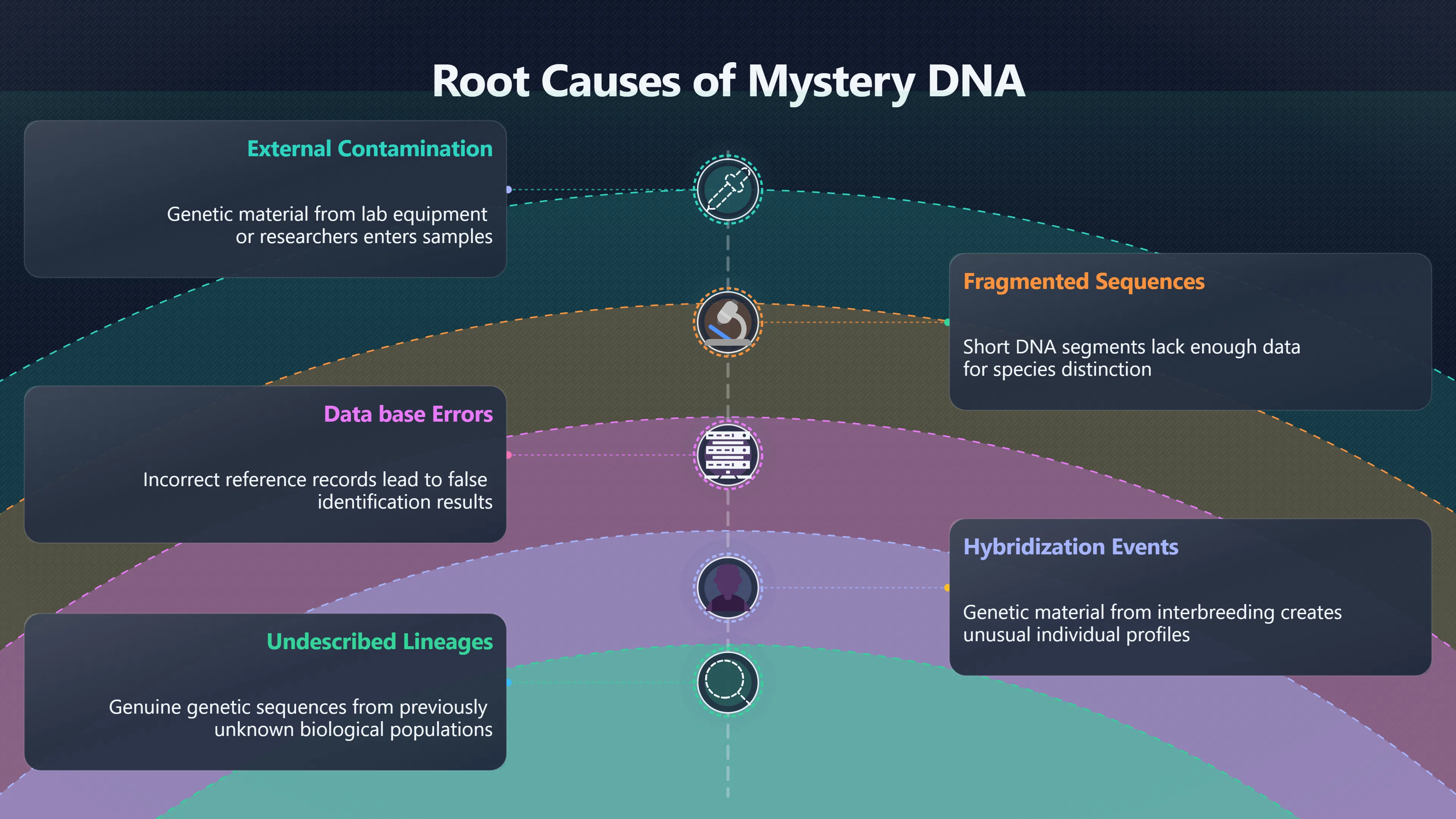
Contamination is a persistent problem. DNA extraction and sequencing can accidentally capture genetic material from other organisms, laboratory equipment, researchers, or previous samples. Environmental samples are particularly vulnerable because they often contain mixtures of DNA from many sources. Even well-designed studies must use controls and replication to reduce the risk of false results.[Frontiers+2Wiley Online Library]frontiersin.orgFrontiersThe devil is in the details: Problems in DNA barcoding…by Z Cheng · 2023 · Cited by 75 — Other contamination can occur if DNA…
Another problem is that many claims rely on only a small fragment of DNA. A short sequence may not contain enough information to distinguish between a new species and a known species that has not been adequately sampled. Researchers have long noted that DNA barcoding becomes less reliable when reference data are incomplete or when species boundaries are poorly understood.[PMC+2PubMed]pmc.ncbi.nlm.nih.govPMCDNA Barcoding: Error Rates Based on Comprehensiveby CP Meyer · 2005 · Cited by 2614 — We find that the lowest overall error for species identification is 4%. In contrast, barcoding pe…
Database quality also matters. Genetic identification depends on comparing an unknown sequence with previously identified specimens. If reference records contain errors, the resulting identification may also be wrong. Studies evaluating barcode databases have found that misidentifications, taxonomic mistakes and databasing errors can create the appearance of unusual genetic results when no new species is actually involved.[PMC]pmc.ncbi.nlm.nih.govBOLD and GenBank revisited – Do identification errors arise…by M Pentinsaari · 2020 · Cited by 178 — 60% of the cases initially tho…
In a cryptozoological context, a sequence that fails to match known records may therefore have several explanations:<div class="content-enhancement content-enhancement--insight-grid" markdown="1">
- The DNA is contaminated.
- The sequence is too short or degraded.
- The relevant species has not yet been sequenced.
- The reference database contains errors.
- The sample comes from a hybrid or unusual individual.
- The result genuinely represents an undescribed lineage.</div>
The existence of multiple plausible explanations is exactly why DNA alone rarely settles the question.
Why Environmental DNA Is Especially Difficult
Environmental DNA, usually called eDNA, has transformed wildlife detection. Researchers can collect water, soil or sediment samples and detect species from traces of genetic material left behind in the environment. This technique is extremely valuable for finding rare or elusive animals.[preslia.cz]preslia.czCombining environmental DNA data and taxonomic…12 Dec 2024 — Combining environmental DNA data and taxonomic surveys provides an unprec…
However, detecting DNA is not the same as documenting a new species.
Environmental DNA can produce false positives through contamination, laboratory error or misassignment of sequences. It can also produce false negatives when a species is present but not detected. Because the sampled DNA is often fragmented and disconnected from an actual specimen, interpretation requires caution. Scientists generally treat unusual eDNA signals as hypotheses that require confirmation through additional evidence rather than as definitive proof of a new animal.[Wiley Online Library]onlinelibrary.wiley.com1755 0998.12508Wiley Online LibraryHow to limit false positives in environmental DNA and…by GF Ficetola · 2016 · Cited by 326 — Environmental DNA (eD…
This distinction is particularly important in cryptozoology. A mysterious genetic trace in a lake, forest or cave may justify further fieldwork, but it does not provide the kind of independently verifiable evidence needed to establish a species.
Why DNA Still Needs a Physical Voucher
The strongest safeguard against error is a voucher specimen: a preserved animal, tissue sample, skeleton, skin, or other physical material deposited in a collection where future researchers can examine it. Voucher specimens allow scientists to verify identifications, repeat analyses and compare findings with new evidence decades later.[PMC]pmc.ncbi.nlm.nih.govPMCWhy vouchers matter in botanical researchNIHby TM Culley · 2013 · Cited by 149 — Vouchers are crucial in authenticating the taxonomy of an organism, as a tool for identifyi…
Without such material, a remarkable DNA sequence can become difficult or impossible to evaluate. Future researchers cannot confirm whether the sample was contaminated, whether the original identification was correct, or whether the sequence truly came from a distinct organism. A voucher provides a permanent reference point linking genetic data to a real animal.[PMC]pmc.ncbi.nlm.nih.govPMCWhy vouchers matter in botanical researchNIHby TM Culley · 2013 · Cited by 149 — Vouchers are crucial in authenticating the taxonomy of an organism, as a tool for identifyi…
This is one reason debates over DNA-only species descriptions remain controversial. Some taxonomists argue that molecular data can play a central role in naming species, especially for organisms that are difficult to study. Others warn that species hypotheses become harder to test when they are detached from preserved reference material. Even supporters of expanded DNA-based taxonomy generally emphasise the need for rigorous standards, reproducibility and traceable evidence.[PMC+2PLOS]pmc.ncbi.nlm.nih.govTightening the requirements for species diagnoses would help…by FE Rheindt · 2023 · Cited by 46 — In this Essay, the International…
For claims involving cryptids, the practical implication is straightforward: an unexplained sequence is much stronger when it can be tied to a preserved specimen that other scientists can inspect.
The Key Question: Unknown DNA or Unknown Animal?
A common misunderstanding is that unknown DNA automatically implies an unknown species. In reality, those are different claims.
An unknown sequence means researchers do not currently know how to classify a particular genetic result. A new species claim goes much further. It requires evidence that the sequence comes from a real biological population distinct from already recognised species and that alternative explanations have been ruled out.[PMC]pmc.ncbi.nlm.nih.govTightening the requirements for species diagnoses would help…by FE Rheindt · 2023 · Cited by 46 — In this Essay, the International…
That distinction explains why reports of unusual genetic samples occasionally attract attention but rarely result in the recognition of a new animal. Science does not ask whether a DNA result is intriguing. It asks whether the result remains convincing after contamination checks, expanded sampling, comparison with museum collections, analysis of morphology, and independent verification by other researchers.
See on Amazon</a></div></div></article><article class="fr-book-card"><a class="fr-book-cover" href="https://www.amazon.com/s?k=The+Song+Of+The+Dodo+by+David+Quammen&i=stripbooks&tag=searcht-20" target="_blank" rel="sponsored noopener noreferrer" aria-label="Open The Song Of The Dodo on Amazon"><span class="fr-book-cover-fallback">Book</span><img class="fr-book-cover-thumb" src="https://books.google.com/books/content?id=53kuEeItYtIC&printsec=frontcover&img=1&zoom=1&edge=curl&source=gbs_api" alt="Cover for The Song Of The Dodo" loading="lazy" decoding="async" fetchpriority="low" referrerpolicy="no-referrer" onerror="this.hidden=true;this.closest('.fr-book-cover').classList.add('fr-book-cover-placeholder');"></a><div class="fr-book-info"><h4 class="fr-book-title"><a href="https://www.amazon.com/s?k=The+Song+Of+The+Dodo+by+David+Quammen&i=stripbooks&tag=searcht-20" target="_blank" rel="sponsored noopener noreferrer" title="The Song Of The Dodo">The Song Of The Dodo</a></h4><p class="fr-book-author">By David Quammen</p><p class="fr-book-desc">Discusses species, evolution, and biological evidence.</p><div class="fr-book-actions"><a href="https://www.amazon.com/s?k=The+Song+Of+The+Dodo+by+David+Quammen&i=stripbooks&tag=searcht-20" class="fr-amazon-btn" target="_blank" rel="sponsored noopener noreferrer">
See on Amazon</a></div></div></article><article class="fr-book-card"><a class="fr-book-cover" href="https://www.amazon.com/s?k=Why+Evolution+is+True+by+Jerry+A.+Coyne&i=stripbooks&tag=searcht-20" target="_blank" rel="sponsored noopener noreferrer" aria-label="Open Why Evolution is True on Amazon"><span class="fr-book-cover-fallback">Book</span><img class="fr-book-cover-thumb" src="https://books.google.com/books/content?id=J91Z6ED7MgEC&printsec=frontcover&img=1&zoom=1&edge=curl&source=gbs_api" alt="Cover for Why Evolution is True" loading="lazy" decoding="async" fetchpriority="low" referrerpolicy="no-referrer" onerror="this.hidden=true;this.closest('.fr-book-cover').classList.add('fr-book-cover-placeholder');"></a><div class="fr-book-info"><h4 class="fr-book-title"><a href="https://www.amazon.com/s?k=Why+Evolution+is+True+by+Jerry+A.+Coyne&i=stripbooks&tag=searcht-20" target="_blank" rel="sponsored noopener noreferrer" title="Why Evolution is True">Why Evolution is True</a></h4><p class="fr-book-author">By Jerry A. Coyne</p><p class="fr-book-desc">Provides framework for evaluating genetic evidence.</p><div class="fr-book-actions"><a href="https://www.amazon.com/s?k=Why+Evolution+is+True+by+Jerry+A.+Coyne&i=stripbooks&tag=searcht-20" class="fr-amazon-btn" target="_blank" rel="sponsored noopener noreferrer">
See on Amazon</a></div></div></article><article class="fr-book-card"><a class="fr-book-cover" href="https://www.amazon.com/s?k=Abominable+Science%21+by+Daniel+Loxton&i=stripbooks&tag=searcht-20" target="_blank" rel="sponsored noopener noreferrer" aria-label="Open Abominable Science! on Amazon"><span class="fr-book-cover-fallback">Book</span><img class="fr-book-cover-thumb" src="https://books.google.com/books/content?id=kTsgAAAAQBAJ&printsec=frontcover&img=1&zoom=1&edge=curl&source=gbs_api" alt="Cover for Abominable Science!" loading="lazy" decoding="async" fetchpriority="low" referrerpolicy="no-referrer" onerror="this.hidden=true;this.closest('.fr-book-cover').classList.add('fr-book-cover-placeholder');"></a><div class="fr-book-info"><h4 class="fr-book-title"><a href="https://www.amazon.com/s?k=Abominable+Science%21+by+Daniel+Loxton&i=stripbooks&tag=searcht-20" target="_blank" rel="sponsored noopener noreferrer" title="Abominable Science!">Abominable Science!</a></h4><p class="fr-book-author">By Daniel Loxton, Donald R. Prothero</p><p class="fr-book-desc">Addresses weak and strong forms of biological evidence.</p><div class="fr-book-actions"><a href="https://www.amazon.com/s?k=Abominable+Science%21+by+Daniel+Loxton&i=stripbooks&tag=searcht-20" class="fr-amazon-btn" target="_blank" rel="sponsored noopener noreferrer">
See on Amazon</a></div></div></article></div><div class="fr-section-footer"><div class="fr-browse-links" aria-label="Browse more on Amazon"><span class="fr-browse-links-label">Browse more on Amazon:</span><a class="fr-browse-more" href="https://www.amazon.com/s?k=The+Tangled+Tree&i=stripbooks&tag=searcht-20" target="_blank" rel="sponsored noopener noreferrer">The Tangled Tree</a><a class="fr-browse-more" href="https://www.amazon.com/s?k=The+Song+Of+The+Dodo&i=stripbooks&tag=searcht-20" target="_blank" rel="sponsored noopener noreferrer">The Song Of The Dodo</a><a class="fr-browse-more" href="https://www.amazon.com/s?k=Why+Evolution+is+True&i=stripbooks&tag=searcht-20" target="_blank" rel="sponsored noopener noreferrer">Why Evolution is True</a></div><p class="fr-disclosure">As an Amazon Associate I earn from qualifying purchases.</p></div></div></section>
eBay marketplace picks
Marketplace Samples
Live-tested eBay searches with available results related to this page.

Endnotes
1.
Source: pmc.ncbi.nlm.nih.gov
Link:https://pmc.ncbi.nlm.nih.gov/articles/PMC10443861/
2.
Source: academic.oup.com
Link:https://academic.oup.com/zoolinnean/advance-article-pdf/doi/10.1093/zoolinnean/zlae043/57399777/zlae043.pdf
3.
Source: onlinelibrary.wiley.com
Title: 1755 0998.12508
Link:https://onlinelibrary.wiley.com/doi/full/10.1111/1755-0998.12508
4.
Source: besjournals.onlinelibrary.wiley.com
Title: 2041 210x.70328
Link:https://besjournals.onlinelibrary.wiley.com/doi/10.1111/2041-210x.70328
5.
Source: pmc.ncbi.nlm.nih.gov
Link:https://pmc.ncbi.nlm.nih.gov/articles/PMC12269782/
6.
Source: journals.plos.org
Link:https://journals.plos.org/plosone/article?id=10.1371%2Fjournal.pone.0057125
7.
Source: preslia.cz
Link:https://www.preslia.cz/article/11574
8.
Source: pmc.ncbi.nlm.nih.gov
Title: PMCWhy vouchers matter in botanical research
Link:https://pmc.ncbi.nlm.nih.gov/articles/PMC4103463/
9.
Source: journals.plos.org
Link:https://journals.plos.org/plosbiology/article?id=10.1371%2Fjournal.pbio.3002251
10.
Source: pmc.ncbi.nlm.nih.gov
Link:https://pmc.ncbi.nlm.nih.gov/articles/PMC12483627/
11.
Source: onlinelibrary.wiley.com
Link:https://onlinelibrary.wiley.com/doi/10.1111/jeu.12865
12.
Source: onlinelibrary.wiley.com
Title: j.1096 0031.2003.00008.x
Link:https://onlinelibrary.wiley.com/doi/10.1111/j.1096-0031.2003.00008.x
13.
Source: pmc.ncbi.nlm.nih.gov
Link:https://pmc.ncbi.nlm.nih.gov/articles/PMC5937547/
14.
Source: frontiersin.org
Link:https://www.frontiersin.org/journals/ecology-and-evolution/articles/10.3389/fevo.2023.1149839/full
15.
Source: pmc.ncbi.nlm.nih.gov
Title: PMCDNA Barcoding: Error Rates Based on Comprehensive
Link:https://pmc.ncbi.nlm.nih.gov/articles/PMC1287506/
16.
Source: pubmed.ncbi.nlm.nih.gov
Link:https://pubmed.ncbi.nlm.nih.gov/40677746/
17.
Source: pmc.ncbi.nlm.nih.gov
Link:https://pmc.ncbi.nlm.nih.gov/articles/PMC7162515/
18.
Source: pmc.ncbi.nlm.nih.gov
Link:https://pmc.ncbi.nlm.nih.gov/articles/PMC519004/
Additional References
19.
Source: usbr.gov
Link:https://www.usbr.gov/research/projects/download_product.cfm?id=1390
20.
Source: free-barcode.com
Link:https://free-barcode.com/barcode/barcode-technology/dna-barcoding-challenges-limitations.asp
21.
Source: iczn.org
Link:https://www.iczn.org/outreach/faqs/
22.
Source: iczn.org
Link:https://www.iczn.org/the-code/the-code-online/
23.
Source: app.pan.pl
Title: Characters purporting to distinguish the new or revised taxa appear in a variety
Link:https://www.app.pan.pl/archive/published/app50/app50-650.pdf
24.
Source: antwiki.org
Title: Dupérré, N. (2020) Old and new challenges in taxonomy (10.11646@megataxa.1.1.12)
Link:https://www.antwiki.org/w/images/8/80/Dup%C3%A9rr%C3%A9%2C_N.%282020%29_Old_and_new_challenges_in_taxonomy%2810.11646%40megataxa.1.1.12%29.pdf
25.
Source: youtube.com
Link:https://www.youtube.com/watch?v=IChGvBujRJc
26.
Source: researchgate.net
Title: What should we do about contaminant sequences in DNA barcoding samples
Link:https://www.researchgate.net/post/What_should_we_do_about_contaminant_sequences_in_DNA_barcoding_samples
27.
Source: edepot.wur.nl
Title: DNA region that is universally present in the target lineages and has
Link:https://edepot.wur.nl/238562
28.
Source: researchgate.net
Title: Why cant traditional taxonomy be replaced by DNA barcoding
Link:https://www.researchgate.net/post/Why_cant_traditional_taxonomy_be_replaced_by_DNA_barcoding
Topic Tree