Within Proof
What Real Mammal Discovery Looks Like
The olinguito became accepted through museum specimens, fieldwork, genetics and anatomy, not through a single surprising sighting.
On this page
- How museum specimens revealed the pattern
- How field evidence confirmed the animal
- What cryptid claims can learn from the case
Page outline Jump by section
Introduction
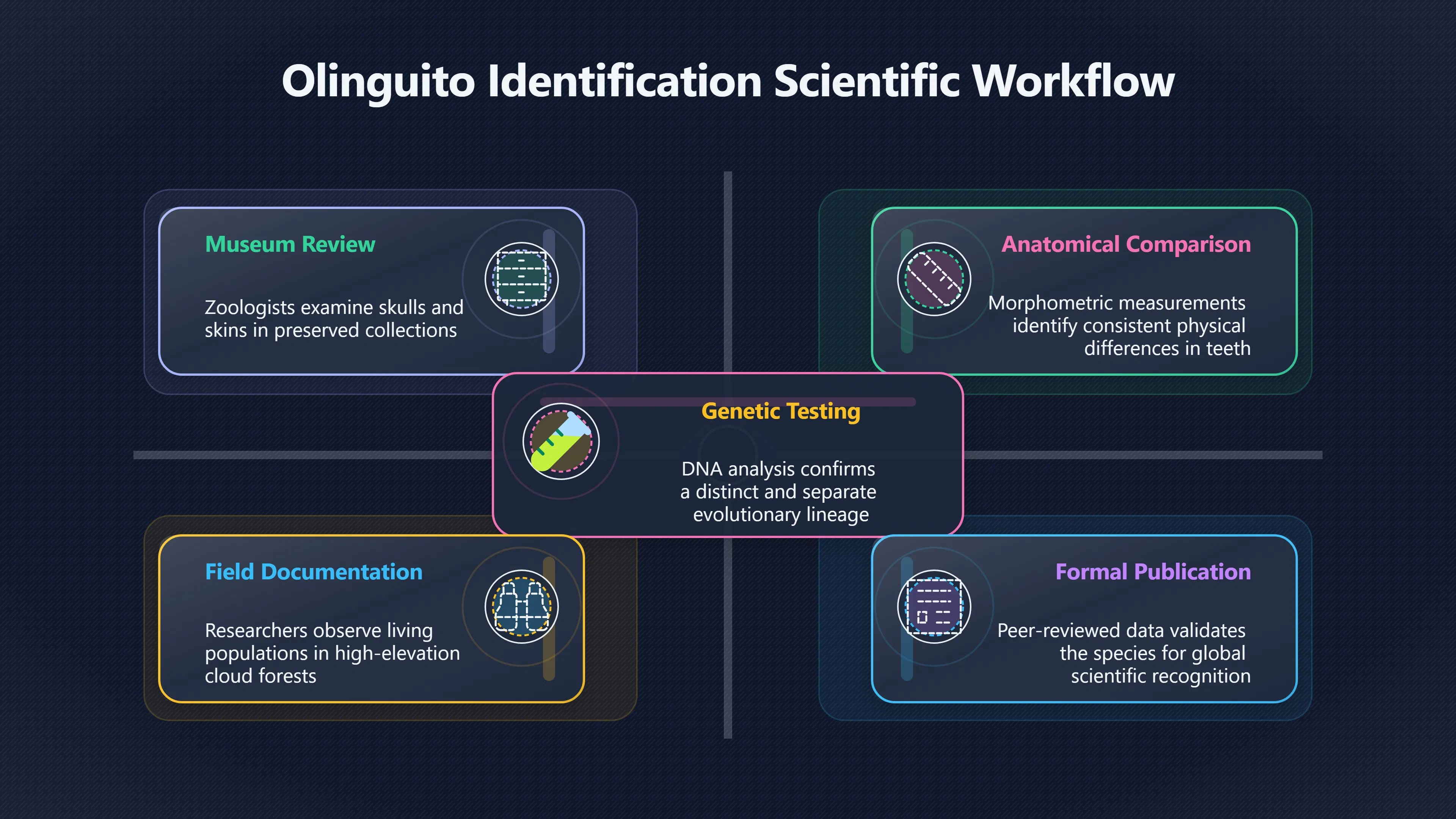
The discovery of the olinguito is one of the clearest modern examples of how zoologists prove that an unfamiliar animal is a real species rather than a rumour, misidentification or folklore claim. Announced in 2013 as Bassaricyon neblina, the olinguito was not validated because somebody reported seeing a strange creature in a remote forest. Instead, its recognition emerged from a long chain of evidence: museum specimens collected decades earlier, detailed anatomical comparisons, genetic testing, field surveys and formal taxonomic review. The case is especially relevant to discussions of cryptozoology because it demonstrates that genuine animal discoveries leave multiple independent lines of evidence that other scientists can inspect and verify.[Zookeys]zookeys.pensoft.netZookeys Taxonomic revision of the olingos (Bassaricyonby KM Helgen · 2013 · Cited by 174 — Our study of Bassaricyon taxonomy originally began with close examination of craniodental tra…
How museum specimens revealed the pattern
How field evidence confirmed the animal
Museum evidence alone was not enough. Researchers still needed to demonstrate that the proposed species represented a living population in nature rather than a collection artefact or unusual variant.
Field records associated with museum specimens showed that the animals came from a distinctive ecological zone in the northern Andes. Unlike other olingos, these specimens consistently originated from high-elevation cloud forests, generally between roughly 1,500 and 2,700 metres above sea level. This geographic and ecological separation strengthened the argument that they represented a distinct species.[Smithsonian Institution]si.eduolinguito discoverySmithsonian InstitutionOlinguito Discovery15 Aug 2013 — Examining museum skins revealed that this new species was also smaller overall wi…
Researchers then travelled into Andean cloud forests in Ecuador and Colombia to locate the animals in the wild. They successfully observed and documented living olinguitos in their natural habitat. These field observations confirmed that the proposed species was not extinct, mislabelled or hypothetical. Scientists could connect museum specimens to real populations occupying a recognisable range and habitat.[Smithsonian Institution+2ResearchGate]si.eduolinguito discoverySmithsonian InstitutionOlinguito Discovery15 Aug 2013 — Examining museum skins revealed that this new species was also smaller overall wi…
The fieldwork also provided biological information that museum specimens alone could not supply, including behaviour, habitat use and distribution. Together, these observations transformed the case from a museum mystery into a documented living species.[ResearchGate]researchgate.netResearchGate(PDF) Taxonomic revision of the olingos (Bassaricyon…12 Aug 2013 — We report on the biology of this new species based on i…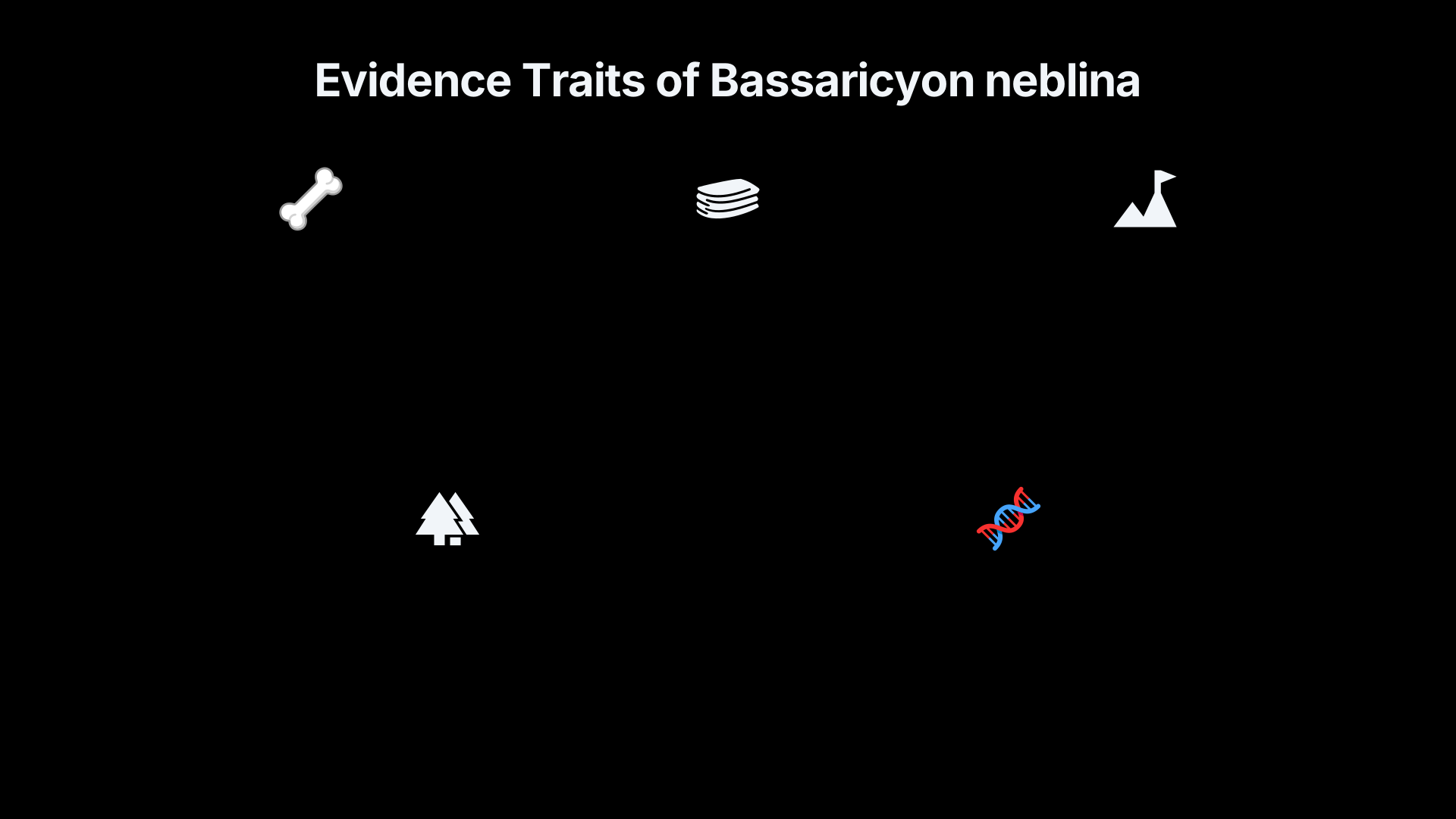
Why genetics and anatomy mattered together
A crucial feature of the olinguito case is that no single piece of evidence carried the entire burden of proof.
What cryptid claims can learn from the case
The olinguito is sometimes cited as evidence that unknown mammals can still exist, and that point is true. It was a previously unrecognised carnivoran species living in a region already visited by scientists. Yet the lesson is not that cryptid reports are automatically plausible. The lesson is that real species discoveries generate a trail of verifiable evidence.[Smithsonian Institution]si.edusmithsonian scientists discover new species carnivoreSmithsonian InstitutionSmithsonian Scientists Discover New Species of Carnivore15 Aug 2013 — The olinguito (Bassaricyon neblina)―the firs…
Several features distinguish the olinguito case from typical cryptid claims:
- Physical specimens existed. Scientists could repeatedly examine skulls, skins and other preserved material.[Zookeys]zookeys.pensoft.netZookeys Taxonomic revision of the olingos (Bassaricyonby KM Helgen · 2013 · Cited by 174 — Our study of Bassaricyon taxonomy originally began with close examination of craniodental tra…
- Multiple specimens showed the same traits. The evidence did not depend on a single unusual animal.[Zookeys]zookeys.pensoft.netZookeys Taxonomic revision of the olingos (Bassaricyonby KM Helgen · 2013 · Cited by 174 — Our study of Bassaricyon taxonomy originally began with close examination of craniodental tra…
- Genetics supported the anatomical findings. Independent methods pointed to the same conclusion.[CUNY Academic Works]academicworks.cuny.eduCUNY Academic WorksRevised distributional estimates for the recently discovered…by BE Gerstner · 2016 — Genetic analyses from that stu…
- Researchers found living populations in the wild. The species could be observed and studied directly.[Smithsonian Institution]si.eduolinguito discoverySmithsonian InstitutionOlinguito Discovery15 Aug 2013 — Examining museum skins revealed that this new species was also smaller overall wi…
- The results were formally published and reviewed. Other scientists could inspect the data and challenge or confirm the conclusions.[Zookeys]zookeys.pensoft.netZookeys Taxonomic revision of the olingos (Bassaricyonby KM Helgen · 2013 · Cited by 174 — Our study of Bassaricyon taxonomy originally began with close examination of craniodental tra…
Most famous cryptids lack this chain of evidence. Reports often rely on eyewitness accounts, ambiguous photographs or isolated traces that cannot be independently verified. The olinguito followed the opposite path: each new line of evidence reinforced the others.
What real mammal discovery looks like
See on Amazon</a></div></div></article><article class="fr-book-card"><a class="fr-book-cover" href="https://www.amazon.com/s?k=The+Diversity+of+Life+by+Edward+O.+Wilson&i=stripbooks&tag=searcht-20" target="_blank" rel="sponsored noopener noreferrer" aria-label="Open The Diversity of Life on Amazon"><span class="fr-book-cover-fallback">Book</span><img class="fr-book-cover-thumb" src="https://books.google.com/books/content?id=ZSqehqH-qTYC&printsec=frontcover&img=1&zoom=1&edge=curl&source=gbs_api" alt="Cover for The Diversity of Life" loading="lazy" decoding="async" fetchpriority="low" referrerpolicy="no-referrer" onerror="this.hidden=true;this.closest('.fr-book-cover').classList.add('fr-book-cover-placeholder');"></a><div class="fr-book-info"><h4 class="fr-book-title"><a href="https://www.amazon.com/s?k=The+Diversity+of+Life+by+Edward+O.+Wilson&i=stripbooks&tag=searcht-20" target="_blank" rel="sponsored noopener noreferrer" title="The Diversity of Life">The Diversity of Life</a></h4><p class="fr-book-author">By Edward O. Wilson</p><p class="fr-book-desc">Provides context for discovering and documenting species.</p><div class="fr-book-actions"><a href="https://www.amazon.com/s?k=The+Diversity+of+Life+by+Edward+O.+Wilson&i=stripbooks&tag=searcht-20" class="fr-amazon-btn" target="_blank" rel="sponsored noopener noreferrer">
See on Amazon</a></div></div></article><article class="fr-book-card"><a class="fr-book-cover" href="https://www.amazon.com/s?k=Why+Evolution+is+True+by+Jerry+A.+Coyne&i=stripbooks&tag=searcht-20" target="_blank" rel="sponsored noopener noreferrer" aria-label="Open Why Evolution is True on Amazon"><span class="fr-book-cover-fallback">Book</span><img class="fr-book-cover-thumb" src="https://books.google.com/books/content?id=J91Z6ED7MgEC&printsec=frontcover&img=1&zoom=1&edge=curl&source=gbs_api" alt="Cover for Why Evolution is True" loading="lazy" decoding="async" fetchpriority="low" referrerpolicy="no-referrer" onerror="this.hidden=true;this.closest('.fr-book-cover').classList.add('fr-book-cover-placeholder');"></a><div class="fr-book-info"><h4 class="fr-book-title"><a href="https://www.amazon.com/s?k=Why+Evolution+is+True+by+Jerry+A.+Coyne&i=stripbooks&tag=searcht-20" target="_blank" rel="sponsored noopener noreferrer" title="Why Evolution is True">Why Evolution is True</a></h4><p class="fr-book-author">By Jerry A. Coyne</p><p class="fr-book-desc">Explains the biological framework behind species recognition.</p><div class="fr-book-actions"><a href="https://www.amazon.com/s?k=Why+Evolution+is+True+by+Jerry+A.+Coyne&i=stripbooks&tag=searcht-20" class="fr-amazon-btn" target="_blank" rel="sponsored noopener noreferrer">
See on Amazon</a></div></div></article><article class="fr-book-card"><a class="fr-book-cover" href="https://www.amazon.com/s?k=The+Song+Of+The+Dodo+by+David+Quammen&i=stripbooks&tag=searcht-20" target="_blank" rel="sponsored noopener noreferrer" aria-label="Open The Song Of The Dodo on Amazon"><span class="fr-book-cover-fallback">Book</span><img class="fr-book-cover-thumb" src="https://books.google.com/books/content?id=53kuEeItYtIC&printsec=frontcover&img=1&zoom=1&edge=curl&source=gbs_api" alt="Cover for The Song Of The Dodo" loading="lazy" decoding="async" fetchpriority="low" referrerpolicy="no-referrer" onerror="this.hidden=true;this.closest('.fr-book-cover').classList.add('fr-book-cover-placeholder');"></a><div class="fr-book-info"><h4 class="fr-book-title"><a href="https://www.amazon.com/s?k=The+Song+Of+The+Dodo+by+David+Quammen&i=stripbooks&tag=searcht-20" target="_blank" rel="sponsored noopener noreferrer" title="The Song Of The Dodo">The Song Of The Dodo</a></h4><p class="fr-book-author">By David Quammen</p><p class="fr-book-desc">Illustrates how fieldwork and evidence reveal biodiversity.</p><div class="fr-book-actions"><a href="https://www.amazon.com/s?k=The+Song+Of+The+Dodo+by+David+Quammen&i=stripbooks&tag=searcht-20" class="fr-amazon-btn" target="_blank" rel="sponsored noopener noreferrer">
See on Amazon</a></div></div></article></div><div class="fr-section-footer"><div class="fr-browse-links" aria-label="Browse more on Amazon"><span class="fr-browse-links-label">Browse more on Amazon:</span><a class="fr-browse-more" href="https://www.amazon.com/s?k=The+Species+Seekers%3A+Heroes%2C+Fools%2C+and+the+Mad+Pursuit+of+Life+on+Earth&i=stripbooks&tag=searcht-20" target="_blank" rel="sponsored noopener noreferrer">The Species Seekers: Heroes, Fools, and the Mad Pursuit of Life on Earth</a><a class="fr-browse-more" href="https://www.amazon.com/s?k=The+Diversity+of+Life&i=stripbooks&tag=searcht-20" target="_blank" rel="sponsored noopener noreferrer">The Diversity of Life</a><a class="fr-browse-more" href="https://www.amazon.com/s?k=Why+Evolution+is+True&i=stripbooks&tag=searcht-20" target="_blank" rel="sponsored noopener noreferrer">Why Evolution is True</a></div><p class="fr-disclosure">As an Amazon Associate I earn from qualifying purchases.</p></div></div></section>
Amazon book picks
Further Reading
Books and field guides related to What Real Mammal Discovery Looks Like. Use these as the next step if you want deeper reading beyond the article.
The Species Seekers: Heroes, Fools, and the Mad Pursuit of Li...
Shows how real species are found and verified.
eBay marketplace picks
Marketplace Samples
Example marketplace items related to this page. Use the search link to explore similar finds on eBay.

Endnotes
1.
Source: researchgate.net
Link:https://www.researchgate.net/publication/256426055_Taxonomic_revision_of_the_olingos_Bassaricyon_with_description_of_a_new_species_the_Olinguito
2.
Source: pmc.ncbi.nlm.nih.gov
Link:https://pmc.ncbi.nlm.nih.gov/articles/PMC3760134/
3.
Source: academicworks.cuny.edu
Link:https://academicworks.cuny.edu/cgi/viewcontent.cgi?article=1604&context=cc_etds_theses
4.
Source: youtube.com
Title: How to Discover a New Mammal Species with Dr. Kris Helgen
Link:https://www.youtube.com/watch?v=VPcMo6ng_9E
5.
Source: youtube.com
Link:https://www.youtube.com/watch?v=074AGwZF8ho
6.
Source: zookeys.pensoft.net
Title: Zookeys Taxonomic revision of the olingos (Bassaricyon
Link:https://zookeys.pensoft.net/article/3550/
7.
Source: si.edu
Title: smithsonian scientists discover new species carnivore
Link:https://www.si.edu/newsdesk/releases/smithsonian-scientists-discover-new-species-carnivore
8.
Source: si.edu
Title: olinguito discovery
Link:https://www.si.edu/stories/olinguito-discovery
9.
Source: amnh.org
Link:https://www.amnh.org/explore/videos/shelf-life/olinguito-skull-species-discovery
10.
Source: Wikipedia
Link:https://en.wikipedia.org/wiki/Bassaricyon
11.
Source: nbcwashington.com
Title: smithsonian to announce discovery of new mammal
Link:https://www.nbcwashington.com/news/local/smithsonian-to-announce-discovery-of-new-mammal/2068366/
12.
Source: cnr.ncsu.edu
Title: discovery the olinguito
Link:https://cnr.ncsu.edu/news/2023/12/discovery-the-olinguito/
13.
Source: novataxa.blogspot.com
Title: bassaricyon neblina
Link:https://novataxa.blogspot.com/2013/08/bassaricyon-neblina.html
Additional References
14.
Source: amazonaid.org
Link:https://amazonaid.org/new-mammal-species-discovered-andean-cloud-forests/
15.
Source: facebook.com
Title: meet the olinguitosmithsonian scientists announced their discovery on this day i
Link:https://www.facebook.com/awfularthursoysterbar/posts/meet-the-olinguitosmithsonian-scientists-announced-their-discovery-on-this-day-i/1214324960723552/
16.
Source: abcnews.com
Link:https://abcnews.com/Technology/newly-discovered-mammal-suffered-mistaken-identity-centuries/story?id=19968422
17.
Source: facebook.com
Link:https://www.facebook.com/61557677125939/posts/this-enchanting-collage-features-the-olinguito-bassaricyon-neblina-a-remarkable-/122246080208255904/
18.
Source: themanitoban.com
Title: newly discovered adorable olinguito
Link:https://themanitoban.com/2013/09/newly-discovered-adorable-olinguito/16023/
19.
Source: fieldmuseum.org
Title: hiding plain sight field museum
Link:https://www.fieldmuseum.org/about/press/hiding-plain-sight-field-museum
20.
Source: insider.si.edu
Title: crowd sourcing olinguito
Link:https://insider.si.edu/2014/08/crowd-sourcing-olinguito/
21.
Source: voanews.com
Link:https://www.voanews.com/a/new-mammal-discovery/1730258.html
22.
Source: youtube.com
Title: Skull of the Olinguito
Link:https://www.youtube.com/watch?v=OEYfY0mRc5k
23.
Source: sciencedaily.com
Link:https://www.sciencedaily.com/releases/2013/08/130815143101.htm
Topic Tree