Within Deep Sea
The Fish Cryptid Arguments Misuse
The coelacanth is a real Lazarus taxon, but its rediscovery does not make every prehistoric monster claim plausible.
On this page
- What the 1938 specimen proved
- Why ecology made survival plausible
- Where prehistoric survivor claims overreach
Page outline Jump by section
Introduction
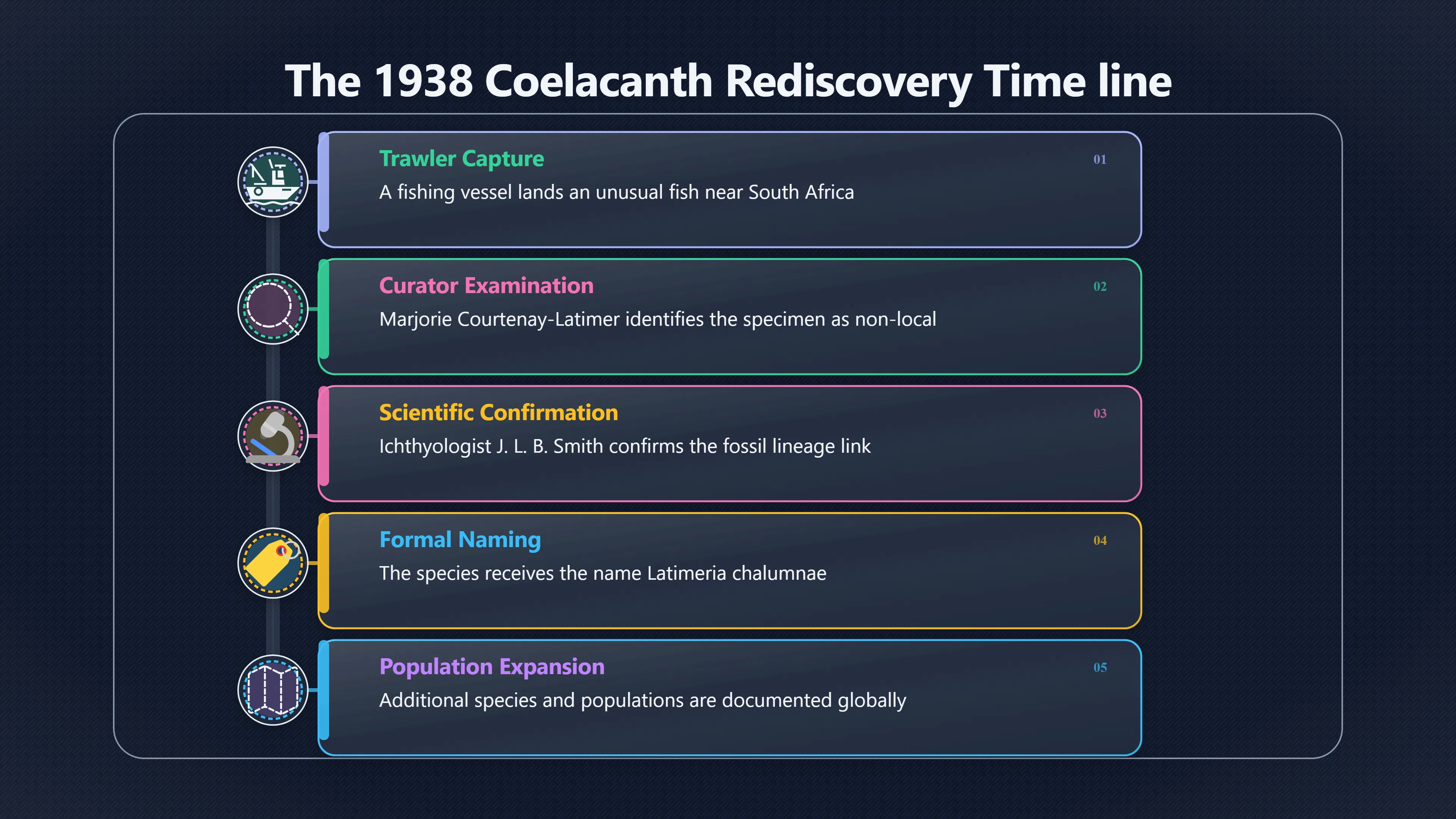
The coelacanth is one of the strongest examples cryptozoologists can point to when arguing that science does not know everything about life on Earth. A fish lineage believed extinct for roughly 66–70 million years was found alive in 1938 off the coast of South Africa, apparently returning from a fossil record that suggested it had vanished with the dinosaurs. The discovery was genuine, scientifically transformative, and remains one of the most famous examples of a “Lazarus taxon” — a group that disappears from the fossil record only to be found alive later.[Smithsonian Ocean+2Natural History Museum]ocean.si.eduSmithsonian OceanCoelacanth | Smithsonian OceanThe first living coelacanth was discovered in 1938 and bears the scientific name Latimeria… Yet the coelacanth is also one of the most misused examples in cryptozoology. Its rediscovery demonstrates that extinction inferences can sometimes be wrong and that remote environments can conceal surviving lineages. It does not demonstrate that every claimed prehistoric survivor, from giant marine reptiles to living dinosaurs, is therefore plausible. Understanding why the coelacanth survived helps explain why many other prehistoric-survivor claims do not fit the evidence.
What the 1938 Specimen Proved
Why Ecology Made Survival Plausible
The coelacanth’s rediscovery was astonishing, but its ecology helps explain why it escaped notice for so long.
Living coelacanths inhabit relatively deep marine environments, often along steep volcanic slopes and cave systems. They spend much of their lives in dimly lit waters that historically received little scientific attention. Before modern submersibles, remotely operated vehicles, and specialised diving expeditions, these habitats were difficult to observe directly.[Smithsonian Institution]si.eduSmithsonian InstitutionCoelacanth7 Jun 2013 — Easily recognized by their distinctive shape and lobed fins, the first living coelacanth wa…
Several factors reduced the chances of discovery:
- Remote habitat: Coelacanths occupy offshore environments that were rarely sampled systematically during the early twentieth century.[Smithsonian Institution]si.eduSmithsonian InstitutionCoelacanth7 Jun 2013 — Easily recognized by their distinctive shape and lobed fins, the first living coelacanth wa…
- Low population density: Modern populations appear small and fragmented rather than abundant and widespread.[NOAA Fisheries]fisheries.noaa.govafrican coelacanthNOAA FisheriesAfrican Coelacanth28 Apr 2016 — The African coelacanth belongs to an ancient lineage of bony, lobe-finned fish. The species…
- Limited interaction with humans: Unlike commercially important fishes, coelacanths were not regularly targeted by fisheries.[Conservation International]conservation.orgConservation InternationalFish story: How a coelacanth discovery set off a flurry of…16 Jan 2019 — The 1938 discovery of a coelacanth…
- Patchy fossil preservation: Fossilisation is rare and uneven. A missing fossil record does not necessarily mean complete biological disappearance.[Reddit]reddit.comYou cannot use the coelacanth as evidence that other…December 22, 2025 — The existence of extant coelacanths is not in itself pr…
This combination of factors makes the coelacanth a credible Lazarus taxon. The fish did not need to remain hidden across populated coastlines or constantly evade observation. It occupied habitats where scientific sampling was historically sparse and where small populations could persist with little human contact.[borea.mnhn.fr+2Smithsonian Institution]borea.mnhn.fradaptation to moderate deep waters, focusing mainly on the hypothesis of bimodal respiration (…
Why “Living Fossil” Does Not Mean Unchanged
Popular accounts often portray the coelacanth as a frozen relic identical to its ancient ancestors. The reality is more complicated.
Where Prehistoric-Survivor Claims Overreach
The most common misuse of the coelacanth is a simple argument: “Scientists thought coelacanths were extinct and were wrong; therefore reports of surviving dinosaurs, marine reptiles, or giant prehistoric predators could also be true.”
The logic sounds persuasive but ignores important differences.
The coelacanth survived because several independent conditions aligned. It was a relatively obscure fish from a known lineage, living in a poorly observed habitat, with a body size and ecological role that did not require vast visible populations. Its rediscovery was followed by physical specimens, repeated captures, photographs, habitat studies, and eventually direct observations of living animals.[Smithsonian Ocean+2Smithsonian Institution]ocean.si.eduSmithsonian OceanCoelacanth | Smithsonian OceanThe first living coelacanth was discovered in 1938 and bears the scientific name Latimeria…
Many famous prehistoric-survivor claims lack these supporting conditions.
Large marine reptiles
Claims involving surviving plesiosaurs or other Mesozoic marine reptiles face ecological and evidential challenges. Large air-breathing animals must surface regularly, reproduce, maintain viable populations, and leave traces. Decades of marine research, satellite monitoring, fisheries activity, and oceanographic exploration have produced no comparable body of evidence. The coelacanth’s survival does not solve those problems.[Smithsonian Institution]si.eduSmithsonian InstitutionCoelacanth7 Jun 2013 — Easily recognized by their distinctive shape and lobed fins, the first living coelacanth wa…
Living dinosaurs
Claims that non-avian dinosaurs survive in remote forests encounter similar difficulties. Large terrestrial vertebrates interact extensively with ecosystems, leave tracks, carcasses, genetic material, and observable impacts. The evidential burden is dramatically higher than for a deep-water fish inhabiting sparsely studied habitats.
Megalodon scenarios
The Real Lesson for Cryptozoology
The coelacanth is neither proof that cryptozoological claims are correct nor proof that they are foolish. Instead, it provides a useful standard.
Its rediscovery shows that science can overlook surviving lineages, especially in remote environments with limited sampling. It demonstrates that absence from the fossil record is not always equivalent to extinction. It also shows how extraordinary discoveries become accepted: through specimens, repeated observations, ecological understanding, and accumulating evidence.[Smithsonian Ocean+2Natural History Museum]ocean.si.eduSmithsonian OceanCoelacanth | Smithsonian OceanThe first living coelacanth was discovered in 1938 and bears the scientific name Latimeria…
For cryptozoology, the coelacanth is best viewed as a lesson in disciplined possibility. Some surprises are real. But the fact that one prehistoric lineage survived in a plausible ecological refuge does not mean every prehistoric survivor claim deserves equal credibility. The rediscovery of the coelacanth expanded the boundaries of what scientists considered possible; it did not erase the need for evidence.[Smithsonian Ocean+2Natural History Museum]ocean.si.eduSmithsonian OceanCoelacanth | Smithsonian OceanThe first living coelacanth was discovered in 1938 and bears the scientific name Latimeria…
Amazon book picks
Further Reading
Books and field guides related to The Fish Cryptid Arguments Misuse. Use these as the next step if you want deeper reading beyond the article.
Abominable Science!
Explains why genuine rediscoveries do not validate every prehistoric-survivor claim.
The Deep
Shows the kind of remote habitats where unusual species can remain poorly known.
Cryptozoology A To Z
Provides context for how the coelacanth is used in cryptozoological arguments.
The Variety of Life
Places rediscovered and rare lineages into a wider biodiversity framework.
eBay marketplace picks
Marketplace Samples
Live-tested eBay searches with available results related to this page.
Endnotes
1.
Source: fisheries.noaa.gov
Title: african coelacanth
Link:https://www.fisheries.noaa.gov/species/african-coelacanth
2.
Source: australian.museum
Title: This’living fossil’ comes from a lineage of fishes
Link:https://australian.museum/learn/animals/fishes/coelacanth-latimeria-chalumnae-smith-1939/
3.
Source: Wikipedia
Link:https://en.wikipedia.org/wiki/Coelacanth
4.
Source: borea.mnhn.fr
Link:https://borea.mnhn.fr/sites/default/files/pdfs/A17-29Cupello.pdf
5.
Source: conservation.org
Link:https://www.conservation.org/news/fish-story-how-a-coelacanth-discovery-set-off-a-flurry-of-science-subterfuge
6.
Source: reddit.com
Link:https://www.reddit.com/r/Cryptozoology/comments/1psocu4/you_cannot_use_the_coelacanth_as_evidence_that/
7.
Source: discovermagazine.com
Link:https://www.discovermagazine.com/a-new-coelacanth-species-was-hiding-in-a-museum-for-150-years-and-it-fills-a-50-million-year-gap-49003
8.
Source: youtube.com
Link:https://www.youtube.com/watch?v=nLDqIfyaJJ4
9.
Source: ocean.si.edu
Link:https://ocean.si.edu/ocean-life/fish/coelacanth
10.
Source: nhm.ac.uk
Title: coelacanths the fish that outdid the loch ness monster
Link:https://www.nhm.ac.uk/discover/coelacanths-the-fish-that-outdid-the-loch-ness-monster.html
11.
Source: historytoday.com
Title: discovery living fossil
Link:https://www.historytoday.com/archive/months-past/discovery-living-fossil
12.
Source: nationalgeographic.com
Link:https://www.nationalgeographic.com/animals/fish/facts/coelacanths
13.
Source: si.edu
Title: coelacanth fish nmnh:siris sic 7497
Link:https://www.si.edu/object/coelacanth-fish-nmnh%3Asiris_sic_7497
14.
Source: si.edu
Link:https://www.si.edu/collections/snapshot/coelacanth
15.
Source: nationalgeographic.com
Title: 130418 coelacanth genome evolution oceans animals science
Link:https://www.nationalgeographic.com/animals/article/130418-coelacanth-genome-evolution-oceans-animals-science
16.
Source: port.ac.uk
Link:https://www.port.ac.uk/news-events-and-blogs/news/150-year-old-museum-specimen-revealed-as-missing-link-in-evolution-of-ancient-fish
17.
Source: nhm.ac.uk
Title: 150 year old museum specimen revealed as missing link in evoluti
Link:https://www.nhm.ac.uk/press-office/press-releases/150-year-old-museum-specimen-revealed-as-missing-link-in-evoluti.html
Additional References
18.
Source: researchgate.net
Link:https://www.researchgate.net/publication/314718630_The_Coelacanth_Latimeria_chalumnae_Smith_1939_at_the_Natural_History_Museum_of_Comiso_taxidermic_preservation_and_notes_on_the_other_world_specimens
19.
Source: amnh.org
Link:https://www.amnh.org/explore/videos/shelf-life/coelacanth-discovery-preservation
20.
Source: critter.science
Link:https://critter.science/lazarus-species-rediscovered-life/
21.
Source: facebook.com
Link:https://www.facebook.com/WildlifePhotographerOfTheYear/posts/up-close-and-personal-until-1938-it-was-thought-coelacanths-had-been-extinct-for/1419448826204837/
22.
Source: youtube.com
Link:https://www.youtube.com/watch?v=__Woo6L1bl0
23.
Source: instagram.com
Link:https://www.instagram.com/p/DVq8hDEiETE/?hl=en
24.
Source: dinoproject.blogs.bristol.ac.uk
Title: The Bristol Dinosaur Project Back From The Dead?
Link:https://dinoproject.blogs.bristol.ac.uk/2024/10/18/back-from-the-dead/
25.
Source: facebook.com
Link:https://www.facebook.com/naturalhistorymuseum/posts/coelacanths-were-thought-to-have-gone-extinct-millions-of-years-ago-until-a-live/10157918631446537/
26.
Source: researchgate.net
Link:https://www.researchgate.net/publication/260137019_Coelacanth_Latimeria_chalumnae_Smith_1939_discoveries_and_conservation_in_Tanzania
27.
Source: smithsonianmag.com
Link:https://www.smithsonianmag.com/smart-news/1930s-curator-discovered-living-fossil-well-sort-180967616/
Topic Tree