Within Prehistoric Claims
How Fossil Shapes Reframe Strange Sightings
Familiar dinosaur and plesiosaur shapes can turn ambiguous wakes, logs or animals into reports of prehistoric monsters.
On this page
- Why familiar outlines shape interpretation
- Common modern sources of monster shapes
- How to separate resemblance from identification
Page outline Jump by section
Introduction
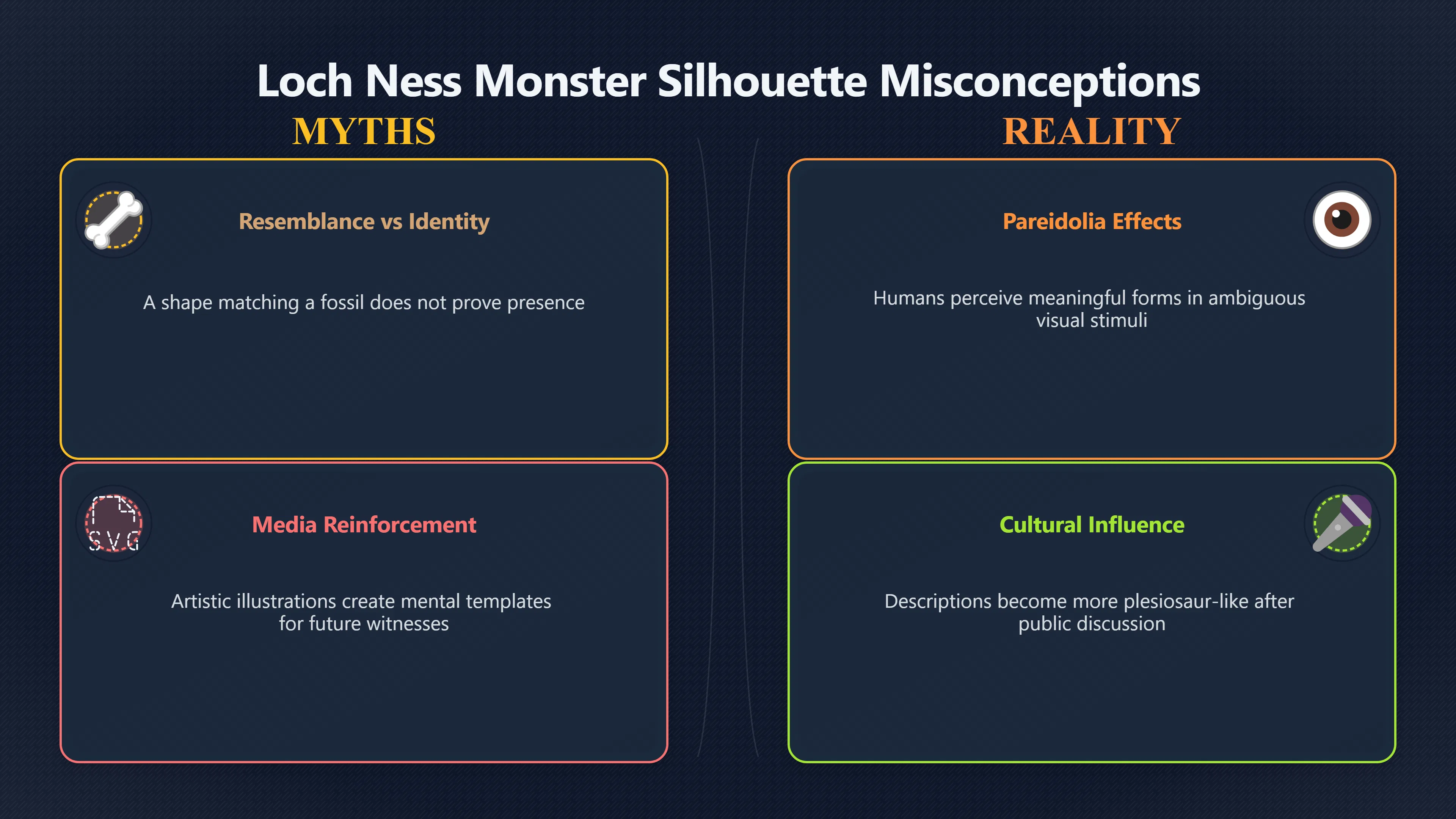
One of the most persistent features of cryptozoology is not a particular creature but a particular way of seeing. Once extinct animals become familiar through museum displays, documentaries and artwork, their silhouettes provide ready-made templates for interpreting ambiguous sights. A dark hump on a lake, a long neck glimpsed above reeds, or a line of swimming animals can quickly become a “plesiosaur”, “sea serpent” or “living dinosaur” in the observer’s mind. The result is a recurring pattern: reports that appear prehistoric at first glance often rely more on resemblance than identification. In discussions of surviving prehistoric animals, this distinction is crucial. A shape can evoke a fossil reconstruction without providing evidence that the reconstructed animal is actually present.[Wikipedia]wikipedia.orgLoch Ness MonsterLoch Ness Monster
Why Familiar Outlines Shape Interpretation
Humans are exceptionally good at recognising patterns, even when information is incomplete. Psychologists refer to a related tendency as pareidolia: the perception of meaningful forms in ambiguous visual stimuli. Under uncertain viewing conditions, observers often match incomplete shapes to familiar mental images.[arXiv+2arXiv]arxiv.orgarXiv Shape2Animal: Creative Animal Generation from Natural SilhouettesShape2Animal: Creative Animal Generation from Natural SilhouettesJune 25, 2025…
In cryptozoology, fossil animals provide some of the most memorable mental images available. A long-necked plesiosaur, a giant sauropod, or a dragon-like reptile has a simple and distinctive outline. Once those forms become culturally familiar, witnesses may unconsciously organise unclear observations around them.
This helps explain why descriptions of alleged prehistoric survivors often converge on a small number of recognisable body plans. The witness is rarely reporting a detailed anatomical assessment. Instead, they are describing a fleeting impression that resembles a known prehistoric image. The resemblance can feel compelling because the fossil template is already stored in memory.
How the Plesiosaur Became the Default Monster Shape
No prehistoric silhouette has influenced monster reports more strongly than the long-necked plesiosaur.
After the modern Loch Ness Monster craze began in the 1930s, commentators quickly suggested that sightings resembled a plesiosaur. The comparison was visually powerful: a small head, long neck and body emerging from water matched popular artistic reconstructions of marine reptiles. The image became so influential that many later reports were interpreted through that framework.[Wikipedia]wikipedia.orgLoch Ness MonsterLoch Ness Monster
Yet the relationship often ran in the opposite direction from what enthusiasts assumed. Rather than sightings independently revealing a plesiosaur-like animal, many descriptions became more plesiosaur-like after the comparison entered public discussion. Investigators have repeatedly noted that witness accounts, sketches and media illustrations can shape one another.[Wikipedia]wikipedia.orgLoch Ness MonsterLoch Ness Monster
The famous “long neck” also illustrates the danger of relying on silhouettes alone. A neck-like shape can be created by partial views of birds, floating debris, waves, branches, swimming mammals or combinations of separate objects seen from a distance. Once observers expect a plesiosaur outline, ordinary features may be assembled into a prehistoric-looking figure.[Wikipedia]wikipedia.orgLoch Ness MonsterLoch Ness Monster
Common Modern Sources of Monster Shapes
Many reported prehistoric-looking creatures emerge from ordinary objects or animals viewed under unusual conditions.
Waterbirds. Swans, cormorants and other waterbirds can create convincing long-necked silhouettes. When distance is difficult to judge, a bird occupying a small part of the visual field may appear much larger than it really is. Investigators of Loch Ness reports have repeatedly pointed to waterbirds as a source of apparent neck-and-head sightings.[New York Post]nypost.comNew York Post Is this the 'answer' to the Loch Ness Monster mystery?Scientist reveals simple explanation for Nessie sightingsAdrian Shine, a Scottish naturalist and long-time investigator, suggests a simpl…
Why Fossil Resemblance Is Not Identification
The central mistake in many prehistoric-survivor claims is treating resemblance as evidence of identity.
Palaeontologists identify extinct animals through anatomy, not through broad silhouette matches. A genuine plesiosaur, for example, would require diagnostic skeletal features, consistent observations, biological traces and ultimately physical evidence. A distant shape that merely resembles a plesiosaur outline cannot establish the presence of a surviving Mesozoic reptile.[Wikipedia]wikipedia.orgLoch Ness MonsterLoch Ness Monster
This distinction becomes especially important because silhouettes discard most of the information needed for identification. Colour, texture, proportions, movement and anatomical detail often disappear under poor lighting, distance or brief viewing times. What remains is the simplest possible shape—and simple shapes can match many different objects.
Cryptozoological reports frequently involve precisely these conditions: low visibility, fleeting encounters, emotional excitement and prior expectations. Those are circumstances in which silhouette-based errors become more likely, not less.[dokumen.pub]dokumen.pubAbominable Science!: Origins of the Yeti, Nessie, and …A captivatingly illustrated general-interest book confronting the persistent myths of cryptozoology
How to Separate Resemblance from Identification
When evaluating a reported prehistoric-looking creature, several questions help distinguish a visual similarity from genuine evidence:
- How much detail was actually observed? A silhouette alone provides far less information than a clear view of anatomy.
-
Could scale have been misjudged? Distance over water is notoriously difficult to estimate. New York Post
-
Are ordinary explanations available? Birds, wakes, logs and known animals should be ruled out before invoking extinct species. Wikipedia
-
Did the prehistoric interpretation come immediately or later? Comparisons introduced after media coverage may reflect cultural influence rather than direct observation.
Amazon book picks
Further Reading
Books and field guides related to How Fossil Shapes Reframe Strange Sightings. Use these as the next step if you want deeper reading beyond the article.
The Scientific American Brave New Brain
Helps explain perception and pattern recognition.
The Search for the Last Undiscovered Animals
Provides context for reports based on visual resemblance.
eBay marketplace picks
Marketplace Samples
Live-tested eBay searches with available results related to this page.

Endnotes
2.
Source: arxiv.org
Title: arXiv Shape2Animal: Creative Animal Generation from Natural Silhouettes
Link:https://arxiv.org/abs/2506.20616
3.
Source: arxiv.org
Title: arXiv Diamonds in the Sky: Pareidolic Animals in Clouds
Link:https://arxiv.org/abs/2606.01361
4.
Source: arxiv.org
Link:https://arxiv.org/abs/2603.03989
5.
Source: dokumen.pub
Link:https://dokumen.pub/abominable-science-origins-of-the-yeti-[nessie
6.
Source: invernesspalacehotel.co.uk
Title: Is The Loch Ness Monster Real?
Link:https://www.invernesspalacehotel.co.uk/blog/is-the-loch-ness-monster-real-new-evidence-shocks-scientists/
7.
Source: tetzoo.com
Title: loch ness monster flipper photos
Link:https://tetzoo.com/blog/2020/8/17/loch-ness-monster-flipper-photos
9.
Source: the-british-reptiles-and-amphibians.fandom.com
Link:https://the-british-reptiles-and-amphibians.fandom.com/wiki/Loch_Ness_Monster
Additional References
10.
Source: scribd.com
Link:https://www.scribd.com/document/872876739/Reports-of-Loch-Ness-Monster-Sightings-Keep-Coming
11.
Source: facebook.com
Title: classified no fun for sure this curious tale from 1942 lives in our librarys mon
Link:https://www.facebook.com/NationalMuseumsScotland/posts/classified-no-fun-for-sure-this-curious-tale-from-1942-lives-in-our-librarys-mon/1349806487185031/
12.
Source: youtube.com
Link:https://www.youtube.com/watch?v=NQ-UrmwAsg0
13.
Source: youtube.com
Link:https://www.youtube.com/watch?v=wW6eKLLViK8
14.
Source: syfy.com
Title: plesiosaur fossils in ancient river make loch ness monster plausible
Link:https://www.syfy.com/syfy-wire/plesiosaur-fossils-in-ancient-river-make-loch-ness-monster-plausible
15.
Source: blog.everythingdinosaur.com
Title: loch ness monster myth solved it was the faults fault
Link:https://blog.everythingdinosaur.com/blog/_archives/2013/07/06/loch-ness-monster-myth-solved-it-was-the-faults-fault.html
16.
Source: lairofmythics.com
Link:https://lairofmythics.com/blogs/cryptid-case-files/loch-ness-monster?srsltid=AfmBOooN8RgkH3UTB9Tuz0AEvl2jkEuzV2iHC81qpOzy1C9r7E7-3ShM
17.
Source: facebook.com
Link:https://www.facebook.com/groups/monstertalkgroupmail/posts/1270786206273531/
18.
Source: facebook.com
Link:https://www.facebook.com/theprehistoricworld/posts/for-nearly-half-a-century-one-of-the-most-persistent-investigators-of-one-of-the/978260461571053/
19.
Source: instagram.com
Link:https://www.instagram.com/reel/DJ2OjRuyuXp/?hl=en
Topic Tree