Within Yeti DNA
Why a bear can look like a Yeti
Snow, distance, dusk, fear and upright bear posture can turn a brief mountain encounter into a much stranger report.
On this page
- Upright posture and human like impressions
- Terrain, weather and distance as distortion factors
- From one encounter to a durable cryptid story
Page outline Jump by section
Introduction
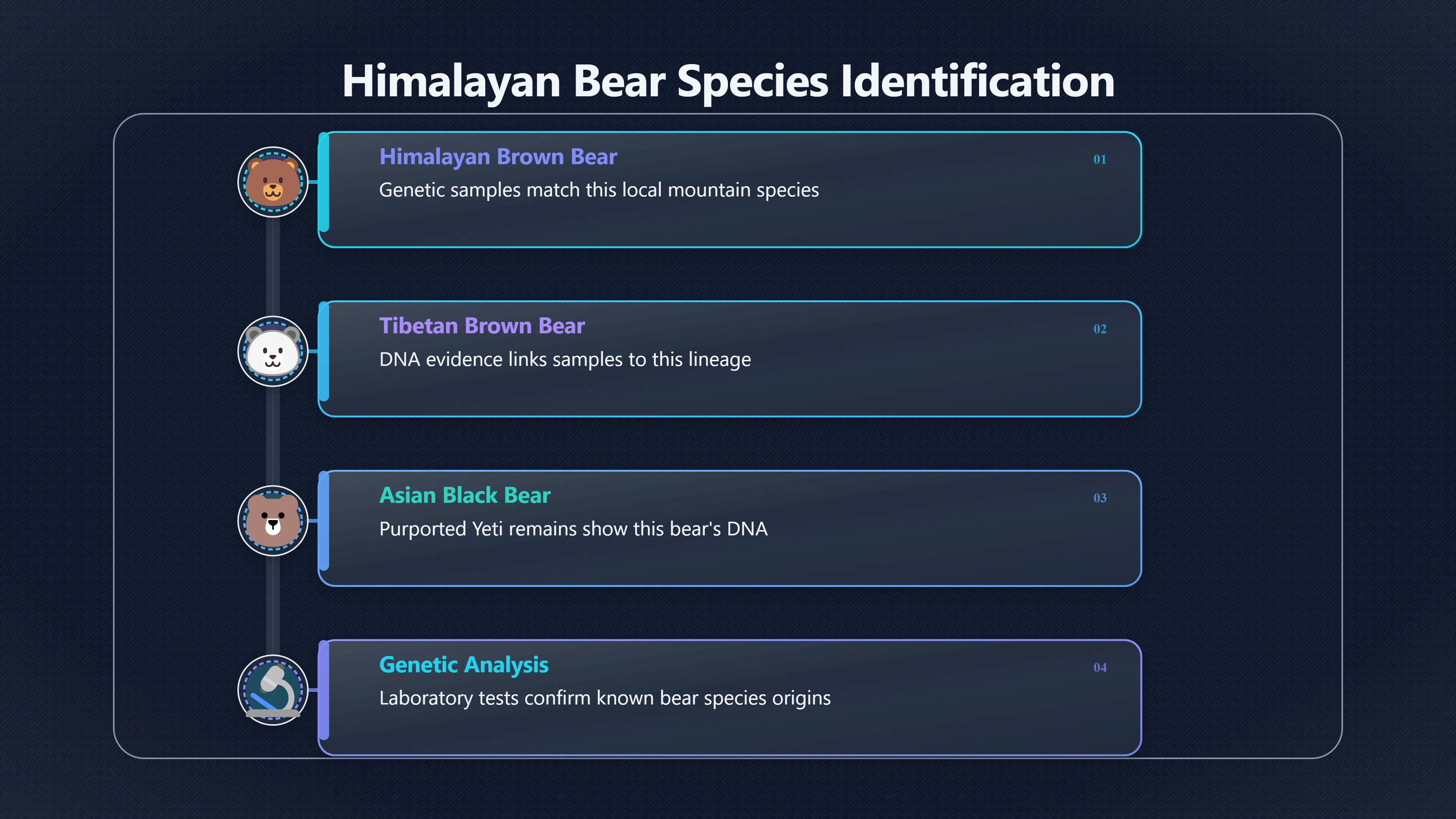
One of the strongest explanations for at least some Yeti sightings is surprisingly simple: people may have encountered bears under conditions that made them appear far more human-like than they really were. This idea gained additional support when genetic studies of purported Yeti samples found that the material belonged to Himalayan brown bears, Tibetan brown bears and Asian black bears rather than an unknown primate.[Royal Society Publishing+2University at Buffalo]royalsocietypublishing.orgsamples associated with Asian black bear, Tibetan brown bear and Himalayan brown bear…. Himalayan 'yeti' DNA: polar bear or DNA degrad… That does not mean every Yeti story began with a bear, nor does it dismiss the cultural importance of Yeti traditions. Instead, it highlights a mechanism that can transform a brief, confusing wildlife encounter into a report of a mysterious humanoid creature. In high mountains, where visibility is often poor and encounters are rare, a bear can sometimes present exactly the kind of ambiguous image that fuels cryptid narratives.
Upright posture and human-like impressions
The most important factor is that bears are capable of standing and moving on their hind legs. They commonly rise upright to investigate scents, survey their surroundings or respond to disturbances. When seen briefly, especially from a distance, an upright bear can create a strikingly human-like silhouette.[YouTube+2Instagram]youtube.comThis sun bear might move like a human — but it is, in fact, a bearA viral video of a sun bear standing on its hind legs and waving…
Several features contribute to this impression:<div class="content-enhancement content-enhancement--insight-grid" markdown="1">
- Broad shoulders and a large torso can resemble a heavily built person.
- Dark fur may obscure the outline of the head and forelimbs.
- Bipedal movement, even for a few steps, can appear deliberate and human.
- Large size can make the figure seem unusually tall when viewed against snowfields or rocky slopes.</div>
Researchers discussing the bear explanation for Yeti reports have repeatedly noted that Himalayan bears are capable of appearing surprisingly human-like when upright. Charlotte Lindqvist, whose team analysed alleged Yeti samples, observed that local bears can stand on their hind legs and appear large and human-shaped, making them plausible contributors to some sightings.[WIRED]wired.comDNA analysis reveals that Yetis are actually a bunch of different bearsUn estudio genético de nueve muestras, que incluían patas, cueros cabelludos, huesos y excrementos cuidadosamente preservados en monaster…
The effect is amplified because mountain observers often see only a fragment of an encounter. A witness may glimpse a dark figure for seconds before it disappears behind rocks, ridges or vegetation. The brain naturally fills in missing details, sometimes producing a more human interpretation than the reality.
Terrain, weather and distance as distortion factors
A bear does not need to look exactly like a human to become a Yeti report. Mountain environments already make accurate identification difficult.
Snow and altered visual cues
Snow removes many of the reference points people normally use to judge size and distance. A bear crossing a snowfield may seem much larger than it is. Shadows cast by uneven snow can also distort body shape and movement.
Snow affects tracks as well. As prints melt, expand or overlap, they can lose their original form. This has long been recognised as one reason why apparently human-like footprints have sometimes emerged from ordinary animal tracks in mountain conditions. Accounts linking unusual tracks to bears have appeared repeatedly in discussions of Yeti evidence.[Wikipedia]WikipediaOpen source on wikipedia.org.
Mist, dusk and brief observation windows
Many reported Yeti encounters occur in marginal viewing conditions: twilight, snowfall, fog or blowing spindrift. Under such circumstances, observers may correctly perceive that they have seen a large animal while misidentifying its exact form.
Psychological research on perception consistently shows that humans are less reliable at identifying unfamiliar objects when visibility is poor. In remote Himalayan regions, where a witness may not expect to encounter a bear at that moment, the uncertainty can push interpretation toward something more unusual.
Unfamiliar wildlife encounters
Unlike residents who regularly encounter local fauna, travellers and expedition members may have limited experience with Himalayan bears. A rare sighting of a large animal behaving unexpectedly can therefore feel extraordinary.
This matters because the Yeti is often described not as a clearly observed creature but as something glimpsed briefly and incompletely. The combination of rarity and ambiguity is exactly the kind of setting in which mistaken identification becomes more likely.
From one encounter to a durable cryptid story
A single confusing sighting does not automatically create a legend. The final step is cultural transmission.
When witnesses discuss an unusual encounter within a region that already contains stories about mysterious mountain beings, the experience gains a narrative framework. Instead of becoming “I saw a bear I could not identify”, it may become “I saw something that matched stories I had heard”.
This process is particularly relevant in the Himalayas because local traditions include multiple categories of mountain spirits, wild beings and man-like creatures. Western explorers later interpreted many of these traditions through the lens of the Yeti, creating a powerful blend of folklore, mountaineering stories and popular media. Once a sighting enters that framework, later retellings often emphasise the most unusual features while downplaying ordinary possibilities.
The bear explanation also helps explain why Yeti descriptions vary. If reports arise from brief encounters with different bear species under different conditions, witnesses would naturally describe different sizes, colours and behaviours. Genetic analyses of alleged Yeti remains have identified more than one local bear lineage, including Himalayan brown bears, Tibetan brown bears and Asian black bears, suggesting there is no single biological source behind all claims.[Royal Society Publishing+2University at Buffalo]royalsocietypublishing.orgsamples associated with Asian black bear, Tibetan brown bear and Himalayan brown bear…. Himalayan 'yeti' DNA: polar bear or DNA degrad…
Why the bear explanation remains influential
The strength of the bear hypothesis is not that it explains every Yeti account. Rather, it connects several independent lines of evidence.
DNA studies of supposed Yeti specimens repeatedly point toward known bear species. Observers have documented bears standing upright and appearing remarkably human-like. Mountain environments routinely distort perception through snow, distance and poor visibility. Together, these factors provide a plausible pathway from a real animal encounter to a report of a mysterious bipedal creature. Royal Society+3Royal Society Publishing+3University at Buffalo[royalsocietypublishing.org]royalsocietypublishing.orgsamples associated with Asian black bear, Tibetan brown bear and Himalayan brown bear…. Himalayan 'yeti' DNA: polar bear or DNA degrad…
Within cryptozoology, this makes bear encounters one of the most important mechanisms for understanding how some Yeti stories may originate: not from a hidden ape, but from the intersection of wildlife behaviour, difficult observation conditions and the human tendency to interpret uncertain experiences through existing legends.
Amazon book picks
Further Reading
Books and field guides related to Why a bear can look like a Yeti. Use these as the next step if you want deeper reading beyond the article.
Field Guide To Bigfoot, Yeti, & Other Mystery Primates Worldwide
Surveys Yeti traditions and competing explanations.
Abominable Science!
Explains misidentification and perception issues behind Yeti reports.
eBay marketplace picks
Marketplace Samples
Live-tested eBay searches with available results related to this page.



Endnotes
1.
Source: buffalo.edu
Title: lindqvist yeti bears
Link:https://www.buffalo.edu/ubnow/stories/2017/11/lindqvist-yeti-bears.html
2.
Source: youtube.com
Link:https://www.youtube.com/watch?v=Ib0vef0QbL8
3.
Source: instagram.com
Link:https://www.instagram.com/reel/DXzghSLRuw1/
4.
Source: wired.com
Title: DNA analysis reveals that Yetis are actually a bunch of different bears
Link:https://www.wired.com/story/yeti-bear-legend-dna-analysis-myth
5.
Source: Wikipedia
Link:https://en.wikipedia.org/wiki/Yeti
6.
Source: instagram.com
Title: A Bornean Sun bear standing upright
Link:https://www.instagram.com/reel/Cv_9NYuJNmG/
7.
Source: instagram.com
Title: What fascinates park rangers
Link:https://www.instagram.com/p/DNlKkdGOcKY/?hl=en
8.
Source: youtube.com
Link:https://www.youtube.com/watch?v=GC9rgMTwe-U
9.
Source: youtube.com
Title: The Yeti: Myth or Dangerous Predator?
Link:https://www.youtube.com/watch?v=zlfmaD9zjuo
10.
Source: youtube.com
Title: Did This Bear Create the YETI Legend? (Tracking the Himalayan Black Bear)
Link:https://www.youtube.com/watch?v=Tav6hr3VOLY
11.
Source: youtube.com
Title: Yeti: The Mystery of the Himalayan Ape-Man
Link:https://www.youtube.com/watch?v=jbEMkIhprnY
12.
Source: youtube.com
Title: The Yeti: Myth or Deadly Predator? | History’s Greatest Mysteries (Season 6)
Link:https://www.youtube.com/watch?v=Nl5uOI4e4mE
13.
Source: youtube.com
Link:https://www.youtube.com/watch?v=qsmJ0D_BgMU
14.
Source: royalsocietypublishing.org
Link:https://royalsocietypublishing.org/rspb/article/284/1868/20171804/78775/Evolutionary-history-of-enigmatic-bears-in-the
15.
Source: royalsociety.org
Title: mysteries of the yeti
Link:https://royalsociety.org/blog/2017/11/mysteries-of-the-yeti/
16.
Source: hwctf.org
Link:https://www.hwctf.org/bears
Additional References
17.
Source: facebook.com
Link:https://www.facebook.com/groups/northidaholife/posts/2756791387898251/
18.
Source: thefurbearers.com
Title: study popularity of roadside bear viewing impacts bears and humans
Link:https://thefurbearers.com/blog/study-popularity-of-roadside-bear-viewing-impacts-bears-and-humans/
19.
Source: news.mongabay.com
Title: new study yeti hairs do not point to unknown bear species
Link:https://news.mongabay.com/2015/01/new-study-yeti-hairs-do-not-point-to-unknown-bear-species/
20.
Source: researchgate.net
Link:https://www.researchgate.net/publication/294278839_Public_segmentation_based_on_the_risk_perception_of_brown_bear_attacks_and_management_preferences
21.
Source: researchgate.net
Link:https://www.researchgate.net/publication/342459863_Phylogenetic_analysis_of_marginal_Asiatic_black_bears_reveals_a_recent_Iranian-Himalayan_divergence_and_has_implications_for_taxonomy_and_conservation
22.
Source: sci.news
Link:https://www.sci.news/biology/yeti-genetically-identical-asian-bears-05486.html
23.
Source: researchgate.net
Title: Himalayan’yeti’ DNA: Polar bear or DNA degradation?
Link:https://www.researchgate.net/publication/269695589Himalayan%27yeti%27DNA_Polar_bear_or_DNA_degradation_A_comment_on%27Genetic_analysis_of_hair_samples_attributed_to_Yeti%27_by_Sykes_et_al_2014
24.
Source: facebook.com
Link:https://www.facebook.com/journalsentinel/posts/tests-from-dna-samples-of-a-yeti-suggests-the-biological-basis-of-the-yeti-legen/10156104870343816/
25.
Source: smithsonianmag.com
Title: dna shows yetis are mostly brown bears 180967361
Link:https://www.smithsonianmag.com/smart-news/dna-shows-yetis-are-mostly-brown-bears-180967361/
26.
Source: aau.edu
Title: abominable snowman was probably bear new study
Link:https://www.aau.edu/research-scholarship/featured-research-topics/abominable-snowman-was-probably-bear-new-study
Topic Tree