Within Proof
The Paper Trail That Makes Animals Real
A species report becomes more valuable when names, dates, places and evidence types are recorded well enough for later reuse.
On this page
- What an occurrence record captures
- Why locality and date data matter
- How poor records weaken cryptid evidence
Page outline Jump by section
Introduction
In cryptozoology, a claimed discovery becomes scientifically useful only when it can be located, checked and compared by other researchers. That is where occurrence records matter. An occurrence record is the basic unit of biodiversity data: a documented observation, specimen, photograph, tissue sample or other evidence showing that an organism was present at a particular place and time. Properly recorded occurrences transform an isolated finding into reusable evidence that can be searched, mapped, reanalysed and linked to future discoveries. Rather than proving a species by themselves, occurrence records create the paper trail that allows evidence to survive beyond the original witness or collector.[GBIF+2techdocs.gbif.org]gbif.orgData quality requirements: Occurrence datasetsOccurrence datasets make up the core of data published through GBIF.org, offering evide… For cryptid investigations, this distinction is crucial. A sighting report may generate interest, but a well-documented occurrence record creates information that other scientists can evaluate years or even decades later. The difference often determines whether a claim remains folklore or enters the scientific record.
What an occurrence record captures
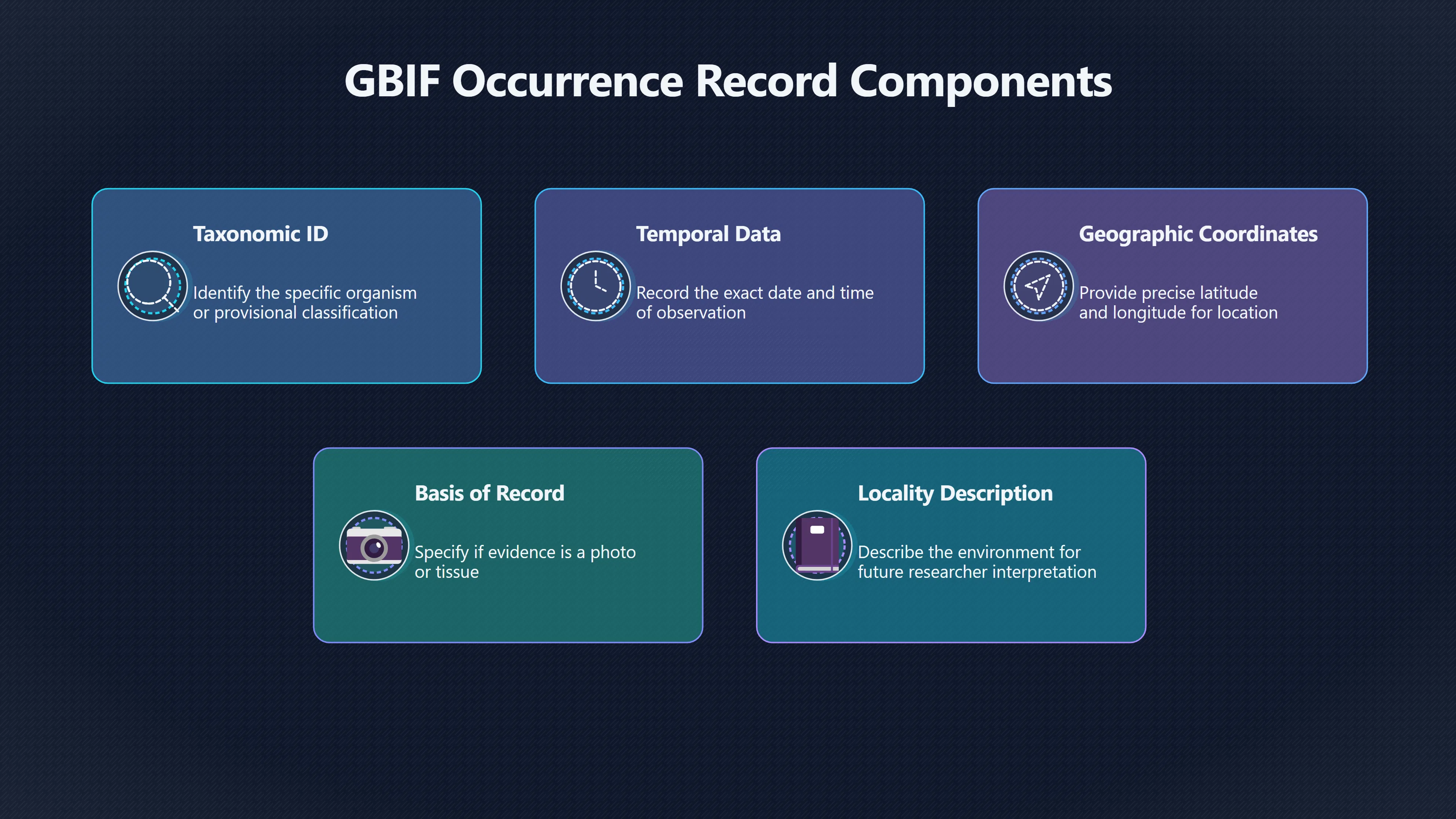
An occurrence record is more than a species name. Biodiversity data standards used by repositories such as the Global Biodiversity Information Facility (GBIF) are designed to answer basic questions: what organism was recorded, where it was found, when it was documented, and what kind of evidence supports the record.[ipt.gbif.org+2GBIF]ipt.gbif.orgData Quality Checklist:: GBIF IPT User ManualUse this checklist to help review biodiversity datasets. Note it is particularly suited for…
A strong occurrence record commonly includes:
- The taxonomic identification or provisional identification.
- The date and time of observation or collection.
- Geographic information, ideally with coordinates.
- Locality descriptions that can be interpreted by future researchers.
- The basis of the record, such as a preserved specimen, photograph, observation or material sample.
- Links to field notes, catalogue numbers, images, DNA samples or museum collections.[techdocs.gbif.org+2GBIF Docs]techdocs.gbif.orgOccurrence download formatsOften serves as a link between field notes and a dwc:Occurrence record, such as a…Read more…
These details allow a record to be connected to other evidence. A tissue sample from an unknown animal, for example, becomes far more valuable if researchers know exactly where it was collected, who collected it and how it relates to photographs, tracks or additional specimens from the same area.
Why locality and date data matter
The most useful occurrence records do not merely say that an animal existed; they show where and when evidence was obtained. Locality and date information allow discoveries to be tested against geography, ecology and historical patterns.
Location turns an observation into a testable claim
A report that an unknown animal was seen in a forest is difficult to evaluate. A report tied to precise coordinates can be compared with habitat maps, known species ranges and later surveys. Researchers can revisit the site, search for additional evidence and assess whether the location is plausible for the claimed species.[ipt.gbif.org]ipt.gbif.orgOccurrence Data:: GBIF IPT User ManualResources which present evidence of the occurrence of a species at a particular place and normally…
Accurate coordinates also permit records from different investigators to be linked together. Multiple independent occurrences clustered in the same region may suggest a genuine biological pattern. Conversely, widely scattered records with no geographical consistency may indicate misidentifications or reporting errors.
Dates reveal patterns through time
Time information is equally important. A single occurrence may be interesting, but repeated records over months or years can reveal seasonal activity, population persistence or range changes. Biodiversity researchers routinely use occurrence datasets to reconstruct historical distributions and track changes through time.[BES Journals+2ipt.gbif.org]besjournals.onlinelibrary.wiley.com2688 8319.12048BES JournalsSpecies data for understanding biodiversity dynamics: The…by TK Petersen · 2021 · Cited by 105 — We examined observational…
For a proposed new species, dates help establish whether reports represent a continuing population or a one-off event. If multiple records originate from different years yet share consistent locality and evidence characteristics, confidence in the underlying phenomenon generally increases.
Reuse depends on standardisation
Occurrence records become especially valuable when they follow shared standards. Systems such as Darwin Core, widely used in biodiversity informatics, provide common fields for locality, dates, identifiers and evidence types. Standardisation allows records from different institutions and decades to be combined into searchable datasets rather than remaining isolated notes in personal notebooks or archives.[techdocs.gbif.org]techdocs.gbif.orgOccurrence download formatsOften serves as a link between field notes and a dwc:Occurrence record, such as a…Read more…
How occurrence records support species discovery
Within zoology, the formal description of a new species depends on more than a name-bearing specimen. Researchers must also document where the evidence originated and how it relates to other records.[occurrence]techdocs.gbif.orgAPI:: Technical Documentation - GBIFThis API works against the GBIF Occurrence Store, which handles occurrence records and makes them av… data help scientists:<div class="content-enhancement content-enhancement--comparison" markdown="1">
- Compare a proposed species with known distributions of similar animals.
- Locate additional specimens or populations.
- Assess whether unusual records represent a distinct species or a known species occurring outside its expected range.
- Link genetic, anatomical and ecological evidence to specific collection events.
- Preserve information after the original discoverers are no longer available to explain their findings.[ipt.gbif.org+2GBIF]ipt.gbif.orgOccurrence Data:: GBIF IPT User ManualResources which present evidence of the occurrence of a species at a particular place and normally…</div>
In cryptozoological contexts, many historical reports fail precisely because these connections are missing. Witness accounts may describe unusual animals, but without precise locality, date and evidence metadata, later investigators cannot reliably compare reports or revisit the original circumstances.
How poor records weaken cryptid evidence
Many cryptid claims suffer not only from a lack of physical evidence but also from weak documentation. Even potentially important finds can lose much of their scientific value when occurrence information is incomplete.
Common problems include:<div class="content-enhancement content-enhancement--checklist" markdown="1">
- Missing or vague locations.
- Uncertain dates.
- No clear chain linking photographs, samples and field notes.
- Ambiguous species identifications.
- Missing information about who collected the evidence and how.[ipt.gbif.org+2IIS]ipt.gbif.orgData Quality Checklist:: GBIF IPT User ManualUse this checklist to help review biodiversity datasets. Note it is particularly suited for…</div>
These weaknesses make independent verification difficult. A hair sample with no reliable provenance cannot easily be connected to a specific animal population. A photograph lacking date and location information cannot be assessed against local fauna or environmental conditions. Even genuine discoveries may become unusable if their associated metadata are poor.
Research on biodiversity databases repeatedly shows that spatial, temporal and taxonomic errors can distort later analyses and reduce confidence in conclusions drawn from occurrence data. Data cleaning and quality-control efforts exist precisely because inaccurate records can create misleading biological patterns.[PMC+2ResearchGate]pmc.ncbi.nlm.nih.govDistorted Views of Biodiversity: Spatial and Temporal Bias in…by EH Boakes · 2010 · Cited by 963 — We investigate patterns of spati…
From isolated discovery to reusable evidence
See on Amazon</a></div></div></article><article class="fr-book-card"><a class="fr-book-cover" href="https://www.amazon.com/s?k=A+Field+Guide+to+Lies+by+Daniel+J.+Levitin&i=stripbooks&tag=searcht-20" target="_blank" rel="sponsored noopener noreferrer" aria-label="Open A Field Guide to Lies on Amazon"><span class="fr-book-cover-fallback">Book</span><img class="fr-book-cover-thumb" src="https://books.google.com/books/content?id=5P7wjwEACAAJ&printsec=frontcover&img=1&zoom=1&source=gbs_api" alt="Cover for A Field Guide to Lies" loading="lazy" decoding="async" fetchpriority="low" referrerpolicy="no-referrer" onerror="this.hidden=true;this.closest('.fr-book-cover').classList.add('fr-book-cover-placeholder');"></a><div class="fr-book-info"><h4 class="fr-book-title"><a href="https://www.amazon.com/s?k=A+Field+Guide+to+Lies+by+Daniel+J.+Levitin&i=stripbooks&tag=searcht-20" target="_blank" rel="sponsored noopener noreferrer" title="A Field Guide to Lies">A Field Guide to Lies</a></h4><p class="fr-book-author">By Daniel J. Levitin</p><p class="fr-book-desc">Teaches evaluation of records, claims, and evidence quality.</p><div class="fr-book-actions"><a href="https://www.amazon.com/s?k=A+Field+Guide+to+Lies+by+Daniel+J.+Levitin&i=stripbooks&tag=searcht-20" class="fr-amazon-btn" target="_blank" rel="sponsored noopener noreferrer">
See on Amazon</a></div></div></article><article class="fr-book-card"><a class="fr-book-cover" href="https://www.amazon.com/s?k=The+Song+Of+The+Dodo+by+David+Quammen&i=stripbooks&tag=searcht-20" target="_blank" rel="sponsored noopener noreferrer" aria-label="Open The Song Of The Dodo on Amazon"><span class="fr-book-cover-fallback">Book</span><img class="fr-book-cover-thumb" src="https://books.google.com/books/content?id=53kuEeItYtIC&printsec=frontcover&img=1&zoom=1&edge=curl&source=gbs_api" alt="Cover for The Song Of The Dodo" loading="lazy" decoding="async" fetchpriority="low" referrerpolicy="no-referrer" onerror="this.hidden=true;this.closest('.fr-book-cover').classList.add('fr-book-cover-placeholder');"></a><div class="fr-book-info"><h4 class="fr-book-title"><a href="https://www.amazon.com/s?k=The+Song+Of+The+Dodo+by+David+Quammen&i=stripbooks&tag=searcht-20" target="_blank" rel="sponsored noopener noreferrer" title="The Song Of The Dodo">The Song Of The Dodo</a></h4><p class="fr-book-author">By David Quammen</p><p class="fr-book-desc">Uses field observations and distribution evidence extensively.</p><div class="fr-book-actions"><a href="https://www.amazon.com/s?k=The+Song+Of+The+Dodo+by+David+Quammen&i=stripbooks&tag=searcht-20" class="fr-amazon-btn" target="_blank" rel="sponsored noopener noreferrer">
See on Amazon</a></div></div></article><article class="fr-book-card"><a class="fr-book-cover" href="https://www.amazon.com/s?k=Abominable+Science%21+by+Daniel+Loxton&i=stripbooks&tag=searcht-20" target="_blank" rel="sponsored noopener noreferrer" aria-label="Open Abominable Science! on Amazon"><span class="fr-book-cover-fallback">Book</span><img class="fr-book-cover-thumb" src="https://books.google.com/books/content?id=kTsgAAAAQBAJ&printsec=frontcover&img=1&zoom=1&edge=curl&source=gbs_api" alt="Cover for Abominable Science!" loading="lazy" decoding="async" fetchpriority="low" referrerpolicy="no-referrer" onerror="this.hidden=true;this.closest('.fr-book-cover').classList.add('fr-book-cover-placeholder');"></a><div class="fr-book-info"><h4 class="fr-book-title"><a href="https://www.amazon.com/s?k=Abominable+Science%21+by+Daniel+Loxton&i=stripbooks&tag=searcht-20" target="_blank" rel="sponsored noopener noreferrer" title="Abominable Science!">Abominable Science!</a></h4><p class="fr-book-author">By Daniel Loxton, Donald R. Prothero</p><p class="fr-book-desc">Explains why documentation matters more than anecdotes.</p><div class="fr-book-actions"><a href="https://www.amazon.com/s?k=Abominable+Science%21+by+Daniel+Loxton&i=stripbooks&tag=searcht-20" class="fr-amazon-btn" target="_blank" rel="sponsored noopener noreferrer">
See on Amazon</a></div></div></article></div><div class="fr-section-footer"><div class="fr-browse-links" aria-label="Browse more on Amazon"><span class="fr-browse-links-label">Browse more on Amazon:</span><a class="fr-browse-more" href="https://www.amazon.com/s?k=The+Diversity+of+Life&i=stripbooks&tag=searcht-20" target="_blank" rel="sponsored noopener noreferrer">The Diversity of Life</a><a class="fr-browse-more" href="https://www.amazon.com/s?k=A+Field+to+Lies+books&i=stripbooks&tag=searcht-20" target="_blank" rel="sponsored noopener noreferrer">A Field to Lies books</a><a class="fr-browse-more" href="https://www.amazon.com/s?k=The+Song+Of+The+Dodo&i=stripbooks&tag=searcht-20" target="_blank" rel="sponsored noopener noreferrer">The Song Of The Dodo</a></div><p class="fr-disclosure">As an Amazon Associate I earn from qualifying purchases.</p></div></div></section>
Amazon book picks
Further Reading
Books and field guides related to The Paper Trail That Makes Animals Real. Use these as the next step if you want deeper reading beyond the article.
The Diversity of Life
Shows how biological records contribute to understanding species.
The Beak of the Finch
Demonstrates long-term value of repeat observations and records.
eBay marketplace picks
Marketplace Samples
Live-tested eBay searches with available results related to this page.



Endnotes
1.
Source: gbif.org
Link:https://www.gbif.org/data-quality-requirements-occurrences
2.
Source: techdocs.gbif.org
Title: Data quality recommendations
Link:https://techdocs.gbif.org/en/data-publishing/data-quality-recommendations
3.
Source: ipt.gbif.org
Link:https://ipt.gbif.org/manual/en/ipt/latest/occurrence-data
4.
Source: ipt.gbif.org
Link:https://ipt.gbif.org/manual/en/ipt/latest/data-quality-checklist
5.
Source: gbif.org
Link:https://www.gbif.org/article/3NNEFbAK2Olyfpo91mEAN6/requirements-for-data-deliverables-of-bid-projects
6.
Source: gbif.us
Link:https://www.gbif.us/faq
7.
Source: techdocs.gbif.org
Title: Occurrence download formats
Link:https://techdocs.gbif.org/en/data-use/download-formats
8.
Source: docs.gbif.org
Link:https://docs.gbif.org/course-data-mobilization/en/data-capture-review-solutions.html
9.
Source: docs.gbif.org
Title: basis of record
Link:https://docs.gbif.org/course-data-use/en/basis-of-record.html
10.
Source: registry.opendata.aws
Link:https://registry.opendata.aws/gbif/
11.
Source: planetarycomputer.microsoft.com
Link:https://planetarycomputer.microsoft.com/dataset/gbif
12.
Source: training.gbif.org
Title: data quality
Link:https://training.gbif.org/en/data-use/data-quality
13.
Source: gbif.org
Link:https://www.gbif.org/
14.
Source: gbif.org
Link:https://www.gbif.org/article/5i3CQEZ6DuWiycgMaaakCo/gbif-infrastructure-data-processing
15.
Source: iis-rio.org
Title: IISIssues with species occurrence data and their impact
Link:https://www.iis-rio.org/wp-content/uploads/2022/09/Issues-with-species-occurrence-data-and-their-impact.pdf
16.
Source: pmc.ncbi.nlm.nih.gov
Link:https://pmc.ncbi.nlm.nih.gov/articles/PMC2879389/
17.
Source: researchgate.net
Link:https://www.researchgate.net/publication/330510248_CoordinateCleaner_Standardized_cleaning_of_occurrence_records_from_biological_collection_databases
18.
Source: gbif.org
Link:https://www.gbif.org/what-is-gbif
19.
Source: gbif.org
Title: GBI F occurrences No information is available for this page
Link:https://www.gbif.org/occurrence
20.
Source: docs.gbif.org
Link:https://docs.gbif.org/sensitive-species-best-practices/master/en/
21.
Source: techdocs.gbif.org
Link:https://techdocs.gbif.org/en/openapi/v1/occurrence
22.
Source: docs.gbif.org
Link:https://docs.gbif.org/guide-publishing-survey-data/en/
23.
Source: discourse.gbif.org
Title: understanding basis of record
Link:https://discourse.gbif.org/t/understanding-basis-of-record/5857
24.
Source: discourse.gbif.org
Title: how to see number of occurrences growth in gbif
Link:https://discourse.gbif.org/t/how-to-see-number-of-occurrences-growth-in-gbif/5880
25.
Source: gbif.org
Link:https://www.gbif.org/dataset-classes
26.
Source: gbif.org
Link:https://www.gbif.org/news/5PapgYCsbHPe7UWmEQTc5a/better-than-the-original-new-sql-based-service-enables-download-of-occurrence-data-cubes
27.
Source: besjournals.onlinelibrary.wiley.com
Title: 2688 8319.12048
Link:https://besjournals.onlinelibrary.wiley.com/doi/full/10.1002/2688-8319.12048
28.
Source: frontiersin.org
Link:https://www.frontiersin.org/journals/ecology-and-evolution/articles/10.3389/fevo.2023.1037282/full
29.
Source: dataportal.gov.tc
Title: tc Occurrence records from the GBIF Database
Link:https://dataportal.gov.tc/fa_IR/dataset/occurrence-records-gbif
Additional References
30.
Source: ecography.org
Title: new r tools acquire manage visualize and cite occurrence data
Link:https://www.ecography.org/blog/new-r-tools-acquire-manage-visualize-and-cite-occurrence-data
31.
Source: thelandbankinggroup.com
Link:https://www.thelandbankinggroup.com/science/indicators/gbif-rare-and-threatend-species
32.
Source: nature.com
Link:https://www.nature.com/articles/s41598-024-56158-3
33.
Source: docs.ropensci.org
Title: getting occurrence data
Link:https://docs.ropensci.org/rgbif/articles/getting_occurrence_data.html
34.
Source: essd.copernicus.org
Title: essd 2024 241
Link:https://essd.copernicus.org/preprints/essd-2024-241/essd-2024-241.pdf
35.
Source: youtube.com
Title: How to Download Data from GBIF
Link:https://www.youtube.com/watch?v=netnQb-6F0M
36.
Source: youtube.com
Title: Biodiversity Data Standards and the Darwin Core Standard
Link:https://www.youtube.com/watch?v=uTJcCNWlqgE
37.
Source: youtube.com
Title: Biodiversa+ Workshop: Mastering the Darwin Core standard
Link:https://www.youtube.com/watch?v=Ts-3ax1_9SY
38.
Source: console.cloud.google.com
Title: gbif occurrences
Link:https://console.cloud.google.com/marketplace/product/bigquery-public-data/gbif-occurrences?hl=fr
39.
Source: youtube.com
Title: How Arctos handles Geographical Data
Link:https://www.youtube.com/watch?v=4e-NK8rNSTs
Topic Tree