Within Pseudoscience
Why Honest Sightings Can Still Be Wrong
Sincere witnesses can still misread animals, shadows, distance and fear as evidence for a creature they already expect.
On this page
- How perception changes in darkness and distance
- Why expectation shapes what witnesses remember
- How known animals become mystery reports
Page outline Jump by section
Introduction
Eyewitness testimony sits at the heart of cryptid culture. Reports of Bigfoot crossing a road, a strange shape rising from Loch Ness, or an unknown creature glimpsed in a forest are often presented as compelling because the witnesses appear sincere and confident. Yet sincerity is not the same as accuracy. Research on perception and memory shows that people can honestly misinterpret what they see, especially in conditions involving darkness, distance, brief viewing times, uncertainty, or strong expectations. In cryptozoology, this creates a recurring pattern: ordinary animals, natural phenomena, or ambiguous shapes become extraordinary creatures in the minds of observers.[PubMed]pubmed.ncbi.nlm.nih.govCognition and belief in paranormal phenomena: gestalt…by MJ Sharps · 2006 · Cited by 63 — Belief in paranormal phenomena and cry… This does not mean witnesses are lying. Rather, many cryptid sightings illustrate how human perception works when information is incomplete. A person may genuinely report a monster while accurately describing what they experienced, even if the underlying object was a bear, a bird, a wave, a log, or another familiar feature of the environment. Understanding that distinction helps explain why eyewitness reports remain abundant even when physical evidence remains elusive.
How Perception Changes in Darkness and Distance
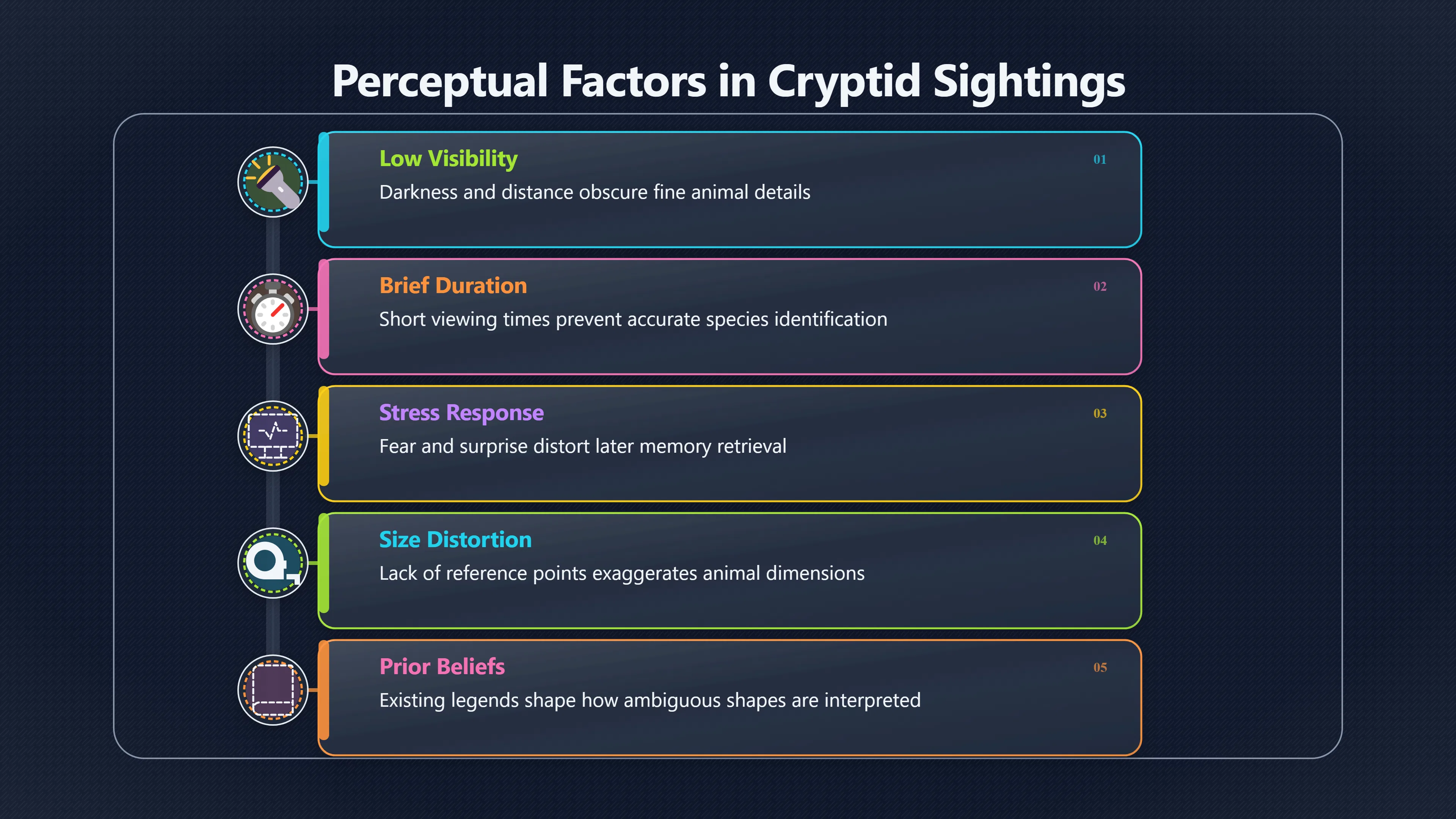
Human vision is remarkably effective under normal conditions, but it becomes less reliable when key details are missing. Many famous cryptid encounters occur at dawn, dusk, night, during bad weather, or at substantial distances. Under these circumstances, the brain fills gaps using assumptions and prior knowledge.
When a witness sees only a silhouette, movement pattern, or partial outline, identification becomes difficult. A standing bear viewed briefly through trees can appear unusually human-like. An animal moving across a ridge may seem much larger than it really is because there are few reliable size references. Shadows, uneven terrain, and atmospheric conditions can further distort judgement.
Why Expectation Shapes What Witnesses Remember
Seeing is not a purely mechanical process. People interpret what they observe through existing beliefs, cultural stories, and prior experiences.
Cryptids provide a powerful framework for interpretation because they are already familiar cultural figures. Someone travelling through an area known for Bigfoot reports may be more likely to classify an unusual sighting as Bigfoot than someone unfamiliar with the legend. Likewise, visitors to Loch Ness often arrive already aware of descriptions of a long-necked monster.
Researchers studying paranormal and cryptid belief have argued that expectation can influence how ambiguous information is processed. An unclear shape, sound, or movement may be interpreted differently depending on what the observer believes is possible.[PubMed]pubmed.ncbi.nlm.nih.govCognition and belief in paranormal phenomena: gestalt…by MJ Sharps · 2006 · Cited by 63 — Belief in paranormal phenomena and cry…
Memory reconstruction adds another layer. Human memory does not function like a video recording. Instead, recollections are rebuilt each time they are recalled. Discussions with friends, media coverage, documentaries, and repeated retellings can gradually reshape details while leaving witnesses completely convinced of their accuracy.
This helps explain a common feature of cryptid reports: confidence often increases over time even when objective evidence remains unchanged. A witness may become more certain of what they saw as the story acquires meaning and coherence.
How Known Animals Become Mystery Reports
Many sceptical explanations of cryptid sightings focus not on deception but on mistaken identification of ordinary animals.
Bears and Bigfoot
Bigfoot provides one of the clearest examples. Black bears can occasionally stand or walk briefly on their hind legs. At a distance, especially in poor visibility, this posture can create a surprisingly human-like appearance. Several analyses have noted correlations between Bigfoot sighting reports and black bear populations, suggesting that at least some reports may stem from bear encounters.[ResearchGate+2ZSL Publications]researchgate.net377389781 Bigfoot If it's there could it be a bearResearchGate(PDF) Bigfoot: If it's there, could it be a bear?29 Jan 2024 — Previous analyses have identified a correlation between 'sasqu…
Wildlife researchers frequently cite bears as a likely explanation for many sightings because observers often have only a few seconds to view the animal. During such brief encounters, characteristics that would normally distinguish a bear—such as a snout or ears—may not be clearly visible.[Newsweek]newsweek.combigfoot likely bear statistics 1776741Scientist Has Very Simple Explanation for Bigfoot30 Jan 2023 — The main explanation for the sightings of Bigfoot is that people a…
Animals in Water
Reports of lake monsters often involve similar processes. Swimming deer, otters, seals, birds, and large fish can produce unusual silhouettes on the water. When only part of an animal is visible above the surface, observers may perceive a neck, hump, or elongated body that does not actually exist.[Wikipedia]WikipediaLoch Ness MonsterLoch Ness Monster
Movement across water can exaggerate these effects. Separate objects may appear connected, while waves can hide parts of an animal and create the illusion of a much larger creature.
Misjudging Size
Cryptid reports frequently involve unexpectedly large dimensions. Size estimation becomes difficult when observers lack familiar reference points. A bear viewed at an unusual angle, a moose partly obscured by vegetation, or a bird seen against open sky may appear substantially larger than reality.
Such errors are common in ordinary wildlife observation and do not require unusual psychological explanations. They arise naturally from the limitations of visual perception.
Why Loch Ness Illustrates the Problem
The Loch Ness Monster provides a particularly well-documented example of mistaken identity.
Over decades, investigators and sceptical researchers have suggested that many sightings can be explained by boat wakes, floating logs, unusual wave patterns, birds, and other natural phenomena. Ronald Binns and other Loch Ness investigators have argued that witnesses often see what they expect to see when observing an already famous location associated with a monster legend.[Wikipedia]WikipediaLoch Ness MonsterLoch Ness Monster
Recent comments from long-time Loch Ness investigator Adrian Shine highlight the same issue. After decades of research, Shine concluded that many reported sightings could be attributed to natural causes such as multi-humped boat wakes and birds viewed under particular conditions. He has described instances where objects initially appearing mysterious later proved to be ordinary features such as rocks.[New York Post]nypost.comThe 76-year-old founder of the Loch Ness Project now attributes reported sightings of "Nessie" to natural phenomena, particularly the wak…
The importance of Loch Ness is not that every report has been individually explained. Rather, it demonstrates how a location with a strong legend can generate a continuous stream of sincere observations interpreted through the lens of that legend.
Why Testimony Alone Is Weak Evidence for a Species
Eyewitness reports can be valuable as starting points. In conventional zoology, unusual observations sometimes direct researchers toward genuinely rare animals or previously unknown populations. However, testimony alone is rarely considered sufficient evidence for a biological species.
The reason is straightforward: human observers make predictable mistakes. People misjudge distance, size, colour, speed, and identity even in ordinary circumstances. When sightings involve rare, unexpected, or culturally loaded creatures, the potential for error increases further.
This does not diminish the honesty of witnesses. Many cryptid reports are likely sincere accounts of unusual experiences. The challenge is that the same psychological and perceptual processes that produce honest testimony can also produce mistaken conclusions. That is why zoology ultimately relies on physical specimens, genetic evidence, repeatable observations, and other forms of independent verification rather than eyewitness reports alone.[PBS]pbs.orgThe Beast of Loch Ness | Eyewitness AccountsEyewitness Accounts While no hard evidence for the existence of the Loch Ness Monster has…
Within cryptozoology, eyewitness sightings remain powerful because they are personal, vivid, and emotionally persuasive. From an evidential standpoint, however, they demonstrate something different: not necessarily the existence of a hidden creature, but the ease with which ordinary perception can transform uncertainty into a convincing mystery.
Amazon book picks
Further Reading
Books and field guides related to Why Honest Sightings Can Still Be Wrong. Use these as the next step if you want deeper reading beyond the article.
Mistakes Were Made (but Not by Me)
Explains why sincere people can be confidently wrong.
eBay marketplace picks
Marketplace Samples
Live-tested eBay searches with available results related to this page.
Endnotes
1.
Source: pbs.org
Link:https://www.pbs.org/wgbh/nova/lochness/eyewitness.html
2.
Source: researchgate.net
Title: 6382288 The effect of fear on eyewitness’ retrieval in recognition memory
Link:https://www.researchgate.net/publication/6382288_The_effect_of_fear_on_eyewitness%27_retrieval_in_recognition_memory
3.
Source: researchgate.net
Title: 377389781 Bigfoot If it’s there could it be a bear
Link:https://www.researchgate.net/publication/377389781_Bigfoot_If_it%27s_there_could_it_be_a_bear
4.
Source: newsweek.com
Title: bigfoot likely bear statistics 1776741
Link:https://www.newsweek.com/bigfoot-likely-bear-statistics-1776741
5.
Source: Wikipedia
Title: Loch Ness Monster
Link:https://en.wikipedia.org/wiki/Loch_Ness_Monster
6.
Source: Wikipedia
Link:https://en.wikipedia.org/wiki/Bigfoot
7.
Source: researchgate.net
Title: The consensus of experts is these
Link:https://www.researchgate.net/publication/401076924_Nessie_and_Noctilucent_Clouds_A_Meteorological_Explanation_for_Some_Loch_Ness_Monster_Sightings
8.
Source: researchgate.net
Link:https://www.researchgate.net/publication/367233091_Of_Monsters_Myths_and_Marketing_The_Case_of_the_Loch_Ness_Monster
9.
Source: pubmed.ncbi.nlm.nih.gov
Link:https://pubmed.ncbi.nlm.nih.gov/17144153/
10.
Source: zslpublications.onlinelibrary.wiley.com
Title: ZSL Publications Bigfoot: If it’s there, could it be a bear?
Link:https://zslpublications.onlinelibrary.wiley.com/doi/10.1111/jzo.13148
11.
Source: nypost.com
Link:https://nypost.com/2026/01/04/us-news/longtime-loch-ness-monster-hunter-turns-skeptic-with-down-to-earth-explanation-for-sightings/
12.
Source: lochness.com
Title: the latest mysteries and sightings revealed
Link:https://lochness.com/news/the-latest-mysteries-and-sightings-revealed/
13.
Source: pmc.ncbi.nlm.nih.gov
Link:https://pmc.ncbi.nlm.nih.gov/articles/PMC8024237/
Additional References
14.
Source: reddit.com
Link:https://www.reddit.com/r/Cryptozoology/comments/14v9ptf/animals_in_unusual_situations_can_be/
15.
Source: reddit.com
Link:https://www.reddit.com/r/Cryptozoology/comments/mrim12/loch_ness_theories/
16.
Source: visitinvernesslochness.com
Link:https://www.visitinvernesslochness.com/the-lochness-monster
17.
Source: ebsco.com
Link:https://www.ebsco.com/research-starters/zoology/loch-ness-monster-cryptozoology
18.
Source: thesun.co.uk
Link:https://www.thesun.co.uk/news/37797045/loch-ness-monster-sightings-fake-expert/
19.
Source: nationalgeographic.com
Title: 130907 cryptid crytozoology bigfoot loch yeti monster abominable science
Link:https://www.nationalgeographic.com/adventure/article/130907-cryptid-crytozoology-bigfoot-loch-yeti-monster-abominable-science
20.
Source: youtube.com
Link:https://www.youtube.com/watch?v=wW6eKLLViK8
21.
Source: bigfootforums.com
Title: 54455 consistency of evidence eyewitness testimony and cryptid primates
Link:https://bigfootforums.com/topic/54455-consistency-of-evidence-eyewitness-testimony-and-cryptid-primates/
22.
Source: vedantu.com
Link:https://www.vedantu.com/general-knowledge/loch-ness-monster-legendary-creature
23.
Source: wrasse.plymouth.ac.uk
Title: unraveling the pseudoscience of nessie sightings 1767648201
Link:https://wrasse.plymouth.ac.uk/ac-news/unraveling-the-pseudoscience-of-nessie-sightings-1767648201
Topic Tree