Within Cryptozoology
How Cryptid Hoaxes Fool the Public
Hoaxes thrive when dramatic images, footprints, or stories travel faster than verification.
On this page
- Why hoaxes are attractive
- Tracks, photos, and planted evidence
- How debunking changes the story
Page outline Jump by section
Introduction
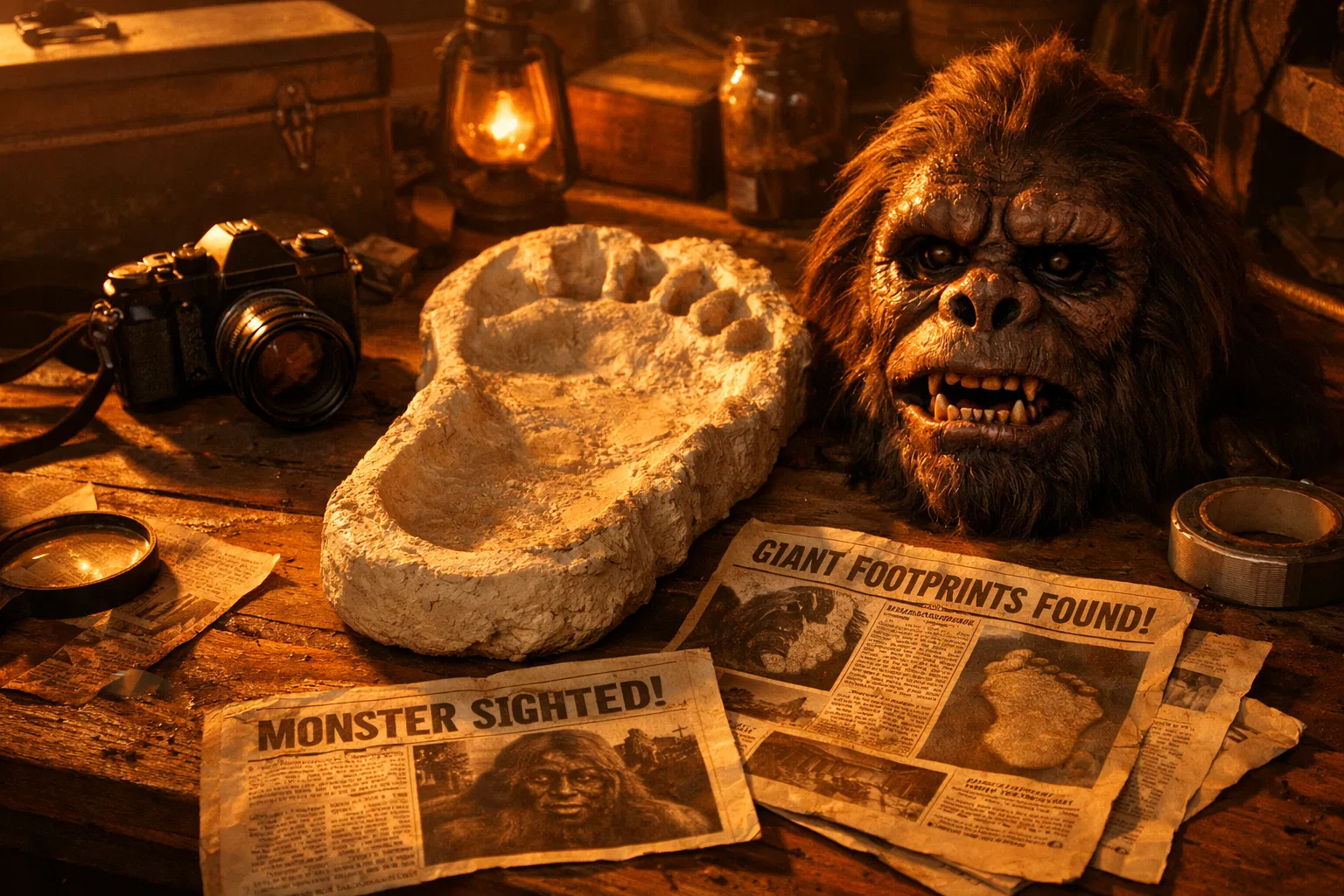
Cryptid hoaxes spread because they give mystery a body: a footprint in mud, a blurred photograph, a frozen “specimen”, a strange carcass, a dramatic witness story. In cryptozoology, that matters because the field often depends on fragments rather than repeatable zoological evidence. A hoax does not merely fool people for a day; it can supply the image, name or “classic case” around which later sightings are interpreted. Bigfoot’s modern public identity was boosted by giant tracks reported in northern California in 1958, later tied by Ray Wallace’s family to carved wooden feet; the Loch Ness Monster’s most famous silhouette came from the 1934 “surgeon’s photograph”, later exposed as a model on a toy submarine.[Smithsonian Magazine+2The Edwardsville Intelligencer]smithsonianmag.comSmithsonian Magazine Why Do So Many People Still Want to Believe in Bigfoot?Smithsonian Magazine Why Do So Many People Still Want to Believe in Bigfoot?
The key mechanism is speed. A dramatic claim travels through newspapers, exhibitions, television, social media and believer communities before investigators can check scale, provenance, motive or physical material. Once an image becomes iconic, debunking may change the official record without fully changing the story people want to tell. Research on online misinformation helps explain the modern version of this old pattern: false news can spread farther, faster and more broadly than true news, partly because novelty makes people more likely to share it.[MIT News]news.mit.edustudy twitter false news travels faster true stories 0308study twitter false news travels faster true stories 0308
Why Hoaxes Are Attractive
Cryptid hoaxes work best when they sit in the gap between “impossible” and “not yet disproved”. A monster in a lake, a hairy figure in a forest, or a mummified mermaid in a cabinet is not automatically credible, but it can feel possible enough to reward attention. The public does not need to accept the claim with scientific certainty for the hoax to succeed; it only has to be interesting enough to repeat, photograph, visit, buy, debate or remember.
The strongest hoaxes usually combine three attractions. First, they offer a simple visual hook: a long neck, a huge footprint, a hairy upright shape, a body in ice. Secondly, they borrow credibility from a setting or person: a remote lake, a wilderness worksite, a doctor, a museum, a travelling show, a supposed scientific witness. Thirdly, they give people a role in the mystery. Viewers can become amateur analysts, comparing shadows, ripples, gait, track depth or anatomical proportions.
That participatory quality is especially important in cryptozoology. A hoax can become a social object even after exposure. The “surgeon’s photograph” remains one of the most recognisable Nessie images despite being widely treated as a fake; the Patterson-Gimlin Bigfoot film remains intensely debated even though sceptical accounts point to its location, timing, commercial incentives and later testimony as reasons for doubt.[Wikipedia+2Smithsonian Magazine]WikipediaLoch Ness MonsterLoch Ness Monster
Hoaxes also benefit from asymmetry. It is easy to plant a track or circulate a cropped image; it is harder to prove exactly who made it, when, with what tool, and whether every related sighting is also false. This allows a common rescue move: believers may concede that one item is fake while arguing that the wider cryptid tradition remains untouched. That is logically possible in some cases, but it also lets weak evidence keep circulating as part of a larger atmosphere of possibility.
Tracks, Photos, and Planted Evidence
Footprints Turn Rumour into “Evidence”
Footprints are among the most powerful cryptid props because they look like traces left by an animal rather than stories invented by a person. They are also relatively easy to fake. A carved foot, a modified shoe, a plaster mould, or even a known animal track distorted by mud can create an object that seems more persuasive than a witness report.
Photographs Compress the Whole Story into One Image
Photographs are especially durable because they can be detached from their original context. A cropped image can hide scale, distance, exposure, the photographer’s motive, and alternative frames. In cryptid history, a picture can become the public’s memory of a monster long after the case file around it has collapsed.
The 1934 “surgeon’s photograph” is the classic example. It appeared in the Daily Mail and was attributed to Robert Kenneth Wilson, a London gynaecologist whose professional status helped the image feel respectable. Later accounts identify the object as a model neck and head attached to a toy submarine, built with the help of Christian Spurling, Wetherell’s stepson. The Guardian describes the familiar image as a Woolworth’s toy submarine with a sculpted wooden head attached, and broader historical accounts note that Spurling later admitted the hoax.[The Guardian]theguardian.comOpen source on theguardian.com.
The image’s power came partly from what it did not show. The famous cropped version offered a clean monster shape: neck, head, water, ripples. It gave viewers the outline they already expected from popular ideas about surviving prehistoric reptiles. Later analysis of the fuller photograph and the hoax account changed its evidential value, but not its cultural efficiency. It still reads instantly as “Nessie”.
The Patterson-Gimlin film functions differently but spreads for a similar reason. Its short, shaky sequence of a large hairy figure walking through Bluff Creek in 1967 produced an iconic frame that has been analysed for decades. Supporters focus on gait, muscle movement and body proportions; sceptics point to the possibility of a costume, the commercial context and the fact that the film was made near an area already associated with earlier Bigfoot track hoaxing.[Wikipedia+2Smithsonian Magazine]WikipediaPatterson–Gimlin filmPatterson–Gimlin film
Specimens Borrow Authority from Museums and Sideshows
Some hoaxes go beyond traces and images by presenting a body. The body may be inaccessible, decomposed, frozen, mummified, guarded by an owner, or displayed under conditions that prevent examination. That restriction is part of the trick: it creates the emotional impact of physical proof while limiting the tests that would settle the claim.
The Feejee or Fiji mermaid is one of the oldest and most useful examples. Nineteenth-century showman P. T. Barnum exhibited a grotesque “mermaid” in 1842, not as the beautiful figure audiences expected but as a shrivelled specimen-like object. Standard accounts describe such mermaids as composite creations, often said to combine a monkey-like upper body and fish tail, and the Horniman Museum’s work on a related merman shows how modern X-rays and CT scanning can reveal construction methods beneath the surface.[Wikipedia]WikipediaFiji mermaidFiji mermaid
The Minnesota Iceman updated the specimen strategy for the Bigfoot era. In the 1960s and early 1970s, a hairy humanlike figure was exhibited in a block of ice at fairs and malls, promoted as a possible “missing link”. Accounts describe Frank Hansen touring the exhibit while giving changing origin stories; scientists from the Smithsonian Institution reportedly judged it likely to be a hoax, and later listings treated the object as a sideshow gaff rather than a biological specimen.[Wikipedia]WikipediaMinnesota IcemanMinnesota Iceman
The lesson is not that every displayed curiosity belongs in cryptozoology. It is that cryptid hoaxes often imitate the forms of proof that science values — tracks, photographs, specimens — while avoiding the conditions that make proof reliable: controlled provenance, independent access, repeatable testing and transparent chain of custody.
How Hoaxes Spread Faster Than Verification
The spread of a cryptid hoax usually follows a recognisable path. A strange object or story appears first; a newspaper, exhibitor, local promoter or online account gives it a memorable frame; audiences repeat the simplified version; then investigators arrive after the claim has already gained emotional momentum. By the time the details are checked, the public may remember the exciting version better than the correction.
Older media systems made this possible through newspapers, lectures, travelling shows and books. Bigfoot’s 1958 tracks became famous because a local worksite puzzle became a newspaper story, then a regional and national curiosity. The Feejee Mermaid spread through Barnum’s promotional machinery, including pamphlets, staged authority and museum display. The Minnesota Iceman travelled physically from fair to fair, turning restricted access into part of the spectacle.[Smithsonian Magazine+2hoaxes.org]smithsonianmag.comSmithsonian Magazine Why Do So Many People Still Want to Believe in Bigfoot?Smithsonian Magazine Why Do So Many People Still Want to Believe in Bigfoot?
Modern platforms intensify the same mechanism. A blurry trail-camera image, AI-generated lake monster, misidentified carcass or fake “expedition” clip can now move globally before specialists see the original file. Research on rumour-sharing shows why this matters: false rumours are often harder to resolve quickly than true ones, and users may support unverified rumours while their status is still uncertain.[PMC]pmc.ncbi.nlm.nih.govOpen source on nih.gov.
Cryptid stories are also unusually shareable because they are low-cost beliefs. Sharing a strange Bigfoot video or Nessie photo does not require the sharer to announce, “I am certain this is real.” They can say, “What do you think?” That question format spreads the material while preserving deniability. It invites debate, which produces more engagement, which gives the claim a longer life.
Several features make cryptid hoaxes particularly contagious:[youtube.com]youtube.comThe Proof Is Out There: Exposing 4 Famous Bigfoot Hoaxes | HistoryGreatest Cryptid Hoaxes | Cryptid Corner…
-
Novelty: A claim that appears to show an unknown creature is inherently more surprising than a correction saying it was a model, bear, eel, log or costume. Misinformation research has found that false news is often more novel than true news, which helps explain why people share it.[PubMed]pubmed.ncbi.nlm.nih.govOpen source on nih.gov.<div class="content-enhancement content-enhancement--insight-grid" markdown="1">
- Ambiguity: Poor images and partial evidence leave room for interpretation. A clear fake may die quickly; a blurred shape can be argued over for years.
- Authority laundering: A doctor, “expedition”, museum, newspaper, local expert or scientific-sounding label can make weak evidence feel stronger than it is.
- Community identity: Believer groups may treat a famous case as part of shared culture. Debunking can then feel less like a correction and more like an attack on the community’s judgement.
- Tourism and entertainment value: Even sceptical attention can keep a monster profitable. A debunked image may still sell tickets, documentaries, merchandise and local legend.</div>
How Debunking Changes the Story
Debunking rarely erases a cryptid hoax. More often, it changes what the hoax is used for. In the first phase, the object is presented as possible proof. In the second, investigators expose weaknesses: scale problems, artificial materials, conflicting testimony, implausible provenance, or missing biological evidence. In the third, the case becomes folklore about belief itself — a story about how people were fooled, why they wanted to believe, and why the image still lingers.
The Loch Ness case shows this clearly. The “surgeon’s photograph” no longer functions as strong evidence for a lake monster in serious discussions, but it remains the visual shorthand for Nessie. Later scientific work has also shifted the evidential conversation away from isolated photographs and towards environmental testing. A 2019 University of Otago-led environmental DNA survey of Loch Ness took hundreds of water samples and reported no evidence for large reptiles or prehistoric monsters, while detecting abundant eel DNA; Professor Neil Gemmell used the attention around Nessie to explain environmental DNA science to a wide audience.[University of Otago]otago.ac.nzfirst edna study of loch ness points to something fishyfirst edna study of loch ness points to something fishy
That kind of debunking is powerful because it does not merely say, “This photo was fake.” It asks what should be present if the claim were true. A breeding population of large unknown animals should leave more than ambiguous pictures: bodies, bones, tissue, waste, feeding signs, consistent sonar or camera evidence, and now perhaps DNA traces. When those expected lines of evidence fail to appear, the burden shifts back to the claim.
Still, exposure can produce several different reactions. Some people abandon the case. Some keep the cryptid but discard the hoax: “That photo was fake, but something else may be there.” Some reinterpret the debunking as incomplete or hostile. Some enjoy the hoax as heritage, especially when it has become part of local identity. This is why the exposure of the “surgeon’s photograph” did not end Nessie tourism, and the Wallace revelations did not end Bigfoot culture.[The Guardian]theguardian.comOpen source on theguardian.com.
Debunking also has a timing problem. Corrections are often more detailed and less emotionally vivid than the original claim. “A toy submarine with a model neck” is interesting, but it competes with the cleaner image of a monster rising from dark water. “Carved wooden feet” explains a track, but it does not satisfy the appetite for a hidden ape in the forest. The correction may win in evidence while losing in imagination.
The Practical Test: What Separates a Hoax from Useful Evidence?
For a cryptid claim to rise above hoax-prone storytelling, it must survive questions that are stricter than ordinary curiosity. The point is not to dismiss every strange report automatically, but to separate evidence that can be checked from material that merely feels dramatic.
A useful first question is provenance: who found the evidence, who handled it, where was it stored, and can independent investigators examine it? Many famous hoaxes weaken at this stage. The Minnesota Iceman was displayed but not freely tested; the Feejee Mermaid depended on theatrical presentation; the “surgeon’s photograph” gained authority through Wilson’s reputation while concealing the makers and scale of the model.[Wikipedia+2hoaxes.org]WikipediaMinnesota IcemanMinnesota Iceman
The second question is proportionality. Extraordinary claims need evidence that scales with them. A single footprint may justify local investigation, but not the conclusion that a large breeding population exists. A photograph may show an anomaly, but not necessarily a new species. A carcass or tissue sample would matter far more, but only if it had a transparent chain of custody and could be tested independently.
The third question is whether the claim improves under scrutiny. Good evidence becomes clearer as more data is gathered. Hoax-prone evidence often becomes more complicated: missing originals, changing stories, unavailable witnesses, restricted access, cropped images, vague locations, or explanations that depend on conspiracy rather than biology.
Why the Hoaxes Still Matter
Cryptid hoaxes matter because they shape the evidence culture around cryptozoology. They teach audiences what to look for — giant tracks, long necks, hairy silhouettes, hidden bodies — and they give later claimants a template to imitate. They also teach sceptics where to look first: scale, motive, provenance, access, materials, and the route by which a local curiosity became a public “mystery”.
They do not prove that every unknown-animal report is false. New species are still discovered, and serious zoological work depends on remaining open to evidence. But hoaxes show why openness without verification is vulnerable. The more dramatic the image, the more urgent the need to ask how it was made, who benefits, whether independent testing is possible, and whether the claim leaves the wider biological traces that a real animal should leave.
In cryptozoology, the most durable hoaxes are not just lies. They are mechanisms: they convert ambiguity into spectacle, spectacle into memory, and memory into tradition. That is why a fake footprint can help name a monster, a toy submarine can define a lake legend, and a sideshow specimen can keep attracting attention long after its claim to reality has failed.
Amazon book picks
Further Reading
Books and field guides related to How Cryptid Hoaxes Fool the Public. Use these as the next step if you want deeper reading beyond the article.
Field Guide to Lake Monsters, Sea Serpents, and Other Mystery...
Provides context for many legendary monster claims.
eBay marketplace picks
Marketplace Samples
Live-tested eBay searches with available results related to this page.
Endnotes
1.
Source: news.mit.edu
Title: study twitter false news travels faster true stories 0308
Link:https://news.mit.edu/2018/study-twitter-false-news-travels-faster-true-stories-0308
2.
Source: Wikipedia
Title: Loch Ness Monster
Link:https://en.wikipedia.org/wiki/Loch_Ness_Monster
3.
Source: bfro.net
Link:https://www.bfro.net/news/wallace_faq.asp
4.
Source: Wikipedia
Title: Patterson–Gimlin film
Link:https://en.wikipedia.org/wiki/Patterson%E2%80%93Gimlin_film
5.
Source: Wikipedia
Title: Fiji mermaid
Link:https://en.wikipedia.org/wiki/Fiji_mermaid
6.
Source: Wikipedia
Title: Minnesota Iceman
Link:https://en.wikipedia.org/wiki/Minnesota_Iceman
7.
Source: hoaxes.org
Title: the feejee mermaid
Link:https://hoaxes.org/archive/permalink/the_feejee_mermaid
8.
Source: pmc.ncbi.nlm.nih.gov
Link:https://pmc.ncbi.nlm.nih.gov/articles/PMC4778911/
9.
Source: Wikipedia
Title: M. A. Wetherell
Link:https://en.wikipedia.org/wiki/M._A._Wetherell
10.
Source: Wikipedia
Link:https://en.wikipedia.org/wiki/Loch
11.
Source: Wikipedia
Title: Piltdown Man
Link:https://en.wikipedia.org/wiki/Piltdown_Man
12.
Source: Wikipedia
Title: Patterson Gimlin Film
Link:https://de.wikipedia.org/wiki/Patterson-Gimlin-Film
13.
Source: Wikipedia
Title: Raymond L. Wallace
Link:https://en.wikipedia.org/wiki/Raymond_L._Wallace
14.
Source: Wikipedia
Title: Mokele mbembe
Link:https://en.wikipedia.org/wiki/Mokele-mbembe
15.
Source: hoaxes.org
Title: how bigfoot got his name
Link:https://hoaxes.org/archive/permalink/how_bigfoot_got_his_name
16.
Source: hoaxes.org
Title: minnesota iceman
Link:https://hoaxes.org/archive/permalink/minnesota_iceman
17.
Source: deepfakes.virtuality.mit.edu
Link:https://deepfakes.virtuality.mit.edu/part1/pg10/
18.
Source: mitsloan.mit.edu
Title: study false news spreads faster truth
Link:https://mitsloan.mit.edu/ideas-made-to-matter/study-false-news-spreads-faster-truth
19.
Source: berinsky.mit.edu
Title: eduemotions and fake news
Link:https://berinsky.mit.edu/files/2026/01/emotionpredict_2022.pdf
20.
Source: smithsonianmag.com
Title: Smithsonian Magazine Why Do So Many People Still Want to Believe in Bigfoot?
Link:https://www.smithsonianmag.com/history/why-so-many-people-still-believe-in-bigfoot-180970045/
21.
Source: theintelligencer.com
Title: Man Who Claimed Bigfoot Legend Dies 10571122
Link:https://www.theintelligencer.com/news/article/Man-Who-Claimed-Bigfoot-Legend-Dies-10571122.php
22.
Source: theguardian.com
Link:https://www.theguardian.com/artanddesign/picture/2013/oct/23/photography
23.
Source: pubmed.ncbi.nlm.nih.gov
Link:https://pubmed.ncbi.nlm.nih.gov/29590045/
24.
Source: donttakepictures.com
Link:https://www.donttakepictures.com/dtp-blog/2017/4/19/the-loch-ness-monster-turns-83-the-story-of-the-surgeons-photograph
25.
Source: theguardian.com
Title: The Guardian’It never happened
Link:https://www.theguardian.com/artanddesign/2025/apr/12/28-fake-images-that-fooled-the-world
26.
Source: otago.ac.nz
Title: first edna study of loch ness points to something fishy
Link:https://www.otago.ac.nz/news/newsroom/first-edna-study-of-loch-ness-points-to-something-fishy
27.
Source: theguardian.com
Title: loch ness monster could be a giant eel say scientists
Link:https://www.theguardian.com/science/2019/sep/05/loch-ness-monster-could-be-a-giant-eel-say-scientists
28.
Source: theguardian.com
Title: piltdown man archaeologys greatest hoax
Link:https://www.theguardian.com/science/2012/feb/05/piltdown-man-archaeologys-greatest-hoax
29.
Source: theguardian.com
Title: mermaid stripped naked
Link:https://www.theguardian.com/science/animal-magic/2014/apr/16/mermaid-stripped-naked
30.
Source: theguardian.com
Title: fake news social media twitter mit journalism
Link:https://www.theguardian.com/commentisfree/2018/mar/19/fake-news-social-media-twitter-mit-journalism
31.
Source: pmc.ncbi.nlm.nih.gov
Link:https://pmc.ncbi.nlm.nih.gov/articles/PMC5108962/
32.
Source: pmc.ncbi.nlm.nih.gov
Link:https://pmc.ncbi.nlm.nih.gov/articles/PMC11575416/
33.
Source: emea.illumina.com
Title: loch ness edna
Link:https://emea.illumina.com/company/news-center/feature-articles/loch-ness-edna.html
34.
Source: illumina.com
Title: loch ness edna
Link:https://www.illumina.com/company/news-center/feature-articles/loch-ness-edna.html
35.
Source: cryptidz.fandom.com
Title: Fiji Mermaid
Link:https://cryptidz.fandom.com/wiki/Fiji_Mermaid
36.
Source: cryptidz.fandom.com
Title: Minnesota Iceman
Link:https://cryptidz.fandom.com/wiki/Minnesota_Iceman
37.
Source: historicmysteries.com
Title: fiji mermaid
Link:https://www.historicmysteries.com/history/fiji-mermaid/34003/
38.
Source: otago.ac.nz
Title: otago scientist reveals loch ness monster could be a giant eel
Link:https://www.otago.ac.nz/news/newsroom/otago-scientist-reveals-loch-ness-monster-could-be-a-giant-eel
39.
Source: thecrimson.com
Title: feejee mermaid
Link:https://www.thecrimson.com/article/2016/10/13/feejee-mermaid/
40.
Source: youtube.com
Title: Neil Gemmell
Link:https://www.youtube.com/watch?v=E4y62Pa4b28
41.
Source: coneyisland.com
Title: feejee mermaid
Link:https://www.coneyisland.com/shof-attractions/feejee-mermaid
42.
Source: northernwilds.com
Title: minnesota iceman
Link:https://northernwilds.com/minnesota-iceman/
43.
Source: brickthology.com
Link:https://brickthology.com/category/cryptozoology/
Additional References
44.
Source: youtube.com
Title: Harvard’s Fee Jee mermaid
Link:https://www.youtube.com/watch?v=MeK40LXEIO4
45.
Source: youtube.com
Title: Wildlife Expert Investigates 5 Infamous Cryptid Animals
Link:https://www.youtube.com/watch?v=NO8TSYfLr_A
46.
Source: youtube.com
Title: The Proof Is Out There: Exposing 4 Famous Bigfoot Hoaxes | History
Link:https://www.youtube.com/watch?v=g4kP6pa25ag
47.
Source: science.org
Title: fake news spreads faster true news twitter thanks people not bots
Link:https://www.science.org/content/article/fake-news-spreads-faster-true-news-twitter-thanks-people-not-bots
48.
Source: instagram.com
Link:https://www.instagram.com/p/Cyn7crEMFTw/?hl=en
49.
Source: researchgate.net
Link:https://www.researchgate.net/publication/387186197_Emotions_in_misinformation_studies_distinguishing_affective_state_from_emotional_response_and_misinformation_recognition_from_acceptance
50.
Source: reddit.com
Link:https://www.reddit.com/r/Cryptozoology/comments/189ygc9/a_point_i_disagree_with_bigfoot_skeptics_on/
51.
Source: reddit.com
Link:https://www.reddit.com/r/bigfoot/comments/189ym4r/a_point_i_disagree_with_bigfoot_skeptics_on/
52.
Source: facebook.com
Link:https://www.facebook.com/61573423387779/posts/capturing-bigfoot-a-decades-old-film-discovered-after-half-a-century-contains-fo/122169058874780779/
53.
Source: facebook.com
Link:https://www.facebook.com/AcademyofNaturalSciences/posts/did-you-know-that-feejee-mermaids-were-created-by-taking-the-head-and-torso-of-a/10156981619454354/
Topic Tree