Within Hidden Mammals
Why the saola changed cryptid evidence claims
The saola shows how a hidden forest mammal becomes real science through remains, local knowledge, habitat fit and follow-up work.
On this page
- The 1992 skull evidence
- Local knowledge and Annamite habitat
- Why discovery is not proof of every cryptid
Page outline Jump by section
Introduction
The 1992 skull evidence
Local knowledge and Annamite habitat
The saola was unknown to international science, but it was not unknown to local people. Hunters in the Annamite region already recognised the animal and possessed horns and skulls. This distinction is important. Many species are first documented scientifically only after researchers learn from communities that live in the relevant habitat. Local knowledge can point scientists toward a real animal, but local knowledge alone is not usually sufficient for formal recognition.[Wikipedia]WikipediaOpen source on wikipedia.org.
The Annamite Mountains provided conditions that helped explain why the species remained undocumented for so long. The region consists of dense forests, rugged terrain, limited access and historically low survey coverage. The saola also appears to exist at very low population densities and avoids human contact, making direct observation difficult. Even decades after its discovery, very few confirmed records of living saola have been obtained.[WWF Panda+2Wikipedia]wwf.panda.orgElusive saola on the verge of extinction | WWFThe saola, a relative of the cow first discovered by scientists in 1992 in the Ann…
Researchers later used local sighting information to study potential saola habitat in Laos. Those reports helped identify patterns, including associations with forested mountain areas and animal trails. Importantly, local accounts were treated as data to be tested against geography and ecology rather than accepted uncritically. The reports became valuable because they fit a coherent habitat model and could guide field research.[Sage Journals]journals.sagepub.comSage JournalsHabitat Use of the Saola Pseudoryx nghetinhensis…19 Jun 2017 — The Saola Pseudoryx nghetinhensis (Mammalia; Bovidae) is I…
The saola therefore illustrates a productive relationship between local knowledge and scientific investigation. Community reports suggested where to look, while specimens, habitat studies and later photographic records provided the verifiable evidence needed for scientific confidence.[Sage Journals+2World Wildlife Fund]journals.sagepub.comSage JournalsHabitat Use of the Saola Pseudoryx nghetinhensis…19 Jun 2017 — The Saola Pseudoryx nghetinhensis (Mammalia; Bovidae) is I…
Why the saola changed cryptid evidence claims
The saola altered discussions about hidden animals because it proved that modern science can still discover large mammals in remote habitats. Before 1992, many people assumed that all sizeable land mammals had already been catalogued. The saola showed that assumption was too strong.[wwf.org.la]wwf.org.laSaola still a mystery 20 years after its spectacular debutMay 21, 2012 — the saola was discovered in 1992 by a joint team surveying the forests of Vu Quang, The team found a skull with unusual lo…
However, the same discovery also highlighted what successful evidence actually looks like. The path to recognition included:<div class="content-enhancement content-enhancement--insight-grid" markdown="1">
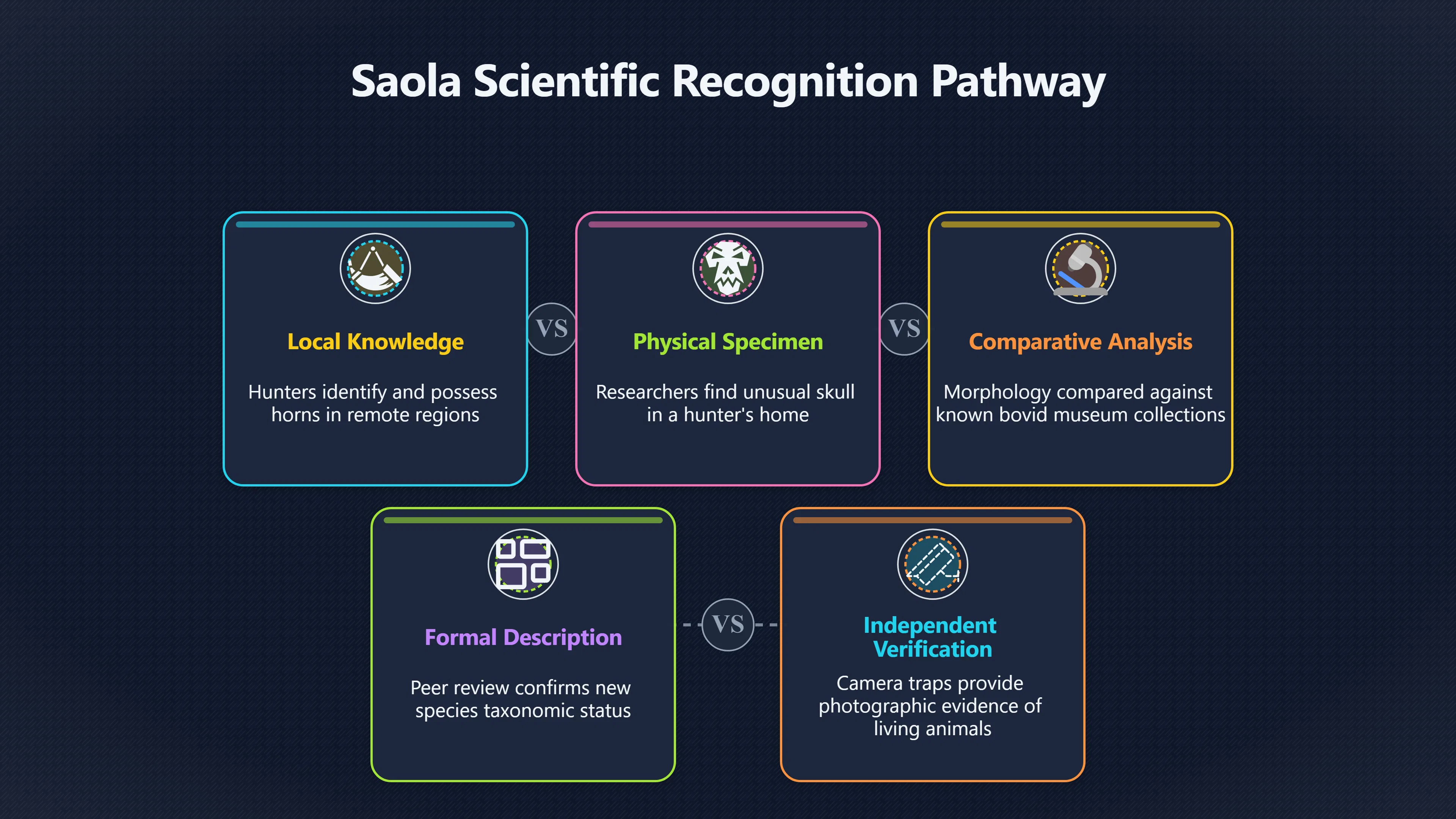
- Physical remains that could be examined.
- Multiple specimens rather than a single anecdote.
- A plausible and restricted habitat.
- Follow-up field surveys.
- Formal scientific description and peer review.
Why discovery is not proof of every cryptid
A common argument in cryptozoology is that if scientists missed the saola, they could also be missing any other alleged creature. The saola case shows why that conclusion does not automatically follow.
The saola left physical traces before its formal discovery. Hunters possessed skulls and horns. The species occupied a specific ecological setting where a small, elusive population could plausibly evade scientific surveys. Once researchers investigated, evidence accumulated quickly enough to support taxonomic recognition.[World Wildlife Fund]worldwildlife.orgWorld Wildlife FundSaola | WWFThe saola was first documented by scientists in May 1992. The team found a skull with unusual long, straigh…
Many famous cryptids differ substantially from this pattern. Claims involving large, widespread, human-sized or long-observed creatures would generally be expected to produce abundant remains, photographs, genetic material or repeated physical evidence. The absence of such evidence becomes increasingly difficult to explain as the claimed animal becomes larger, more numerous or more geographically widespread.
The lesson of the saola is therefore narrower and more useful than either sceptics or enthusiasts sometimes suggest. It demonstrates that unknown mammals can exist in poorly surveyed habitats. It does not demonstrate that all legendary animals are equally plausible. What it demonstrates most clearly is the importance of an evidence threshold: discovery occurs when claims are supported by specimens, habitat data and independent verification that other researchers can examine for themselves.[World Wildlife Fund+2Sage Journals]worldwildlife.orgWorld Wildlife FundSaola | WWFThe saola was first documented by scientists in May 1992. The team found a skull with unusual long, straigh…
Amazon book picks
Further Reading
Books and field guides related to Why the saola changed cryptid evidence claims. Use these as the next step if you want deeper reading beyond the article.
Cryptozoology A To Z
Provides broader context for hidden-animal debates and discoveries.
eBay marketplace picks
Marketplace Samples
Live-tested eBay searches with available results related to this page.

Endnotes
1.
Source: wwf.org.la
Title: Saola still a mystery 20 years after its spectacular debut
Link:https://www.wwf.org.la/?204726%2FSaola-still-a-mystery-20-years-after-its-spectacular-debut=
2.
Source: Wikipedia
Link:https://en.wikipedia.org/wiki/Saola
3.
Source: Wikipedia
Link:https://fr.wikipedia.org/wiki/Saola
4.
Source: wwf.panda.org
Link:https://wwf.panda.org/es/?11783%2FElusive-saola-on-the-verge-of-extinction=
5.
Source: Wikipedia
Title: Saola Working Group
Link:https://en.wikipedia.org/wiki/Saola_Working_Group
6.
Source: wwf.panda.org
Link:https://wwf.panda.org/es/?204726%2FSaola-still-a-mystery-20-years-after-its-spectacular-debut=
7.
Source: worldwildlife.org
Link:https://www.worldwildlife.org/species/saola/
8.
Source: journals.sagepub.com
Link:https://journals.sagepub.com/doi/10.1177/1940082917713014
Additional References
9.
Source: researchgate.net
Link:https://www.researchgate.net/publication/317710461_Habitat_Use_of_the_Saola_Pseudoryx_nghetinhensis_Mammalia_Bovidae_Based_on_Local_Sightings_in_the_Northern_Annamite_Mountains_of_Lao_PDR
10.
Source: katiensafari.com
Link:https://katiensafari.com/wildlife-news/saola-asian-unicorn/
11.
Source: facebook.com
Link:https://www.facebook.com/groups/8633729870037397/posts/9366101083466935/
12.
Source: facebook.com
Link:https://www.facebook.com/theprehistoricworld/posts/one-of-the-rarest-large-animals-on-the-planet-the-saola-is-so-elusive-that-it-ha/816127481117686/
13.
Source: instagram.com
Link:https://www.instagram.com/p/DZbZUu2iPPe/?hl=en-gb
14.
Source: wwf.or.jp
Title: WWFジャパンSaola rediscovered!
Link:https://www.wwf.or.jp/eng/activities/1665.html
15.
Source: vietnamnet.vn
Title: saola in vietnam E89266
Link:https://vietnamnet.vn/en/saola-in-vietnam-E89266.html
16.
Source: bioone.org
Link:https://bioone.org/journals/tropical-conservation-science/volume-10/issue-1/1940082917713014/Habitat-Use-of-the-Saola-Pseudoryx-nghetinhensis-Mammalia-Bovidae-Based/10.1177/1940082917713014.full
17.
Source: en.mae.gov.vn
Title: protecting the saola 8819
Link:https://en.mae.gov.vn/protecting-the-saola-8819.htm
18.
Source: youtube.com
Title: Saola and Serow in the Wild | Rare and Endangered Species of Asia
Link:https://www.youtube.com/watch?v=xYCQRfSII_k
Topic Tree