Within Field Basics
When weather makes animals look strange
Fog, glare, moonlight, headlights and rain can turn ordinary animals or shapes into much stranger reports.
On this page
- Low light, glare and blocked views
- Rain, fog, wind and sound distortion
- Recording conditions before interpretation
Page outline Jump by section
Introduction
Many cryptid sightings are reported at night, in poor weather, or under difficult viewing conditions. That does not automatically make them false, but it does make them more vulnerable to ordinary perceptual errors. Low light reduces colour and detail, fog and rain obscure shapes, bright lights create glare, and wind can alter how sounds travel. Under these conditions, familiar animals can appear larger, stranger, or more mysterious than they would in daylight. Responsible field investigation therefore begins by examining the conditions of observation before treating a report as evidence of an unknown creature. Research in wildlife observation, vision science and environmental acoustics consistently shows that weather and lighting can dramatically affect what people see and hear.[iwdg.ie+2Wikipedia]iwdg.ieOpen source on iwdg.ie.
Low light, glare and blocked views
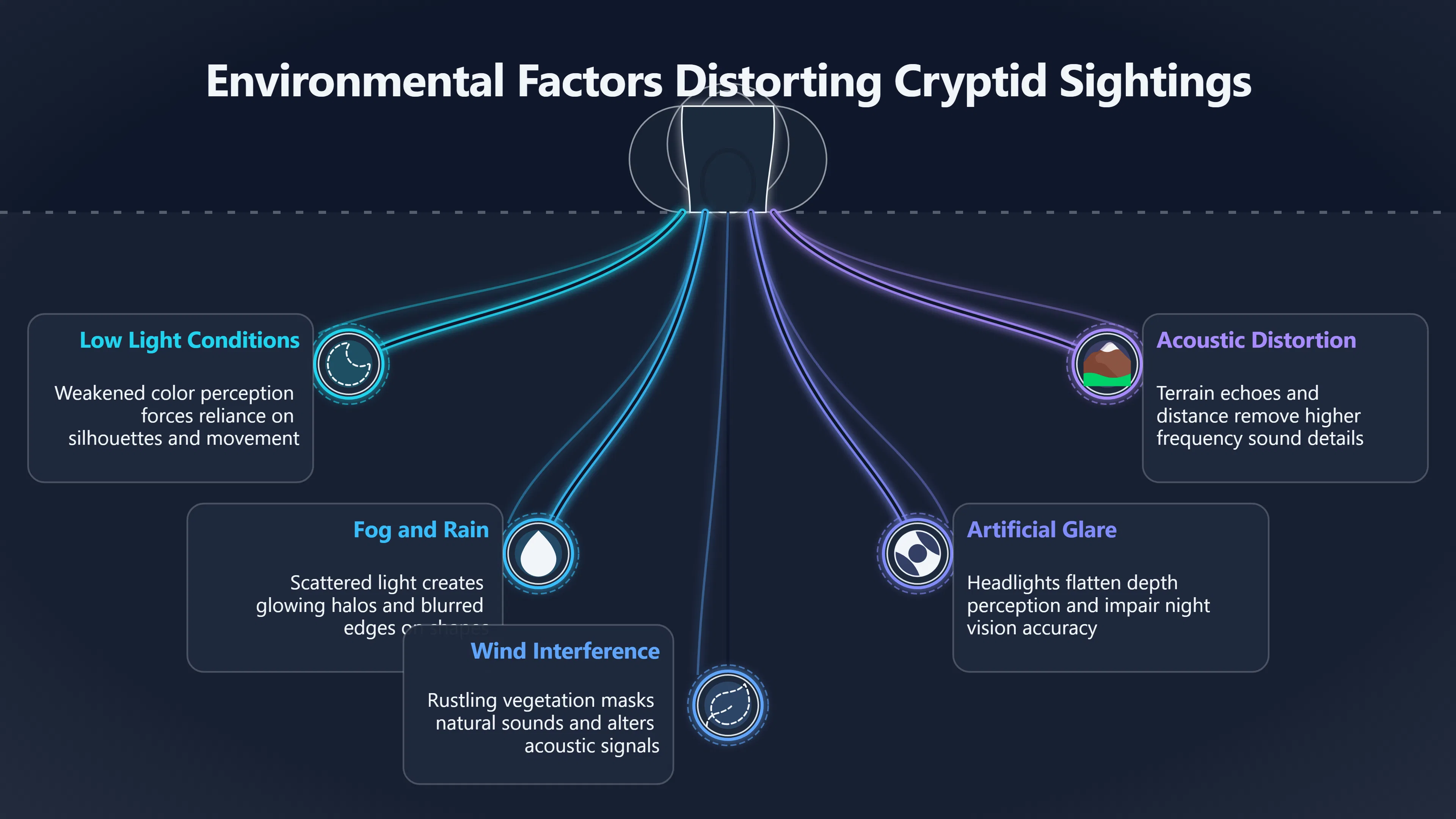
Human vision works differently at night than during the day. As light levels fall, colour perception weakens, fine detail becomes harder to distinguish, and observers rely more heavily on silhouettes and movement. Objects that would be instantly recognisable in daylight may become ambiguous outlines after dark. Even modern computer vision systems struggle under extreme low-light conditions, illustrating how difficult object recognition becomes when visual information is limited.[arXiv]arxiv.orgNOD: Taking a Closer Look at Detection under Extreme Low-Light Conditions with Night Object Detection DatasetOctober 20, 2021…
For cryptid reports, this matters because witnesses often describe only partial features. A deer glimpsed between trees, a bear seen in silhouette, or a large bird crossing moonlit sky can appear unfamiliar when only fragments are visible. The brain naturally fills missing information with assumptions, sometimes creating a more dramatic interpretation than the raw visual data supports.
Moonlight can also change appearances in unexpected ways. Natural variations in nighttime illumination affect animal behaviour and alter how observers perceive distance, size and movement. A dark animal crossing a bright moonlit background may seem larger than it is, while a partially illuminated animal can appear to have unusual proportions.[publishup.uni-potsdam.de]publishup.uni-potsdam.deWelcome to the Dark SideUniversität Potsdamby J Hoffmann · 2022 · Cited by 16 — Differences in natural light conditions caused by changes in moonlight are known…
Artificial light introduces additional problems:<div class="content-enhancement content-enhancement--insight-grid" markdown="1">
- Headlights can flatten depth perception and make animals appear closer or larger.
- Torch beams illuminate only a narrow area, leaving surrounding features invisible.
- Streetlights and security lights create strong contrast between bright and dark zones.
- Glare reduces contrast and can temporarily impair night vision, making shapes harder to identify accurately.[Wikipedia]WikipediaLight pollutionLight pollution</div>
A common source of confusion is eyeshine. Many mammals possess reflective structures behind the retina that return light through the eye, producing bright reflections when illuminated by headlights or torches. At night, observers may see only glowing eyes without a clear view of the animal’s body, encouraging speculation about size or identity.[Facebook]facebook.comNocturnal wildlife of Badlands National ParkIt acts like a built-in night-vision booster—bouncing light back through the eye to h…<div class="youtube-embed-container youtube-embed-fallback youtube-embed-link-only"><div class="youtube-embed-card"><div class="youtube-embed-link-panel">What is this?</div><div class="youtube-embed-footer"><p class="youtube-embed-title">What is this?</p><p class="youtube-embed-actions">Open on YouTube</p></div></div></div>
Why partial views create extraordinary reports
Many memorable sightings involve only seconds of observation. Trees, brush, terrain, darkness or weather may block part of an animal’s body. A witness may see a moving shape without a head, a pair of eyes without a body, or a silhouette without scale references.
These conditions can distort estimates of:<div class="content-enhancement content-enhancement--phrase-pills" markdown="1">
- Height and length
- Distance from the observer
- Speed of movement
- Number of animals present
- Direction of travel</div>
A bear standing briefly on its hind legs, for example, presents a very different silhouette from the same bear moving on all fours. When viewed through darkness, vegetation and glare simultaneously, the resulting impression may differ substantially from the underlying reality.
Rain, fog, wind and sound distortion
Weather affects more than visibility. It changes how light travels, how sounds propagate and how animals behave.
Fog is especially important because it reduces visibility while scattering light. Headlights, torches and moonlight can produce glowing halos and blurred edges within fog, making ordinary objects appear larger, more distant or less distinct. Visibility can fall dramatically even over short distances, preventing reliable assessment of size and shape.[Wikipedia]WikipediaOpen source on wikipedia.org.
Rain introduces similar challenges. Falling water obscures detail, creates moving reflections and reduces contrast. Wet surfaces can reflect light in unexpected ways, while streams, ponds and lakes may produce unusual patterns that appear animate when viewed briefly.
Wind adds another layer of complexity. Moving branches, grass and vegetation can create fleeting impressions of movement. Strong wind also affects hearing. Natural sounds become masked by rustling leaves, rainfall or blowing vegetation, making it difficult to determine where a sound originated. Wildlife researchers note that environmental conditions such as vegetation, humidity and weather can alter sound transmission and degrade acoustic signals before they reach a listener.[ResearchGate]researchgate.netdry and rainyResearchGate(PDF) Effects of different environments on acoustic…April 12, 2010 — In natural environments, the emitted sound is affecte…
When sounds seem stranger than they are
Many cryptid traditions include reports of unusual screams, calls or vocalisations. Sound identification at night is often much harder than visual identification.
Several mechanisms contribute:<div class="content-enhancement content-enhancement--insight-grid" markdown="1">
- Wind can carry sounds farther than expected.
- Terrain can create echoes and reflections.
- Dense vegetation can distort sound characteristics.
- Rain and background noise can mask familiar features.
- Distance can remove higher frequencies, making calls sound deeper or more unfamiliar.[ResearchGate]researchgate.netdry and rainyResearchGate(PDF) Effects of different environments on acoustic…April 12, 2010 — In natural environments, the emitted sound is affecte…</div>
An observer may therefore hear a known animal but perceive something entirely different. This does not require dishonesty or exaggeration; it is a predictable consequence of environmental acoustics.<div class="youtube-embed-container youtube-embed-fallback youtube-embed-link-only"><div class="youtube-embed-card"><div class="youtube-embed-link-panel">How to Identify Predators Through Thermal Optics</div><div class="youtube-embed-footer"><p class="youtube-embed-title">How to Identify Predators Through Thermal Optics</p><p class="youtube-embed-actions">Open on YouTube</p></div></div></div>
Animals also behave differently in difficult conditions
Another reason weather complicates sightings is that animals themselves change behaviour in response to light, noise and weather.
Research shows that natural moonlight, artificial lighting and noise can alter movement patterns, foraging behaviour and activity levels in many species. Predators and prey often respond differently to changing conditions, and rainy or windy weather can affect hunting behaviour and movement.[Frontiers+2The Wildlife Society]frontiersin.orgFrontiersWelcome to the Dark Side: Partial Nighttime Illumination…by J Hoffmann · 2022 · Cited by 16 — Differences in natural light co…
This means a witness may encounter an animal acting in an unusual way precisely because the weather is unusual. A familiar species behaving unexpectedly can appear more mysterious than the same animal observed under normal conditions.
For example:<div class="content-enhancement content-enhancement--insight-grid" markdown="1">
- Animals may emerge at unusual times during storms.
- Noise may encourage movement away from roads or settlements.
- Moonlit conditions may change where animals feed.
- Artificial lighting may attract or repel certain species.[Frontiers+2BioRxiv]frontiersin.orgFrontiersWelcome to the Dark Side: Partial Nighttime Illumination…by J Hoffmann · 2022 · Cited by 16 — Differences in natural light co…</div>
Behaviour that seems extraordinary is therefore not always evidence of an unknown species.
Recording conditions before interpretation
Because weather and lighting influence both observation and animal behaviour, documenting conditions is one of the most valuable steps in cryptid fieldwork.
Before deciding what was seen, investigators should record:<div class="content-enhancement content-enhancement--benefit" markdown="1">
- Exact time of sighting
- Moon phase and cloud cover
- Presence of fog, mist, rain or snow
- Wind strength and direction
- Light sources such as headlights, torches or streetlights
- Observer position and viewing angle
- Estimated distance to the target
- Any obstacles between observer and subject</div>
Wildlife monitoring programmes routinely record weather and environmental conditions because they affect detection rates and interpretation of observations. A report that includes these details is far more useful than one focused solely on the claimed creature.[Adventure Scientists+2Nebraska Today]adventurescientists.orgAdventure ScientistsWildlife ObservationsQuestions for the wildlife observations project in the iNaturalist app address weather condition…
In responsible cryptid investigation, unusual conditions are not reasons to dismiss a witness. They are clues that help explain how a sighting occurred. The more carefully those conditions are documented, the easier it becomes to distinguish a genuinely unexplained observation from a known animal transformed by darkness, weather and human perception.[iwdg.ie+2Adventure Scientists]iwdg.ieOpen source on iwdg.ie.<div class="youtube-embed-container youtube-embed-fallback youtube-embed-link-only"><div class="youtube-embed-card"><div class="youtube-embed-link-panel">How Monsters Took Over The Woods</div><div class="youtube-embed-footer"><p class="youtube-embed-title">How Monsters Took Over The Woods</p><p class="youtube-embed-actions">Open on YouTube</p></div></div></div>
Amazon book picks
Further Reading
Books and field guides related to When weather makes animals look strange. Use these as the next step if you want deeper reading beyond the article.
Abominable Science!
Examines how unusual observations gain extraordinary interpretations.
Weather For Dummies
Helps readers understand fog, rain, visibility, and atmospheric effects.
eBay marketplace picks
Marketplace Samples
Live-tested eBay searches with available results related to this page.


Endnotes
1.
Source: iwdg.ie
Link:https://iwdg.ie/recording-techniques/
2.
Source: Wikipedia
Link:https://en.wikipedia.org/wiki/Fog
3.
Source: Wikipedia
Title: Light pollution
Link:https://en.wikipedia.org/wiki/Light_pollution
4.
Source: arxiv.org
Link:https://arxiv.org/abs/2110.10364
5.
Source: publishup.uni-potsdam.de
Title: Welcome to the Dark Side
Link:https://publishup.uni-potsdam.de/frontdoor/index/index/docId/54470
6.
Source: Wikipedia
Link:https://en.wikipedia.org/wiki/Roadkill
7.
Source: facebook.com
Link:https://www.facebook.com/BadlandsNPS/posts/-ever-feel-like-youre-being-watchedthe-animals-of-badlands-national-park-can-rel/1434448412056602/
8.
Source: Wikipedia
Link:https://en.wikipedia.org/wiki/Spotlighting
9.
Source: arxiv.org
Link:https://arxiv.org/abs/2308.01738
10.
Source: researchgate.net
Title: dry and rainy
Link:https://www.researchgate.net/publication/311652832_Effects_of_different_environments_on_acoustic_communication_animals
11.
Source: wildlife.org
Title: research sheds light on sensory pollution and wildlife
Link:https://wildlife.org/research-sheds-light-on-sensory-pollution-and-wildlife/
12.
Source: biorxiv.org
Link:https://www.biorxiv.org/content/10.1101/2021.02.18.431905.full
13.
Source: researchgate.net
Link:https://www.researchgate.net/publication/313587062_Ecological_Effects_of_Light_Pollution_How_Can_We_Improve_Our_Understanding_Using_Light_Loggers_on_Individual_Animals
14.
Source: frontiersin.org
Link:https://www.frontiersin.org/journals/ecology-and-evolution/articles/10.3389/fevo.2021.779825/full
15.
Source: adventurescientists.org
Link:https://www.adventurescientists.org/wildlife-observations.html
16.
Source: news.unl.edu
Title: Nebraska Today It’s a trap!
Link:https://news.unl.edu/article/it-s-a-trap-study-finds-effects-of-weather-time-on-wildlife-sightings
Additional References
17.
Source: woah.org
Link:https://www.woah.org/app/uploads/2021/03/a-4th-cycle-finale.pdf
18.
Source: fishwildlife.org
Link:https://www.fishwildlife.org/application/files/7216/4616/6166/AFWA_Field_Investigations_Guide_2022.pdf
19.
Source: pmc.ncbi.nlm.nih.gov
Link:https://pmc.ncbi.nlm.nih.gov/articles/PMC9582234/
20.
Source: wildlifeact.com
Title: why camera traps are essential for monitoring elusive wildlife species
Link:https://www.wildlifeact.com/blog/why-camera-traps-are-essential-for-monitoring-elusive-wildlife-species
21.
Source: images.sussexwildlifetrust.org.uk
Title: Wildlife Surveys and Monitoring Increases our understanding of the natural world
Link:https://images.sussexwildlifetrust.org.uk/Files/wildlifemonitoringbookletframes.pdf
22.
Source: wildlife.nh.gov
Title: field investigations manual
Link:https://www.wildlife.nh.gov/sites/g/files/ehbemt746/files/inline-documents/sonh/field-investigations-manual.pdf
23.
Source: pubmed.ncbi.nlm.nih.gov
Link:https://pubmed.ncbi.nlm.nih.gov/40396451/
24.
Source: blog.londolozi.com
Title: the effect of weather on animal behaviour
Link:https://blog.londolozi.com/2022/11/02/the-effect-of-weather-on-animal-behaviour/
25.
Source: robbiegeorgephotography.com
Title: A field guide to predicting wildlife
Link:https://www.robbiegeorgephotography.com/wildlife-observation-field-techniques?srsltid=AfmBOoqwD3TWArH8puX0FbtNlnGsjUFqjARpX7mQAW3NFglSIzQtTUKk
26.
Source: instagram.com
Link:https://www.instagram.com/reel/DWLxsvqATUe/
Topic Tree