Within Cryptozoology
Did Yeti Samples Point to Bears?
Yeti hair and tissue claims show how DNA can turn dramatic legends into testable questions about known animals.
On this page
- Yeti reports in Himalayan tradition
- What anomalous primate DNA studies found
- Why unusual bears can fuel legends
Page outline Jump by section
Introduction
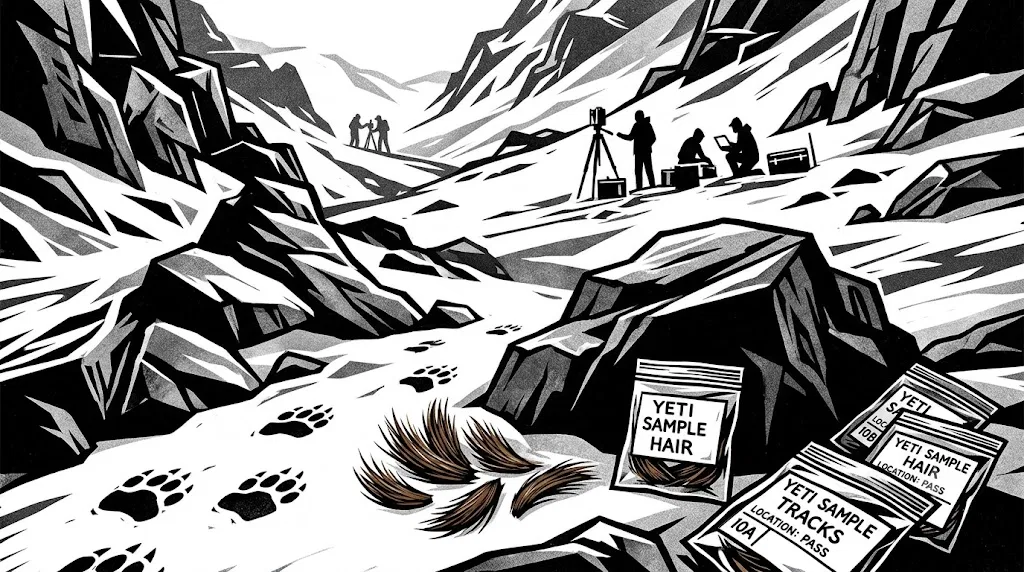
Yeti samples are one of the clearest examples of how cryptozoology can move from dramatic legend to testable evidence. Hair, skin, bone, tooth and faecal samples said to come from the Yeti have been analysed with DNA methods, and the strongest published results point not to an unknown ape, but to bears native to the Himalayan and Tibetan Plateau region. The most important turn came after an earlier study suggested that two Himalayan hair samples might be linked to an ancient polar bear line. Later reanalysis and a broader 2017 genetic study found a simpler explanation: the tested “Yeti” material matched Asian black bears, Himalayan brown bears, Tibetan brown bears and, in one case, a domestic dog.[PubMed+2PMC]pubmed.ncbi.nlm.nih.govGenetic analysis of hair samples attributed to yeti, bigfoot…22 Aug 2014 — We have used rigorous decontamination followed by mit…
That does not make Himalayan Yeti tradition meaningless. It changes the question. Instead of asking whether every story points to a hidden primate, the evidence asks how real animals, rare encounters, preserved relics, high-altitude terrain and local story traditions can combine into a powerful cryptid identity. In this case, DNA did not simply “debunk” a monster; it showed why bears are central to the biological side of the Yeti puzzle.
Why Yeti reports were suited to DNA testing
The Yeti occupies a distinctive place in cryptozoology because the claims have not rested only on distant sightings or footprints. Over time, museums, monasteries, private collections and expedition accounts accumulated physical objects said to be connected to the creature: hair, scalps, paws, bones and other remains. That made the Yeti different from many cryptids whose evidence is mainly photographic, anecdotal or folkloric. Physical samples can be contaminated, mislabelled or misidentified, but they can also be tested.
The basic scientific question is narrow: what animal did the sample come from? DNA analysis is useful because even small tissue or hair samples can contain mitochondrial DNA, a genetic marker often used for species identification. Mitochondrial DNA is inherited through the maternal line and is abundant compared with nuclear DNA, which makes it especially useful when samples are old, damaged or limited. But it also has limits: a short fragment may identify a broad lineage while failing to resolve a subspecies, hybrid history or close relationship among bears.
That limitation became central to the Yeti debate. In 2014, Bryan Sykes and colleagues published a systematic genetic survey of 30 hair samples attributed to “anomalous primates”, including Yeti, Bigfoot and related claims. Most samples came from known mammals, but two Himalayan hair samples, one from Ladakh in India and one from Bhutan, were reported as having their closest affinity with a Palaeolithic polar bear sequence. The result was intriguing because it shifted the claim away from an unknown ape and towards the possibility of an unusual bear lineage.[PubMed]pubmed.ncbi.nlm.nih.govGenetic analysis of hair samples attributed to yeti, bigfoot…22 Aug 2014 — We have used rigorous decontamination followed by mit…
That was a useful scientific moment for cryptozoology: an extraordinary claim became a narrower, testable biological hypothesis. If a hidden Yeti population existed, DNA should eventually point to something coherent. If the samples were from known animals, repeated testing should converge on known species. The evidence that followed strongly favoured the second outcome.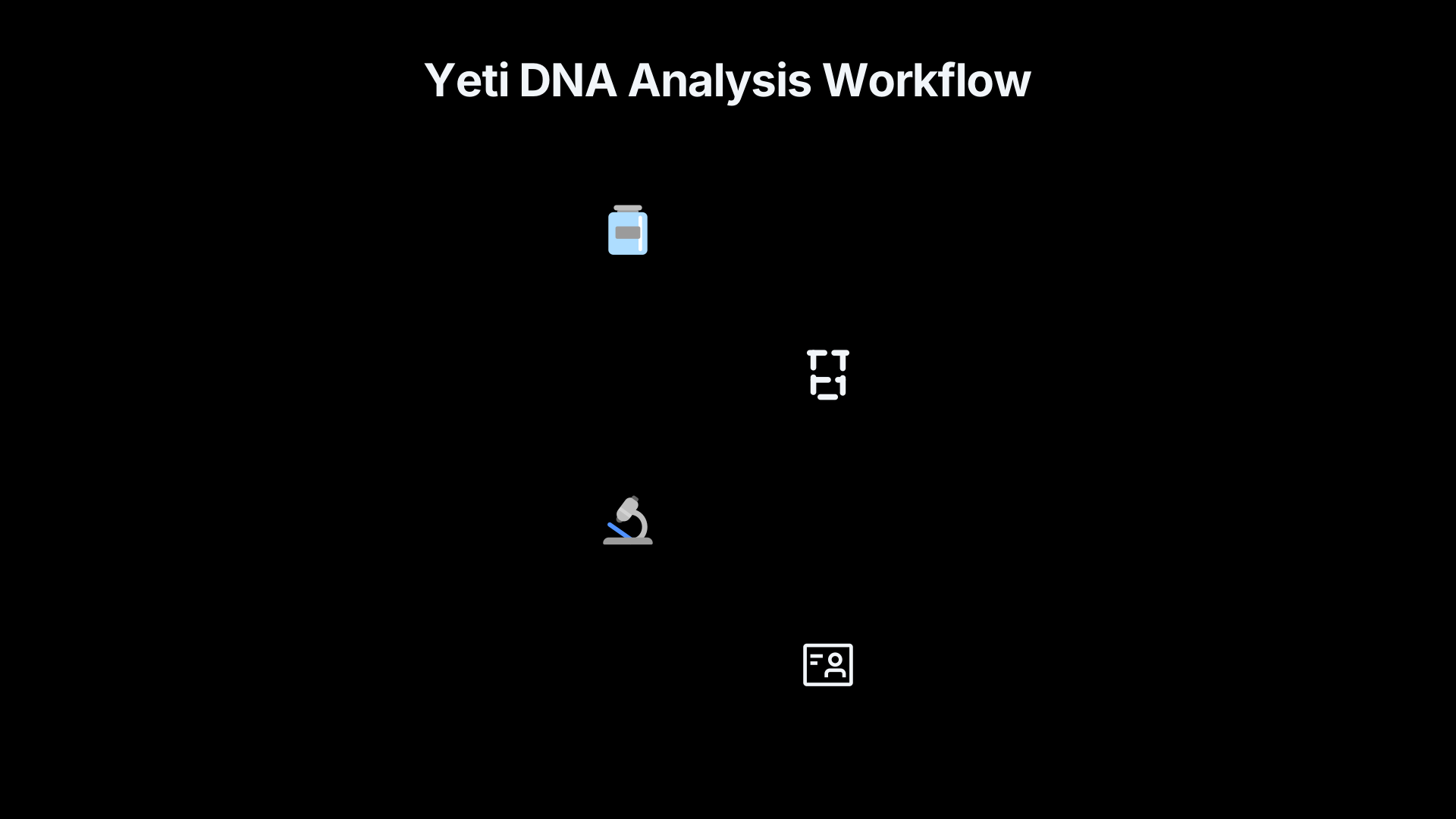
What anomalous primate DNA studies found
The 2014 Sykes study mattered because it treated cryptid samples as biological evidence rather than as folklore objects. The researchers used decontamination and mitochondrial 12S RNA sequencing to identify the species origin of submitted hairs. The result was not a catalogue of hidden primates. Apart from the two Himalayan samples flagged as polar-bear-like, the tested hairs belonged to known living mammals.[PubMed]pubmed.ncbi.nlm.nih.govGenetic analysis of hair samples attributed to yeti, bigfoot…22 Aug 2014 — We have used rigorous decontamination followed by mit…
The polar bear angle quickly became controversial. Edwards and Barnett reanalysed the claim and argued that the evidence rested on only 104 base pairs of mitochondrial 12S ribosomal RNA, a very short DNA fragment. They said the two Himalayan hair samples were not solid evidence of a Palaeolithic polar bear connection and could be better explained by the limits of short, degraded sequences and comparison problems.[PMC]pmc.ncbi.nlm.nih.govPMCHimalayan 'yeti' DNA: polar bear or DNA degradationby CJ Edwards · 2015 · Cited by 6 — Based on 104 base pairs of the mitochondrial 12S ribosomal RNA gene, Sykes et al. [1] identified t…
A separate 2015 analysis by Eliécer Gutiérrez also challenged the idea that the samples required a new or hybrid bear explanation. Gutiérrez concluded that the short 12S fragment used in the earlier study was not informative enough to support the proposed taxonomic identity, and that there was no good reason to think the samples came from anything other than brown bears.[Zookeys]zookeys.pensoft.netOpen source on pensoft.net.
The lesson is important for readers of cryptozoology evidence. DNA does not work like a magic label that instantly names a mystery animal. It depends on sample quality, the length and type of genetic sequence, comparison databases, contamination control and the degree of difference between possible source animals. A short fragment can be enough to rule out an ape, but not enough to justify a new bear species.
The 2017 study that put bears at the centre
The most influential follow-up came in 2017, when Charlotte Lindqvist and colleagues published a broader study on bears from the Tibetan Plateau and Himalaya. The team analysed 24 samples in total, including nine attributed to the Yeti. These were not only loose hairs; they included bone, tooth, skin, hair and faecal material connected with museums, private collections and reported Yeti relics.[EurekAlert!+2CORDIS]eurekalert.orgnews releasesnews releases
The result was clear. Of the nine purported Yeti samples, eight were from Asian bears and one was from a dog. More specifically, the bear samples included Asian black bear, Himalayan brown bear and Tibetan brown bear material. The study also assembled complete mitochondrial genomes for Himalayan brown bear and Himalayan black bear for the first time, making the work useful beyond the Yeti question itself.[Royal Society Publishing+2PMC]royalsocietypublishing.orgOpen source on royalsocietypublishing.org.
Some of the concrete examples are striking because they show how relics can acquire cryptid identities without being fabricated from nothing. A scrap of skin from the hand or paw of a supposed Yeti relic turned out to be from an Asian black bear. A fragment of femur bone from a decayed “Yeti” found in a cave on the Tibetan Plateau turned out to be from a Tibetan brown bear. Hair from a mummified animal in a monastery was identified as Himalayan brown bear, while a tooth associated with a stuffed specimen collected in the 1930s was identified as dog.[The Atlantic+2AAU]theatlantic.comThe Atlantic DNA Reveals the Yeti Is Actually a Bunch of BearsThe Atlantic DNA Reveals the Yeti Is Actually a Bunch of Bears
The 2017 paper did not prove that every Yeti story has the same origin. It did, however, strongly refute the need for an unknown primate or exotic polar-bear-like creature to explain the tested material. The Royal Society’s own summary of the research stated that the results refuted the earlier preliminary finding and strongly suggested that the biological basis of the Yeti legend lies in local brown and black bears.[Royal Society]royalsociety.orgmysteries of the yetimysteries of the yeti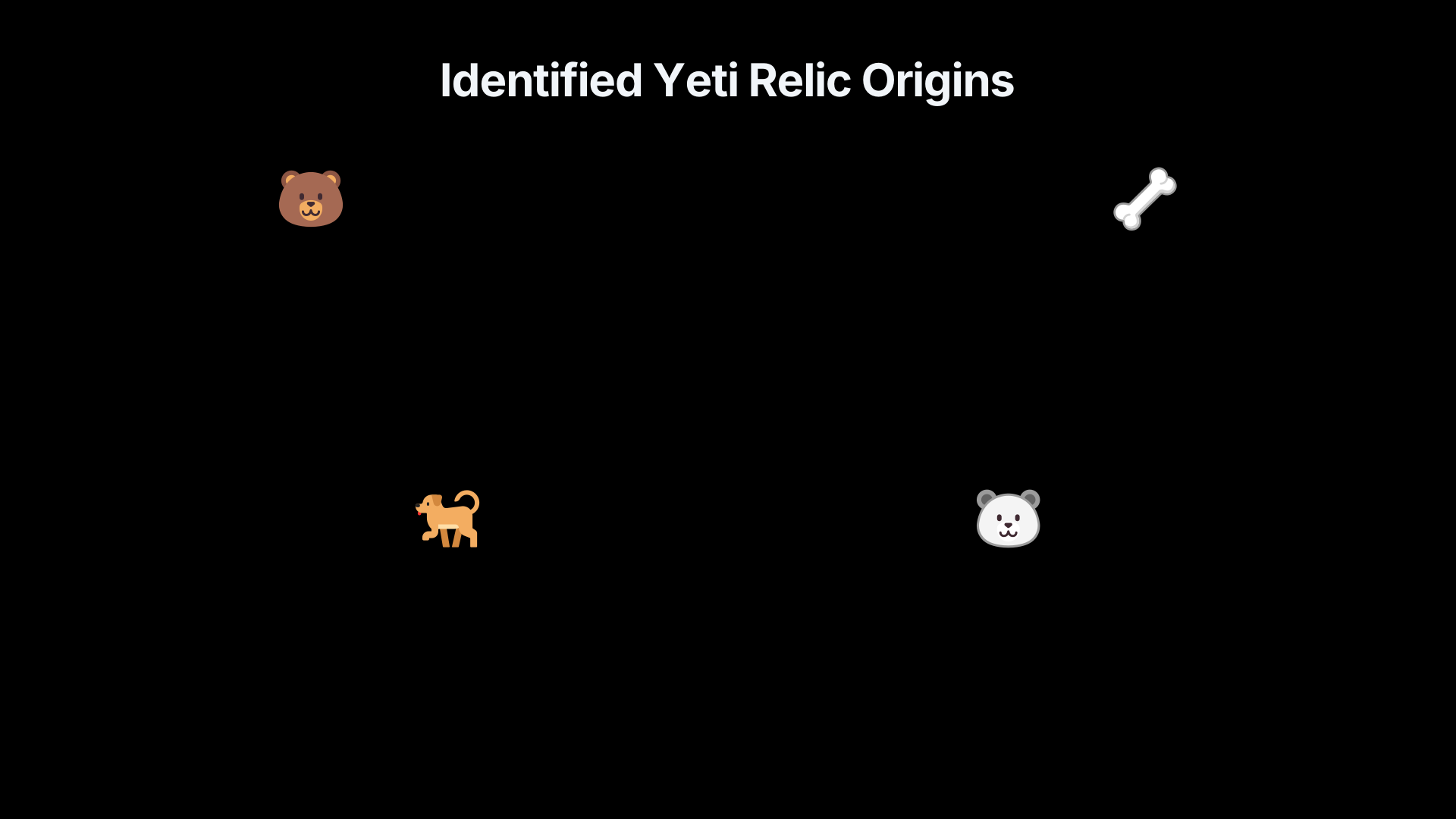
Why unusual bears can fuel Yeti legends
The bear explanation is more interesting than a simple “people saw a bear” dismissal. Himalayan and Tibetan bears live in terrain where brief, stressful or distant encounters can be difficult to interpret: snowfields, steep slopes, forest margins, high passes and remote settlements. A bear standing on its hind legs, moving through snow, raiding livestock or appearing briefly at dusk can look larger, stranger and more human-like than it would in a clear daylight view.
The species involved also matter. Asian black bears and brown bears are real animals in the broader region, but they are not equally familiar to every observer, and some populations are scarce, elusive or poorly studied. Lindqvist’s team used the Yeti samples partly as a route into studying the evolutionary history of these regional bears, because Himalayan brown bears and Tibetan brown bears are themselves biologically distinctive and under-sampled compared with better-known bear populations.[Royal Society Publishing+2EurekAlert!]royalsocietypublishing.orgOpen source on royalsocietypublishing.org.
The genetic findings also showed that the Himalayan brown bear has a notable evolutionary history. The 2017 study found that Himalayan brown bears form a deeply divergent lineage, separated from other brown bears around the time of Middle Pleistocene glaciation in the region. That does not make them Yetis, but it does help explain why a rare, high-altitude bear might become wrapped in local stories as something exceptional.[Royal Society Publishing]royalsocietypublishing.orgOpen source on royalsocietypublishing.org.
There is also a cultural mechanism. A relic in a monastery or private collection does not need to begin as a deliberate hoax. A paw, scalp or bone from a rare bear can be preserved, retold, displayed and reinterpreted over generations. Once an object is embedded in a sacred, local or expeditionary story, its identity may be maintained by tradition rather than anatomy. DNA testing can then reveal the animal source without fully explaining the social life of the object.
What the bear DNA explanation does and does not prove
The strongest conclusion is modest but powerful: the best-tested physical Yeti samples so far do not support an unknown ape-like animal. They point to known regional mammals, especially bears. That matters because physical samples are among the most promising forms of cryptozoological evidence. If the strongest available tissue, hair and bone claims repeatedly resolve into known animals, the burden of proof shifts heavily back onto anyone arguing for a hidden primate.
The evidence does not prove that every Yeti report was a bear sighting. Folklore can absorb many sources: tracks in snow, oral tradition, religious symbolism, expedition storytelling, misidentified animals, hoaxes, local warnings, and the human habit of turning rare encounters into memorable narrative. But when the question is specifically “what were the tested Yeti samples?”, the answer is overwhelmingly zoological rather than mysterious.
A careful reading leaves four practical takeaways:
- Hair is not enough on its own. A hair sample needs documented collection, contamination control and enough genetic material for meaningful comparison.
- Short DNA matches can mislead. The polar-bear-like result became less persuasive once researchers examined how little sequence data supported it.
- Bears are not a weak explanation. They are large, dangerous, sometimes upright, regionally present and culturally memorable animals.
- Negative cryptid evidence can still produce good science. The Yeti samples helped generate useful genetic data on poorly studied Himalayan and Tibetan bears.[Royal Society+3PMC+3Zookeys]pmc.ncbi.nlm.nih.govPMCHimalayan 'yeti' DNA: polar bear or DNA degradationby CJ Edwards · 2015 · Cited by 6 — Based on 104 base pairs of the mitochondrial 12S ribosomal RNA gene, Sykes et al. [1] identified t…
Why this case matters for cryptozoology
The Yeti DNA story is valuable because it models a better version of cryptozoological inquiry. It does not begin and end with ridicule, nor does it accept legend as evidence by itself. It asks a testable question, applies a method, corrects early overinterpretation and updates the explanation when stronger data appear.
That makes the Yeti bear studies a useful contrast with weaker cryptid cases. A blurry photograph can be argued over indefinitely. A footprint can be shaped by snowmelt, substrate and expectation. A story can preserve local knowledge while also changing across retellings. But a bone, tooth, skin sample or hair shaft can sometimes be brought into the same evidential world as ordinary zoology. In this case, that world led back to bears.
The outcome also avoids a false choice between “the legend is true” and “the legend is worthless”. The Yeti, as a hidden ape-like creature, has not been supported by the tested DNA samples. Yet the legend may still preserve encounters with rare, impressive and sometimes poorly understood animals in a difficult landscape. The bear DNA explanation shows how a cryptid can have a biological seed without being a new species.
Amazon book picks
Further Reading
Books and field guides related to Did Yeti Samples Point to Bears?. Use these as the next step if you want deeper reading beyond the article.
Bigfoot, Yeti, and the Last Neanderthal
Focuses on genetic analysis of Yeti and related cryptid evidence.
eBay marketplace picks
Marketplace Samples
Live-tested eBay searches with available results related to this page.



Endnotes
1.
Source: pmc.ncbi.nlm.nih.gov
Title: PMCHimalayan’yeti’ DNA: polar bear or DNA degradation
Link:https://pmc.ncbi.nlm.nih.gov/articles/PMC4298200/
2.
Source: pmc.ncbi.nlm.nih.gov
Link:https://pmc.ncbi.nlm.nih.gov/articles/PMC4100498/
3.
Source: eurekalert.org
Title: news releases
Link:https://www.eurekalert.org/news-releases/844761
4.
Source: cordis.europa.eu
Title: CORDISYeti or not Yeti? DNA samples provide a response
Link:https://cordis.europa.eu/article/id/122699-trending-science-yeti-or-not-yeti-dna-samples-provide-a-response
5.
Source: pmc.ncbi.nlm.nih.gov
Link:https://pmc.ncbi.nlm.nih.gov/articles/PMC5740279/
6.
Source: aau.edu
Title: abominable snowman was probably bear new study
Link:https://www.aau.edu/research-scholarship/featured-research-topics/abominable-snowman-was-probably-bear-new-study
7.
Source: yeti.com
Link:https://www.yeti.com/
8.
Source: uk.yeti.com
Link:https://uk.yeti.com/
9.
Source: eurekalert.org
Title: news releases
Link:https://www.eurekalert.org/news-releases/895983
10.
Source: pubmed.ncbi.nlm.nih.gov
Link:https://pubmed.ncbi.nlm.nih.gov/24990672/
11.
Source: royalsocietypublishing.org
Link:https://royalsocietypublishing.org/rspb/article/284/1868/20171804/78775/Evolutionary-history-of-enigmatic-bears-in-the
12.
Source: royalsocietypublishing.org
Link:https://royalsocietypublishing.org/doi/abs/10.1098/rspb.2014.0161
13.
Source: zookeys.pensoft.net
Link:https://zookeys.pensoft.net/articles.php?id=4885
14.
Source: zookeys.pensoft.net
Title: Zookeys No need to replace an “anomalous” primate
Link:https://zookeys.pensoft.net/article/4885/
15.
Source: theatlantic.com
Title: The Atlantic DNA Reveals the Yeti Is Actually a Bunch of Bears
Link:https://www.theatlantic.com/science/archive/2017/11/yeti-dna-sequencing/546806/
16.
Source: royalsociety.org
Title: mysteries of the yeti
Link:https://royalsociety.org/blog/2017/11/mysteries-of-the-yeti/
17.
Source: royalsocietypublishing.org
Title: Response to Edward and Barnett
Link:https://royalsocietypublishing.org/rspb/article/282/1800/20142434/77521/Response-to-Edward-and-BarnettResponse-to-Edwards
18.
Source: Wikipedia
Title: Himalayan brown bear
Link:https://en.wikipedia.org/wiki/Himalayan_brown_bear
19.
Source: Wikipedia
Title: Brown bear
Link:https://en.wikipedia.org/wiki/Brown_bear
20.
Source: bearconservation.org.uk
Title: himalayan brown bear
Link:https://www.bearconservation.org.uk/himalayan-brown-bear/
21.
Source: pmc.ncbi.nlm.nih.gov
Link:https://pmc.ncbi.nlm.nih.gov/articles/PMC4455819/
22.
Source: pubmed.ncbi.nlm.nih.gov
Link:https://pubmed.ncbi.nlm.nih.gov/29187630/
23.
Source: pmc.ncbi.nlm.nih.gov
Link:https://pmc.ncbi.nlm.nih.gov/articles/PMC4366689/
24.
Source: animals.fandom.com
Title: Himalayan Brown Bear
Link:https://animals.fandom.com/wiki/Himalayan_Brown_Bear
25.
Source: dictionary.cambridge.org
Link:https://dictionary.cambridge.org/dictionary/english/yeti
26.
Source: fwegb.gov.pk
Link:https://fwegb.gov.pk/wp-content/uploads/2022/09/GB-FWP-Brown-Bears-Survey-2022-09-03.pdf
Additional References
27.
Source: researchgate.net
Link:https://www.researchgate.net/publication/273631992_No_need_to_replace_an_anomalous_primate_Primates_with_an_anomalous_bear_Carnivora_Ursidae
28.
Source: researchgate.net
Link:https://www.researchgate.net/publication/321361263_Evolutionary_history_of_enigmatic_bears_in_the_Tibetan_Plateau-Himalaya_region_and_the_identity_of_the_yeti
29.
Source: nationalgeographic.com
Link:https://www.nationalgeographic.com/animals/mammals/facts/bears-grizzly-polar-panda
30.
Source: iucnredlist.org
Link:https://www.iucnredlist.org/species/pdf/121229971/attachment
31.
Source: alphabiolabs.co.uk
Link:https://www.alphabiolabs.co.uk/blog/[dna-tests
32.
Source: researchgate.net
Link:https://www.researchgate.net/publication/269695589Himalayan%27yeti%27DNA_Polar_bear_or_DNA_degradation_A_comment_on%27Genetic_analysis_of_hair_samples_attributed_to_Yeti%27_by_Sykes_et_al_2014
33.
Source: academia.edu
Link:https://www.academia.edu/9822092/Himalayan_yeti_DNA_polar_bear_or_DNA_degradation_A_comment_on_Genetic_analysis_of_hair_samples_attributed_to_yeti_by_Sykes_et_al_2014_
34.
Source: facebook.com
Link:https://www.facebook.com/groups/2396916380538057/posts/3979692055593807/
35.
Source: iucnredlist.org
Link:https://www.iucnredlist.org/
36.
Source: iucn.org
Link:https://iucn.org/resources/conservation-tool/iucn-red-list-threatened-species
Topic Tree