Within Lazarus Taxa
Why Extinction Needs a High Bar
Extinction is declared cautiously because rare animals can evade surveys, but that caution is not evidence for every survival claim.
On this page
- What exhaustive surveys are meant to show
- Why possibly extinct is different from extinct
- How the standard limits cryptid analogies
Page outline Jump by section
Introduction
One of the least appreciated lessons from Lazarus taxa is not that extinction declarations are unreliable, but that conservation science deliberately makes them difficult. The International Union for Conservation of Nature (IUCN), which maintains the global Red List of threatened species, sets an exceptionally high threshold before a species can be classified as Extinct (EX). A species is considered extinct only when there is “no reasonable doubt” that the last individual has died, and that conclusion should follow exhaustive surveys across known and expected habitat, conducted at appropriate times and over a period suitable for the organism’s life history.[IUCN Red List+2IUCN Portals]iucnredlist.orgIUCN Red ListIUCN Red List of Threatened SpeciesA taxon is presumed Extinct when exhaustive surveys in known and/or expected habitat, at… This caution exists because rediscoveries are real. Species have repeatedly vanished from scientific records for decades and later been found alive. Yet the same standard that protects against premature extinction declarations also limits how far such cases can be used as analogies in cryptozoology. The fact that some rare species evade detection does not mean any claimed hidden animal is equally likely to exist.
Why Extinction Needs a High Bar
The IUCN definition of extinction is intentionally conservative. Rather than treating absence of evidence as proof, the Red List framework requires a strong effort to rule out survival before extinction can be declared. Surveys must cover the species’ historic range and expected habitat, occur during seasons and times when detection is most likely, and be appropriate to the biology of the organism.[IUCN Red List+2IUCN Red List]iucnredlist.orgIUCN Red ListIUCN Red List of Threatened SpeciesA taxon is presumed Extinct when exhaustive surveys in known and/or expected habitat, at…
This approach reflects a basic reality of field biology: some species are genuinely difficult to find. Small populations may persist in remote valleys, deep oceans, caves, forest canopies, or politically inaccessible regions. Others may be active only briefly each year, resemble related species, or occur at densities so low that standard surveys miss them. Studies of rediscovered species have found that many were naturally elusive or poorly studied even before they disappeared from records.[PMC]pmc.ncbi.nlm.nih.govPMCThe World's Rediscovered Species: Back from the Brink?by BR Scheffers · 2011 · Cited by 127 — This marker (“Possibly Extinct”) is now incorporated into the IUCN system. Many rediscovered s…
The result is a governance system designed to avoid a specific mistake: declaring a species extinct while it still survives somewhere.
What Exhaustive Surveys Are Meant to Show
“Exhaustive surveys” do not mean searching every square metre of habitat. In practice, the term refers to a level of investigation sufficient to make continued survival highly improbable.
For assessors, the key questions include:<div class="content-enhancement content-enhancement--insight-grid" markdown="1">
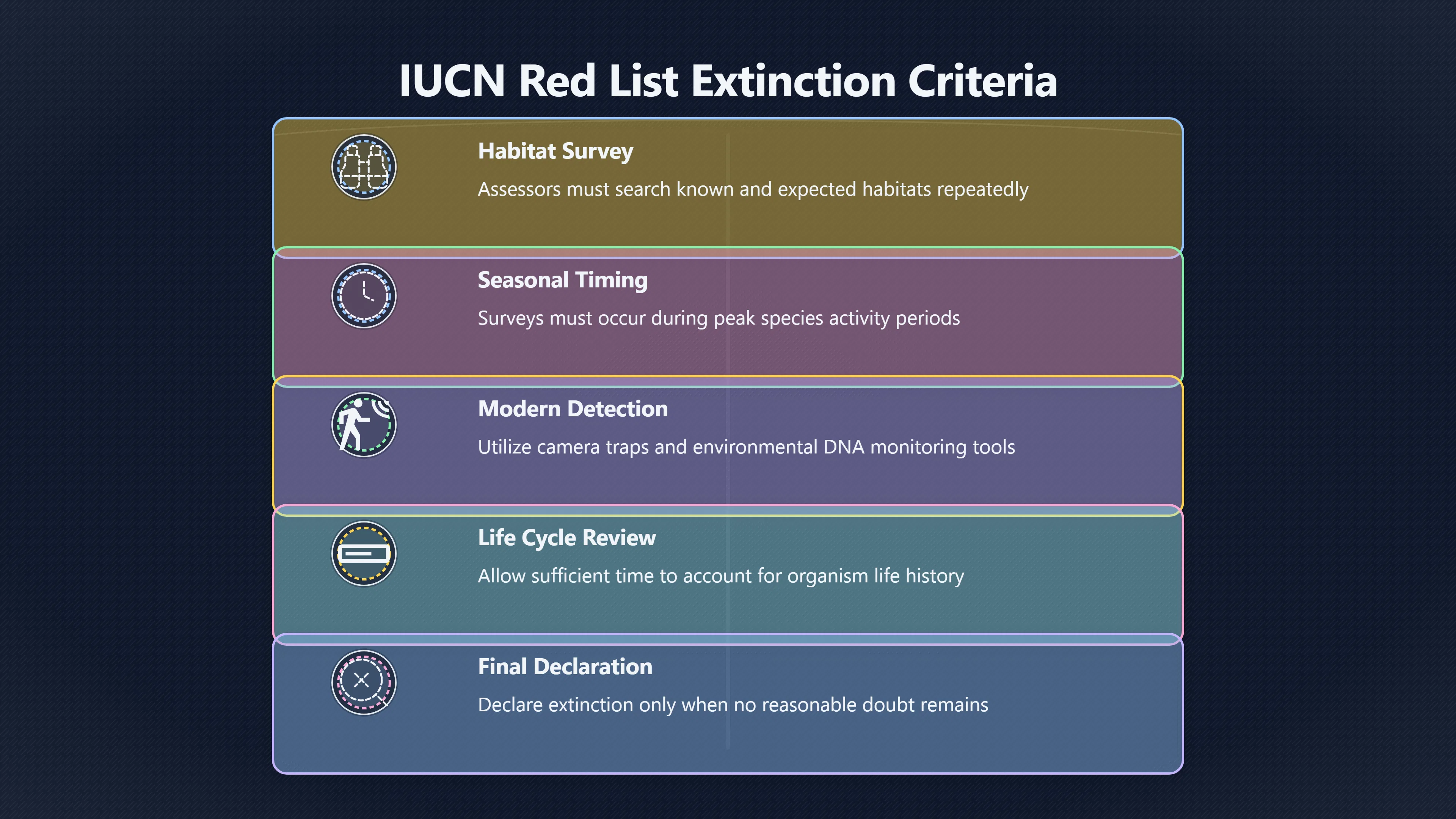
- Have known habitats been searched repeatedly?
- Have likely but unsurveyed habitats also been examined?
- Were surveys conducted during the species’ active season?
- Were modern detection methods used where appropriate, such as camera traps, acoustic monitoring, environmental DNA, or targeted field searches?
- Has enough time passed to account for the species’ life cycle and detectability?[IUCN Red List+2IUCN Portals]nc.iucnredlist.orgOpen source on iucnredlist.org.</div>
The standard therefore evaluates both the quantity and quality of searching. A species missing for decades is not automatically extinct if surveys have been sparse or poorly targeted. Conversely, a relatively short period without records may support extinction if intensive searches repeatedly fail to detect an organism that should be easy to find.
This distinction matters because non-detection is always probabilistic. The IUCN framework attempts to reduce uncertainty rather than eliminate it completely.
Why “Possibly Extinct” Is Different from Extinct
Recognising that uncertainty remains even after extensive surveys, conservationists developed intermediate approaches. One of the most influential has been the use of the informal “Possibly Extinct” marker for species that are likely gone but for which definitive extinction cannot yet be demonstrated. Research on rediscovered species helped motivate this practice, and the marker became incorporated into Red List assessment procedures for certain critically endangered taxa.[PMC]pmc.ncbi.nlm.nih.govPMCThe World's Rediscovered Species: Back from the Brink?by BR Scheffers · 2011 · Cited by 127 — This marker (“Possibly Extinct”) is now incorporated into the IUCN system. Many rediscovered s…
This category serves several purposes.
First, it acknowledges serious concern without overstating certainty. Second, it encourages continued searches in cases where survival remains biologically plausible. Third, it prevents extinction statistics from being inflated by species whose status remains unresolved.
The existence of such a category demonstrates that conservation bodies do not treat extinction as a simple binary decision. Between “known alive” and “confirmed extinct” lies a zone of uncertainty that may persist for years or even decades.[PMC]pmc.ncbi.nlm.nih.govPMCThe World's Rediscovered Species: Back from the Brink?by BR Scheffers · 2011 · Cited by 127 — This marker (“Possibly Extinct”) is now incorporated into the IUCN system. Many rediscovered s…
Rediscoveries That Justify the Caution
The caution built into IUCN procedures is not theoretical. Numerous species presumed extinct or feared extinct have later reappeared.
Research on rediscovered species has documented hundreds of cases across birds, mammals, amphibians, reptiles, fishes and invertebrates. Many had gone unrecorded for decades before targeted surveys located surviving populations.[PMC]pmc.ncbi.nlm.nih.govPMCThe World's Rediscovered Species: Back from the Brink?by BR Scheffers · 2011 · Cited by 127 — This marker (“Possibly Extinct”) is now incorporated into the IUCN system. Many rediscovered s…
Recent examples continue to reinforce the point. The Barbados threadsnake, absent from records for around two decades and considered among the world’s “lost” species, was rediscovered during focused field surveys. Conservationists subsequently shifted attention from proving survival to protecting its remaining habitat.[The Guardian]theguardian.comIt was found during a March ecological survey by the Barbadian environment ministry and the conservation group Re:wild. Measuring up to 1…
Similarly, species such as Wellington’s solitary coral in the Galápagos and the Monte Gordo grasshopper of Cape Verde were rediscovered after years of presumed disappearance, often because researchers searched previously overlooked habitats or applied more targeted methods.[SFGATE]sfgate.comSan Francisco researchers rediscover species once presumed extinctPreviously last seen in 2000 and presumed extinct, the coral was located by chance during a dive near Tagus Cove on Isabela Island, as sc…
These cases validate the IUCN’s reluctance to declare extinction prematurely. They show that even extensive scientific knowledge can contain gaps.
How the Standard Limits Cryptid Analogies
Rediscoveries are frequently cited in cryptozoological arguments. The reasoning is straightforward: if species believed extinct have survived unnoticed, then perhaps other unconfirmed animals survive as well.
The IUCN framework supports only a much narrower conclusion.
Rediscovered species typically share several characteristics:
- They were already known to science.
- Physical specimens or historical records existed.
- Their former distribution was documented.
- Their survival required only a small remnant population.
- Rediscovery eventually produced verifiable evidence such as specimens, photographs, genetic data or repeated observations.[PMC]pmc.ncbi.nlm.nih.govPMCThe World's Rediscovered Species: Back from the Brink?by BR Scheffers · 2011 · Cited by 127 — This marker (“Possibly Extinct”) is now incorporated into the IUCN system. Many rediscovered s…
Many famous cryptids differ fundamentally from this pattern. Claims may involve large-bodied animals, populations requiring substantial breeding numbers, habitats that have been intensively studied, or decades of alleged sightings without corresponding physical evidence.
The lesson from Lazarus taxa is therefore not that absence of evidence is meaningless. It is that evidence thresholds matter. Conservation science accepts that rare species can be missed, but it also demands increasingly strong reasons to believe in survival as searches accumulate and evidence fails to appear.
The Balance Between Skepticism and Hope
The IUCN extinction standard represents a deliberate balance between two errors. One error is declaring extinction too soon and abandoning a species that still survives. The other is maintaining belief in survival long after the evidence points the other way.
Rediscoveries show why caution is necessary. Some species genuinely persist beyond what scientists expect. Yet the same framework that protects against premature extinction declarations also imposes discipline on survival claims. A species is not kept alive by rumours alone, and a rediscovery becomes scientifically meaningful only when supported by verifiable evidence.
For cryptozoology, this is the central lesson of extinction policy. The possibility of overlooked survival is real enough to justify careful searching, but not strong enough to suspend normal standards of proof. The high bar for declaring extinction exists because nature can surprise researchers. The equally high bar for accepting survival claims exists for exactly the same reason.
eBay marketplace picks
Marketplace Samples
Live-tested eBay searches with available results related to this page.


Endnotes
1.
Source: portals.iucn.org
Link:https://portals.iucn.org/library/sites/library/files/documents/RL-2001-001-2nd.pdf
2.
Source: portals.iucn.org
Link:https://portals.iucn.org/library/sites/library/files/documents/RL-2001-001.pdf
3.
Source: portals.iucn.org
Link:https://portals.iucn.org/library/node/10315
4.
Source: pmc.ncbi.nlm.nih.gov
Title: PMCThe World’s Rediscovered Species: Back from the Brink?
Link:https://pmc.ncbi.nlm.nih.gov/articles/PMC3144889/
5.
Source: sfgate.com
Title: San Francisco researchers rediscover species once presumed extinct
Link:https://www.sfgate.com/local/article/sf-researchers-rediscover-species-presumed-extinct-20402699.php
6.
Source: iucn.org
Link:https://iucn.org/
7.
Source: iucn.org
Link:https://iucn.org/resources/conservation-tool/iucn-red-list-threatened-species
8.
Source: youtube.com
Title: The IUCN Red List: A Barometer of Life
Link:https://www.youtube.com/watch?v=VukyqMajAOU
9.
Source: iucnredlist.org
Link:https://www.iucnredlist.org/
10.
Source: nc.iucnredlist.org
Link:https://nc.iucnredlist.org/redlist/content/attachment_files/RedListGuidelines.pdf
11.
Source: iucnredlist.org
Link:https://www.iucnredlist.org/about/faqs
12.
Source: theguardian.com
Link:https://www.theguardian.com/environment/2025/jul/24/worlds-smallest-snake-rediscovered-in-barbados-20-years-after-last-sighting
13.
Source: researchgate.net
Title: IUC N red list status of rediscovered mammals
Link:https://www.researchgate.net/figure/UCN-red-list-status-of-rediscovered-mammals-EX-extinct-CR-EX-critically_fig3_228091966
14.
Source: researchgate.net
Link:https://www.researchgate.net/publication/387621866_IUCN_Red_List_criteria_fail_to_recognise_most_threatened_and_extinct_species
15.
Source: researchgate.net
Title: Secrecy considerations for conserving Lazarus species
Link:https://www.researchgate.net/publication/262194906_Secrecy_considerations_for_conserving_Lazarus_species
16.
Source: iucnredlist.org
Link:https://www.iucnredlist.org/resources/summary-statistics
17.
Source: Wikipedia
Title: International Union for Conservation of Nature
Link:https://en.wikipedia.org/wiki/International_Union_for_Conservation_of_Nature
18.
Source: Wikipedia
Title: IUCN Red List
Link:https://en.wikipedia.org/wiki/IUCN_Red_List
19.
Source: environment.nt.gov.au
Link:https://environment.nt.gov.au/consultations-decisions-policies/nt-threatened-species-review-2020/iucn-categories
20.
Source: eatforhealth.gov.au
Link:https://www.eatforhealth.gov.au/guidelines/guidelines
21.
Source: artensterben.de
Title: iucn red list 2025 extinct species
Link:https://www.artensterben.de/en/iucn-red-list-2025-extinct-species/
22.
Source: youtube.com
Link:https://www.youtube.com/watch?v=fuB-QhC3t0M
23.
Source: scribd.com
Link:https://www.scribd.com/presentation/116565124/Iucn
Additional References
24.
Source: livingrainforest.org
Link:https://livingrainforest.org/learning-resources/iucn-conservation-status-explained
25.
Source: rewild.org
Link:https://www.rewild.org/lost-species/lost-species-found
26.
Source: iucnssg.org
Link:https://www.iucnssg.org/iucnredlist.html
27.
Source: washingtonpost.com
Link:https://www.washingtonpost.com/science/2025/05/25/monte-gordo-grasshopper-discovery/
28.
Source: quizlet.com
Link:https://quizlet.com/mt/303240994/01-e-the-iucn-red-list-categories-and-criteria-flash-cards/
29.
Source: timesofindia.indiatimes.com
Link:https://timesofindia.indiatimes.com/etimes/trending/worlds-smallest-snake-barbados-threadsnake-rediscovered-after-20-years-know-why-it-matters-more-than-its-size/articleshow/122911373.cms
30.
Source: researchgate.net
Link:https://www.researchgate.net/publication/260151562_Detecting_Extinction_Risk_from_Climate_Change_by_IUCN_Red_List_Criteria
31.
Source: quizlet.com
Title: 01e the iucn red list categories and criteria flash cards
Link:https://quizlet.com/303283418/01e-the-iucn-red-list-categories-and-criteria-flash-cards/
32.
Source: bundesumweltministerium.de
Title: international union for the conservation of nature iucn
Link:https://www.bundesumweltministerium.de/en/topics/nature-and-biological-diversity/international-biological-diversity/international-union-for-the-conservation-of-nature-iucn
33.
Source: zslpublications.onlinelibrary.wiley.com
Title:’Lost’ taxa and their conservation implications
Link:https://zslpublications.onlinelibrary.wiley.com/doi/10.1111/acv.12788
Topic Tree