Within Hidden Mammals
The echidna rediscovery built on local knowledge
Attenborough's long-beaked echidna shows how Indigenous knowledge, remote terrain and cameras can reopen a lost-species case.
On this page
- Why the Cyclops Mountains mattered
- How local surveys shaped the search
- What the camera trap record changed
Page outline Jump by section
Introduction
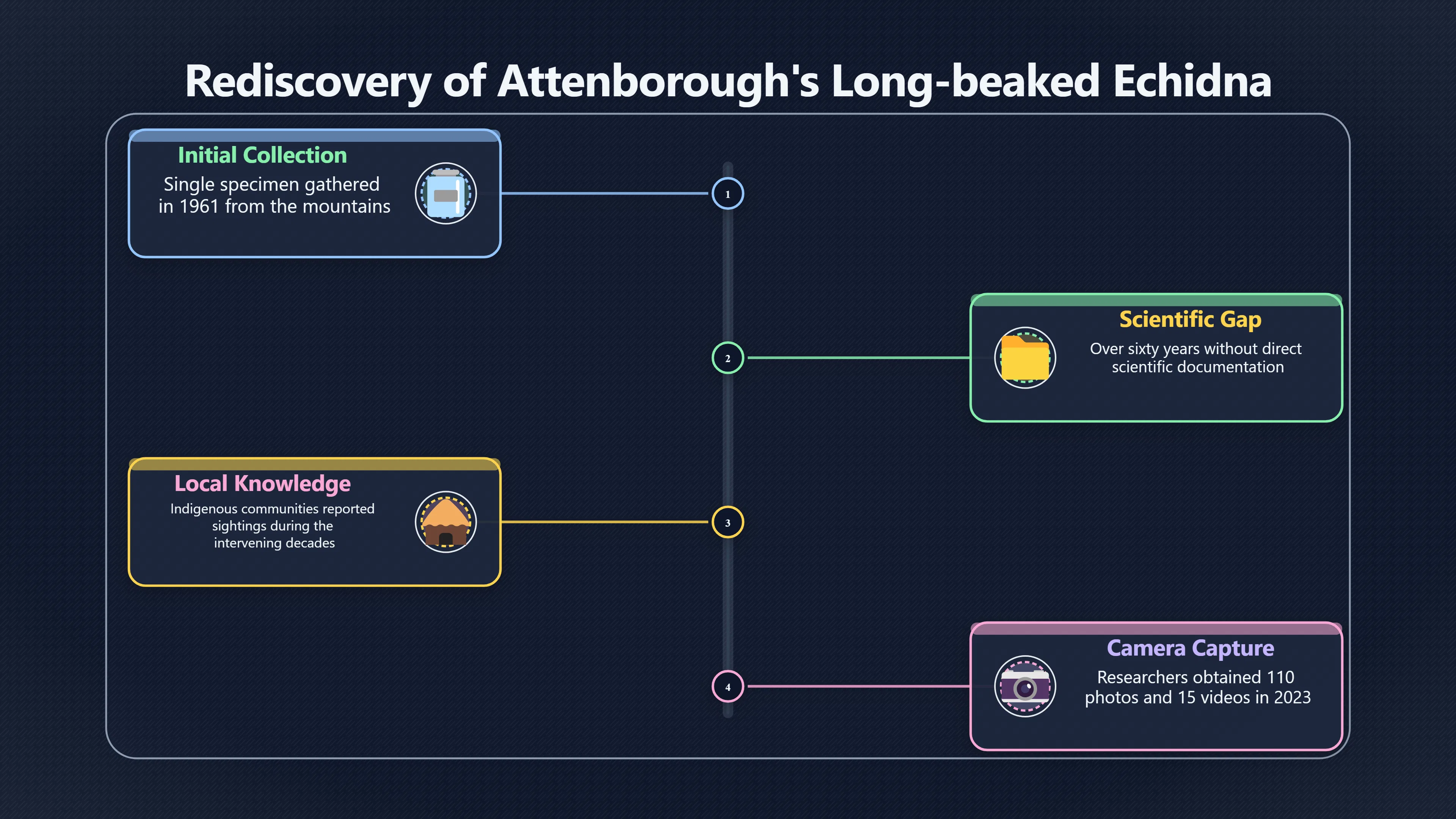
Attenborough’s long-beaked echidna is one of the clearest modern examples of how a “lost species” can move from rumour-like status back into documented zoology. For more than sixty years, the species was known scientifically from a single specimen collected in 1961 in Indonesia’s Cyclops Mountains. Yet local communities continued to report its presence long after outside science had lost direct evidence. When researchers finally obtained camera-trap photographs and videos in 2023, the rediscovery did not emerge from technology alone. It depended on Indigenous and local knowledge that guided where, when and how researchers searched. In the context of cryptozoology, the case is significant because it shows how local observations can preserve accurate information about a rare animal while also demonstrating that claims ultimately require verifiable evidence.[Nature]nature.comAttenborough's echidna rediscovered by combining…by G Morib · 2025 · Cited by 3 — In 2022 and 2023, we deployed camera-traps in…
Why the Cyclops Mountains mattered
How local surveys shaped the search
The eventual rediscovery was not the result of researchers randomly placing cameras across the mountains. Before large-scale camera-trapping began, scientists and local partners conducted participatory mapping exercises and Indigenous and local knowledge surveys in 2017 and 2018. These efforts sought to identify where people believed echidnas still occurred, what habitats they preferred and what signs they left behind.[Nature]nature.comAttenborough's echidna rediscovered by combining…by G Morib · 2025 · Cited by 3 — In 2022 and 2023, we deployed camera-traps in…
Several strands of information emerged:<div class="content-enhancement content-enhancement--insight-grid" markdown="1">
- Local people reported recent sightings despite the absence of scientific records.
- Communities shared knowledge about habitats where echidnas were most likely to occur.
- Researchers learned how to recognise traces such as distinctive foraging signs known as “nose pokes,” created when echidnas probe the soil for invertebrates.
- Participatory mapping highlighted areas with a higher probability of persistence.[Nature]nature.comAttenborough's echidna rediscovered by combining…by G Morib · 2025 · Cited by 3 — In 2022 and 2023, we deployed camera-traps in…</div>
The process helped narrow a vast search area into locations with realistic chances of success. Researchers later stated that Indigenous and local knowledge informed where cameras should be placed, how field teams should search for evidence and, crucially, why they believed the species was still present in the first place.[Nature]nature.comAttenborough's echidna rediscovered by combining…by G Morib · 2025 · Cited by 3 — In 2022 and 2023, we deployed camera-traps in…
This approach differs from a common stereotype in which local reports are treated merely as anecdotes awaiting scientific correction. Instead, the echidna project treated local knowledge as a source of testable ecological information. Camera traps then served as the verification tool.[Nature]nature.comAttenborough's echidna rediscovered by combining…by G Morib · 2025 · Cited by 3 — In 2022 and 2023, we deployed camera-traps in…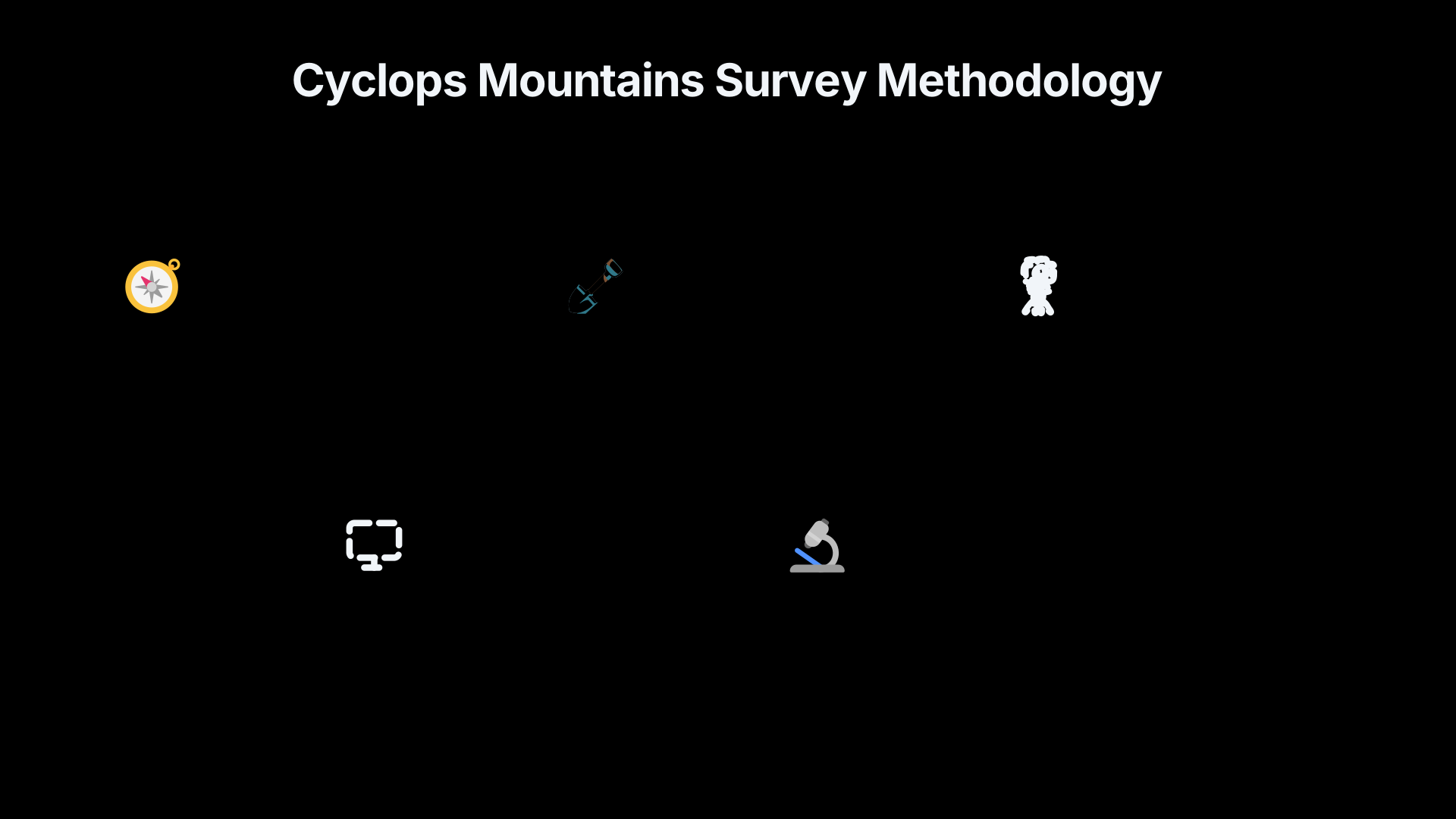
What the camera-trap record changed
The 2022 survey failed to obtain photographic proof of the species. Rather than disproving local reports, the result highlighted how difficult the animal was to detect. Researchers refined their approach and continued surveying. During the 2023 expedition, cameras placed at higher elevations finally recorded Attenborough’s long-beaked echidna.[Nature]nature.comAttenborough's echidna rediscovered by combining…by G Morib · 2025 · Cited by 3 — In 2022 and 2023, we deployed camera-traps in…
The evidence was far stronger than a single image. Researchers obtained 110 photographs from 26 independent capture events as well as 15 videos. The material allowed specialists to distinguish the species from other long-beaked echidnas by examining diagnostic features.[Nature]nature.comAttenborough's echidna rediscovered by combining…by G Morib · 2025 · Cited by 3 — In 2022 and 2023, we deployed camera-traps in…
The recordings changed several things at once:<div class="content-enhancement content-enhancement--insight-grid" markdown="1">
- They confirmed that the species had survived more than six decades without scientific documentation.
- They transformed local reports from plausible but unverified claims into evidence-supported observations.
- They demonstrated that targeted camera-trapping informed by local expertise could succeed where broader surveys had failed.
What the echidna case means for cryptozoology
Attenborough’s long-beaked echidna occupies an unusual position in discussions about hidden animals. Before 2023, it resembled a classic lost-species mystery: a remote mountain range, decades without confirmation and scattered reports from people familiar with the landscape. Yet the rediscovery does not validate every claim about unknown creatures.
Instead, the case highlights a more specific lesson. Indigenous and local knowledge can preserve accurate information about rare animals long after formal scientific records disappear. However, that knowledge becomes most powerful when it guides systematic investigation rather than replacing it. In the Cyclops Mountains, local observations identified where to look, while camera traps provided the evidence needed for scientific confirmation.[Nature]nature.comAttenborough's echidna rediscovered by combining…by G Morib · 2025 · Cited by 3 — In 2022 and 2023, we deployed camera-traps in…
The rediscovery therefore stands as a model of cooperation rather than a triumph of folklore over science or science over local tradition. The species was found because people who knew the mountains and people who brought specialised survey tools worked together. In a field often divided between belief and scepticism, the echidna search demonstrates how credible lost-species investigations can bridge that gap.[Nature+2EDGE of Existence]nature.comAttenborough's echidna rediscovered by combining…by G Morib · 2025 · Cited by 3 — In 2022 and 2023, we deployed camera-traps in…
Amazon book picks
Further Reading
Books and field guides related to The echidna rediscovery built on local knowledge. Use these as the next step if you want deeper reading beyond the article.
Abominable Science!
Provides context for separating anecdote from verifiable evidence.
eBay marketplace picks
Marketplace Samples
Live-tested eBay searches with available results related to this page.



Endnotes
1.
Source: nature.com
Link:https://www.nature.com/articles/s44185-025-00086-6
2.
Source: news.mongabay.com
Link:https://news.mongabay.com/short-article/camera-traps-and-indigenous-knowledge-help-confirm-presence-of-lost-echidna-species/
3.
Source: ora.ox.ac.uk
Link:https://ora.ox.ac.uk/objects/uuid%3A75c7d5c5-72e6-4cf7-b6d6-cde477e68a16
4.
Source: ox.ac.uk
Link:https://www.ox.ac.uk/news/2023-11-10-found-last-bizarre-egg-laying-mammal-finally-rediscovered-after-60-years
5.
Source: abcnews.com
Link:https://abcnews.com/US/scientists-confirmed-existence-200-million-year-species-thought/story?id=122773046
6.
Source: edgeofexistence.org
Link:https://www.edgeofexistence.org/projects/safeguarding-attenboroughs-long-beaked-echidna-extinction/
7.
Source: ox.ac.uk
Link:https://www.ox.ac.uk/
8.
Source: Wikipedia
Link:https://en.wikipedia.org/wiki/Oxford
Additional References
9.
Source: oxfordhouse.org
Link:https://www.oxfordhouse.org/
10.
Source: rewild.org
Title: found egg laying mammal last recorded in 1961 waddles its way back into view
Link:https://www.rewild.org/press/found-egg-laying-mammal-last-recorded-in-1961-waddles-its-way-back-into-view
11.
Source: pmc.ncbi.nlm.nih.gov
Title: PMCAttenborough’s echidna rediscovered by combining
Link:https://pmc.ncbi.nlm.nih.gov/articles/PMC12069574/
12.
Source: oxfordlearnersdictionaries.com
Link:https://www.oxfordlearnersdictionaries.com/us/
13.
Source: abc.net.au
Title: long beaked echidna rediscovered in papua mountains
Link:https://www.abc.net.au/news/2023-11-10/long-beaked-echidna-rediscovered-in-papua-mountains/103089936
14.
Source: discoverwildlife.com
Title: attenboroughs long beaked echidna rediscovered
Link:https://www.discoverwildlife.com/animal-facts/mammals/attenboroughs-long-beaked-echidna-rediscovered
15.
Source: instagram.com
Link:https://www.instagram.com/reel/DLVrMauNXUE/
16.
Source: facebook.com
Link:https://www.facebook.com/thebrainmazeofficial/posts/the-long-beaked-echidna-caught-on-camera-believed-extinct-for-over-60-years-the-/739778968705699/
17.
Source: internationalconservationfund.org
Title: ICF -Attenborough’s Long-beaked Echidna
Link:https://internationalconservationfund.org/attenboroughs-long-beaked-echidna/
18.
Source: researchgate.net
Link:https://www.researchgate.net/publication/391663261_Attenborough%27s_echidna_rediscovered_by_combining_Indigenous_knowledge_with_camera-trapping
Topic Tree