Within New Species
Where Unknown Species Are Most Plausible
Remote forests, caves, reefs, and seafloor habitats can still hold unknown species because ordinary surveys rarely reach them well.
On this page
- Habitats where surveys remain difficult
- Why under sampling matters more than mystery fame
- How plausible habitats differ from famous cryptid locations
Page outline Jump by section
Introduction
If unknown animal species remain to be discovered, the most plausible places to find them are usually not the locations made famous by cryptid stories. They are habitats that scientists have sampled only rarely, incompletely, or with limited technology. In biodiversity research, the strongest predictor of future discoveries is often under-sampling rather than mystery. Remote tropical forests, cave systems, deep coral habitats, ocean trenches, hydrothermal vent fields, groundwater networks and seafloor environments continue to yield species that were previously unknown to science because they are difficult, expensive or dangerous to study.[ResearchGate+2Coastal Wiki]researchgate.netunique attributes of the world's largest ecosystemSeptember 1, 2010 — 13 Sept 2010 — Nevertheless, the deep sea is still most… This distinction matters in discussions of cryptozoology. Real undiscovered species are most likely to exist in places where observation is sparse and biological inventories remain incomplete. They are less likely to be large animals repeatedly reported in heavily visited areas. Understanding where surveys remain weak helps explain why species discovery continues without providing strong support for most famous cryptid claims.
Habitats Where Surveys Remain Difficult
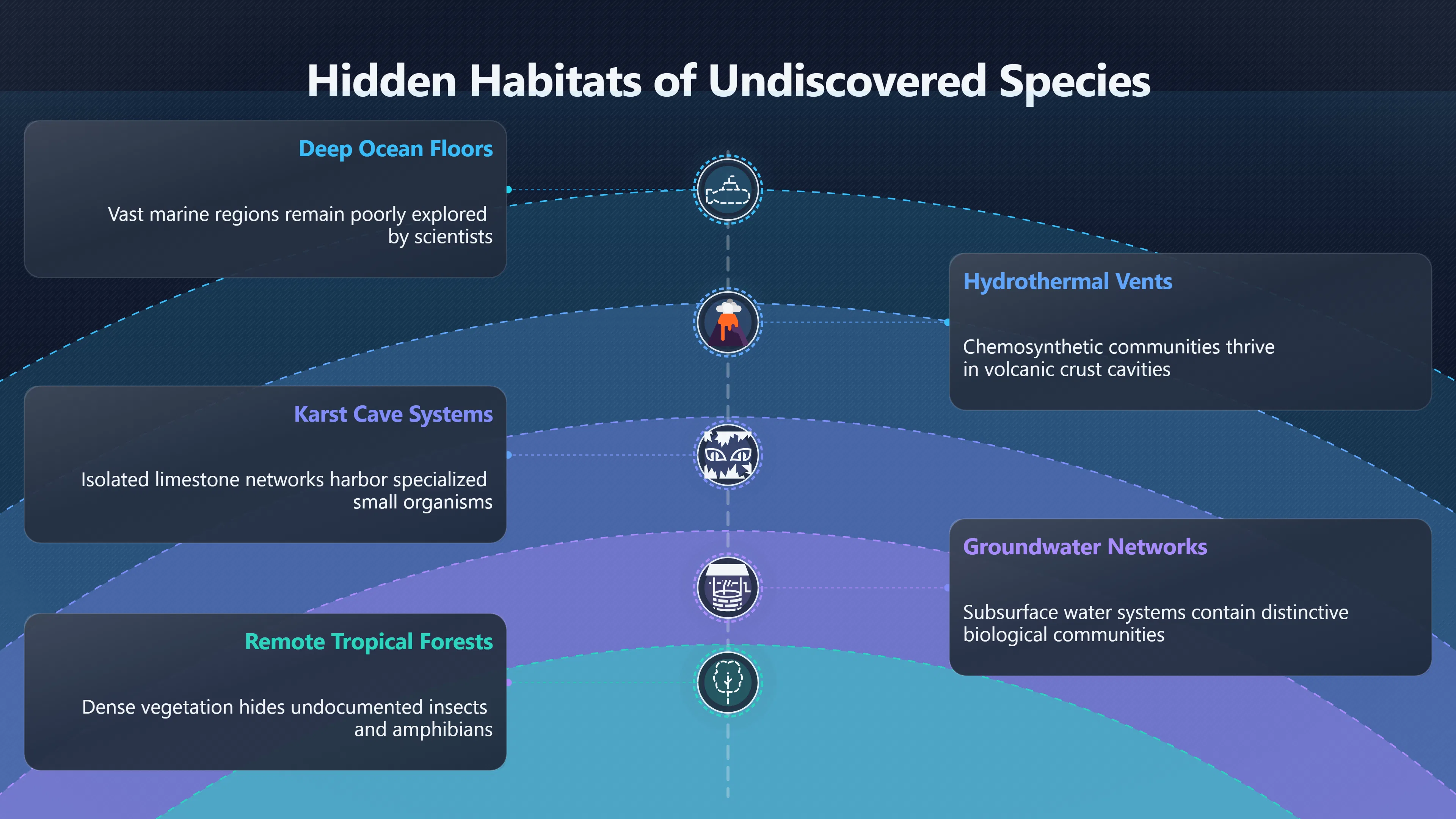
Deep ocean floors and trenches
The deep sea is the largest habitat on Earth, yet much of it remains poorly explored. Researchers have repeatedly noted that discovery rates for deep-sea species remain high, even after more than a century of marine science. Many areas are visited only occasionally because exploration requires specialised ships, remotely operated vehicles, deep-diving submersibles and substantial funding.[ResearchGate]researchgate.netunique attributes of the world's largest ecosystemSeptember 1, 2010 — 13 Sept 2010 — Nevertheless, the deep sea is still most…
Recent discoveries illustrate how incomplete knowledge remains. Ocean Census, an international effort focused on accelerating marine species discovery, argues that the vast majority of marine species remain undescribed and has already reported hundreds of newly discovered marine organisms from expeditions to poorly explored regions.[Ocean Census+2Ocean Census]oceancensus.orgOcean CensusThe Ocean Census | Discover LifeCurrently, over 90% of ocean species remain undiscovered, far less is protected and much is u…
Even well-known ocean regions can produce surprises. Expeditions to remote seamounts, trenches and Southern Ocean habitats have recently revealed dozens of previously unknown species, including crustaceans, worms, corals and sponges. Researchers involved in these projects consistently describe such regions as profoundly under-sampled rather than mysterious.[People.com+2The Guardian]people.comThese findings emphasize the biodiversity of deep-sea environments and offer valuable insights for conservation and marine park managemen…
Hydrothermal vents and the subseafloor
Hydrothermal vents are among the most biologically unusual habitats on Earth. Since their discovery in 1977, scientists have repeatedly found species that exist nowhere else. Vent communities rely on chemosynthesis rather than sunlight, supporting dense ecosystems in otherwise food-poor deep-sea environments.[PMC]pmc.ncbi.nlm.nih.govPMCThe Discovery of New Deep-Sea Hydrothermal Ventby AD Rogers · 2012 · Cited by 330 — Since the first discovery of deep-sea hydrothermal vents along the Galápagos Rift in 1977, numero…
What makes these habitats especially important for undiscovered-species discussions is that even apparently studied vent systems can contain unexplored spaces. In 2023 and 2024, researchers discovered animal communities living beneath hydrothermal vents inside cavities in volcanic crust. Worms, snails and other organisms occupied habitats that scientists had largely overlooked for decades because most research focused on the vent surfaces themselves.[naturetoday.com+2Schmidt Ocean Institute]naturetoday.comScientists discover new ecosystem underneath…21 Aug 2023 — Using an underwater robot, scientists overturned chunks of volcanic crust…
The lesson is significant: unknown species can persist not because they are legendary, but because researchers have not yet searched every ecological niche within a known environment.
Caves, karst systems and groundwater
Caves are classic examples of habitats where isolation and limited access create opportunities for undiscovered biodiversity. Many cave organisms are small, highly specialised and restricted to single cave networks or limestone formations. Because surveys are often geographically patchy, new species continue to emerge whenever unexplored cave systems receive detailed attention.[Coastal Wiki+2Fauna & Flora]coastalwiki.orgNewly explored habitatsCoastal WikiNewly explored habitats11 Sept 2020 — Shallow-water marine caves and the deep sea. Marine caves located in the littoral zone…
A recent survey of more than sixty karst caves in Cambodia uncovered multiple species new to science, demonstrating how quickly discoveries can accumulate when neglected cave systems are examined systematically.[Fauna & Flora]fauna-flora.orgThey uncovered a treasureFauna & FloraSpotlighting the wildlife of Cambodia's karst caves23 Mar 2026 — In 2025, Fauna & Flora led a biodiversity survey exploring…
Groundwater ecosystems are similarly overlooked. Unlike surface rivers or lakes, these environments are difficult to access directly and often require specialised sampling methods. As a result, they receive far less scientific attention than more visible habitats despite harbouring distinctive biological communities.[BioAgora]bioagora.eucoral reefs (6072) have attracted more research. 118 attention than less accessible habitats like caves (2478), groundwater (2531) or dee…
Remote tropical forests
Tropical forests remain among the richest ecosystems on Earth, but many regions are still incompletely surveyed. Dense vegetation, difficult terrain, political instability, seasonal accessibility and limited taxonomic expertise all contribute to under-sampling. New species are frequently found not because forests are untouched wildernesses hiding giant animals, but because countless insects, amphibians, reptiles, plants and small vertebrates remain undocumented.
The challenge is particularly acute in forest canopies, mountain slopes and isolated valleys. These areas can be biologically distinct while receiving only intermittent scientific attention. The result is a steady stream of discoveries that fit established ecological expectations rather than dramatic cryptid narratives.
Deep and remote coral habitats
Coral reefs are often associated with shallow tropical waters, but extensive coral communities also occur in deeper and more remote marine environments. Scientists have repeatedly noted that the distribution of deep-sea corals remains unknown across large parts of the ocean because surveys are sparse and technically demanding.[Nature]nature.comUnderwater surveys reveal deep-sea corals in newly…by NF Carvalho · 2023 · Cited by 11 — Here, we defined deep-sea coral species…
High-seas coral ecosystems, deep reef slopes and remote reef complexes frequently contain species assemblages that have never been comprehensively catalogued. These habitats occupy an intermediate position between familiar coastal environments and the extreme deep sea: accessible enough to study, yet still sampled too infrequently to provide complete inventories.[Frontiers]frontiersin.orgFrontiersCoral Reefs of the High Seas: Hidden Biodiversity Hotspots…by D Wagner · 2020 · Cited by 101 — This study offers a definition…
Why Under-Sampling Matters More Than Mystery Fame
A common misunderstanding in cryptozoology is that fame makes a location biologically significant. In reality, scientific plausibility works in the opposite direction. Habitats become promising for discovery when researchers have little data, not when stories about them are widely known.
Several factors increase the likelihood that unknown species remain present:
- Low survey frequency: Areas visited rarely by biologists accumulate large knowledge gaps.
-
Difficult access: Depth, darkness, remoteness or hazardous conditions reduce sampling effort.<div class="content-enhancement content-enhancement--insight-grid" markdown="1">
- High habitat complexity: Environments with many ecological niches can support overlooked species.
- Small or cryptic organisms: Species that are tiny, nocturnal or visually similar to known organisms are easily missed.
- Restricted ranges: Cave species, island species and vent organisms may occur only in very small areas.[ResearchGate+2Coastal Wiki]researchgate.netunique attributes of the world's largest ecosystemSeptember 1, 2010 — 13 Sept 2010 — Nevertheless, the deep sea is still most…</div>
These factors explain why discoveries often emerge from obscure habitats rather than from locations already scrutinised by tourists, amateur investigators, journalists and scientists.
How Plausible Habitats Differ from Famous Cryptid Locations
Many famous cryptid stories focus on places that are actually observed far more intensively than the habitats most associated with modern species discovery. Well-known lakes, national parks and populated forest regions may generate thousands of witness reports, but they also receive decades of human presence, aerial observation, recreational use and scientific study.
By contrast, a deep trench thousands of metres below the ocean surface may receive only a handful of direct observations. A cave system may have never been biologically surveyed. A hydrothermal vent field may be reachable only through expensive deep-sea expeditions. These environments possess genuine information gaps.[ResearchGate+2PMC]researchgate.netunique attributes of the world's largest ecosystemSeptember 1, 2010 — 13 Sept 2010 — Nevertheless, the deep sea is still most…
The distinction affects what kinds of undiscovered species are plausible. Under-sampled habitats may conceal:
- New invertebrates.
- Small fishes.
- Cave-adapted animals.
- Deep-sea crustaceans.
- Corals and sponges.
- Parasites and symbiotic organisms.
- Cryptic species that resemble known species but are genetically distinct.
They are far less likely to conceal large terrestrial mammals that would require extensive populations, broad ranges and frequent interaction with already monitored environments.
What Hidden Habitats Tell Us About Cryptozoology
See on Amazon</a></div></div></article><article class="fr-book-card"><a class="fr-book-cover" href="https://www.amazon.com/s?k=The+Song+Of+The+Dodo+by+David+Quammen&i=stripbooks&tag=searcht-20" target="_blank" rel="sponsored noopener noreferrer" aria-label="Open The Song Of The Dodo on Amazon"><span class="fr-book-cover-fallback">Book</span><img class="fr-book-cover-thumb" src="https://books.google.com/books/content?id=53kuEeItYtIC&printsec=frontcover&img=1&zoom=1&edge=curl&source=gbs_api" alt="Cover for The Song Of The Dodo" loading="lazy" decoding="async" fetchpriority="low" referrerpolicy="no-referrer" onerror="this.hidden=true;this.closest('.fr-book-cover').classList.add('fr-book-cover-placeholder');"></a><div class="fr-book-info"><h4 class="fr-book-title"><a href="https://www.amazon.com/s?k=The+Song+Of+The+Dodo+by+David+Quammen&i=stripbooks&tag=searcht-20" target="_blank" rel="sponsored noopener noreferrer" title="The Song Of The Dodo">The Song Of The Dodo</a></h4><p class="fr-book-author">By David Quammen</p><p class="fr-book-desc">Explains biodiversity patterns and underexplored habitats.</p><div class="fr-book-actions"><a href="https://www.amazon.com/s?k=The+Song+Of+The+Dodo+by+David+Quammen&i=stripbooks&tag=searcht-20" class="fr-amazon-btn" target="_blank" rel="sponsored noopener noreferrer">
See on Amazon</a></div></div></article><article class="fr-book-card"><a class="fr-book-cover" href="https://www.amazon.com/s?k=The+Sixth+Extinction+by+Elizabeth+Kolbert&i=stripbooks&tag=searcht-20" target="_blank" rel="sponsored noopener noreferrer" aria-label="Open The Sixth Extinction on Amazon"><span class="fr-book-cover-fallback">Book</span><img class="fr-book-cover-thumb" src="https://books.google.com/books/content?id=wlnCAwAAQBAJ&printsec=frontcover&img=1&zoom=1&edge=curl&source=gbs_api" alt="Cover for The Sixth Extinction" loading="lazy" decoding="async" fetchpriority="low" referrerpolicy="no-referrer" onerror="this.hidden=true;this.closest('.fr-book-cover').classList.add('fr-book-cover-placeholder');"></a><div class="fr-book-info"><h4 class="fr-book-title"><a href="https://www.amazon.com/s?k=The+Sixth+Extinction+by+Elizabeth+Kolbert&i=stripbooks&tag=searcht-20" target="_blank" rel="sponsored noopener noreferrer" title="The Sixth Extinction">The Sixth Extinction</a></h4><p class="fr-book-author">By Elizabeth Kolbert</p><p class="fr-book-desc">Provides modern biodiversity and discovery context.</p><div class="fr-book-actions"><a href="https://www.amazon.com/s?k=The+Sixth+Extinction+by+Elizabeth+Kolbert&i=stripbooks&tag=searcht-20" class="fr-amazon-btn" target="_blank" rel="sponsored noopener noreferrer">
See on Amazon</a></div></div></article><article class="fr-book-card"><a class="fr-book-cover" href="https://www.amazon.com/s?k=The+Future+of+Life+by+Edward+O.+Wilson&i=stripbooks&tag=searcht-20" target="_blank" rel="sponsored noopener noreferrer" aria-label="Open The Future of Life on Amazon"><span class="fr-book-cover-fallback">Book</span><img class="fr-book-cover-thumb" src="https://books.google.com/books/content?id=2Soam0uCArsC&printsec=frontcover&img=1&zoom=1&source=gbs_api" alt="Cover for The Future of Life" loading="lazy" decoding="async" fetchpriority="low" referrerpolicy="no-referrer" onerror="this.hidden=true;this.closest('.fr-book-cover').classList.add('fr-book-cover-placeholder');"></a><div class="fr-book-info"><h4 class="fr-book-title"><a href="https://www.amazon.com/s?k=The+Future+of+Life+by+Edward+O.+Wilson&i=stripbooks&tag=searcht-20" target="_blank" rel="sponsored noopener noreferrer" title="The Future of Life">The Future of Life</a></h4><p class="fr-book-author">By Edward O. Wilson</p><p class="fr-book-desc">Highlights the vast diversity still being documented by science.</p><div class="fr-book-actions"><a href="https://www.amazon.com/s?k=The+Future+of+Life+by+Edward+O.+Wilson&i=stripbooks&tag=searcht-20" class="fr-amazon-btn" target="_blank" rel="sponsored noopener noreferrer">
See on Amazon</a></div></div></article></div><div class="fr-section-footer"><div class="fr-browse-links" aria-label="Browse more on Amazon"><span class="fr-browse-links-label">Browse more on Amazon:</span><a class="fr-browse-more" href="https://www.amazon.com/s?k=The+Lost+Species&i=stripbooks&tag=searcht-20" target="_blank" rel="sponsored noopener noreferrer">The Lost Species</a><a class="fr-browse-more" href="https://www.amazon.com/s?k=The+Song+Of+The+Dodo&i=stripbooks&tag=searcht-20" target="_blank" rel="sponsored noopener noreferrer">The Song Of The Dodo</a><a class="fr-browse-more" href="https://www.amazon.com/s?k=The+Sixth+Extinction&i=stripbooks&tag=searcht-20" target="_blank" rel="sponsored noopener noreferrer">The Sixth Extinction</a></div><p class="fr-disclosure">As an Amazon Associate I earn from qualifying purchases.</p></div></div></section>
eBay marketplace picks
Marketplace Samples
Live-tested eBay searches with available results related to this page.



Endnotes
1.
Source: researchgate.net
Link:https://www.researchgate.net/publication/307668401_Deep_diverse_and_definitely_different_unique_attributes_of_the_world%27s_largest_ecosystem
2.
Source: bioagora.eu
Link:https://bioagora.eu/knowledge-exchange-networks/freshwater?download=382&file_name=hidden_biodiversity_18jul25.pdf
3.
Source: people.com
Link:https://people.com/hat-wearing-sponge-crab-among-nearly-150-new-animals-discovered-11995630
4.
Source: pmc.ncbi.nlm.nih.gov
Title: PMCThe Discovery of New Deep-Sea Hydrothermal Vent
Link:https://pmc.ncbi.nlm.nih.gov/articles/PMC3250512/
5.
Source: naturetoday.com
Link:https://www.naturetoday.com/intl/en/nature-reports/message/?msg=31144
6.
Source: reuters.com
Link:https://www.reuters.com/science/animals-found-living-underground-near-deep-sea-hydrothermal-vents-2024-10-17/
7.
Source: nature.com
Link:https://www.nature.com/articles/s43247-023-00924-0
8.
Source: coastalwiki.org
Title: Newly explored habitats
Link:https://www.coastalwiki.org/wiki/Newly_explored_habitats
9.
Source: oceancensus.org
Link:https://oceancensus.org/
10.
Source: oceancensus.org
Title: how many ocean species remain undiscovered
Link:https://oceancensus.org/how-many-ocean-species-remain-undiscovered/
11.
Source: oceandecade.org
Title: scientists discover over 1100 new marine species in landmark ocean census
Link:https://oceandecade.org/news/partner-news/scientists-discover-over-1100-new-marine-species-in-landmark-ocean-census/
12.
Source: theguardian.com
Link:https://www.theguardian.com/environment/2025/oct/29/carnivorous-death-ball-sponge-among-new-species-found-in-depths-of-southern-ocean
13.
Source: schmidtocean.org
Title: scientists discover new ecosystem underneath hydrothermal vents
Link:https://schmidtocean.org/scientists-discover-new-ecosystem-underneath-hydrothermal-vents/
14.
Source: fauna-flora.org
Title: They uncovered a treasure
Link:https://www.fauna-flora.org/explained/discoveries-in-the-dark-cambodias-karst-caves/
15.
Source: frontiersin.org
Link:https://www.frontiersin.org/journals/marine-science/articles/10.3389/fmars.2020.567428/full
16.
Source: pmc.ncbi.nlm.nih.gov
Link:https://pmc.ncbi.nlm.nih.gov/articles/PMC2914025/
17.
Source: divernet.com
Title: ocean census targets 100k unknown marine species
Link:https://divernet.com/world-dives/ocean-census-targets-100k-unknown-marine-species/
Additional References
18.
Source: facebook.com
Link:https://www.facebook.com/uniofessex/posts/thirty-previously-unknown-deep-sea-species-including-a-carnivorous-death-ball-sp/1257461066411298/
19.
Source: vliz.be
Link:https://www.vliz.be/imisdocs/publications/114387.pdf
20.
Source: unep-wcmc.org
Title: unep wcmc provides data expertise for major ocean exploration initiative
Link:https://www.unep-wcmc.org/en/news/unep-wcmc-provides-data-expertise-for-major-ocean-exploration-initiative
21.
Source: geomar.de
Title: entdeckung in der tiefsee einzigartiger lebensraum an heissen quellen
Link:https://www.geomar.de/en/news/article/entdeckung-in-der-tiefsee-einzigartiger-lebensraum-an-heissen-quellen
22.
Source: ecomagazine.com
Title: scientists discover new ecosystem underneath hydrothermal vents
Link:https://ecomagazine.com/news/research/scientists-discover-new-ecosystem-underneath-hydrothermal-vents/
23.
Source: oceanographicmagazine.com
Link:https://oceanographicmagazine.com/news/subseafloor-exploration-finds-life-exists-in-incredible-places/
24.
Source: facebook.com
Link:https://www.facebook.com/CSIROnews/posts/new-species-just-dropped-scientists-have-discovered-more-than-110-new-marine-spe/1492318496270160/
25.
Source: europe.oceana.org
Title: habitats in danger dec2006 ENG
Link:https://europe.oceana.org/wp-content/uploads/sites/26/habitats_in_danger_dec2006_ENG.pdf
26.
Source: youtube.com
Title: Exploring the world’s deep coral reefs
Link:https://www.youtube.com/watch?v=Jh0RIFtNc5s
27.
Source: facebook.com
Link:https://www.facebook.com/oceandecade/posts/did-you-know-we-have-yet-to-discover-around-three-quarters-of-the-species-that-l/1303934148436628/
Topic Tree