Within Heuvelmans
Can Monster Reports Become Animal Evidence?
His method made testimony useful, but it also exposed cryptozoology's dependence on unverifiable and ambiguous clues.
On this page
- Reports, tracks and testimony as clues
- How comparative clustering built possible species cases
- Where fuzzy evidence becomes a scientific weakness
Page outline Jump by section
Introduction
Reports, Tracks and Testimony as Clues
Heuvelmans began from a simple observation: zoologists have often learned of animals before obtaining complete scientific proof. Local hunters, travellers and indigenous communities frequently knew of species long before museums acquired specimens. He used examples such as the okapi, giant panda and other once-obscure animals to argue that testimony should not be automatically discarded.[Wikipedia]WikipediaOn the Track of Unknown AnimalsOn the Track of Unknown Animals
His method therefore treated several kinds of indirect evidence as potentially meaningful:<div class="content-enhancement content-enhancement--insight-grid" markdown="1">
- Repeated witness descriptions from different observers.
- Footprints, tracks or other physical traces.
- Historical records and travellers’ accounts.
- Indigenous and local knowledge.
- Photographs, sketches and alleged remains.
How Comparative Clustering Built Possible Species Cases
The distinctive feature of Heuvelmans’ method was comparative clustering. He did not usually rely on a single dramatic sighting. Instead, he assembled large numbers of reports and looked for recurring characteristics.
If dozens of witnesses from different times and places described a creature with similar features, Heuvelmans regarded that repetition as potentially significant. He believed that random errors would produce inconsistent stories, whereas a real animal might generate a recognisable pattern.[Cryptozoological Reference Library]wordpress.comCryptozoological Reference Library Heuvelmans, B1988). The sources and method of …by B HEUVELMANS · Cited by 26 — The animal forms within which some of these "hidden" animals can be…
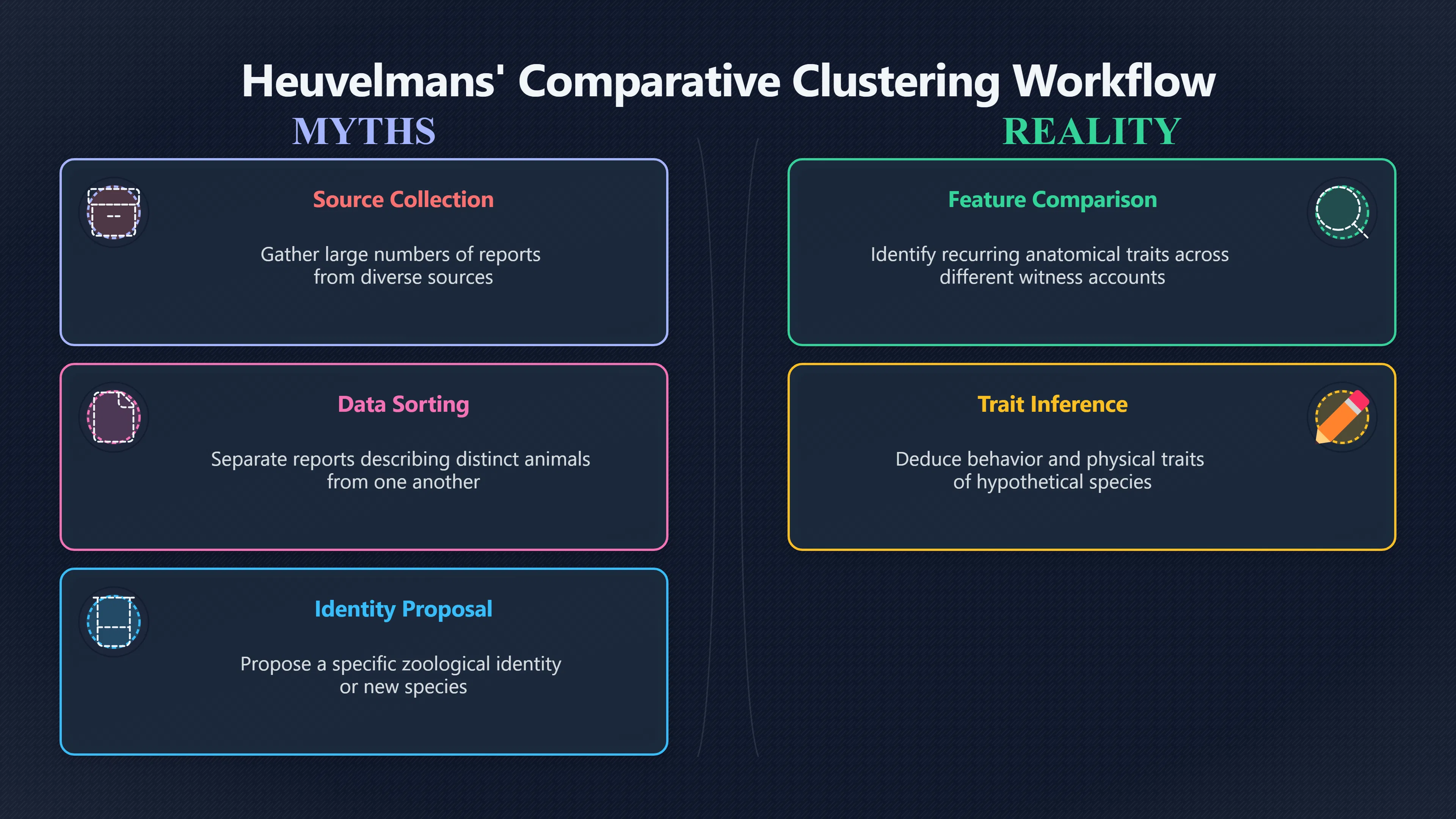
His books often followed the same process:
 <div class="content-enhancement content-enhancement--step-flow" markdown="1">
- Collect reports from many sources.
- Compare descriptions for common features.
- Separate reports that appear to describe different animals.
- Infer anatomical traits and behaviour.
- Propose a zoological identity or an entirely new species. Cryptozoological Reference Library</div>
A revealing example involved the so-called Nandi Bear of East Africa. Rather than assuming every sighting referred to one creature, Heuvelmans compared individual reports and argued that they appeared to describe multiple animals, some known and some possibly unknown. This reflected his broader belief that careful sorting could reveal hidden zoological patterns beneath confused folklore. Cryptid Archives
He later defended this reconstructive approach by arguing that cryptozoology should generate testable predictions. If a reconstructed hidden animal were eventually discovered and matched the prediction, the method would gain support. cryptozoologicalreferencelibrary.files.wordpress.com
Why the Method Appeared Scientific
Part of the appeal of Heuvelmans’ system was that it borrowed tools familiar to science. He classified reports, compared anatomical details, mapped distributions and attempted to fit unknown creatures into established zoological categories. His books were heavily documented and encyclopaedic in scope, giving readers the impression of a systematic research programme rather than simple monster hunting. Wikipedia
The method also addressed a genuine scientific challenge. Rare animals are difficult to study. Deep oceans, remote forests and inaccessible mountains have historically produced unexpected discoveries. Heuvelmans argued that scientists should not assume that all large animals had already been catalogued. Google Books
For supporters, the strength of the approach was that it kept inquiry open. Reports were treated as data to be examined rather than stories to be dismissed. Sage Journals
Where Fuzzy Evidence Becomes a Scientific Weakness
The central criticism is that Heuvelmans’ evidence rarely became stronger than the clues from which it started.
A witness account can be mistaken. A footprint may be misidentified. A photograph may be ambiguous. Folklore can spread between communities and influence later reports. When many weak forms of evidence are combined, critics argue that the result is not necessarily strong evidence. It may simply be a larger collection of uncertain observations. Sage Journals+2ResearchGate
Modern analyses of cryptozoology often describe its evidence base as “fuzzy data”. The term refers to information that is suggestive but difficult to verify independently. Unlike a specimen in a museum or a repeatable experiment, fuzzy data cannot easily be checked by other researchers. Sage Journals
Several methodological problems follow:
- Selection bias: investigators may collect reports that fit a preferred hypothesis while overlooking contradictory evidence.
- Memory distortion: eyewitness recollections change over time.
- Cultural contamination: later witnesses may unknowingly repeat details already circulating in popular culture.
- Multiple explanations: the same report may be explained by known animals, hoaxes, mistakes or environmental conditions.
- Lack of falsification: it is often difficult to determine what evidence would conclusively disprove a proposed hidden animal. Sage Journals+2ResearchGate
The clustering process itself can also become circular. Similar reports may seem to support one another, but if all originate from misidentifications, the apparent pattern may be misleading. A large number of related anecdotes does not automatically become independent confirmation. Wikipedia
The Lasting Tension in the Hidden Animal Method
Heuvelmans’ method remains important because it attempted to solve a real problem: how can investigators study a creature that has not yet been captured or formally described? His answer was to treat indirect clues as the starting point of zoological inquiry and to search for recurring patterns hidden within scattered reports. Cryptozoological Reference Library
Yet the method never fully escaped its dependence on uncertain evidence. The same flexibility that allowed cryptozoologists to investigate alleged hidden animals also made it difficult to distinguish genuine discoveries from folklore, error and wishful thinking. As a result, Heuvelmans left cryptozoology with both its defining research strategy and its most persistent scientific vulnerability. Wikipedia+3Sage Journals+3ResearchGate
Amazon book picks
Further Reading
Books and field guides related to Can Monster Reports Become Animal Evidence?. Use these as the next step if you want deeper reading beyond the article.
Field Guide To Bigfoot, Yeti, & Other Mystery Primates Worldwide
Demonstrates clustering of testimony and sightings.
Why People Believe Weird Things
Explores confirmation bias and interpretation of weak evidence.
eBay marketplace picks
Marketplace Samples
Live-tested eBay searches with available results related to this page.



Endnotes
1.
Source: books.google.com
Title: Books On the Track of Unknown Animals
Link:https://books.google.com/books/about/On_the_Track_of_Unknown_Animals.html?id=OYudQgAACAAJ
2.
Source: Wikipedia
Title: On the Track of Unknown Animals
Link:https://en.wikipedia.org/wiki/On_the_Track_of_Unknown_Animals
4.
Source: researchgate.net
Title: 379174634 Heuvelmans the Heretic and Hidden Animals
Link:https://www.researchgate.net/publication/379174634_Heuvelmans_the_Heretic_and_Hidden_Animals
5.
Source: Wikipedia
Title: Bernard Heuvelmans
Link:https://en.wikipedia.org/wiki/Bernard_Heuvelmans
6.
Source: academia.edu
Title: A Review of Cryptozoology: Towards a Scientific Approach
Link:https://www.academia.edu/20109683/A_Review_of_Cryptozoology_Towards_a_Scientific_Approach_to_the_Study_of_Hidden_Animals_
7.
Source: cryptozoologicalreferencelibrary.files.wordpress.com
Title: heuvelmans 1982
Link:https://cryptozoologicalreferencelibrary.files.wordpress.com/2020/08/heuvelmans-1982.pdf
8.
Source: Wikipedia
Link:https://en.wikipedia.org/wiki/Cryptozoology
9.
Source: youtube.com
Title: Was the Minnesota Iceman Real?
Link:https://www.youtube.com/watch?v=–CbC6XP9jE
10.
Source: youtube.com
Title: On the Track of Unknown Animals | Wikipedia audio article
Link:https://www.youtube.com/watch?v=VMgwBeOC5lY
11.
Source: journals.sagepub.com
Title: Sage Journals Heuvelmans the Heretic and Hidden Animals
Link:https://journals.sagepub.com/doi/10.1177/03080188241233107
12.
Source: cryptidarchives.fandom.com
Link:https://cryptidarchives.fandom.com/wiki/On_the_Track_of_Unknown_Animals
13.
Source: biologyonline.com
Link:https://www.biologyonline.com/articles/cryptozoology-evidence-creatures
14.
Source: heinen.nl
Title: On The Track Of Unknown Animals
Link:https://www.heinen.nl/a/bernard-heuvelmans/on-the-track-of-unknown-animals/9781138977525
Additional References
15.
Source: api.pageplace.de
Link:https://api.pageplace.de/preview/DT0400.9781317845690_A23912824/preview-9781317845690_A23912824.pdf
16.
Source: api.pageplace.de
Link:https://api.pageplace.de/preview/DT0400.9781317848127_A23912929/preview-9781317848127_A23912929.pdf
17.
Source: amazon.nl
Title: On The Track Of Unknown Animals: Heuvelmans, Bernard From the Back Cover
Link:https://www.amazon.nl/-/en/Track-Animals-Bernard-Heuvelmans/dp/1138977527?tag=searcht-20
18.
Source: wearethemutants.com
Title: impossible animals bernard heuvelmans and the making of cryptozoology
Link:https://wearethemutants.com/2020/10/06/impossible-animals-bernard-heuvelmans-and-the-making-of-cryptozoology/
19.
Source: reddit.com
Link:https://www.reddit.com/r/Cryptozoology/comments/1q8swmd/bernard_heuvelmans_a_natural_history_of_hidden/
20.
Source: scribd.com
Link:https://www.scribd.com/document/754080667/Bernard-Heuvelmans-On-the-Track-of-Unknown-Animals-1970
21.
Source: amazon.com
Link:https://www.amazon.com/Natural-History-Animals-Bernard-Heuvelman/dp/0710313330?tag=searcht-20
22.
Source: archive.org
Link:https://archive.org/stream/cryptidstuff/%28Cryptids%29%20On%20The%20Track%20Of%20Unknown%20Animals%20by%20Bernard%20Heuvelmans_djvu.txt
23.
Source: journals.uchicago.edu
Link:https://www.journals.uchicago.edu/doi/10.1086/592667
24.
Source: youtube.com
Title: The Search for Creatures We’ve Never Seen | SLICE EARTH | FULL DOC
Link:https://www.youtube.com/watch?v=wGcf6Q8-XD0
Topic Tree