Within Coelacanth
The Curator Who Saved the Coelacanth
Courtenay-Latimer's quick judgment turned an odd trawler catch into one of the most important zoological finds of the century.
On this page
- Why the trawler catch almost vanished
- How museum judgment preserved the evidence
- What the case says about expertise and chance
Page outline Jump by section
Introduction
The discovery of the coelacanth is often told as a story about a fish that should not have existed. Equally important, however, is the story of the person who prevented that fish from disappearing before anyone realised what it was. In December 1938, museum curator Marjorie Courtenay-Latimer recognised that an unusual trawler catch deserved attention, even though she could not identify it. Her decision to save, document and seek expert advice about the specimen transformed an anonymous bycatch fish into one of the most significant zoological discoveries of the twentieth century. The episode remains one of the clearest examples in both zoology and cryptozoology of how major discoveries can depend on practical judgement exercised before the evidence is fully understood.[Natural History Museum+2Smithsonian Magazine]nhm.ac.ukNatural History MuseumCoelacanths: The fish that 'outdid' the Loch Ness MonsterMarjorie Courtenay-Latimer, curator of the East London Mus…
Why the Trawler Catch Almost Vanished
How Museum Judgement Preserved the Evidence
Recognising that a specimen is unusual is only the first step. Preserving it long enough for experts to examine it is often the harder challenge.
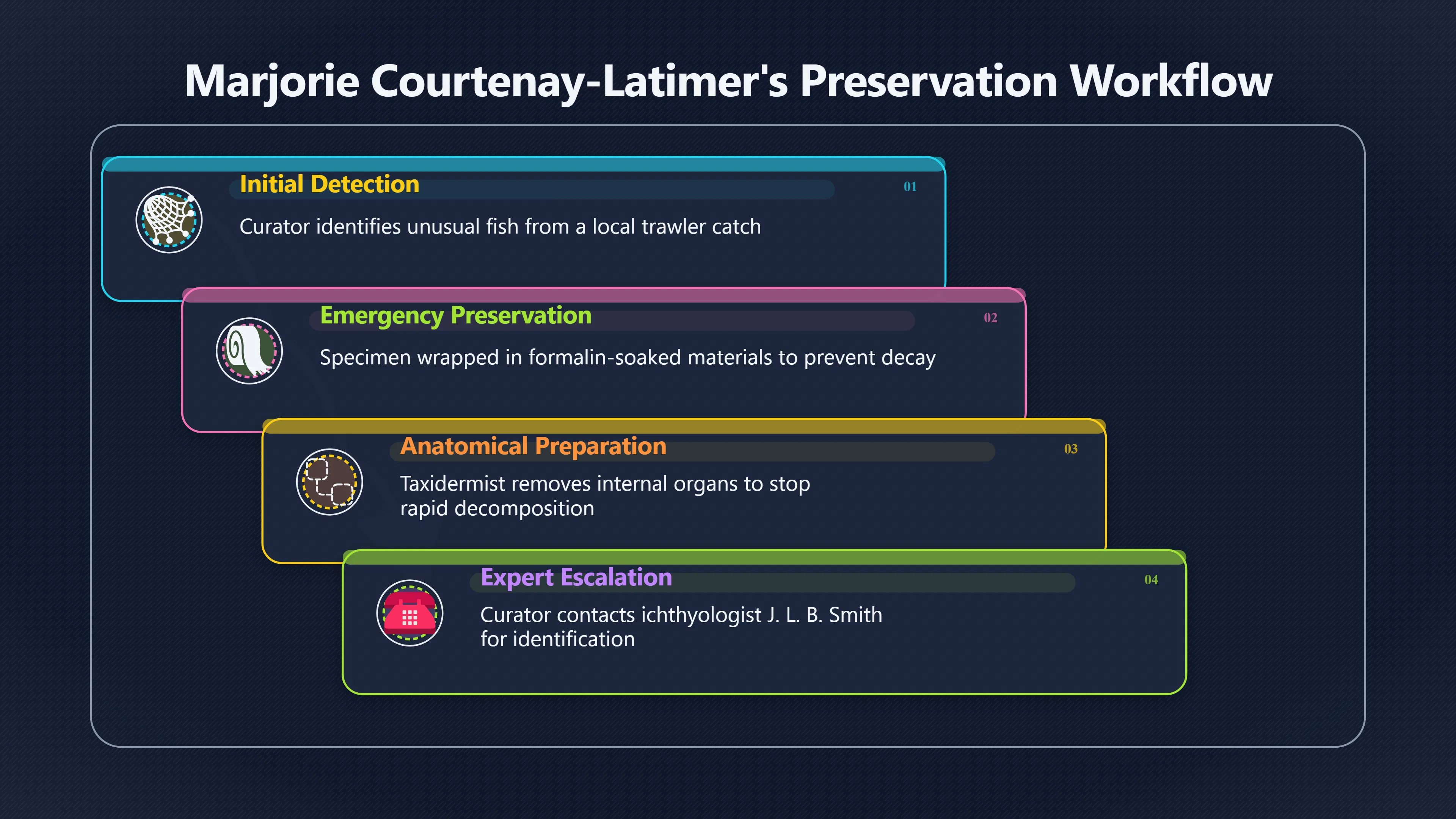
Courtenay-Latimer faced a practical problem: the East London Museum lacked suitable facilities for storing a large fish in the South African summer. She attempted to find refrigeration and sought help from local institutions, but available options proved inadequate. Meanwhile she was trying to contact J. L. B. Smith, the ichthyologist whose expertise she trusted.[Wikipedia]WikipediaMarjorie Courtenay-LatimerMarjorie Courtenay-Latimer
As the specimen began to deteriorate, she worked with taxidermist Robert Center to preserve as much of it as possible. The fish was wrapped in formalin-soaked materials and prepared for mounting. Eventually, because decomposition was advancing and Smith remained unreachable while on holiday, the fish was skinned and its internal organs removed. This decision has sometimes been portrayed as unfortunate because valuable anatomical information was lost. Yet the alternative was likely far worse: complete destruction of the specimen through decay.[Wikipedia]WikipediaMarjorie Courtenay-LatimerMarjorie Courtenay-Latimer
The mounted specimen retained enough key features for scientific identification. When Smith finally examined it in February 1939, he immediately recognised that it belonged to a lineage previously known only from fossils. Without the preserved skin, scales, fins and overall body structure, that recognition might never have occurred.[Natural History Museum]nhm.ac.ukNatural History MuseumCoelacanths: The fish that 'outdid' the Loch Ness MonsterMarjorie Courtenay-Latimer, curator of the East London Mus…
This is a classic implementation lesson in natural-history work. Perfect preservation was impossible. Courtenay-Latimer’s contribution lay in making the best decision available under severe constraints and preserving enough evidence to keep scientific investigation alive.[American Museum of Natural History]amnh.orgAmerican Museum of Natural HistoryDiscovery and Preservation of a CoelacanthThe specimen pulled from the trawling nets of a South African…
Why Recognition Mattered More Than Identification
A common misunderstanding is that Courtenay-Latimer discovered the coelacanth because she identified it as a living representative of an extinct group. In fact, she did not make that taxonomic determination. Smith performed the formal identification and later named the species Latimeria chalumnae in her honour.[Natural History Museum]nhm.ac.ukNatural History MuseumCoelacanths: The fish that 'outdid' the Loch Ness MonsterMarjorie Courtenay-Latimer, curator of the East London Mus…
Her contribution was different and, in many ways, more fundamental. She performed three tasks that occur before scientific classification:<div class="content-enhancement content-enhancement--step-flow" markdown="1">
- Detection – noticing that the specimen was exceptional.
- Preservation – ensuring it survived long enough to be studied.
- Escalation – bringing it to the attention of someone with the relevant expertise.</div>
What the Case Says About Expertise and Chance
The coelacanth story is frequently cited in cryptozoological discussions because it demonstrates that remarkable animals can remain unknown to mainstream science for long periods. Yet the specific lesson is often misunderstood.
The discovery did not emerge from a rumour, a fleeting sighting or a legend. It emerged because an observant curator combined curiosity with disciplined evidence preservation. Chance supplied the unusual fish. Expertise entered through a sequence of decisions: noticing an anomaly, protecting the specimen and consulting the right specialist. Natural History Museum+2American Museum of Natural History[nhm.ac.uk]nhm.ac.ukNatural History MuseumCoelacanths: The fish that 'outdid' the Loch Ness MonsterMarjorie Courtenay-Latimer, curator of the East London Mus…
Courtenay-Latimer herself was not a formally trained ichthyologist. Contemporary accounts describe her as a capable self-taught naturalist who had developed an eye for unusual specimens through years of museum work. Her success therefore illustrates a broader truth about discovery: valuable expertise is not only the ability to provide answers. It is also the ability to recognise when something deserves closer examination.[American Museum of Natural History]amnh.orgAmerican Museum of Natural HistoryDiscovery and Preservation of a CoelacanthThe specimen pulled from the trawling nets of a South African…
For cryptozoology, the lasting lesson is practical rather than romantic. Extraordinary animals become scientifically real not when someone claims to have seen them, but when someone preserves evidence well enough for others to verify. Marjorie Courtenay-Latimer’s decision to save a strange fish before she understood its significance remains one of the strongest demonstrations of that principle.[instagram.com+2Natural History Museum]instagram.com, who saved the specimen for science. #ComeExplore · April 20…
Amazon book picks
Further Reading
Books and field guides related to The Curator Who Saved the Coelacanth. Use these as the next step if you want deeper reading beyond the article.
Abominable Science!
"A sharp analysis of the quest for unreal critters―cryptids, as they are called―and the people who pursue them . . . entertaining and tho...
The Search for the Last Undiscovered Animals
Highlights discoveries made through observation and collection.
The dinosaur hunters
Shows how individuals can transform science by preserving evidence.
eBay marketplace picks
Marketplace Samples
Live-tested eBay searches with available results related to this page.
Endnotes
1.
Source: Wikipedia
Title: Marjorie Courtenay-Latimer
Link:https://en.wikipedia.org/wiki/Marjorie_Courtenay-Latimer
2.
Source: instagram.com
Link:https://www.instagram.com/p/CrSLioeIqfm/
3.
Source: Wikipedia
Title: Marjorie (song)
Link:https://en.wikipedia.org/wiki/Marjorie_%28song%29
4.
Source: Wikipedia
Title: Marjorie Taylor Greene
Link:https://en.wikipedia.org/wiki/Marjorie_Taylor_Greene
5.
Source: Wikipedia
Title: Natural (disambiguation)
Link:https://en.wikipedia.org/wiki/Natural_%28disambiguation%29
6.
Source: instagram.com
Link:https://www.instagram.com/realmarjoriegreene/?hl=en
7.
Source: nhm.ac.uk
Link:https://www.nhm.ac.uk/discover/coelacanths-the-fish-that-outdid-the-loch-ness-monster.html
8.
Source: smithsonianmag.com
Title: 1930s curator discovered living fossil well sort 180967616
Link:https://www.smithsonianmag.com/smart-news/1930s-curator-discovered-living-fossil-well-sort-180967616/
9.
Source: amnh.org
Link:https://www.amnh.org/explore/videos/shelf-life/coelacanth-discovery-preservation
10.
Source: saafmuseum.org.za
Title: the fish
Link:https://saafmuseum.org.za/6832/the-fish/
11.
Source: merriam-webster.com
Link:https://www.merriam-webster.com/dictionary/natural
12.
Source: dictionary.cambridge.org
Link:https://dictionary.cambridge.org/dictionary/english/natural
13.
Source: scientificwomen.net
Title: courtenay latimer marjorie 172
Link:https://scientificwomen.net/women/courtenay-latimer-marjorie-172
Additional References
14.
Source: knysnamuseums.co.za
Link:https://www.knysnamuseums.co.za/pages/the-coelacanth/
15.
Source: iflscience.com
Link:https://www.iflscience.com/in-1938-marjorie-courtenay-latimer-resurrected-a-species-thought-to-be-extinct-for-66-million-years-82268
16.
Source: themarjorie.org
Link:https://themarjorie.org/
17.
Source: iheart.com
Title: marjorie courtenay latimer and the coelacanth 156695239
Link:https://www.iheart.com/podcast/105-stuff-you-missed-in-histor-21124503/episode/marjorie-courtenay-latimer-and-the-coelacanth-156695239/
18.
Source: journal.ru.ac.za
Title: She was 97 and had earned an international reputation
Link:https://journal.ru.ac.za/index.php/Coelacanth/article/download/2409/1317
19.
Source: blog.biodiversitylibrary.org
Title: marjorie eileen doris courtenay latimer
Link:https://blog.biodiversitylibrary.org/2019/03/marjorie-eileen-doris-courtenay-latimer
20.
Source: artsandculture.google.com
Link:https://artsandculture.google.com/asset/marjorie-courtenay-latimer-and-coelacanth-courtesy-of-the-east-london-museum-south-africa/xAHib-jO571edA?hl=en
21.
Source: thesaurus.com
Title: NATURA L Synonyms & Antonyms
Link:https://www.thesaurus.com/browse/natural
22.
Source: cbsnews.com
Title: Marjorie Taylor Greene news
Link:https://www.cbsnews.com/tag/marjorie-taylor-greene/
23.
Source: lindahall.org
Title: marjorie courtenay latimer
Link:https://www.lindahall.org/about/news/scientist-of-the-day/marjorie-courtenay-latimer/
Topic Tree