Within Heuvelmans
The Book That Made Monsters Look Zoological
Heuvelmans' landmark book turned scattered monster reports into a structured search for possible hidden animals.
On this page
- What the 1955 book tried to do
- How it grouped Yeti, sea serpent and prehistoric survival reports
- Why later writers treated it as a founding text
Page outline Jump by section
Introduction
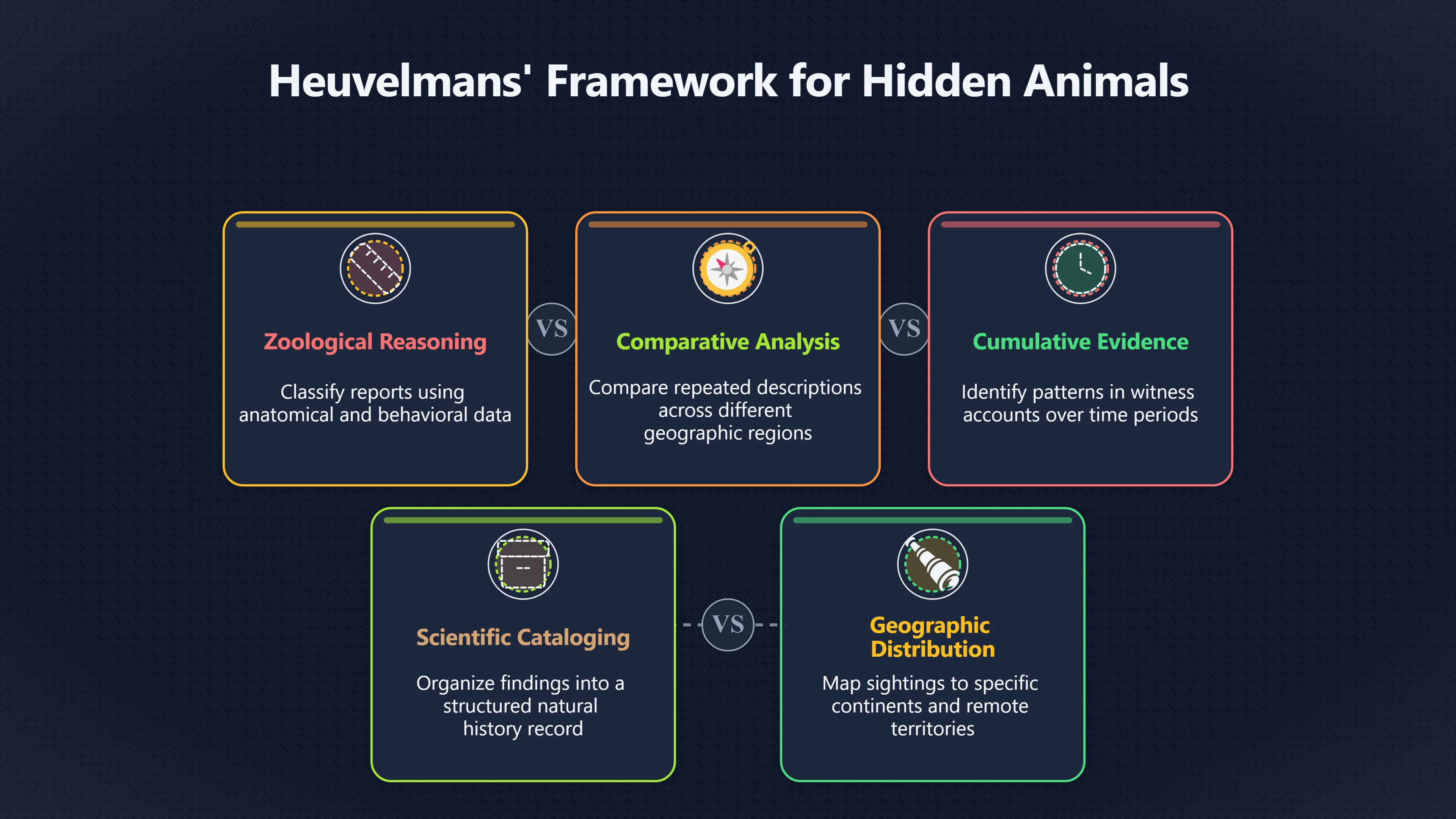
Few books have shaped an entire fringe field as decisively as Bernard Heuvelmans’ Sur la piste des bêtes ignorées (1955), published in English in 1958 as On the Track of Unknown Animals. Although stories of mysterious creatures long predated it, the book is widely regarded as the work that transformed scattered monster traditions, explorer anecdotes and local legends into a coherent programme of investigation. Later generations of enthusiasts and researchers repeatedly identified it as the founding text of modern cryptozoology, while Heuvelmans himself came to be known as the “Father of Cryptozoology”.[Wikipedia+2Cryptid Archives]WikipediaOn the Track of Unknown AnimalsOn the Track of Unknown Animals The importance of the book lies less in any individual creature it discussed than in the intellectual framework it proposed. Heuvelmans argued that reports of unknown animals should not automatically be dismissed as folklore or hoaxes. Instead, they could be assembled, classified and compared using zoological reasoning. His central claim was that some persistent traditions might preserve evidence of real but unrecognised animals, especially in remote regions where scientific exploration remained incomplete. This approach became the foundation upon which later cryptozoological literature was built.[Wikipedia+2Academia]WikipediaOn the Track of Unknown AnimalsOn the Track of Unknown Animals
What the 1955 Book Tried to Do
Turning Monster Stories into Zoological Categories
One of the book’s most influential innovations was its method of classification. Rather than treating every mystery creature as an isolated curiosity, Heuvelmans grouped reports into broader zoological types.
How the Book Grouped Yeti, Sea-Serpent and Prehistoric-Survival Reports
The book is remembered largely because of the remarkable range of creatures it attempted to analyse within a single framework.
The Yeti and Unknown Primates
Heuvelmans devoted considerable attention to reports of unknown ape-like creatures. These included the Himalayan Yeti as well as alleged relic hominids and mysterious primates from South and Southeast Asia. Rather than treating such reports as supernatural beings, he attempted to compare witness descriptions with known primates and fossil human relatives.[Wikipedia]WikipediaOn the Track of Unknown AnimalsOn the Track of Unknown Animals
His discussions often combined expedition accounts, local traditions, physical descriptions and evolutionary speculation. The resulting arguments were highly controversial, but they established a model that later Bigfoot and Yeti researchers would follow for decades.[Wikipedia]WikipediaOn the Track of Unknown AnimalsOn the Track of Unknown Animals
Sea Serpents and Marine Mysteries
Sea serpents occupied another major section of Heuvelmans’ intellectual universe. Although he later wrote more specialised works on the subject, On the Track of Unknown Animals already presented marine monster reports as potentially zoological rather than purely mythical.[Wikipedia]WikipediaOn the Track of Unknown AnimalsOn the Track of Unknown Animals
He collected descriptions from sailors, explorers and coastal witnesses, then attempted to identify recurring forms. Instead of asking whether every report was true, he asked whether repeated descriptions might indicate undiscovered marine species. This analytical move became a hallmark of cryptozoological methodology.[Wikipedia]WikipediaOn the Track of Unknown AnimalsOn the Track of Unknown Animals
Living Fossils and Prehistoric Survivors
The Book’s Research Style
Part of the book’s influence came from its sheer scale. The original work was extensive, featuring a large bibliography, maps, illustrations and references drawn from travel literature, zoological reports, newspapers and historical documents. Reviewers frequently commented on the breadth of material Heuvelmans assembled, even when they disagreed with his conclusions.[Wikipedia]WikipediaOn the Track of Unknown AnimalsOn the Track of Unknown Animals
Unlike many later cryptid books aimed primarily at entertainment, On the Track of Unknown Animals attempted to present itself as serious natural-history scholarship. The text cited sources extensively and often examined alternative explanations before advancing its own interpretation. Contemporary and later readers noted its encyclopaedic character and unusually detailed documentation.[Wikipedia]WikipediaOn the Track of Unknown AnimalsOn the Track of Unknown Animals
At the same time, the book relied heavily on indirect evidence. Eyewitness testimony, folklore, tracks, historical reports and second-hand accounts formed the bulk of its evidentiary base. Physical specimens were generally absent. This dependence on what later commentators described as “fuzzy” evidence became both the defining strength and defining weakness of Heuvelmans’ approach.[Academia]academia.eduA Review of Cryptozoology: Towards a Scientific Approach…Heuvelmans emphasized the importance of indirect evidence, such as fo…
Why Later Writers Treated It as a Founding Text
The book’s reputation rests less on the accuracy of individual claims than on its role in creating a field.
Later cryptozoologists repeatedly traced the origins of their discipline back to On the Track of Unknown Animals. Publisher histories, scholarly discussions of cryptozoology and retrospective accounts consistently identify the book as the moment when the subject acquired a coherent identity. The work is widely credited with popularising the concept of cryptozoology and establishing its basic intellectual agenda.[Routledge+3Wikipedia+3Cryptid Archives]WikipediaOn the Track of Unknown AnimalsOn the Track of Unknown Animals
The influence extended beyond the book itself. Its framework inspired later organisations, specialist journals and field investigations devoted to unknown animals. Many subsequent writers adopted Heuvelmans’ distinction between creatures known only through indirect evidence and animals already recognised by conventional zoology.[Academia]academia.eduA Review of Cryptozoology: Towards a Scientific Approach…Heuvelmans emphasized the importance of indirect evidence, such as fo…
The book also provided a shared canon. Later researchers inherited a standard collection of cases—Yeti reports, sea serpents, relic hominids, mystery cats, lake monsters and alleged prehistoric survivors—that had already been assembled and interpreted within Heuvelmans’ system. Even critics often accepted that modern cryptozoology would look very different without this organising framework.[Wikipedia]WikipediaOn the Track of Unknown AnimalsOn the Track of Unknown Animals
The Central Tension in the Book’s Legacy
The enduring significance of On the Track of Unknown Animals arises from a tension that has never been fully resolved. Heuvelmans succeeded in making monster reports appear suitable for zoological investigation. He demonstrated that folklore, witness testimony and historical records could be collected systematically rather than casually dismissed.[Academia]academia.eduA Review of Cryptozoology: Towards a Scientific Approach…Heuvelmans emphasized the importance of indirect evidence, such as fo…
Yet the same book also revealed the limits of that approach. Most of the creatures it examined remained unsupported by specimens or conclusive evidence. Mainstream zoology generally requires physical proof, repeatable observations and demonstrable populations. Heuvelmans instead relied on patterns in testimony and tradition. Critics argued that this methodology encouraged speculation beyond what the evidence could justify.[ResearchGate]researchgate.netResearchGate(PDF) A Review of Cryptozoology: Towards a Scientific…Cryptozoology is still generally considered a non-academic disciplin…
Nevertheless, as a historical document, the book achieved something undeniable. It reframed mysterious-animal reports from curiosities into a purported research programme. Whether viewed as pioneering natural history, imaginative synthesis or the beginning of a controversial pseudoscience, On the Track of Unknown Animals remains the book that made monsters look zoological and established the conceptual foundations of modern cryptozoology.[Wikipedia+2Google Books]WikipediaOn the Track of Unknown AnimalsOn the Track of Unknown Animals
Amazon book picks
Further Reading
Books and field guides related to The Book That Made Monsters Look Zoological. Use these as the next step if you want deeper reading beyond the article.
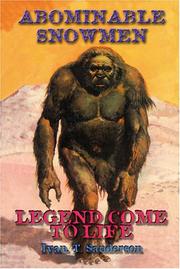
Abominable Snowmen, Legend Come to Life
Extended the framework pioneered by Heuvelmans.
Field Guide To Bigfoot, Yeti, & Other Mystery Primates Worldwide
Shows the continuing influence of the founding text.
eBay marketplace picks
Marketplace Samples
Live-tested eBay searches with available results related to this page.



Endnotes
1.
Source: Wikipedia
Title: On the Track of Unknown Animals
Link:https://en.wikipedia.org/wiki/On_the_Track_of_Unknown_Animals
2.
Source: academia.edu
Link:https://www.academia.edu/20109683/A_Review_of_Cryptozoology_Towards_a_Scientific_Approach_to_the_Study_of_Hidden_Animals_
3.
Source: bol.com
Link:https://www.bol.com/nl/nl/f/on-the-track-of-unknown-animals/39740036/
4.
Source: books.google.com
Title: Books On The Track Of Unknown Animals
Link:https://books.google.com/books/about/On_The_Track_Of_Unknown_Animals.html?id=u64ABAAAQBAJ
5.
Source: routledge.com
Title: On The Track Of Unknown Animals
Link:https://www.routledge.com/On-The-Track-Of-Unknown-Animals/Heuvelmans/p/book/9781138977525
6.
Source: researchgate.net
Link:https://www.researchgate.net/publication/288975639_A_Review_of_Cryptozoology_Towards_a_Scientific_Approach_to_the_Study_of_Hidden_Animals
7.
Source: youtube.com
Title: On the Track of Unknown Animals | Wikipedia audio article
Link:https://www.youtube.com/watch?v=VMgwBeOC5lY
8.
Source: cryptidarchives.fandom.com
Title: On the Track of Unknown Animals
Link:https://cryptidarchives.fandom.com/wiki/On_the_Track_of_Unknown_Animals
9.
Source: wearethemutants.com
Title: impossible animals bernard heuvelmans and the making of cryptozoology
Link:https://wearethemutants.com/2020/10/06/impossible-animals-bernard-heuvelmans-and-the-making-of-cryptozoology/
10.
Source: abebooks.com
Title: On The Track Of Unknown Animals
Link:https://www.abebooks.com/9781138977525/Track-Unknown-Animals-Heuvelmans-0-1138977527/plp
Additional References
11.
Source: journals.uchicago.edu
Link:https://www.journals.uchicago.edu/doi/10.1086/592667
12.
Source: api.pageplace.de
Link:https://api.pageplace.de/preview/DT0400.9781317848127_A23912929/preview-9781317848127_A23912929.pdf
13.
Source: goodreads.com
Link:https://www.goodreads.com/en/book/show/977399.On_the_Track_of_Unknown_Animals
14.
Source: goodreads.com
Title: On the Track of Unknown Animals by Bernard Heuvelmans First published
Link:https://www.goodreads.com/book/show/2066470
15.
Source: amazon.com
Title: On the Track of Unknown Animals This study is both a popular
Link:https://www.amazon.com/Track-Animals-Heuvelmans/dp/0710304986?tag=searcht-20
16.
Source: goodreads.com
Link:https://www.goodreads.com/author/list/493126.Bernard_Heuvelmans
17.
Source: scholarworks.iu.edu
Link:https://scholarworks.iu.edu/journals/index.php/cl/article/view/41746/44352
18.
Source: dokumen.pub
Link:https://dokumen.pub/on-the-track-of-unknown-animals-1nbsped-0710304986-9780710304988.html
19.
Source: barnesandnoble.com
Title: on the track of unknown animals bernard heuvelmans
Link:https://www.barnesandnoble.com/w/on-the-track-of-unknown-animals-bernard-heuvelmans/1013434207
20.
Source: reddit.com
Title: my 1955 first edition of on the track of unknown
Link:https://www.reddit.com/r/Cryptozoology/comments/l13cg9/my_1955_first_edition_of_on_the_track_of_unknown/
Topic Tree