Within Pseudoscience
Why Cryptids Need More Than Sightings
A famous cryptid claim becomes scientifically serious only when it produces physical evidence strong enough to identify a real species.
On this page
- Why anecdotes can start but not finish a species claim
- What bodies, bones, tissue and DNA can prove
- Why large animals should leave repeated traces
Page outline Jump by section
Introduction
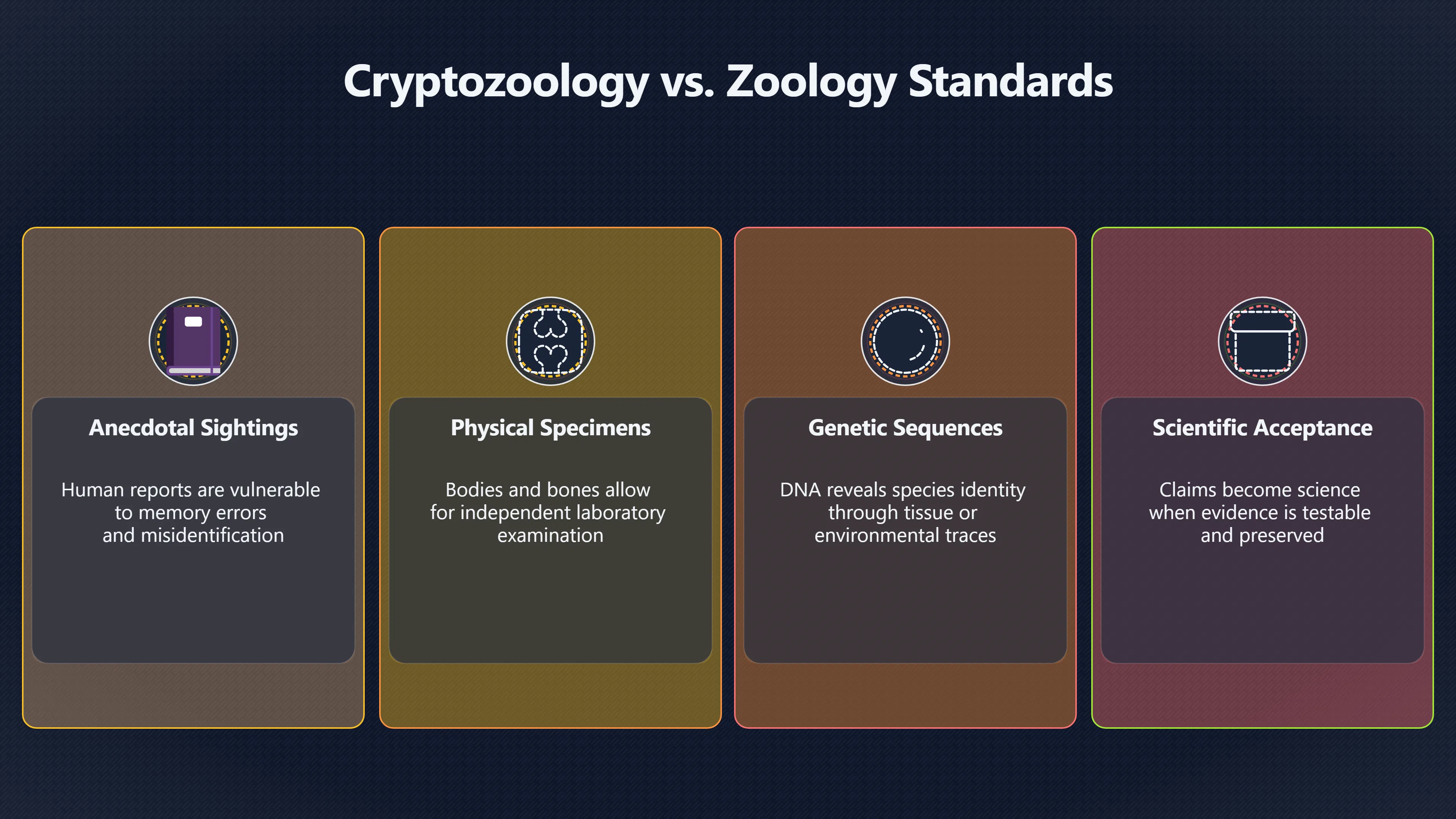
A cryptid claim becomes scientifically serious when it produces evidence that can identify a real animal, not merely suggest that something unusual was seen. In zoology, eyewitness reports, folklore, footprints and photographs may justify an investigation, but they do not establish a species. What changes a claim from speculation to science is the arrival of physical evidence that can be independently examined: a body, skeleton, tissue sample, hair with a verified origin, or genetic material that clearly belongs to an unknown organism. The distinction matters because cryptozoology often asks readers to accept large, distinctive animals on evidence that would be considered preliminary in mainstream wildlife biology. Scientific acceptance begins when evidence can be collected, tested, preserved and re-examined by other researchers.[Scientific American]scientificamerican.comScientific American Do Mythic Creatures Exist?Show Me the BodyAugust 4, 2008 — 4 Aug 2008 —… cryptid cousins Bigfoot, Nessie, et al. They also have in common—a body! In order to na…
Why Anecdotes Can Start but Not Finish a Species Claim
Sightings have played a role in many genuine zoological discoveries. Local reports may alert scientists to unusual animals, and eyewitness accounts can help direct fieldwork. However, human observation is vulnerable to misidentification, memory errors, expectation effects and environmental conditions such as darkness, distance or poor visibility.
For that reason, zoology treats testimony as a lead rather than a conclusion. A witness may honestly report seeing a large unknown creature, but the report alone cannot determine whether the animal was a new species, a known species seen under unusual circumstances, a hoax or a mistaken interpretation. Scientific claims require evidence that remains available after the observer has gone home.
What Bodies, Bones, Tissue and DNA Can Prove
Physical remains matter because they can answer questions that anecdotes cannot.
A specimen allows researchers to determine:<div class="content-enhancement content-enhancement--phrase-stack" markdown="1">
- Whether the animal is genuinely unknown to science.
- Its anatomy and diagnostic features.
- Its relationship to other species.
- Its age, sex and health.
- Its genetic identity.
- Whether independent laboratories obtain the same results.</div>
Modern taxonomy is built around this principle. New species are formally described from physical reference material, traditionally a holotype specimen that other scientists can examine. Without such material, there is no reliable way to compare claims, resolve disputes or verify identification.[Scientific American]scientificamerican.comScientific American Do Mythic Creatures Exist?Show Me the BodyAugust 4, 2008 — 4 Aug 2008 —… cryptid cousins Bigfoot, Nessie, et al. They also have in common—a body! In order to na…
DNA has expanded these capabilities. Tissue, hair, blood, faeces and environmental DNA (eDNA) can reveal the presence of species that are difficult to observe directly. Scientists now detect rare amphibians, mammals and aquatic species through genetic traces left in water, soil and other environments. Importantly, these methods generate evidence that can be sequenced, archived and independently analysed.[National Geographic+2National Wildlife Federation]nationalgeographic.comenvironmental dna sheds light on animal lives ednaNational GeographicHidden DNA is revealing secrets of animals' lives5 Aug 2022 — At Eagle Pass, Ruppert found enough environmental DNA—tr…
For a cryptid claim, therefore, a verified tissue sample or distinctive genetic sequence would be far more persuasive than another photograph. A photograph can show that something was present. DNA can show what it was.
The Coelacanth Shows How Science Changes Its Mind
Cryptozoology supporters often cite the coelacanth as proof that extraordinary animals can remain undiscovered. The example is real, but its lesson is frequently misunderstood.
Why Large Animals Should Leave Repeated Traces
The demand for a body becomes even stronger when the proposed animal is large.
A breeding population of large mammals, reptiles or aquatic vertebrates should leave more than occasional sightings. Animals shed hair, skin and faeces. They die and leave bones. They interact with prey, parasites and habitats. They produce tracks, feeding signs and genetic traces. The larger and more numerous the population, the more opportunities there are for physical evidence to accumulate.
This ecological reality creates a major challenge for famous cryptids such as Bigfoot or the Loch Ness Monster. Claims often involve animals large enough to sustain breeding populations for decades or centuries, yet the expected trail of biological evidence remains elusive.
Modern detection methods have made this problem harder to ignore. Environmental DNA surveys, camera traps, acoustic monitoring and other techniques routinely detect rare wildlife. Even species that are secretive, nocturnal or difficult to observe often reveal themselves through traces. When a large animal is repeatedly reported but continues to leave no verifiable specimen or genetic signature, scientists become increasingly sceptical. National Wildlife Federation+3National Geographic+3sciencefocus.com[nationalgeographic.com]nationalgeographic.comenvironmental dna sheds light on animal lives ednaNational GeographicHidden DNA is revealing secrets of animals' lives5 Aug 2022 — At Eagle Pass, Ruppert found enough environmental DNA—tr…
Why a Body Changes the Conversation
The phrase “show me the body” is sometimes portrayed as an unfair demand, but in biology it reflects a practical standard. A body, skeleton, tissue sample or other diagnostic material transforms a claim from a story about an animal into evidence of an animal.
Once that threshold is crossed, the discussion changes completely. Scientists can stop debating whether something exists and start investigating what it is. The claim leaves the realm of cryptozoology and enters ordinary zoology.
See on Amazon</a></div></div></article><article class="fr-book-card"><a class="fr-book-cover" href="https://www.amazon.com/s?k=The+Tangled+Tree+by+David+Quammen&i=stripbooks&tag=searcht-20" target="_blank" rel="sponsored noopener noreferrer" aria-label="Open The Tangled Tree on Amazon"><span class="fr-book-cover-fallback">Book</span><img class="fr-book-cover-thumb" src="https://books.google.com/books/content?id=WnlJDwAAQBAJ&printsec=frontcover&img=1&zoom=1&edge=curl&source=gbs_api" alt="Cover for The Tangled Tree" loading="lazy" decoding="async" fetchpriority="low" referrerpolicy="no-referrer" onerror="this.hidden=true;this.closest('.fr-book-cover').classList.add('fr-book-cover-placeholder');"></a><div class="fr-book-info"><h4 class="fr-book-title"><a href="https://www.amazon.com/s?k=The+Tangled+Tree+by+David+Quammen&i=stripbooks&tag=searcht-20" target="_blank" rel="sponsored noopener noreferrer" title="The Tangled Tree">The Tangled Tree</a></h4><p class="fr-book-author">By David Quammen</p><p class="fr-book-desc">Provides context for how DNA evidence transforms biological understanding.</p><div class="fr-book-actions"><a href="https://www.amazon.com/s?k=The+Tangled+Tree+by+David+Quammen&i=stripbooks&tag=searcht-20" class="fr-amazon-btn" target="_blank" rel="sponsored noopener noreferrer">
See on Amazon</a></div></div></article><article class="fr-book-card"><a class="fr-book-cover" href="https://www.amazon.com/s?k=Abominable+Science%21+by+Daniel+Loxton&i=stripbooks&tag=searcht-20" target="_blank" rel="sponsored noopener noreferrer" aria-label="Open Abominable Science! on Amazon"><span class="fr-book-cover-fallback">Book</span><img class="fr-book-cover-thumb" src="https://books.google.com/books/content?id=kTsgAAAAQBAJ&printsec=frontcover&img=1&zoom=1&edge=curl&source=gbs_api" alt="Cover for Abominable Science!" loading="lazy" decoding="async" fetchpriority="low" referrerpolicy="no-referrer" onerror="this.hidden=true;this.closest('.fr-book-cover').classList.add('fr-book-cover-placeholder');"></a><div class="fr-book-info"><h4 class="fr-book-title"><a href="https://www.amazon.com/s?k=Abominable+Science%21+by+Daniel+Loxton&i=stripbooks&tag=searcht-20" target="_blank" rel="sponsored noopener noreferrer" title="Abominable Science!">Abominable Science!</a></h4><p class="fr-book-author">By Daniel Loxton, Donald R. Prothero</p><p class="fr-book-desc">Directly addresses why physical specimens matter more than anecdotes.</p><div class="fr-book-actions"><a href="https://www.amazon.com/s?k=Abominable+Science%21+by+Daniel+Loxton&i=stripbooks&tag=searcht-20" class="fr-amazon-btn" target="_blank" rel="sponsored noopener noreferrer">
See on Amazon</a></div></div></article><article class="fr-book-card"><a class="fr-book-cover fr-book-cover-placeholder" href="https://www.amazon.com/s?k=The+Demon-haunted+World+by+Carl+Sagan&i=stripbooks&tag=searcht-20" target="_blank" rel="sponsored noopener noreferrer" aria-label="Open The Demon-haunted World on Amazon"><span class="fr-book-cover-fallback">Book</span></a><div class="fr-book-info"><h4 class="fr-book-title"><a href="https://www.amazon.com/s?k=The+Demon-haunted+World+by+Carl+Sagan&i=stripbooks&tag=searcht-20" target="_blank" rel="sponsored noopener noreferrer" title="The Demon-haunted World">The Demon-haunted World</a></h4><p class="fr-book-author">By Carl Sagan</p><p class="fr-book-desc">Reinforces why testable physical evidence carries special weight.</p><div class="fr-book-actions"><a href="https://www.amazon.com/s?k=The+Demon-haunted+World+by+Carl+Sagan&i=stripbooks&tag=searcht-20" class="fr-amazon-btn" target="_blank" rel="sponsored noopener noreferrer">
See on Amazon</a></div></div></article></div><div class="fr-section-footer"><div class="fr-browse-links" aria-label="Browse more on Amazon"><span class="fr-browse-links-label">Browse more on Amazon:</span><a class="fr-browse-more" href="https://www.amazon.com/s?k=Hunting+Monsters&i=stripbooks&tag=searcht-20" target="_blank" rel="sponsored noopener noreferrer">Hunting Monsters</a><a class="fr-browse-more" href="https://www.amazon.com/s?k=The+Tangled+Tree&i=stripbooks&tag=searcht-20" target="_blank" rel="sponsored noopener noreferrer">The Tangled Tree</a><a class="fr-browse-more" href="https://www.amazon.com/s?k=Abominable+Science%21&i=stripbooks&tag=searcht-20" target="_blank" rel="sponsored noopener noreferrer">Abominable Science!</a></div><p class="fr-disclosure">As an Amazon Associate I earn from qualifying purchases.</p></div></div></section>
Amazon book picks
Further Reading
Books and field guides related to Why Cryptids Need More Than Sightings. Use these as the next step if you want deeper reading beyond the article.
On the Track of Unknown Animals
Illustrates the historical reliance on reports and traces before specimens appeared.
The Tangled Tree
Provides context for how DNA evidence transforms biological understanding.
The Demon-haunted World
Reinforces why testable physical evidence carries special weight.
eBay marketplace picks
Marketplace Samples
Live-tested eBay searches with available results related to this page.
Endnotes
1.
Source: science.howstuffworks.com
Link:https://science.howstuffworks.com/science-vs-myth/strange-creatures/cryptozoology.htm
2.
Source: conservation.org
Link:https://www.conservation.org/news/fish-story-how-a-coelacanth-discovery-set-off-a-flurry-of-science-subterfuge
3.
Source: sciencefocus.com
Title: loch ness monster how edna helps us discover what lurks beneath
Link:https://www.sciencefocus.com/nature/loch-ness-monster-how-edna-helps-us-discover-what-lurks-beneath
4.
Source: discovermagazine.com
Link:https://www.discovermagazine.com/a-new-coelacanth-species-was-hiding-in-a-museum-for-150-years-and-it-fills-a-50-million-year-gap-49003
5.
Source: scientificamerican.com
Title: Scientific American Do Mythic Creatures Exist?
Link:https://www.scientificamerican.com/article/show-me-the-body-mythic-creatures/
6.
Source: ocean.si.edu
Link:https://ocean.si.edu/ocean-life/fish/coelacanth
7.
Source: nationalgeographic.com
Title: environmental dna sheds light on animal lives edna
Link:https://www.nationalgeographic.com/animals/article/environmental-dna-sheds-light-on-animal-lives-edna
8.
Source: nwf.org
Title: Edna Environmental Dna
Link:https://www.nwf.org/Magazines/National-Wildlife/2024/Fall/Conservation/Edna-Environmental-Dna
9.
Source: nhm.ac.uk
Title: Discover the story of this strange fish
Link:https://www.nhm.ac.uk/discover/coelacanths-the-fish-that-outdid-the-loch-ness-monster.html
10.
Source: Wikipedia
Link:https://en.wikipedia.org/wiki/Coelacanth
Additional References
11.
Source: amnh.org
Link:https://www.amnh.org/explore/videos/shelf-life/coelacanth-discovery-preservation
12.
Source: axios.com
Link:https://www.axios.com/2017/12/15/rare-species-are-leaving-behind-traces-of-dna-1513302736
13.
Source: researchgate.net
Link:https://www.researchgate.net/publication/288975639_A_Review_of_Cryptozoology_Towards_a_Scientific_Approach_to_the_Study_of_Hidden_Animals
14.
Source: port.ac.uk
Link:https://www.port.ac.uk/news-events-and-blogs/news/150-year-old-museum-specimen-revealed-as-missing-link-in-evolution-of-ancient-fish
15.
Source: youtube.com
Link:https://www.youtube.com/watch?v=eOW8116e2AE
16.
Source: youtube.com
Link:https://www.youtube.com/watch?v=__Woo6L1bl0
17.
Source: academia.edu
Link:https://www.academia.edu/20109683/A_Review_of_Cryptozoology_Towards_a_Scientific_Approach_to_the_Study_of_Hidden_Animals_
18.
Source: reddit.com
Title: thought extinct for 66 million years and known
Link:https://www.reddit.com/r/Awwducational/comments/sr5pfg/thought_extinct_for_66_million_years_and_known/
19.
Source: facebook.com
Link:https://www.facebook.com/InYourArea.co.uk/posts/if-youve-got-a-soft-spot-for-the-mysterious-and-the-unexplained-then-youre-alrea/1476042864535395/
20.
Source: facebook.com
Link:https://www.facebook.com/Facts.Random.Weird/posts/scientists-have-deployed-advanced-sonar-mapping-environmental-dna-sampling-and-u/1336687401937406/
Topic Tree