Within Okapi
Why Okapi Reports Needed Skins and Skulls
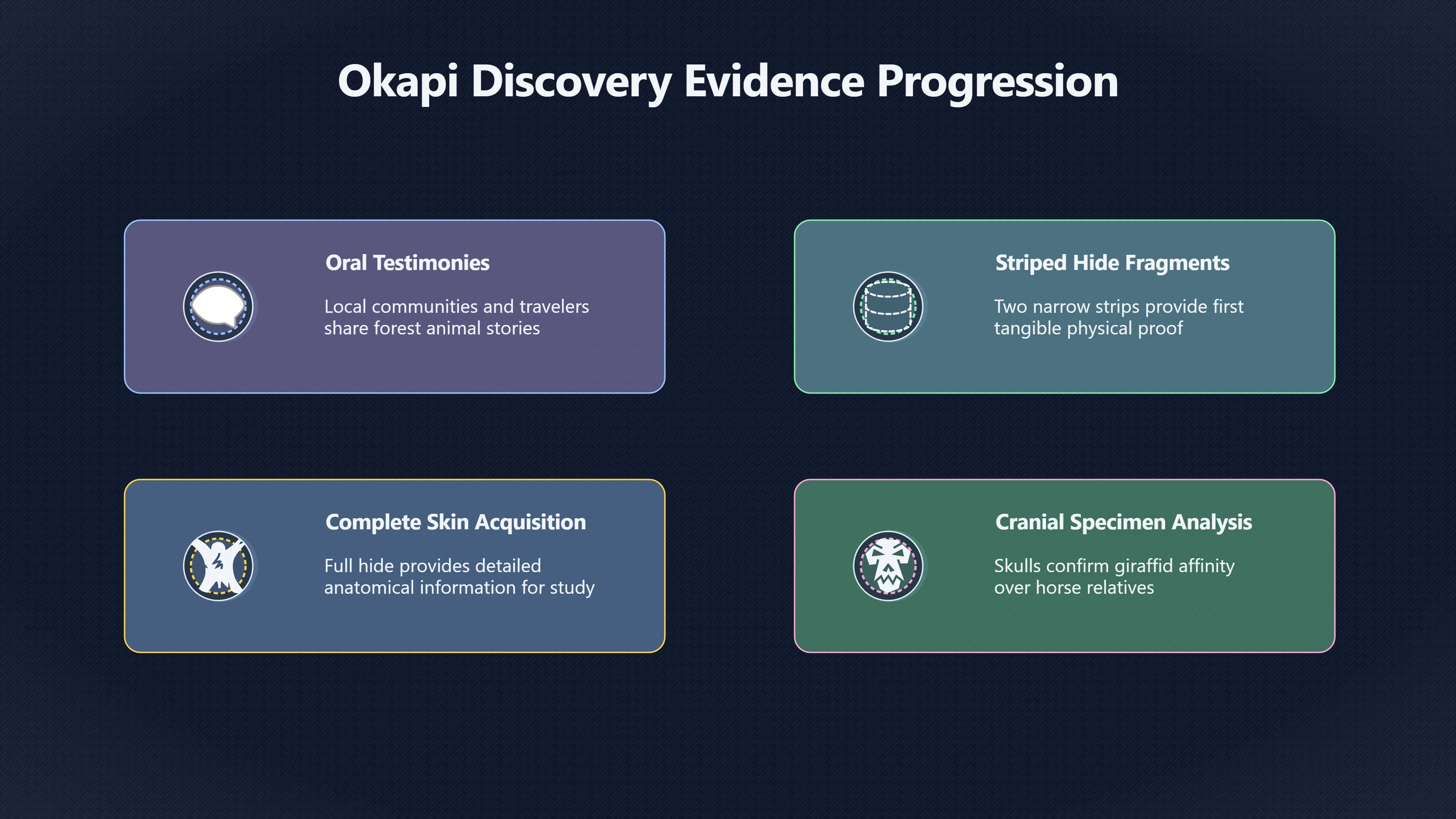
Johnston's collected hides and skulls show why physical remains changed the okapi from report to zoological fact.
On this page
- From rumours to collected remains
- Why specimens changed the claim
- How this sets a standard for cryptids
Page outline Jump by section
Introduction
The okapi is frequently invoked in cryptozoology as proof that large animals can remain unknown to science. Yet the crucial lesson of the okapi is not that reports existed; it is that reports were eventually backed by physical specimens. Harry Johnston’s role in obtaining strips of skin, a complete hide, and skulls illustrates the evidence threshold that transformed a rumoured forest animal into a recognised species. The transition from testimony to examinable remains is what made the okapi scientifically persuasive. For cryptozoology, this episode is less a celebration of rumours than a demonstration of the kind of evidence required before an extraordinary zoological claim becomes accepted fact.[Royal Museum for Central Africa]africamuseum.beRoyal Museum for Central Africa Okapis | Royal Museum for Central AfricaRoyal Museum for Central AfricaOkapis | Royal Museum for Central Africa - Tervuren10 Mar 2022 — In the same year, Johnston managed to obt…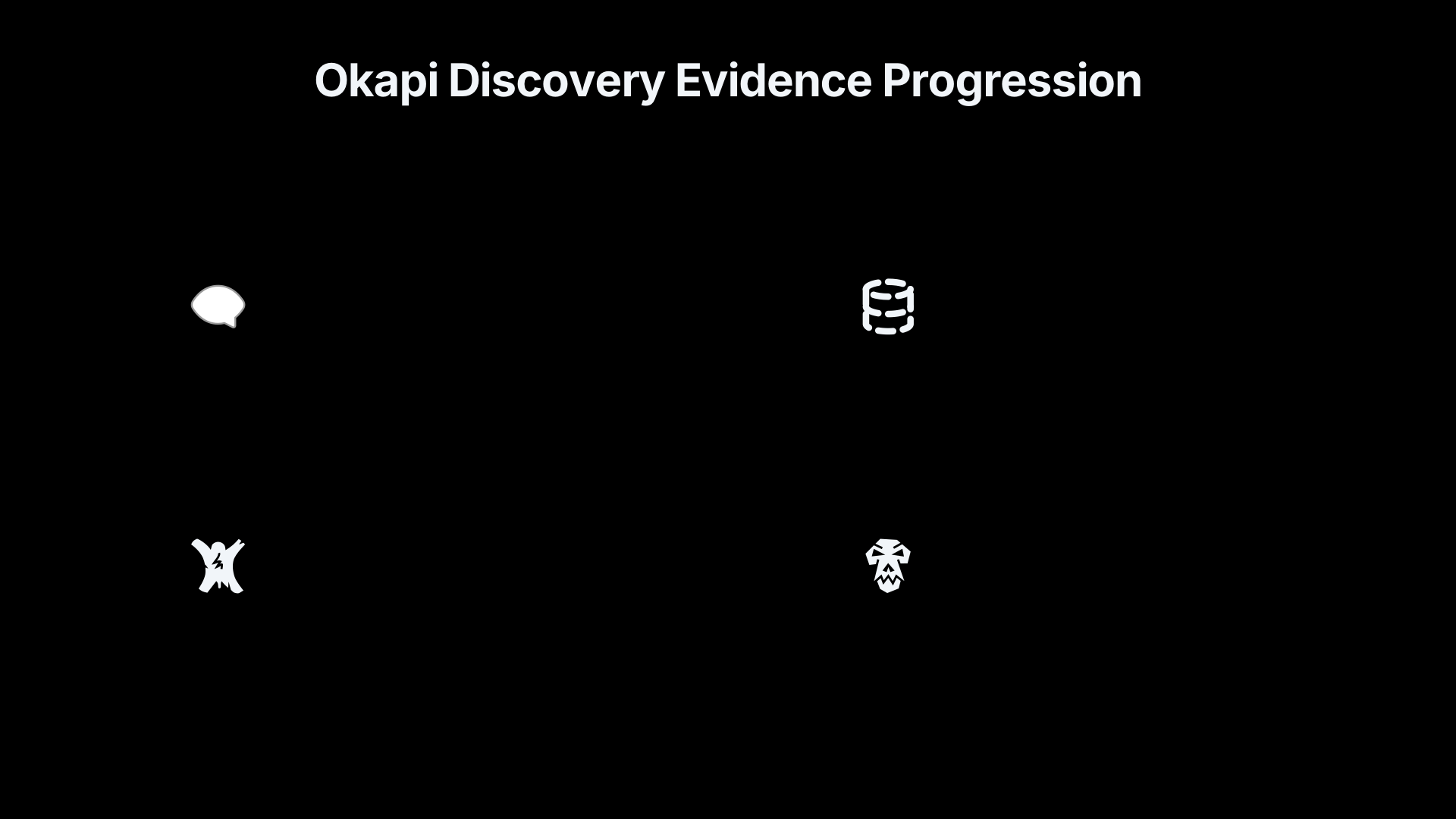
From Rumours to Collected Remains
Why Skins and Skulls Changed the Claim
Scientific acceptance depends on evidence that can be independently examined. The complete skin and skulls met that requirement in a way that eyewitness reports never could.
Several features made the specimens transformative:<div class="content-enhancement content-enhancement--insight-grid" markdown="1">
- Repeatability: Museum specialists could study the same material rather than relying on second-hand descriptions.
- Comparative anatomy: The skulls could be compared directly with known mammals.
- Correction of earlier errors: Initial assumptions based on stripes could be tested against the animal’s full anatomy.
- Permanent reference material: The specimens became preserved evidence available to future researchers.[Taylor & Francis Online+2IUCN Portals]tandfonline.comThis is the skin figured and described in my…</div>
The skulls were especially important because they revealed relationships hidden by the animal’s external appearance. The okapi’s striped legs had encouraged comparisons with zebras, but cranial features indicated affinity with giraffids. Examination of the complete remains led zoologists away from the horse family and toward recognition of a previously unknown giraffe relative. The result was the establishment of the genus Okapia and the species name Okapia johnstoni.[Journal of Zoology Blog+2IUCN Portals]jzoblog.wordpress.comJournal of Zoology Blog Hidden GemJournal of Zoology BlogHidden Gem - Journal of Zoology Blog - WordPress.comJuly 18, 2013 — 18 Jul 2013 — However, it was not until Johnst…
This episode demonstrates that evidence is not merely about quantity. A hundred stories describing a horse-like forest creature could not accomplish what a single diagnostic skull could. The quality of evidence mattered more than the number of reports.[Journal of Zoology Blog]jzoblog.wordpress.comJournal of Zoology Blog Hidden GemJournal of Zoology BlogHidden Gem - Journal of Zoology Blog - WordPress.comJuly 18, 2013 — 18 Jul 2013 — However, it was not until Johnst…
The Specimens as Scientific Objects
How the Okapi Sets a Standard for Cryptids
The okapi occupies a special place in cryptozoological discussions because it represents a genuine case of a large animal entering scientific knowledge relatively late. However, the pathway to acceptance is often misunderstood.
The okapi was not validated when reports accumulated. It was validated when physical remains crossed a threshold that allowed independent verification. Even then, the first interpretation was partly wrong: the animal was initially classified as zebra-like before better specimens corrected the mistake. The case therefore shows both the power of specimens and the fallibility of interpretation when evidence is incomplete. Royal Museum for Central Africa+2IUCN Portals[africamuseum.be]africamuseum.beRoyal Museum for Central Africa Okapis | Royal Museum for Central AfricaRoyal Museum for Central AfricaOkapis | Royal Museum for Central Africa - Tervuren10 Mar 2022 — In the same year, Johnston managed to obt…
For modern cryptid claims, the lesson is straightforward. Anecdotes, footprints, sketches, and local traditions may indicate that a claim deserves investigation, just as reports of the okapi encouraged further searching. Yet the okapi became zoological fact only after researchers could examine material evidence that carried anatomical information. The threshold was not curiosity but verifiability.[Tetrapod Zoology+2IUCN Portals]tetzoo.comthe discovery of the okapi part 2Tetrapod ZoologyThe Discovery of the Okapi, Part 2April 28, 2023 — 28 Apr 2023 — Harry Johnston is credited with being the first European…
This is why the okapi serves as both an inspiration and a caution within cryptozoology. It demonstrates that unknown animals can exist, but it also demonstrates the standard required for acceptance. Johnston’s skins and skulls did not merely support the claim; they transformed it from a story about an unusual forest animal into a testable biological reality. Royal Museum for Central Africa+2Taylor & Francis Online[africamuseum.be]africamuseum.beRoyal Museum for Central Africa Okapis | Royal Museum for Central AfricaRoyal Museum for Central AfricaOkapis | Royal Museum for Central Africa - Tervuren10 Mar 2022 — In the same year, Johnston managed to obt…
Amazon book picks
Further Reading
Books and field guides related to Why Okapi Reports Needed Skins and Skulls. Use these as the next step if you want deeper reading beyond the article.
A Fish Caught in Time
Offers a parallel example where specimens settled scientific debate.
The Kingdon Field Guide to African Mammals
Provides reliable information on the okapi and its identification.
The Beasts That Hide from Man
Explores the transition from reports to tangible evidence.
Cryptozoology A To Z
Places specimen-based discoveries within broader cryptozoology history.
eBay marketplace picks
Marketplace Samples
Live-tested eBay searches with available results related to this page.


Endnotes
1.
Source: portals.iucn.org
Title: Realising this was in fact a relative
Link:https://portals.iucn.org/library/sites/library/files/documents/2015-046.pdf
2.
Source: commons.wikimedia.org
Title: File:Pieces from Okapi leather, obtained by Sir Harry Johnston (crop).jpg
Link:https://commons.wikimedia.org/wiki/File%3APieces_from_Okapi_leather%2C_obtained_by_Sir_Harry_Johnston_%28crop%29.jpg
3.
Source: africamuseum.be
Title: Royal Museum for Central Africa Okapis | Royal Museum for Central Africa
Link:https://www.africamuseum.be/en/learn/[provenance
4.
Source: tetzoo.com
Title: the discovery of the okapi part 1
Link:https://tetzoo.com/blog/2023/4/11/the-discovery-of-the-okapi-part-1
5.
Source: Wikipedia
Link:https://en.wikipedia.org/wiki/Okapi
6.
Source: tandfonline.com
Link:https://www.tandfonline.com/doi/pdf/10.1080/00222930208678695
7.
Source: jzoblog.wordpress.com
Title: Journal of Zoology Blog Hidden Gem
Link:https://jzoblog.wordpress.com/2013/07/18/hidden-gem-3/
8.
Source: tetzoo.com
Title: the discovery of the okapi part 2
Link:https://tetzoo.com/blog/2023/4/28/the-discovery-of-the-okapi-part-2
9.
Source: gbif.org
Link:https://www.gbif.org/zh-tw/species/113392070
10.
Source: creation.com
Link:https://creation.com/en/articles/okapi
Additional References
11.
Source: facebook.com
Link:https://www.facebook.com/witspress/posts/discovering-the-okapi-by-simon-pooley-offers-a-riveting-portrait-of-the-okapi-an/1686486205754140/
12.
Source: researchgate.net
Link:https://www.researchgate.net/publication/388942596_Discovering_the_Okapi_Western_Science_Indigenous_Knowledge_and_the_Search_for_a_Rainforest_Enigma
13.
Source: zslpublications.onlinelibrary.wiley.com
Title: On the Existence of Rudimentary Antlers in the Okapi
Link:https://zslpublications.onlinelibrary.wiley.com/doi/full/10.1111/j.1096-3642.1907.tb01804.x
14.
Source: reddit.com
Title: the history guy covers the discovery of the okapi
Link:https://www.reddit.com/r/Cryptozoology/comments/aceahr/the_history_guy_covers_the_discovery_of_the_okapi/
15.
Source: instagram.com
Link:https://www.instagram.com/p/DLp6icSNukl/
16.
Source: facebook.com
Link:https://www.facebook.com/Mittmuseum/[photos
17.
Source: youtube.com
Link:https://www.youtube.com/watch?v=3XLjztKDOrA
18.
Source: iheart.com
Title: The Okapi and the Western World
Link:https://www.iheart.com/podcast/105-stuff-you-missed-in-histor-21124503/episode/the-okapi-and-the-western-world-96333554/
19.
Source: ielc.libguides.com
Link:https://ielc.libguides.com/sdzg/factsheets/okapi/taxonomy
20.
Source: everything-everywhere.com
Link:https://everything-everywhere.com/real-life-cryptids/
Topic Tree