Within Cryptozoology
Why the Okapi Became Real Science
The okapi shows how local knowledge can precede formal science, but documented remains made the case zoological.
On this page
- Local knowledge and European science
- Skins, remains, and formal description
- Why okapi analogies need care
Page outline Jump by section
Introduction
The okapi is one of cryptozoology’s favourite cautionary examples: a large, striking mammal that was long familiar to people in its own forest world but unknown to European zoology until the early twentieth century. It shows that formal science can miss real animals, especially in politically remote, densely forested, and locally expert landscapes. But it also shows why “the okapi was once unknown” is not a blank cheque for every modern cryptid claim. The okapi became zoology not because reports sounded intriguing, but because skins, skulls, anatomical comparison, and formal description moved it from rumour into verifiable evidence. Johnston’s role in acquiring specimens mattered, yet the story also depends on African local knowledge, colonial routes of collection, and later taxonomic correction. That makes the okapi useful in cryptozoology debates precisely because it cuts both ways: local testimony can be important, but scientific confirmation still required physical remains and a testable biological identity. Royal Museum for Central Africa+2Mammal Diversity[africamuseum.be]africamuseum.beRoyal Museum for Central Africa Okapis | Royal Museum for Central AfricaRoyal Museum for Central AfricaOkapis | Royal Museum for Central Africa - Tervuren10 Mar 2022 — In the same year, Johnston managed to obt…
Local Knowledge Came First
The okapi was not “discovered” in any simple sense in 1901. It was discovered by European science then, but people living in and around the forests of the north-eastern Congo already knew the animal. That distinction matters because many popular retellings flatten the story into a heroic outsider narrative, as though the animal entered existence only when a European official obtained specimens.
Accounts of the okapi’s route into European zoology often begin with reports of a strange forest animal sometimes imagined by outsiders as horse-like or zebra-like. Harry Johnston, then connected with British administration in Uganda, became involved after hearing accounts from people with knowledge of the Congo forests. Modern summaries of the discovery stress that Johnston did not simply stumble upon a living okapi in the forest. He learned from local informants, followed clues, and eventually obtained parts of the animal that could be studied elsewhere.[Tetrapod Zoology]tetzoo.comthe discovery of the okapi part 1Tetrapod ZoologyThe Discovery of the Okapi, Part 1April 12, 2023 — 12 Apr 2023 — In 1899/1900, Harry Johnston was tasked with returning a…
That is the first lesson for cryptozoology: local ecological knowledge can be real evidence of attention, habitat familiarity, and animal behaviour, even before it becomes formal taxonomy. Forest peoples, hunters, porters, traders, and local officials may know animals that outside institutions have not yet collected or named. The okapi’s case is a reminder that “unknown to science” often means unknown to particular institutions, languages, museums, and publication systems — not unknown to everyone.
The second lesson is less flattering to the romantic version. The okapi’s passage into Western science was entangled with colonial power, extraction, and unequal credit. A recent scholarly treatment of the okapi’s discovery story emphasises the overlooked role of Indigenous African expertise and the way colonial politics shaped early accounts of the animal.[ResearchGate]researchgate.netResearch Gate(PDF) Discovering the Okapi: Western Science, IndigenousResearch Gate(PDF) Discovering the Okapi: Western Science, Indigenous This does not make the zoological discovery invalid, but it does change what the story is about. It is not just a mystery animal vindicated. It is also a case study in whose knowledge counts, who gets named, and what kind of evidence institutions are prepared to recognise.
Skins, Skulls, and Formal Description Made the Difference
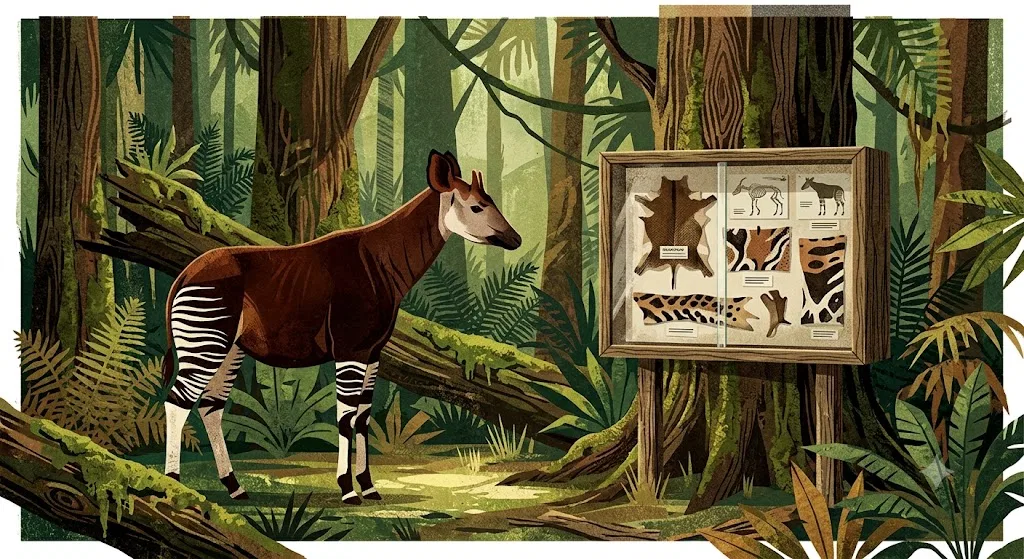
The okapi did not become accepted because Europeans merely heard a good story about a strange animal. It became accepted because physical material reached specialists who could compare it with known mammals. The key transition was from testimony to specimens.
The first published name was not even the final one. In 1901, Philip Lutley Sclater described the animal as Equus johnstoni, treating it as an apparently new zebra-like animal from the Semliki region. The Mammal Diversity Database records the original name as Equus(?) johnstoni and identifies the authority publication as Sclater’s 1901 paper in the Proceedings of the Zoological Society of London.[Mammal Diversity]mammaldiversity.orgMammal DiversityOkapia johnstoni • OkapiSclater, P.L. 1901-06. On an apparently new species of zebra from the Semliki Forest. Proceedings… This early classification shows how partial evidence can mislead even competent zoologists: stripes and second-hand descriptions made the animal seem horse-like.
The correction came through better anatomical evidence. Johnston obtained a more complete skin and skulls, and these allowed zoologists to recognise that the animal was not a zebra or horse at all, but a member of the giraffe family. The Royal Museum for Central Africa notes that Johnston first obtained strips of hide, after which Sclater’s name Equus johnstoni was adopted, and that later in 1901 Johnston obtained a whole skin and two skulls from Karl Erikson at Beni.[Royal Museum for Central Africa]africamuseum.beRoyal Museum for Central Africa Okapis | Royal Museum for Central AfricaRoyal Museum for Central AfricaOkapis | Royal Museum for Central Africa - Tervuren10 Mar 2022 — In the same year, Johnston managed to obt… Ray Lankester then placed the animal in a new giraffid genus, Okapia, producing the combination Okapia johnstoni.[Tetrapod Zoology]tetzoo.comthe discovery of the okapi part 1Tetrapod ZoologyThe Discovery of the Okapi, Part 1April 12, 2023 — 12 Apr 2023 — In 1899/1900, Harry Johnston was tasked with returning a…
That sequence is important because it shows science correcting itself through evidence. The okapi did not pass from “legend” to “fact” in one clean leap. It passed through a mistaken horse-like framing, then a revised giraffid classification, because skulls, teeth, feet, hair, hide, and comparative anatomy gave researchers something to test. The modern okapi is now recognised as the only species in the genus Okapia and, with giraffes, one of the living members of the family Giraffidae.[OUP Academic]academic.oup.comAcademic Okapia johnstoni | Mammalian SpeciesSource details in endnotes.
This is the part of the okapi analogy that cryptozoology debates often underplay. The decisive event was not that an odd animal had been reported. Odd animals are reported all the time. The decisive event was that remains could be examined by people able to compare them with known species, publish a description, and make the claim available for scrutiny.
Why the Okapi Was Plausible in a Way Many Cryptids Are Not
The okapi was surprising, but it was not biologically impossible. It lived in dense tropical forest, had a restricted range, was shy and difficult to observe, and occupied a region that was poorly integrated into European museum science at the time. Those conditions make delayed formal recognition plausible. They do not automatically transfer to every claimed cryptid.
Its habitat and behaviour help explain why an outside scientific system could miss it. Okapis are associated with dense rainforest in the Democratic Republic of the Congo, especially the Ituri region, and are difficult to observe directly. Conservation sources still describe the animal as elusive and hard to survey, with modern monitoring complicated by forest conditions, insecurity, illegal hunting, mining, and habitat loss.[IUCN Portals]portals.iucn.orgPortals Okapi (Okapia johnstoniPortals Okapi (Okapia johnstoni If a known endangered mammal remains difficult to count today, it is not hard to understand why European zoologists lacked a formal specimen in 1900.
But plausibility is not proof. A useful comparison asks whether a modern cryptid claim has the same conditions that made the okapi case credible:<div class="content-enhancement content-enhancement--insight-grid" markdown="1">
- A realistic habitat: the okapi lived in a large, difficult forest environment where a secretive ungulate could remain poorly known to outsiders.
- Consistent local knowledge: the animal was not only a tourist rumour or isolated sighting; it was known to people familiar with the forest.
- Physical material: skins and skulls moved the claim into zoology.
- Taxonomic fit: once examined, the remains made anatomical sense as a real mammal related to known groups.
- A limited claim: the okapi did not require a breeding population of giant animals in a heavily surveyed region, a surviving prehistoric reptile in a small lake, or a creature leaving no reliable biological trace.</div>
This is why the okapi is a strong analogy for some possible discoveries — rare forest mammals, poorly surveyed habitats, animals already known locally but not formally described — and a weak analogy for claims that lack remains despite decades of searching in accessible places. The existence of one formerly unrecognised mammal does not lower the evidential burden for every reported creature.
The “Former Cryptid” Label Can Mislead
Calling the okapi a “former cryptid” is understandable in popular cryptozoology, but it can be misleading. If “cryptid” simply means “an animal reported before formal scientific recognition”, then the okapi fits loosely. But if “cryptid” implies a creature whose existence is disputed in the style of Bigfoot, the Loch Ness Monster, or surviving dinosaurs, the label imports too much modern cryptozoological baggage.
The okapi was a real species embedded in local knowledge and then confirmed through specimens. It was not validated by a permanently ambiguous photograph, a footprint cast, a folklore motif, or a chain of anecdotal sightings. It entered zoology through the ordinary machinery of natural history: collecting, describing, comparing, naming, and revising. The earliest taxonomic confusion — zebra, horse, extinct giraffid relative, then new giraffid genus — is not a weakness in the story. It is exactly what should happen when partial evidence improves.
The phrase “former cryptid” can also obscure the difference between European ignorance and universal mystery. Africans did not need London zoologists to make the animal real. What changed in 1901 was institutional recognition, not the animal’s existence. That matters because cryptozoology sometimes uses the okapi as though it proves that “legends turn out to be true”. A more careful reading says something narrower and more useful: local knowledge can point scientists towards real animals, but zoological acceptance depends on evidence that can be independently examined.
What the Okapi Analogy Can and Cannot Prove
The okapi should make sceptics humble, but not credulous. It demonstrates that large animals can remain outside formal science when geography, politics, habitat, and institutional blind spots align. It also demonstrates that the path from report to recognition is evidence-heavy.
The analogy is strongest when a claimed unknown animal resembles the okapi case in structure: remote habitat, repeated local knowledge, ecological plausibility, and a clear route to physical verification. It is much weaker when invoked for creatures that would need large breeding populations in well-monitored environments, or for claims that have produced no bodies, bones, tissue, clear DNA, or unambiguous images after long public attention.
The okapi also shows that mistaken first impressions are normal. Its stripes encouraged horse and zebra comparisons; its skull redirected the classification towards giraffes.[GBIF]gbif.orgOpen source on gbif.org. That is a useful warning against over-reading eyewitness descriptions. People describe unfamiliar animals through familiar categories: horse, zebra, antelope, monster, ape, serpent. The description may preserve something real, but it may also distort the animal’s identity. Good evidence does not merely repeat the description; it tests it.
In cryptozoology, the okapi is therefore not a slogan for belief. It is a standard to meet. The question is not “Was the okapi once unknown?” The question is: where are the skins, skulls, tissue, dung DNA, camera-trap records, ecological surveys, or repeatable observations that would let the next claim move from story into zoology?
Why This Case Still Matters
The okapi remains valuable because it keeps two truths in view at the same time. First, science is not omniscient. Formal zoology has often depended on local knowledge, colonial routes, museum access, and the uneven geography of research. Second, science is not just a matter of being open-minded. The okapi became a scientific animal through evidence that could be handled, compared, named, and revised.
That double lesson is especially important in cryptozoology. Without humility, scepticism can become a lazy dismissal of local testimony and under-surveyed ecosystems. Without evidential discipline, open-mindedness can become a way of treating every attractive story as if it were already halfway proven. The okapi sits between those errors.
Its discovery is not proof that famous cryptids are likely to be real. It is proof that unknown animals become known through a chain of evidence: local knowledge, specimen recovery, anatomical study, formal description, and later conservation biology. That chain is the reason the okapi belongs in zoology rather than remaining a mystery animal.
Amazon book picks
Further Reading
Books and field guides related to Why the Okapi Became Real Science. Use these as the next step if you want deeper reading beyond the article.
Mammals of Africa
Provides detailed information on okapi biology and discovery context.
The Kingdon Field Guide to African Mammals
Includes the okapi and its scientific classification.
The Beasts That Hide from Man
Explores cases where unusual animals entered scientific awareness.
eBay marketplace picks
Marketplace Samples
Live-tested eBay searches with available results related to this page.
Endnotes
1.
Source: academic.oup.com
Title: Academic Okapia johnstoni | Mammalian Species
Link:https://academic.oup.com/mspecies/article/doi/10.2307/3504153/2600675
2.
Source: researchgate.net
Title: Research Gate(PDF) Discovering the Okapi: Western Science, Indigenous
Link:https://www.researchgate.net/publication/388942596_Discovering_the_Okapi_Western_Science_Indigenous_Knowledge_and_the_Search_for_a_Rainforest_Enigma
3.
Source: researchgate.net
Link:https://www.researchgate.net/publication/306026622_Okapia_johnstoni_The_IUCN_Red_List_of_Threatened_Species_2015
4.
Source: portals.iucn.org
Title: Portals Okapi (Okapia johnstoni)
Link:https://portals.iucn.org/library/sites/library/files/documents/2015-046.pdf
5.
Source: iucn.org
Title: world okapi day
Link:https://iucn.org/news/species-survival-commission/202110/world-okapi-day
6.
Source: gbif.org
Link:https://www.gbif.org/species/113392070
7.
Source: researchgate.net
Link:https://www.researchgate.net/publication/313222302_First_comprehensive_morphological_analysis_on_the_metapodials_of_Giraffidae
8.
Source: researchgate.net
Title: Okapia johnstoni The IUCN Red List of Threatened Species 2015
Link:https://www.researchgate.net/profile/Noelle-Kuempel/publication/306026622_Okapia_johnstoni_The_IUCN_Red_List_of_Threatened_Species_2015/links/57ab25ed08ae7a6420bf500c/Okapia-johnstoni-The-IUCN-Red-List-of-Threatened-Species-2015.pdf
9.
Source: researchgate.net
Title: 274341775 Okapia johnstoni
Link:https://www.researchgate.net/publication/274341775_Okapia_johnstoni
10.
Source: researchgate.net
Link:https://www.researchgate.net/publication/292607244_Using_natural_history_information_for_zoo_animal_management_a_case_study_with_okapi_Okapia_johnstoni
11.
Source: gbif.org
Link:https://www.gbif.org/zh-tw/species/113392070
12.
Source: gbif.org
Link:https://www.gbif.org/fr/species/2441207
13.
Source: africamuseum.be
Title: Royal Museum for Central Africa Okapis | Royal Museum for Central Africa
Link:https://www.africamuseum.be/en/learn/[provenance
14.
Source: mammaldiversity.org
Link:https://www.mammaldiversity.org/taxon/1006343/
15.
Source: tetzoo.com
Title: the discovery of the okapi part 1
Link:https://tetzoo.com/blog/2023/4/11/the-discovery-of-the-okapi-part-1
16.
Source: londonzoo.org
Link:https://www.londonzoo.org/whats-here/animals/okapi
17.
Source: ielc.libguides.com
Link:https://ielc.libguides.com/sdzg/factsheets/okapi/taxonomy
18.
Source: ielc.libguides.com
Link:https://ielc.libguides.com/sdzg/factsheets/okapi/population
19.
Source: creation.com
Link:https://creation.com/en/articles/okapi
20.
Source: tetzoo.com
Title: the discovery of the okapi part 2
Link:https://tetzoo.com/blog/2023/4/28/the-discovery-of-the-okapi-part-2
21.
Source: monaconatureencyclopedia.com
Title: okapia johnstoni
Link:https://www.monaconatureencyclopedia.com/okapia-johnstoni/?lang=en
22.
Source: animaldiversity.org
Title: Okapia johnstoni
Link:https://animaldiversity.org/accounts/Okapia_johnstoni/
23.
Source: cryptidarchives.fandom.com
Link:https://cryptidarchives.fandom.com/wiki/Okapi
Additional References
24.
Source: facebook.com
Link:https://www.facebook.com/witspress/posts/discovering-the-okapi-by-simon-pooley-offers-a-riveting-portrait-of-the-okapi-an/1686486205754140/
25.
Source: facebook.com
Link:https://www.facebook.com/groups/WildGreenMemesForEcologicalFiends/posts/2624035587825675/
26.
Source: facebook.com
Link:https://www.facebook.com/faunaflora/posts/important-update-on-our-okapi-project-the-okapi-is-a-rare-mammal-that-can-be-fou/672757278223201/
27.
Source: darwininitiative.org.uk
Link:https://www.darwininitiative.org.uk/documents/DAR18014/23499/18-014%20FR%20-%20Edited.pdf
28.
Source: instagram.com
Link:https://www.instagram.com/p/DYzUAEqiBRC/
29.
Source: isu.edu
Link:https://www.isu.edu/[media
30.
Source: instagram.com
Link:https://www.instagram.com/p/DP9J3SQkWEK/
31.
Source: faunafocus.com
Link:https://faunafocus.com/portfolio/okapi/
32.
Source: reddit.com
Link:https://www.reddit.com/r/Cryptozoology/comments/1leqfcv/okapi/
33.
Source: zoo-berlin.de
Link:https://www.zoo-berlin.de/en/species-conservation/worldwide/okapi
Topic Tree