Within Cryptozoology
Can e DNA Solve Lake Monster Mysteries?
Environmental DNA can test what lives in a lake, but it cannot turn every absence into a final answer.
On this page
- How environmental DNA works
- What lake surveys can and cannot detect
- Why results narrow monster theories
Page outline Jump by section
Introduction
Environmental DNA, usually shortened to eDNA, has changed what a lake monster search can responsibly claim. Instead of waiting for a clear photograph, a carcass, or a dramatic sonar contact, researchers can sample water and look for traces of DNA shed by fish, amphibians, birds, mammals, plants, microbes and anything else using the lake. For cryptozoology, that matters because it moves famous lake-monster claims from “people report something” towards “what animals does this lake actually contain?”
The clearest case is Loch Ness. In 2018, an international team led by University of Otago geneticist Neil Gemmell took 250 water samples from different parts and depths of the loch, then sequenced the DNA and compared it with global reference databases. The results did not find evidence for a plesiosaur-like reptile, giant catfish, sturgeon or shark, but they did find abundant eel DNA, leaving “large eels” as a more biologically plausible explanation for at least some sightings than prehistoric-survivor theories. eDNA does not prove that every monster story is false, but it sharply limits which explanations still fit the evidence.[University of Otago+2Science Focus]otago.ac.nzUniversity of OtagoFirst eDNA Study Of Loch Ness Points To Something Fishy5 Sept 2019 — The results come after 250 samples of water were…
How eDNA turns a lake into a biological record
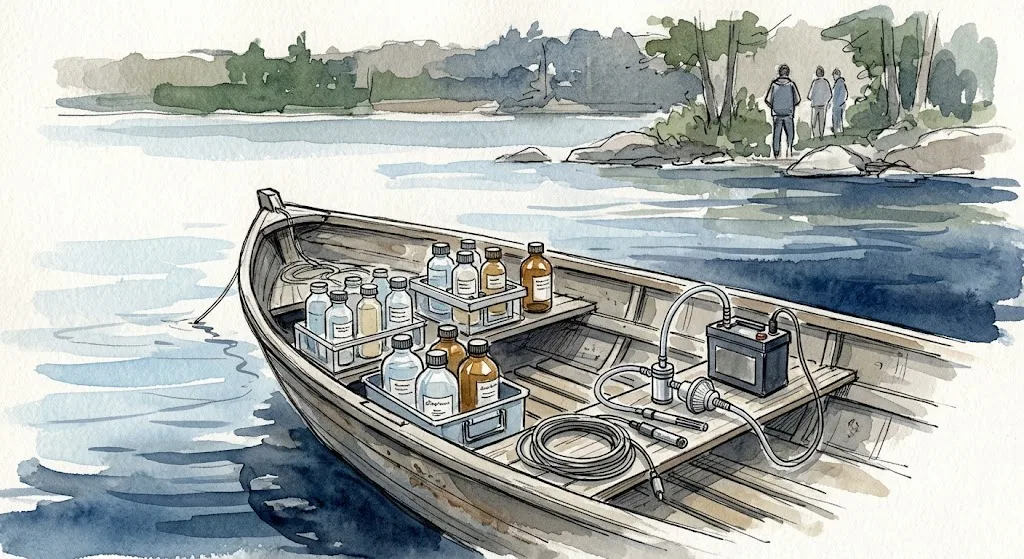
Every animal leaves genetic material behind. Skin cells, scales, mucus, faeces, eggs, sperm, feathers, hair and fragments of tissue can enter water and remain detectable for a period before they degrade, disperse, settle or are diluted. An eDNA survey collects water, filters or concentrates the biological material, extracts DNA, amplifies target genetic markers, sequences them, and compares the resulting reads with reference databases of known species. In plain terms, the method asks: what organisms have recently left genetic traces in this environment?
For lake monster searches, the appeal is obvious. A large unknown animal would not need to pose for a camera. If it lived, fed, bred or regularly moved through a lake, it should shed biological material like other animals. That makes eDNA especially useful for checking claims about hidden aquatic creatures, because water naturally mixes biological traces from places that are difficult, dangerous or expensive to survey directly.
The method is not speculative; it is now widely used in biodiversity monitoring. National Park Service and US Geological Survey authors describe eDNA as a way to identify species present at the time of sample collection, while freshwater studies have shown that eDNA metabarcoding can detect fish communities in large lakes and sometimes reveal more species than conventional netting surveys. One major Windermere study detected 14 of 16 historically recorded fish species using eDNA, compared with four species in the most recent gill-net survey cited by the authors.[National Park Service]nps.govOpen source on nps.gov.
That sensitivity is why eDNA has become so attractive to scientifically minded cryptozoology. It does not depend on eyewitness judgement, folklore, local reputation or dramatic footage. It produces a dataset that can be reanalysed, compared with later surveys, and checked against known biology. The Loch Ness Project described the 2018 work as involving shoreline, surface, mid-water and deep-water sampling at Loch Ness and three other lochs, with water filtered and processed after collection.[Loch Ness Project]lochnessproject.orgOpen source on lochnessproject.org.
What the Loch Ness survey actually found
What lake surveys can and cannot detect
eDNA is powerful because it can detect traces from organisms that are hard to see or catch. It is also limited because it is an indirect method. A sample does not contain a whole animal; it contains fragments of genetic material shaped by sampling design, water movement, degradation, laboratory sensitivity, contamination control and database coverage.
A useful way to read any lake-monster eDNA result is to separate four questions:<div class="content-enhancement content-enhancement--checklist" markdown="1">
- Was the target animal shedding DNA where and when samples were taken? A resident breeding population should be easier to detect than a rare visitor, a seasonal migrant or a single animal moving through a huge water body.
- Did the sampling plan cover the right places? Deep basins, shorelines, inflows, outflows, sediment layers and open water may carry different DNA signals.
- Can the lab detect the relevant lineage? Detection depends on primers, sequencing depth, contamination controls and the quality of reference databases.
- Does absence of DNA mean absence of the animal? Not always. It means the survey did not detect a matching signal under its specific conditions.</div>
Scientific reviews of eDNA repeatedly stress this uncertainty. False negatives can occur when a species is present but its DNA is not captured in a field sample or falls below laboratory detection limits. False positives can arise from contamination, analytical errors, or DNA transported from elsewhere. Recent work on eDNA uncertainty argues that detection and non-detection should be modelled probabilistically rather than treated as perfect proof of presence or absence.[Biodiversity and Evolution+2Nature]besjournals.onlinelibrary.wiley.com2041 210X.127432041 210X.12743
This matters for cryptozoology because a dramatic claim requires a careful evidential standard. If a lake monster is proposed as a population of large air-breathing reptiles, eDNA non-detection across extensive sampling is serious evidence against that idea. If the claim is a rare animal that enters only occasionally, a single negative survey is weaker. The more permanent, numerous, biologically active and lake-resident the proposed creature is, the more damaging a well-designed eDNA non-detection becomes.
The method also depends on known reference sequences. If an animal is entirely unknown to science, eDNA may not return a neat species name. It might produce an unmatched or poorly resolved sequence, or assign it only to a broad group. But for famous lake-monster hypotheses such as plesiosaurs, giant catfish, sturgeon, sharks, seals, otters, amphibians or eels, researchers can still ask whether DNA appears close to known relatives. The absence of any reptile-like signal at Loch Ness is therefore more meaningful than a generic failure to find “monster DNA”.[The Guardian]theguardian.comThe GuardianLoch Ness monster could be a giant eel, say scientists5 Sept 2019 — His study sequenced DNA from 250 samples of Loch Ness wat…
Why eDNA narrows monster theories rather than ending folklore
The strongest contribution of eDNA to lake monster searches is not that it “solves” every legend. It changes the shortlist of explanations. Before the Loch Ness survey, popular ideas included prehistoric reptiles, giant fish, sharks, catfish, sturgeon, seals, otters, eels, misidentified birds, floating debris, boat wakes and hoaxes. After the eDNA work, several animal hypotheses became much harder to defend for Loch Ness specifically.
That is different from saying every sighting has the same explanation. A long-necked shape at the surface could be a bird, a line of birds, a swimming deer, a seal-like visitor, a wave pattern, a floating log, a boat wake, an eel, a camera artefact, a hoax, or a sincere misperception under poor viewing conditions. eDNA does not interpret old photographs or judge witness honesty. It tests whether the lake’s biological traces fit the idea of a hidden animal population.
The eel result shows the difference between narrowing and proving. Eels are real residents of Loch Ness, and abundant eel DNA makes them a biologically grounded candidate for some elongated, moving shapes. But the eDNA survey did not show that Loch Ness contains eels of extraordinary size. A later statistical paper on the eel hypothesis argued from European eel catch data that extremely large eels become increasingly improbable as proposed size increases, meaning the eel explanation may be plausible for modest “large animal” reports but not for the most extravagant monster descriptions.[ResearchGate]researchgate.netResearch Gate(PDF) The Loch Ness Monster: If It's Real, Could It Be an Eel?Research Gate(PDF) The Loch Ness Monster: If It's Real, Could It Be an Eel?
For cryptozoology, this is a healthy result. eDNA does not replace sceptical fieldwork, local ecological knowledge, sonar, photography, historical research or conventional biology. It forces each monster theory to become more specific. A claim can no longer rest on “something unknown might be there” when a lake has been sampled and its known animal signals are available for comparison.
The future: repeated surveys, better databases, fewer escape hatches
The future of lake monster searches is likely to look less like a single expedition and more like long-term ecological monitoring. One survey is a snapshot. Repeated eDNA sampling across seasons, years, depths and weather conditions would make the evidence stronger, especially in large lakes where DNA distribution varies with currents, stratification, inflows and animal behaviour.
Better reference databases will also matter. Metabarcoding works by comparing sequences with known DNA records, so poor database coverage can limit identification. Fisheries and biodiversity studies increasingly call for more complete reference libraries, multi-marker assays and careful sampling design to improve reliability. In lake-monster contexts, this means future surveys should not simply ask whether an exciting animal appears; they should document all ordinary species well enough that any unusual signal stands out clearly.[GOV.UK]assets.publishing.service.gov.ukOpen source on service.gov.uk.
The Loch Ness case also suggests that monster searches can produce useful science even when they do not find monsters. Gemmell has described the survey as a way to showcase eDNA’s power for biodiversity monitoring, and Otago reported that the Loch Ness dataset could be compared with future tests to identify environmental trends and changes in the loch. That reframes the expedition from a yes-or-no monster hunt into a baseline survey of a culturally famous ecosystem.[University of Otago]otago.ac.nzUniversity of OtagoFirst eDNA Study Of Loch Ness Points To Something Fishy5 Sept 2019 — The results come after 250 samples of water were…
A credible future lake-monster eDNA programme would therefore include:
-
repeated sampling, not just one media-friendly expedition;<div class="content-enhancement content-enhancement--comparison" markdown="1">
- transparent sampling maps, depths, dates and laboratory controls;
- multiple genetic markers rather than reliance on a single assay;
- independent replication by different laboratories;
- publication of methods and, where possible, sequence data;
- comparison with conventional surveys, sonar, camera traps and local ecological records.</div>
This approach would not drain the mystery from lake legends. It would separate the parts that belong to culture, tourism and storytelling from the parts that make testable biological claims.
What a negative eDNA result really means for cryptozoology
A negative eDNA result is not a magic eraser. It does not prove that nobody ever saw anything unusual, and it does not prove that an animal was never present at any time in the past. It means that, under the survey’s design and detection limits, researchers did not find genetic evidence for the proposed animal.
For a serious cryptozoological claim, that still matters. A lake large enough to hide a breeding population of giant animals should also contain food webs, waste, shed cells, carcass traces, reproductive material and repeated biological signals. If careful eDNA surveys repeatedly detect ordinary fish, amphibians, birds, mammals and human-associated species but never detect the lineage required by the monster theory, the burden shifts heavily back to the claimant.
That is why eDNA is most useful as a narrowing tool. It cannot turn every absence into a final answer, but it can make some answers much less plausible. At Loch Ness, the future of the search is no longer mainly about whether a Jurassic reptile has escaped detection for millions of years. The evidence now points towards a more grounded set of possibilities: known animals seen under difficult conditions, unusual but not monstrous eels, occasional visitors, optical effects, wakes, folklore, hoaxes, and the powerful human habit of turning ambiguous shapes on dark water into stories.
Amazon book picks
Further Reading
Books and field guides related to Can eDNA Solve Lake Monster Mysteries?. Use these as the next step if you want deeper reading beyond the article.
In Search of Lake Monsters
Provides historical context for monster reports now tested by eDNA methods.
eBay marketplace picks
Marketplace Samples
Live-tested eBay searches with available results related to this page.

Endnotes
1.
Source: nature.com
Link:https://www.nature.com/articles/s41598-021-91166-7
2.
Source: researchgate.net
Title: Research Gate(PDF) The Loch Ness Monster: If It’s Real, Could It Be an Eel?
Link:https://www.researchgate.net/publication/390620130_The_Loch_Ness_Monster_If_It%27s_Real_Could_It_Be_an_Eel
3.
Source: assets.publishing.service.gov.uk
Link:https://assets.publishing.service.gov.uk/media/5a816ee6e5274a2e8ab53f6d/A_DNA_based_monitoring_method_for_fish_in_lakes_-_report.pdf
4.
Source: researchgate.net
Link:https://www.researchgate.net/publication/342296365_ESSAY_REVIEW_Disappointing_documentary_about_Loch_Ness_Monsters_Nessies_Can_good_documentaries_be_made_about_such_subjects
5.
Source: researchgate.net
Link:https://www.researchgate.net/figure/Sources-of-eDNA-false-positive-and-false-negative-detections-Errors-can-result-from_fig5_313849926
6.
Source: researchgate.net
Link:https://www.researchgate.net/publication/339422489_Environmental_DNA_Sampling_Informs_Fish_Eradication_Efforts_Case_Studies_and_Lessons_Learned
7.
Source: researchgate.net
Link:https://www.researchgate.net/publication/346237675_Marine_environmental_DNA_eDNA_for_biodiversity_assessments_a_one-to-one_comparison_between_eDNA_and_baited_remote_underwater_video_BRUV_surveys
8.
Source: researchgate.net
Link:https://www.researchgate.net/figure/Neil-Gemmell-at-Loch-Ness_fig1_342296365
9.
Source: mdba.gov.au
Title: edna biodiversity findings report murray darling basin spring 2023
Link:https://www.mdba.gov.au/sites/default/files/publications/edna-biodiversity-findings-report-murray-darling-basin-spring-2023.pdf
10.
Source: youtube.com
Title: Neil Gemmell
Link:https://www.youtube.com/watch?v=E4y62Pa4b28
11.
Source: otago.ac.nz
Link:https://www.otago.ac.nz/news/newsroom/first-edna-study-of-loch-ness-points-to-something-fishy
12.
Source: sciencefocus.com
Title: loch ness monster dna study reveals plausible explanation for sightings
Link:https://www.sciencefocus.com/news/loch-ness-monster-dna-study-reveals-plausible-explanation-for-sightings
13.
Source: theguardian.com
Link:https://www.theguardian.com/science/2019/sep/05/loch-ness-monster-could-be-a-giant-eel-say-scientists
14.
Source: nps.gov
Link:https://www.nps.gov/articles/aps-19-1-6.htm
15.
Source: lochnessproject.org
Link:https://www.lochnessproject.org/FIELDWORKGROUNDTRUTH/eDNA%20LOCH%20NESS/eDNA%20LOCHNESS_index.html
16.
Source: besjournals.onlinelibrary.wiley.com
Title: 2041 210X.12743
Link:https://besjournals.onlinelibrary.wiley.com/doi/10.1111/2041-210X.12743
17.
Source: emea.illumina.com
Title: loch ness edna
Link:https://emea.illumina.com/company/news-center/feature-articles/loch-ness-edna.html
18.
Source: illumina.com
Title: loch ness edna
Link:https://www.illumina.com/content/illumina-marketing/amr/en_US/company/news-center/feature-articles/loch-ness-edna.html
19.
Source: illumina.com
Title: loch ness edna
Link:https://www.illumina.com/company/news-center/feature-articles/loch-ness-edna.html
20.
Source: Wikipedia
Link:https://en.wikipedia.org/wiki/Loch
21.
Source: merriam-webster.com
Link:https://www.merriam-webster.com/dictionary/loch
22.
Source: sciencefocus.com
Title: loch ness monster how edna helps us discover what lurks beneath
Link:https://www.sciencefocus.com/nature/loch-ness-monster-how-edna-helps-us-discover-what-lurks-beneath
23.
Source: dictionary.cambridge.org
Link:https://dictionary.cambridge.org/us/dictionary/english/loch
24.
Source: frontiersin.org
Link:https://www.frontiersin.org/journals/marine-science/articles/10.3389/fmars.2026.1747671/full
25.
Source: seanoe.org
Link:https://www.seanoe.org/data/00846/95815/
26.
Source: otago.ac.nz
Title: communicating the loch ness study
Link:https://www.otago.ac.nz/news/newsroom/communicating-the-loch-ness-study
Additional References
27.
Source: youtube.com
Title: Professor Neil Gemmell prepares for his trip to Loch Ness in the hunt for Nessie
Link:https://www.youtube.com/watch?v=uMN7on6ZKcQ
28.
Source: youtube.com
Link:https://www.youtube.com/watch?v=P76FAAiuNYQ
29.
Source: youtube.com
Title: DNA Sequencing Exposed Loch Ness’ Secret — Nessie Was Never What We Thought
Link:https://www.youtube.com/watch?v=EraB4J49aRg
30.
Source: visitscotland.com
Link:https://www.visitscotland.com/things-to-do/landscapes-nature/lochs
31.
Source: stir.ac.uk
Link:https://www.stir.ac.uk/research/hub/file/1446789
32.
Source: researchsystem.canberra.edu.au
Link:https://researchsystem.canberra.edu.au/ws/portalfiles/portal/99354931/Environmental_DNA_-2023-Yates-_Beyond_species_detection_leveraging_environmental_DNA_and_environmental_RNA_to_push.pdf
33.
Source: rabbies.com
Link:https://www.rabbies.com/en-gb/blog/loch-vs-lake
34.
Source: facebook.com
Link:https://www.facebook.com/groups/470765477828717/posts/1350997809805475/
35.
Source: research-collection.ethz.ch
Link:https://www.research-collection.ethz.ch/server/api/core/bitstreams/4009194d-47fe-4929-80ff-dd74f4183a57/content
36.
Source: facebook.com
Link:https://www.facebook.com/cryptozoologymuseum/posts/the-team-took-250-water-samples-at-various-depths-throughout-the-loch-last-year-/10156107266981086/
Topic Tree