Within Pseudoscience
Why Blurry Bigfoot Photos Persuade People
Ambiguous images let believers and sceptics see different things because the picture itself lacks enough detail to decide.
On this page
- Why unclear images invite competing readings
- How prior belief fills visual gaps
- What a decisive wildlife image would need
Page outline Jump by section
Introduction
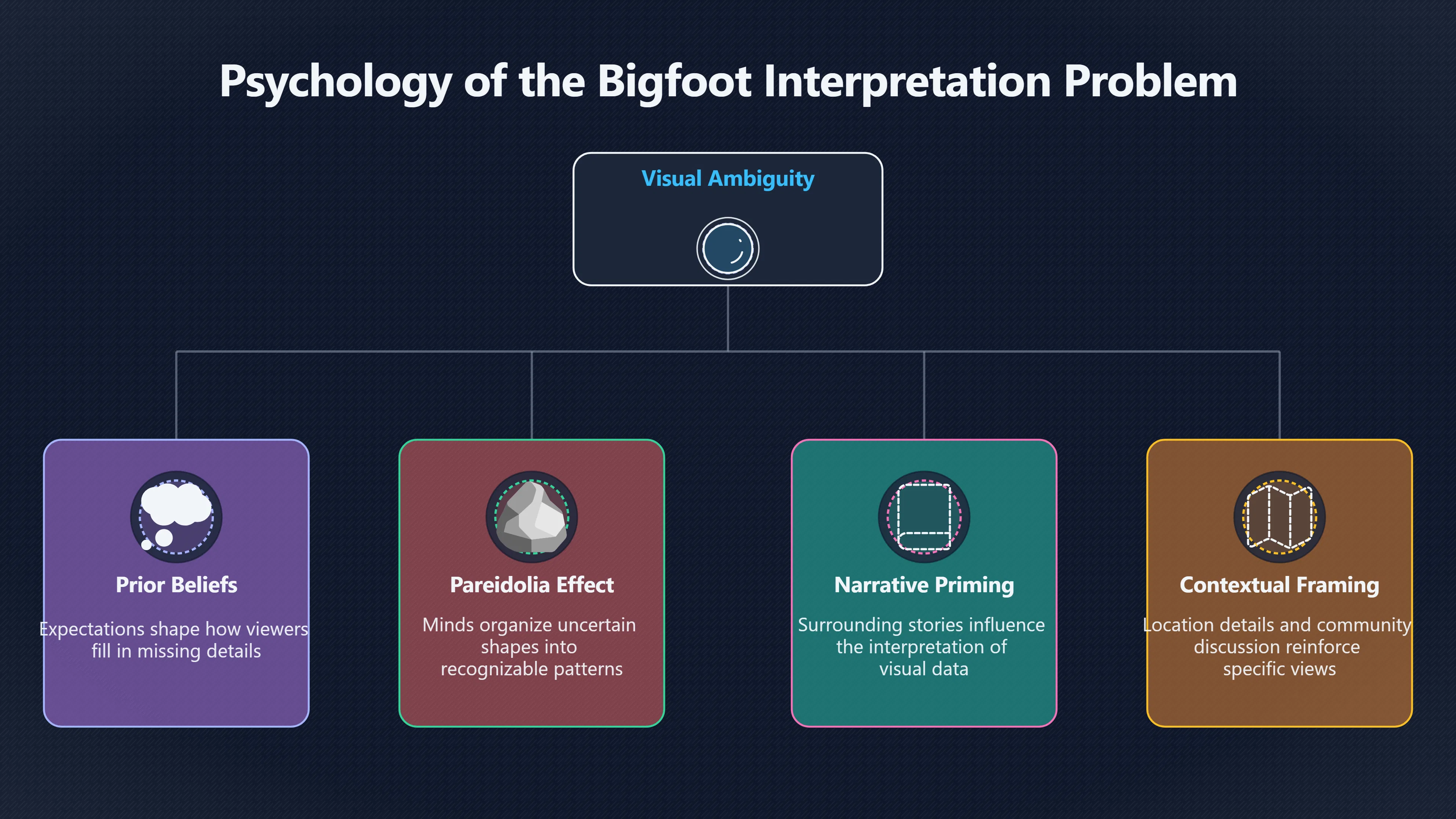
Bigfoot photographs are famous not because they settle the question of whether a large unknown primate exists, but because they rarely do. Most of the images that circulate in Bigfoot culture are distant, grainy, shaky or partially obscured. Their ambiguity creates what might be called the Bigfoot interpretation problem: the same image can appear compelling evidence to one viewer and a misidentified person, bear, tree stump or visual artefact to another. In cryptozoology, blurry photographs often function less as proof than as prompts for debate, belief and competing explanations. The central issue is not simply image quality. It is how human perception works when visual information is incomplete. When a photograph lacks enough detail to identify its subject confidently, viewers frequently fill the gaps using expectations, prior beliefs and context. As a result, the argument shifts from “What is in the picture?” to “What do we think we are looking at?”[Skeptical Inquirer]skepticalinquirer.orgSkeptical Inquirer Let's Not Agree to Disagree: Bigfoot as a Case ExampleThe position must be taken that a positive claim is assumed false until proven true by strong evidence (…Read more…
Why Unclear Images Invite Competing Readings
Photographs are often treated as objective records, but an image only provides as much information as its resolution, focus, lighting and distance allow. Once those factors degrade, interpretation becomes increasingly subjective.
Bigfoot imagery is especially vulnerable to this problem because the alleged subject is usually photographed unexpectedly and at a distance. A dark shape between trees may contain too little visual information to distinguish a human, a bear, a shadow or something unknown. Because the image itself does not resolve the question, observers rely on inference. Believers may see body proportions, posture or movement consistent with a large primate, while sceptics see ordinary explanations obscured by poor image quality.[Wikipedia]WikipediaPatterson–Gimlin filmPatterson–Gimlin film
This dynamic explains why the same photograph can generate decades of disagreement. The debate often persists precisely because the evidence is neither clear enough to confirm nor clear enough to dismiss conclusively. Ambiguity creates interpretive space in which multiple explanations remain plausible.
How Prior Belief Fills Visual Gaps
Psychologists have long documented that perception is not a purely passive process. Human beings interpret sensory information using expectations, assumptions and prior knowledge. When evidence is incomplete, those influences become more powerful.
In the Bigfoot context, a person who already considers the creature plausible may notice apparent signs of authenticity in a blurry image: unusual proportions, muscle contours, a non-human gait or behaviour. A sceptical viewer examining the same image may focus instead on signs of misidentification, costume effects or photographic artefacts. Neither observer is necessarily inventing details consciously; rather, the brain is constructing a coherent interpretation from limited information.[Psychology Today]psychologytoday.comwhy bigfoot believers dont change their mindsThis is the tendency for beliefs to persist even after the evidence supporting them has…Read more…
A related phenomenon is pareidolia, the tendency to perceive meaningful patterns in ambiguous stimuli. People see faces in clouds, animals in rock formations and figures in shadows. Ambiguous visual material encourages the mind to organise uncertain shapes into recognisable forms. Research on ambiguous images shows that observers can reach different conclusions from the same visual input, especially when expectations differ.[PMC]pmc.ncbi.nlm.nih.govPMCDo ambiguous images provide psychological insightsby R Wiseman · 2025 · Cited by 1 — Social media posts and websites claim that the way in which people perceive ambiguous images reveal…
Within Bigfoot culture, this process is reinforced by context. If an image is presented as a possible Bigfoot photograph, viewers are primed to search for evidence supporting that interpretation. The photograph does not arrive alone; it arrives with stories, witness testimony, location details and community discussion. Those surrounding narratives influence what people think they see.
The Patterson–Gimlin Film as the Classic Example
No case illustrates the interpretation problem better than the 1967 Patterson–Gimlin film, the most famous visual evidence in Bigfoot history. The footage shows a large hairy figure walking across a creek bed in northern California before glancing back toward the camera. More than half a century later, the film remains the centrepiece of Bigfoot debates.[Wikipedia+2Skeptical Inquirer]WikipediaPatterson–Gimlin filmPatterson–Gimlin film
The film’s significance comes partly from its ambiguity. Supporters argue that the figure displays anatomical features, movement patterns and apparent musculature that would have been difficult to fake convincingly in 1967. Critics counter that the footage is distant, affected by camera movement and limited by the technical quality of the original recording, making definitive conclusions impossible. Some analysts have argued for authenticity, while others have suggested costume-related explanations or pointed to methodological problems in pro-Bigfoot analyses.[Wikipedia]WikipediaPatterson–Gimlin filmPatterson–Gimlin film
What is striking is that decades of enhancement, stabilisation and frame-by-frame examination have not ended the dispute. Improved processing can make details easier to inspect, but it cannot create information that was never captured. Viewers often emerge from studying the same frames with opposite conclusions. The film’s endurance therefore reflects not only what it shows, but also how much interpretation it requires.[Wikipedia]WikipediaPatterson–Gimlin filmPatterson–Gimlin film
The Patterson–Gimlin film demonstrates a broader lesson about cryptozoological evidence. An image can be culturally powerful without being scientifically decisive. It persists because it remains open to multiple readings.
What a Decisive Wildlife Image Would Need
The contrast between blurry Bigfoot photographs and accepted wildlife documentation helps explain why the debate continues. In zoology, a persuasive image typically possesses several characteristics:<div class="content-enhancement content-enhancement--insight-grid" markdown="1">
- High resolution sufficient to show diagnostic anatomical features.
- Clear scale references that establish size.
- Multiple angles or multiple independent photographs.
- Known provenance and a verifiable chain of custody.
- Supporting evidence such as tracks, DNA, specimens or repeat observations.
- Independent confirmation by other observers or recording devices.</div>
A single ambiguous image rarely satisfies these requirements. Instead, scientists look for converging lines of evidence. A photograph gains credibility when it is supported by physical traces, repeatability and independent verification rather than standing alone.[Wikipedia]WikipediaPatterson–Gimlin filmPatterson–Gimlin film
This is one reason why blurry photographs occupy such an unusual position in cryptozoology. They are often intriguing enough to sustain interest but too limited to resolve the underlying claim. Their ambiguity allows them to survive scrutiny because different audiences can continue extracting different meanings from the same visual record.
Why the Blurry Photo Remains Central to Bigfoot Culture
The persistence of blurry Bigfoot imagery is not simply a technological issue. Modern cameras are vastly better than those available in the 1960s, yet debates over ambiguous photographs continue. The enduring appeal lies in the fact that uncertain images invite participation. Viewers become interpreters, investigators and advocates rather than passive recipients of a clear answer.[Skeptical Inquirer]skepticalinquirer.orgdocumentarys devastating bigfoot debunkingSkeptical InquirerDocumentary's Devastating Bigfoot Debunking13 Mar 2026 — The famous and iconic 1967 footage taken in Bluff Creek, Calif…
For believers, an unclear photograph may represent a rare glimpse of an elusive creature. For sceptics, it illustrates the unreliability of anecdotal visual evidence. For researchers of belief and perception, it offers a case study in how humans construct meaning from incomplete information. The image itself often becomes secondary to the social and psychological process surrounding it.
See on Amazon</a></div></div></article><article class="fr-book-card"><a class="fr-book-cover" href="https://www.amazon.com/s?k=Abominable+Science%21+by+Daniel+Loxton&i=stripbooks&tag=searcht-20" target="_blank" rel="sponsored noopener noreferrer" aria-label="Open Abominable Science! on Amazon"><span class="fr-book-cover-fallback">Book</span><img class="fr-book-cover-thumb" src="https://books.google.com/books/content?id=kTsgAAAAQBAJ&printsec=frontcover&img=1&zoom=1&edge=curl&source=gbs_api" alt="Cover for Abominable Science!" loading="lazy" decoding="async" fetchpriority="low" referrerpolicy="no-referrer" onerror="this.hidden=true;this.closest('.fr-book-cover').classList.add('fr-book-cover-placeholder');"></a><div class="fr-book-info"><h4 class="fr-book-title"><a href="https://www.amazon.com/s?k=Abominable+Science%21+by+Daniel+Loxton&i=stripbooks&tag=searcht-20" target="_blank" rel="sponsored noopener noreferrer" title="Abominable Science!">Abominable Science!</a></h4><p class="fr-book-author">By Daniel Loxton, Donald R. Prothero</p><p class="fr-book-desc">Addresses ambiguous evidence and image interpretation.</p><div class="fr-book-actions"><a href="https://www.amazon.com/s?k=Abominable+Science%21+by+Daniel+Loxton&i=stripbooks&tag=searcht-20" class="fr-amazon-btn" target="_blank" rel="sponsored noopener noreferrer">
See on Amazon</a></div></div></article><article class="fr-book-card"><a class="fr-book-cover" href="https://www.amazon.com/s?k=The+Invisible+Gorilla+by+Christopher+Chabris&i=stripbooks&tag=searcht-20" target="_blank" rel="sponsored noopener noreferrer" aria-label="Open The Invisible Gorilla on Amazon"><span class="fr-book-cover-fallback">Book</span><img class="fr-book-cover-thumb" src="https://books.google.com/books/content?id=VecEbBYC_sEC&printsec=frontcover&img=1&zoom=1&source=gbs_api" alt="Cover for The Invisible Gorilla" loading="lazy" decoding="async" fetchpriority="low" referrerpolicy="no-referrer" onerror="this.hidden=true;this.closest('.fr-book-cover').classList.add('fr-book-cover-placeholder');"></a><div class="fr-book-info"><h4 class="fr-book-title"><a href="https://www.amazon.com/s?k=The+Invisible+Gorilla+by+Christopher+Chabris&i=stripbooks&tag=searcht-20" target="_blank" rel="sponsored noopener noreferrer" title="The Invisible Gorilla">The Invisible Gorilla</a></h4><p class="fr-book-author">By Christopher Chabris, Daniel Simons</p><p class="fr-book-desc">Shows how perception can mislead observers.</p><div class="fr-book-actions"><a href="https://www.amazon.com/s?k=The+Invisible+Gorilla+by+Christopher+Chabris&i=stripbooks&tag=searcht-20" class="fr-amazon-btn" target="_blank" rel="sponsored noopener noreferrer">
See on Amazon</a></div></div></article><article class="fr-book-card"><a class="fr-book-cover" href="https://www.amazon.com/s?k=The+Believing+Brain+by+Michael+Shermer&i=stripbooks&tag=searcht-20" target="_blank" rel="sponsored noopener noreferrer" aria-label="Open The Believing Brain on Amazon"><span class="fr-book-cover-fallback">Book</span><img class="fr-book-cover-thumb" src="https://books.google.com/books/content?id=a1ueBAAAQBAJ&printsec=frontcover&img=1&zoom=1&edge=curl&source=gbs_api" alt="Cover for The Believing Brain" loading="lazy" decoding="async" fetchpriority="low" referrerpolicy="no-referrer" onerror="this.hidden=true;this.closest('.fr-book-cover').classList.add('fr-book-cover-placeholder');"></a><div class="fr-book-info"><h4 class="fr-book-title"><a href="https://www.amazon.com/s?k=The+Believing+Brain+by+Michael+Shermer&i=stripbooks&tag=searcht-20" target="_blank" rel="sponsored noopener noreferrer" title="The Believing Brain">The Believing Brain</a></h4><p class="fr-book-author">By Michael Shermer</p><p class="fr-book-desc">Explains how people find meaning in ambiguous data.</p><div class="fr-book-actions"><a href="https://www.amazon.com/s?k=The+Believing+Brain+by+Michael+Shermer&i=stripbooks&tag=searcht-20" class="fr-amazon-btn" target="_blank" rel="sponsored noopener noreferrer">
See on Amazon</a></div></div></article></div><div class="fr-section-footer"><div class="fr-browse-links" aria-label="Browse more on Amazon"><span class="fr-browse-links-label">Browse more on Amazon:</span><a class="fr-browse-more" href="https://www.amazon.com/s?k=Mistakes+Were+Made+%28but+Not+by+Me%29&i=stripbooks&tag=searcht-20" target="_blank" rel="sponsored noopener noreferrer">Mistakes Were Made (but Not by Me)</a><a class="fr-browse-more" href="https://www.amazon.com/s?k=Abominable+Science%21&i=stripbooks&tag=searcht-20" target="_blank" rel="sponsored noopener noreferrer">Abominable Science!</a><a class="fr-browse-more" href="https://www.amazon.com/s?k=The+Invisible+Gorilla&i=stripbooks&tag=searcht-20" target="_blank" rel="sponsored noopener noreferrer">The Invisible Gorilla</a></div><p class="fr-disclosure">As an Amazon Associate I earn from qualifying purchases.</p></div></div></section>
Amazon book picks
Further Reading
Books and field guides related to Why Blurry Bigfoot Photos Persuade People. Use these as the next step if you want deeper reading beyond the article.
Mistakes Were Made (but Not by Me)
Explains belief persistence and interpretation biases.
eBay marketplace picks
Marketplace Samples
Live-tested eBay searches with available results related to this page.
Endnotes
1.
Source: Wikipedia
Title: Patterson–Gimlin film
Link:https://en.wikipedia.org/wiki/Patterson%E2%80%93Gimlin_film
2.
Source: reddit.com
Title: there is still a notable lack of bigfoot
Link:https://www.reddit.com/r/Cryptozoology/comments/1ebp73a/2024_study_on_bigfoot_photo_and_video_evidence/
3.
Source: pmc.ncbi.nlm.nih.gov
Title: PMCDo ambiguous images provide psychological insights
Link:https://pmc.ncbi.nlm.nih.gov/articles/PMC11847482/
4.
Source: reddit.com
Link:https://www.reddit.com/r/bigfoot/comments/1rx338v/the_truth_about_pattys_face_what_you_see_is_what/
5.
Source: reddit.com
Link:https://www.reddit.com/r/Cryptozoology/comments/1rofs29/what_did_patterson_gimlin_see/
6.
Source: people.com
Title: famous 1967 bigfoot film was staged says director of new doc 11926085
Link:https://people.com/famous-1967-bigfoot-film-was-staged-says-director-of-new-doc-11926085
7.
Source: skepticalinquirer.org
Title: Skeptical Inquirer Let’s Not Agree to Disagree: Bigfoot as a Case Example
Link:https://skepticalinquirer.org/exclusive/lets-not-agree-to-disagree-bigfoot-as-a-case-example/
8.
Source: skepticalinquirer.org
Title: documentarys devastating bigfoot debunking
Link:https://skepticalinquirer.org/exclusive/documentarys-devastating-bigfoot-debunking/
9.
Source: psychologytoday.com
Title: why bigfoot believers dont change their minds
Link:https://www.psychologytoday.com/us/blog/speaking-in-tongues/202603/why-bigfoot-believers-dont-change-their-minds
Additional References
10.
Source: isu.edu
Link:https://www.isu.edu/media/libraries/rhi/research-papers/ANALYSIS-INTEGRITY-OF-THE-PATTERSON-GIMLIN-FILM-IMAGE_final.pdf
11.
Source: facebook.com
Link:https://www.facebook.com/groups/136640606405094/posts/7067696689966083/
12.
Source: scholarcommons.sc.edu
Title: The pictures were of the Paterson Film which was gave offered explanations
Link:https://scholarcommons.sc.edu/scurs/2023symposium/2023posterpresentations/38/
13.
Source: facebook.com
Link:https://www.facebook.com/ghostcitytours/posts/it-does-damage-to-the-subjectcliff-barackman-on-why-speculative-theories-distrac/1202847702001165/
14.
Source: wrasse.plymouth.ac.uk
Title: pseudoscience photography unveiling visual myths 1764798185
Link:https://wrasse.plymouth.ac.uk/ac-news/pseudoscience-photography-unveiling-visual-myths-1764798185
15.
Source: livescience.com
Title: 19178 tracking belief bigfoot infographic
Link:https://www.livescience.com/19178-tracking-belief-bigfoot-infographic.html
16.
Source: imba.missouri.edu
Title: bigfoot patterson gimlin film 1939426045
Link:https://imba.missouri.edu/bigfoot-patterson-gimlin-film-1939426045.html
17.
Source: facebook.com
Link:https://www.facebook.com/groups/149844915349213/posts/2160087017658316/
18.
Source: theguardian.com
Title: The Guardian’It never happened
Link:https://www.theguardian.com/artanddesign/2025/apr/12/28-fake-images-that-fooled-the-world
19.
Source: facebook.com
Link:https://www.facebook.com/blurrycreatures/posts/new-documentary-says-the-infamous-pattersongimlin-film-is-a-fake-but-what-if-its/1530642892179289/
Topic Tree