Within Proof
One Creature Is Not a Species
A credible animal claim needs signs of a breeding population, including repeated traces, habitat use and independent rediscovery.
On this page
- Why species claims need populations
- What traces elusive animals normally leave
- When repeat observations become useful evidence
Page outline Jump by section
Introduction
In cryptozoology, a single sighting is rarely enough to support the existence of a new species. Zoologists expect an animal population, not a lone observation. A species persists through breeding, feeding, movement across habitat and repeated interactions with its environment. For that reason, the scientific value of repeat sightings is not simply that they occur more often. Their importance lies in whether they reveal evidence of a stable, reproducing population occupying a real ecological niche. Evidence becomes stronger when independent observers report similar animals in the same region over time and when those reports are accompanied by physical traces, habitat patterns or other signs that can be tested.[USFS Research & Development]research.fs.usda.govUSFS Research & DevelopmentUsing anecdotal occurrence data for rare or elusive speciesJanuary 13, 2009 — by KS MCKELVEY · 2008 · Cited by… For claims involving large unknown animals, this population requirement is especially important. Large mammals need food, territory and mates. If such animals exist in meaningful numbers, they should leave detectable evidence beyond eyewitness accounts.[Reddit]reddit.comDoes anyone know why most scientist deny the existence…Mainly because large animals require a lot of resources and tend to leave…
Why Species Claims Need Populations
A new species is not established because one unusual creature was reportedly seen. Scientists need evidence that a population exists and can persist through time. Even if an observer accurately saw an unfamiliar animal, that observation alone does not show whether the animal represents a previously unknown species, a rare wanderer, a hybrid, an escaped captive animal or a misidentified known species.[USFS Research & Development]research.fs.usda.govUSFS Research & DevelopmentUsing anecdotal occurrence data for rare or elusive speciesJanuary 13, 2009 — by KS MCKELVEY · 2008 · Cited by…
Population evidence matters because species are biological lineages. A viable species must reproduce, maintain genetic diversity and occupy habitat across multiple generations. Conservation biology and wildlife monitoring therefore focus on occupancy, distribution and repeated detection rather than isolated records. Researchers routinely use repeated observations from multiple locations and time periods to infer whether a population occupies an area.[NERC Open Research Archive]nora.nerc.ac.ukNERC Open Research Archive Biological ConservationNERC Open Research ArchiveBiological Conservation - NERC Open Research ArchiveJanuary 17, 2022 — by FG Coomber · 2021 · Cited by 42 — Con…
This principle creates a major challenge for many famous cryptids. Reports may accumulate over decades, but unless those reports reveal a coherent population pattern, they remain anecdotal rather than biological evidence. The question shifts from “Was something seen?” to “What signs would a population inevitably leave behind?”
What Traces Elusive Animals Normally Leave
Many real species are difficult to observe directly. Some are nocturnal, inhabit dense forests, live underground or occur at very low densities. Yet even elusive animals leave indirect evidence.
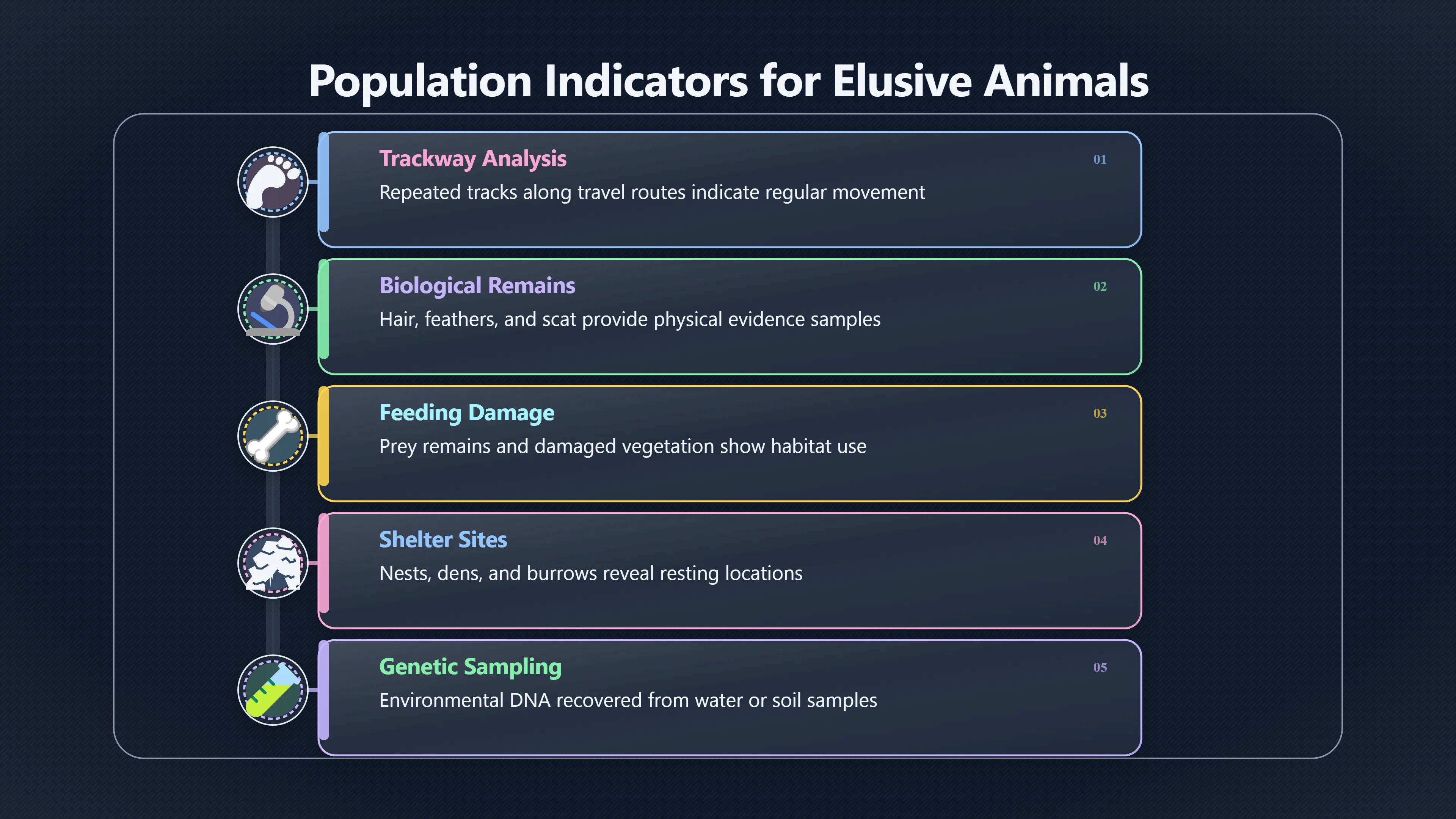
Common population indicators include:
-
Repeated tracks along travel routes.<div class="content-enhancement content-enhancement--insight-grid" markdown="1">
- Hair, feathers, scat or shed skin.
- Feeding damage and prey remains.
- Nests, dens, burrows or resting sites.
- Consistent camera-trap detections.
- Distinctive vocalisations recorded over time.
- Environmental DNA (eDNA) recovered from water, soil or other habitats.</div>
Wildlife monitoring often relies heavily on such indirect signs because direct sightings are relatively rare. Modern ecological surveys routinely infer animal presence and habitat use from traces rather than from constant visual encounters.[Mammal Society+2ResearchGate]mammal.org.ukMammal SocietyMonitoring MammalsMonitoring and recording the wild mammals in the landscape is a fun, engaging and educational way for peo…
For a hypothetical large unknown mammal, these traces would be expected to accumulate. The larger the animal and the more individuals present, the more difficult it becomes for every ecological sign to remain absent. This expectation helps explain scientific scepticism toward reports of undiscovered large mammals in heavily surveyed regions.[Reddit]reddit.comDoes anyone know why most scientist deny the existence…Mainly because large animals require a lot of resources and tend to leave…
Why Absence of Traces Matters
The absence of evidence is not always evidence of absence. Rare species are sometimes missed for years, especially in remote habitats. However, scientists evaluate whether the claimed animal’s biology is compatible with the scarcity of evidence.
A small amphibian in an isolated mountain valley might escape detection because it occupies a tiny range. In contrast, a large ape-like mammal would require substantial food resources, breeding opportunities and territory. Such ecological demands increase the likelihood that tracks, carcasses, genetic material or repeated physical evidence would eventually be found.[PLOS]journals.plos.orgThe World's Rediscovered Species: Back from the Brink?by BR Scheffers · 2011 · Cited by 127 — We document the number, distribution an…
This is why discussions about cryptids often focus less on individual reports and more on the expected footprint of a population.
When Repeat Observations Become Useful Evidence
Repeated sightings become scientifically valuable when they reveal patterns that can be independently verified.
Several factors increase credibility:
Consistency across observers. Independent witnesses reporting similar characteristics, behaviour and locations are more informative than repeated stories that originate from a single source.[USFS Research & Development]research.fs.usda.govUSFS Research & DevelopmentUsing anecdotal occurrence data for rare or elusive speciesJanuary 13, 2009 — by KS MCKELVEY · 2008 · Cited by…
Geographic clustering. Reports concentrated in specific habitats may indicate a real biological phenomenon. Randomly scattered observations are harder to interpret. Wildlife researchers frequently use repeated detections within defined areas to estimate occupancy and distribution.[NERC Open Research Archive]nora.nerc.ac.ukNERC Open Research Archive Biological ConservationNERC Open Research ArchiveBiological Conservation - NERC Open Research ArchiveJanuary 17, 2022 — by FG Coomber · 2021 · Cited by 42 — Con…
Temporal persistence. Records occurring over years in the same region are generally more significant than brief waves of reports that quickly disappear. Long-term persistence is one of the characteristics expected of a resident population.[NERC Open Research Archive]nora.nerc.ac.ukNERC Open Research Archive Biological ConservationNERC Open Research ArchiveBiological Conservation - NERC Open Research ArchiveJanuary 17, 2022 — by FG Coomber · 2021 · Cited by 42 — Con…
Correlation with physical evidence. Sightings gain strength when accompanied by photographs, trackways, DNA samples, sound recordings or other material that can be independently examined. Multiple evidence streams are more persuasive than repeated eyewitness testimony alone.[USFS Research & Development]research.fs.usda.govUSFS Research & DevelopmentUsing anecdotal occurrence data for rare or elusive speciesJanuary 13, 2009 — by KS MCKELVEY · 2008 · Cited by…
Importantly, repeated observations do not automatically prove a species exists. They provide hypotheses that can be tested. Scientists still ask whether known animals, environmental conditions, folklore, expectation effects or reporting biases could explain the pattern.
Rediscovery Shows What Strong Population Evidence Looks Like
Real zoology provides examples of species that were lost, overlooked or thought extinct before being rediscovered. These cases are often cited in cryptozoological discussions because they demonstrate what successful rediscovery usually looks like.
Studies of rediscovered mammals, birds and amphibians show that most were eventually confirmed through repeated field detections, specimens, photographs, ecological surveys or other verifiable evidence. Rediscoveries generally occurred in restricted habitats where small populations persisted unnoticed, not because the animals left no evidence at all.[PLOS]journals.plos.orgThe World's Rediscovered Species: Back from the Brink?by BR Scheffers · 2011 · Cited by 127 — We document the number, distribution an…
Likewise, methods used to assess whether species still exist often examine the pattern and reliability of sightings over time. Researchers distinguish between isolated anecdotal reports and repeated observations that fit a coherent ecological picture. Statistical approaches can even evaluate sighting histories when determining whether a species is likely extinct or still present.[PubMed]pubmed.ncbi.nlm.nih.govInferring extinction of mammals from sighting records…by DO Fisher · 2012 · Cited by 24 — For species with five or more sighting…
These examples illustrate a key point: repeat observations become meaningful when they help reveal a population that can be found again by other investigators.
One Creature Is Not a Species
Within scientific standards for proving a new animal species, repeated sightings matter because they address the population question. A single observation may suggest that further investigation is warranted. A network of independent observations, supported by ecological traces and repeated rediscovery, begins to suggest that real animals may be occupying a real habitat.
See on Amazon</a></div></div></article><article class="fr-book-card"><a class="fr-book-cover" href="https://www.amazon.com/s?k=The+Diversity+of+Life+by+Edward+O.+Wilson&i=stripbooks&tag=searcht-20" target="_blank" rel="sponsored noopener noreferrer" aria-label="Open The Diversity of Life on Amazon"><span class="fr-book-cover-fallback">Book</span><img class="fr-book-cover-thumb" src="https://books.google.com/books/content?id=ZSqehqH-qTYC&printsec=frontcover&img=1&zoom=1&edge=curl&source=gbs_api" alt="Cover for The Diversity of Life" loading="lazy" decoding="async" fetchpriority="low" referrerpolicy="no-referrer" onerror="this.hidden=true;this.closest('.fr-book-cover').classList.add('fr-book-cover-placeholder');"></a><div class="fr-book-info"><h4 class="fr-book-title"><a href="https://www.amazon.com/s?k=The+Diversity+of+Life+by+Edward+O.+Wilson&i=stripbooks&tag=searcht-20" target="_blank" rel="sponsored noopener noreferrer" title="The Diversity of Life">The Diversity of Life</a></h4><p class="fr-book-author">By Edward O. Wilson</p><p class="fr-book-desc">Shows how species exist as populations within ecosystems.</p><div class="fr-book-actions"><a href="https://www.amazon.com/s?k=The+Diversity+of+Life+by+Edward+O.+Wilson&i=stripbooks&tag=searcht-20" class="fr-amazon-btn" target="_blank" rel="sponsored noopener noreferrer">
See on Amazon</a></div></div></article><article class="fr-book-card"><a class="fr-book-cover" href="https://www.amazon.com/s?k=Abominable+Science%21+by+Daniel+Loxton&i=stripbooks&tag=searcht-20" target="_blank" rel="sponsored noopener noreferrer" aria-label="Open Abominable Science! on Amazon"><span class="fr-book-cover-fallback">Book</span><img class="fr-book-cover-thumb" src="https://books.google.com/books/content?id=kTsgAAAAQBAJ&printsec=frontcover&img=1&zoom=1&edge=curl&source=gbs_api" alt="Cover for Abominable Science!" loading="lazy" decoding="async" fetchpriority="low" referrerpolicy="no-referrer" onerror="this.hidden=true;this.closest('.fr-book-cover').classList.add('fr-book-cover-placeholder');"></a><div class="fr-book-info"><h4 class="fr-book-title"><a href="https://www.amazon.com/s?k=Abominable+Science%21+by+Daniel+Loxton&i=stripbooks&tag=searcht-20" target="_blank" rel="sponsored noopener noreferrer" title="Abominable Science!">Abominable Science!</a></h4><p class="fr-book-author">By Daniel Loxton, Donald R. Prothero</p><p class="fr-book-desc">Discusses why species claims require more than sightings.</p><div class="fr-book-actions"><a href="https://www.amazon.com/s?k=Abominable+Science%21+by+Daniel+Loxton&i=stripbooks&tag=searcht-20" class="fr-amazon-btn" target="_blank" rel="sponsored noopener noreferrer">
See on Amazon</a></div></div></article><article class="fr-book-card"><a class="fr-book-cover" href="https://www.amazon.com/s?k=A+Field+Guide+to+Lies+by+Daniel+J.+Levitin&i=stripbooks&tag=searcht-20" target="_blank" rel="sponsored noopener noreferrer" aria-label="Open A Field Guide to Lies on Amazon"><span class="fr-book-cover-fallback">Book</span><img class="fr-book-cover-thumb" src="https://books.google.com/books/content?id=5P7wjwEACAAJ&printsec=frontcover&img=1&zoom=1&source=gbs_api" alt="Cover for A Field Guide to Lies" loading="lazy" decoding="async" fetchpriority="low" referrerpolicy="no-referrer" onerror="this.hidden=true;this.closest('.fr-book-cover').classList.add('fr-book-cover-placeholder');"></a><div class="fr-book-info"><h4 class="fr-book-title"><a href="https://www.amazon.com/s?k=A+Field+Guide+to+Lies+by+Daniel+J.+Levitin&i=stripbooks&tag=searcht-20" target="_blank" rel="sponsored noopener noreferrer" title="A Field Guide to Lies">A Field Guide to Lies</a></h4><p class="fr-book-author">By Daniel J. Levitin</p><p class="fr-book-desc">Helps readers evaluate weak versus strong evidence.</p><div class="fr-book-actions"><a href="https://www.amazon.com/s?k=A+Field+Guide+to+Lies+by+Daniel+J.+Levitin&i=stripbooks&tag=searcht-20" class="fr-amazon-btn" target="_blank" rel="sponsored noopener noreferrer">
See on Amazon</a></div></div></article></div><div class="fr-section-footer"><div class="fr-browse-links" aria-label="Browse more on Amazon"><span class="fr-browse-links-label">Browse more on Amazon:</span><a class="fr-browse-more" href="https://www.amazon.com/s?k=Why+Evolution+is+True&i=stripbooks&tag=searcht-20" target="_blank" rel="sponsored noopener noreferrer">Why Evolution is True</a><a class="fr-browse-more" href="https://www.amazon.com/s?k=The+Diversity+of+Life&i=stripbooks&tag=searcht-20" target="_blank" rel="sponsored noopener noreferrer">The Diversity of Life</a><a class="fr-browse-more" href="https://www.amazon.com/s?k=Abominable+Science%21&i=stripbooks&tag=searcht-20" target="_blank" rel="sponsored noopener noreferrer">Abominable Science!</a></div><p class="fr-disclosure">As an Amazon Associate I earn from qualifying purchases.</p></div></div></section>
eBay marketplace picks
Marketplace Samples
Live-tested eBay searches with available results related to this page.

Endnotes
1.
Source: natureserve.org
Title: documenting species ecosystems
Link:https://www.natureserve.org/documenting-species-ecosystems
2.
Source: reddit.com
Link:https://www.reddit.com/r/Cryptozoology/comments/1gvep0j/does_anyone_know_why_most_scientist_deny_the/
3.
Source: researchgate.net
Link:https://www.researchgate.net/publication/370529396_Ecological_inferences_about_marine_mammals_from_passive_acoustic_data
4.
Source: journals.plos.org
Link:https://journals.plos.org/plosone/article?id=10.1371%2Fjournal.pone.0022531
5.
Source: researchgate.net
Title: 403177941 Rediscovering Cryptozoology as an Integrative Science
Link:https://www.researchgate.net/publication/403177941_Rediscovering_Cryptozoology_as_an_Integrative_Science
6.
Source: research.fs.usda.gov
Link:https://research.fs.usda.gov/download/treesearch/31759.pdf
7.
Source: nora.nerc.ac.uk
Title: NERC Open Research Archive Biological Conservation
Link:https://nora.nerc.ac.uk/id/eprint/531651/1/N531651JA.pdf
8.
Source: mammal.org.uk
Link:https://mammal.org.uk/monitoring-mammals
9.
Source: Wikipedia
Title: Conservation biology
Link:https://en.wikipedia.org/wiki/Conservation_biology
10.
Source: pubmed.ncbi.nlm.nih.gov
Link:https://pubmed.ncbi.nlm.nih.gov/22136403/
Additional References
11.
Source: eprints.glos.ac.uk
Link:https://eprints.glos.ac.uk/13111/1/13111%20Goodenough%2C%20Berry%2C%20Carpenter%2C%20Dawson%2C%20Furlong%2C%20Lamb%2C%20MacTavish%2C%20O%27Reilly%2C%20Toms%2C%20Whitehead%2C%20Hart%20%282023%29%20Do%20you%20see%20what%20I%20see%20-%20Variation%20in%20detective%2C%20identification%20and%20enumeration%20of%20mammals%20during%20transect%20surv.pdf
12.
Source: alliedacademies.org
Link:https://www.alliedacademies.org/articles/mammalian-ecology-understanding-the-lives-of-mammals-in-natural-environments-32464.html
13.
Source: royalsocietypublishing.org
Link:https://royalsocietypublishing.org/rspb/article/278/1708/1090/73511/Correlates-of-rediscovery-and-the-detectability-of
14.
Source: gre.myprepclub.com
Title: the field of cryptozoology is the search for animals unknown to scienc 32269
Link:https://gre.myprepclub.com/forum/the-field-of-cryptozoology-is-the-search-for-animals-unknown-to-scienc-32269.html
15.
Source: facebook.com
Link:https://www.facebook.com/Facts.Random.Weird/posts/scientists-have-deployed-advanced-sonar-mapping-environmental-dna-sampling-and-u/1336687401937406/
16.
Source: instagram.com
Link:https://www.instagram.com/reel/DPOmxxdDQj-/
17.
Source: royalsocietypublishing.org
Link:https://royalsocietypublishing.org/rstb/article/378/1881/20220181/109209/Detecting-and-attributing-the-causes-of
18.
Source: hangar1publishing.com
Link:https://hangar1publishing.com/blogs/cryptids/cryptid-habitats-and-ecosystems?srsltid=AfmBOooB_A334dKNZjfvQMzpASCwqL1-M2FOhhpL8c3xxmqdlFAm3Keu
19.
Source: zoo.cam.ac.uk
Title: cam.ac.uk Publications | Department of Zoology
Link:https://www.zoo.cam.ac.uk/research/groups/larg/publications
20.
Source: link.springer.com
Link:https://link.springer.com/article/10.1007/s10592-025-01729-8
Topic Tree