Within Coelacanth
The Coelacanth Test for Cryptid Claims
The coelacanth case sets a practical test for cryptids: preserved evidence, plausible habitat, taxonomic fit, and independent confirmation.
On this page
- What evidence made the coelacanth decisive
- How famous cryptid claims usually differ
- A practical checklist for extraordinary animal reports
Page outline Jump by section
Introduction
The coelacanth is often invoked in cryptozoology as proof that science can be surprised. That much is true. A fish lineage believed absent from the modern world was confirmed alive in 1938 when a physical specimen was recovered and examined. Yet the most important lesson is not that extraordinary creatures frequently turn out to be real. The lesson is that the coelacanth became accepted because it satisfied a demanding chain of evidence: a preserved specimen, expert examination, a plausible habitat, repeated discoveries, and independent confirmation by multiple researchers over time.[Natural History Museum]nhm.ac.ukDiscover the story of this strange fishNatural History MuseumCoelacanths: The fish that 'outdid' the Loch Ness MonsterCoelacanths were thought to have been extinct for 70 milli… For assessing cryptid claims, the coelacanth is therefore less a symbol of scientific failure than a practical benchmark. Rather than asking whether an unusual animal is theoretically possible, the coelacanth case asks what evidence would be required to move a claim from folklore, eyewitness testimony, or speculation into zoological reality.
The Coelacanth Test for Cryptid Claims
The decisive feature of the coelacanth story is that it did not begin with a mystery photograph, rumour, or anecdote. It began with a body that could be preserved, measured, dissected, compared with fossils, and examined by specialists. Once identified, the specimen generated testable predictions: if one coelacanth existed, others should exist as well. Subsequent discoveries confirmed that prediction.[American Museum of Natural History+2PBS]amnh.orgThe Museum stood ready to preserve a newly discoveredAmerican Museum of Natural HistoryDiscovery and Preservation of a CoelacanthIn 1938, a newly discovered coelacanth surprised scientists…
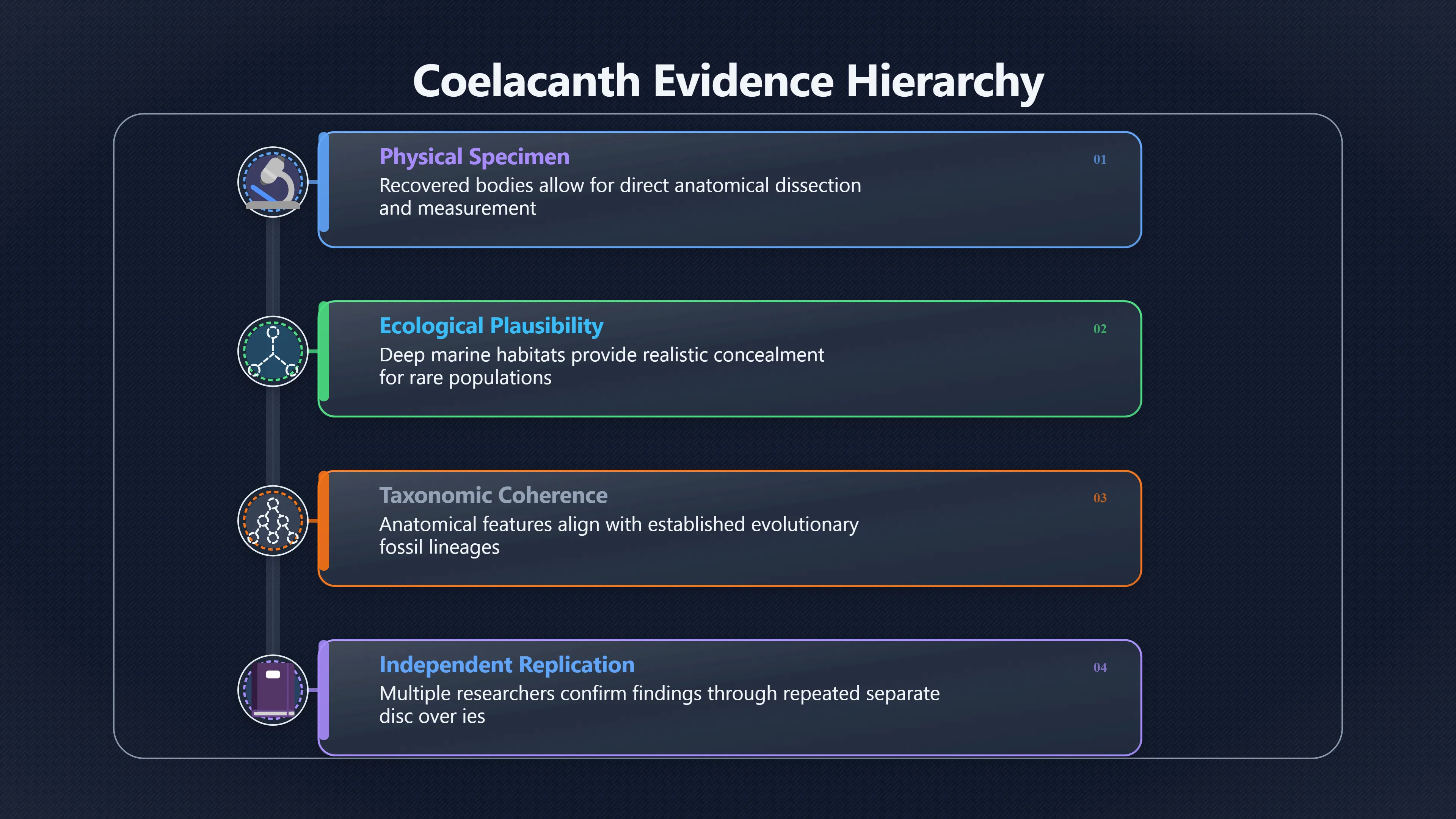
From a governance and evidence-evaluation perspective, the coelacanth establishes four core standards:<div class="content-enhancement content-enhancement--step-flow" markdown="1">
- Physical evidence – A specimen or biological material available for independent examination.
- Ecological plausibility – A habitat capable of concealing a rare population without contradicting known biology.
- Taxonomic coherence – Anatomical features that fit within established evolutionary relationships rather than requiring ad hoc explanations.
- Independent replication – Confirmation by additional discoveries, observations, and researchers.</div>
These standards transformed the coelacanth from an extraordinary claim into an accepted species. Without them, the discovery would have remained merely a story.[Natural History Museum]nhm.ac.ukDiscover the story of this strange fishNatural History MuseumCoelacanths: The fish that 'outdid' the Loch Ness MonsterCoelacanths were thought to have been extinct for 70 milli…
What Evidence Made the Coelacanth Decisive?
A preserved specimen ended the debate
The 1938 fish could be inspected directly. Scientists were not evaluating witness reliability or interpreting ambiguous images. They were examining fins, scales, bones, and anatomical structures. This distinction is crucial because physical specimens allow repeated testing by different experts.[American Museum of Natural History]amnh.orgThe Museum stood ready to preserve a newly discoveredAmerican Museum of Natural HistoryDiscovery and Preservation of a CoelacanthIn 1938, a newly discovered coelacanth surprised scientists…
Many cryptid reports never reach this stage. Claims often depend on testimony that cannot be independently verified years later. The coelacanth crossed the threshold from report to evidence.
The habitat was unusual but realistic
Modern coelacanths inhabit deep marine environments, commonly occupying caves, volcanic slopes, and steep underwater terrain hundreds of feet below the surface. Such habitats were historically difficult to explore and remain less observed than most terrestrial environments. Smithsonian Ocean+2Vlaams Instituut voor de Zee[ocean.si.edu]ocean.si.eduSmithsonian OceanCoelacanth | Smithsonian OceanThe two specimens observed from a submersible in Indonesia were in a deep carbonate cave a…
This matters because rarity alone does not make a claim plausible. A proposed species must have somewhere credible to exist. The coelacanth’s environment provided a realistic explanation for why a large vertebrate could remain poorly documented without requiring a worldwide scientific conspiracy or a complete failure of modern observation.[Smithsonian Ocean]ocean.si.eduSmithsonian OceanCoelacanth | Smithsonian OceanThe two specimens observed from a submersible in Indonesia were in a deep carbonate cave a…
Independent discoveries followed
A single specimen could have represented an anomaly, misidentification, or isolated survival. Instead, additional specimens were recovered, populations were documented around the Comoros, living individuals were observed in their natural habitat, and a second living species was eventually recognised in Indonesia.[Scuba Diver Life+2The Australian Museum]scubadiverlife.comthe coelacanth a living fossilScuba Diver LifeThe Coelacanth: A Living FossilNov 5, 2015 — After the first coelacanth was discovered, Smith began an earnest campaign t…
The evidential strength came from accumulation. Each new discovery reduced uncertainty and increased confidence that a genuine biological population existed.
The claim fit evolutionary expectations
Although surprising, the coelacanth did not require rewriting fundamental biology. It belonged to a known fossil lineage and possessed anatomical characteristics that could be compared with previously discovered fossils. Scientists were adding a living representative to an existing branch of the evolutionary tree rather than inventing an entirely unsupported category of organism.[Natural History Museum]nhm.ac.ukDiscover the story of this strange fishNatural History MuseumCoelacanths: The fish that 'outdid' the Loch Ness MonsterCoelacanths were thought to have been extinct for 70 milli…
This taxonomic continuity is often overlooked. Extraordinary discoveries become easier to accept when they fit broader biological patterns.
How Famous Cryptid Claims Usually Differ
The coelacanth is frequently cited in arguments for creatures such as lake monsters, surviving dinosaurs, giant unknown predators, or relic populations of prehistoric animals. However, most famous cryptid cases diverge sharply from the coelacanth model.
Evidence type
- Coelacanth: preserved specimen and later multiple specimens.
- Typical cryptid claim: eyewitness reports, photographs, videos, footprints, or anecdotal testimony.[American Museum of Natural History]amnh.orgThe Museum stood ready to preserve a newly discoveredAmerican Museum of Natural HistoryDiscovery and Preservation of a CoelacanthIn 1938, a newly discovered coelacanth surprised scientists…
Habitat visibility
- Coelacanth: deep-water caves and poorly explored marine terrain.[Smithsonian Ocean]ocean.si.eduSmithsonian OceanCoelacanth | Smithsonian OceanThe two specimens observed from a submersible in Indonesia were in a deep carbonate cave a…
- Many cryptids: lakes, forests, coastlines, or regions already subject to extensive observation and ecological study.
Population requirements
- Coelacanths exist as real breeding populations distributed across identifiable habitats.[The Australian Museum]australian.museumThe Australian MuseumCoelacanth, Latimeria chalumnae Smith, 1939by M McGrouther — This Coelacanth specimen caught in 1938 led to the disc…
- Large cryptids would typically require sizeable breeding populations that should leave detectable traces such as carcasses, DNA, feeding signs, or repeated physical evidence.
Replication
- Coelacanth evidence accumulated through repeated independent discoveries.[Scuba Diver Life]scubadiverlife.comthe coelacanth a living fossilScuba Diver LifeThe Coelacanth: A Living FossilNov 5, 2015 — After the first coelacanth was discovered, Smith began an earnest campaign t…
- Many cryptid claims remain dependent on isolated incidents that never produce comparable confirmation.
A Practical Checklist for Extraordinary Animal Reports
The coelacanth case can be turned into a practical evaluation framework for cryptid claims.
1. Is there recoverable physical evidence?
The strongest evidence includes specimens, tissue, bones, genetic material, or other biological remains that can be examined independently. Without this step, a claim remains provisional.
2. Does the proposed habitat make sense?
A credible claim should identify an environment capable of supporting and concealing the species. Deep oceans, remote cave systems, and poorly studied ecosystems generally offer stronger concealment potential than heavily monitored landscapes.
3. Would a breeding population be viable?
A species cannot persist for generations as a single individual. Reports should be consistent with realistic population sizes, food availability, reproductive biology, and geographic range.
4. Does the animal fit known biology?
A newly discovered species may be surprising, but it should not require abandoning well-supported principles of anatomy, ecology, or evolution without compelling evidence.
5. Can independent investigators confirm the claim?
The coelacanth did not become accepted because one expert believed it. Acceptance emerged because evidence could be checked repeatedly by other researchers. Independent confirmation remains the central safeguard against error.
Why the Coelacanth Remains the Best Benchmark
The coelacanth is valuable to cryptozoology precisely because it demonstrates both openness and restraint. It shows that apparently improbable animals can exist, especially in poorly explored environments. At the same time, it shows that acceptance depends on evidence that survives scrutiny.
See on Amazon</a></div></div></article><article class="fr-book-card"><a class="fr-book-cover" href="https://www.amazon.com/s?k=A+Fish+Caught+in+Time+by+Samantha+Weinberg&i=stripbooks&tag=searcht-20" target="_blank" rel="sponsored noopener noreferrer" aria-label="Open A Fish Caught in Time on Amazon"><span class="fr-book-cover-fallback">Book</span><img class="fr-book-cover-thumb" src="https://books.google.com/books/content?id=UDHAaqOk7jwC&printsec=frontcover&img=1&zoom=1&edge=curl&source=gbs_api" alt="Cover for A Fish Caught in Time" loading="lazy" decoding="async" fetchpriority="low" referrerpolicy="no-referrer" onerror="this.hidden=true;this.closest('.fr-book-cover').classList.add('fr-book-cover-placeholder');"></a><div class="fr-book-info"><h4 class="fr-book-title"><a href="https://www.amazon.com/s?k=A+Fish+Caught+in+Time+by+Samantha+Weinberg&i=stripbooks&tag=searcht-20" target="_blank" rel="sponsored noopener noreferrer" title="A Fish Caught in Time">A Fish Caught in Time</a></h4><p class="fr-book-author">By Samantha Weinberg</p><p class="fr-book-desc">Shows the actual evidence chain that turned an unexpected animal into accepted science.</p><div class="fr-book-actions"><a href="https://www.amazon.com/s?k=A+Fish+Caught+in+Time+by+Samantha+Weinberg&i=stripbooks&tag=searcht-20" class="fr-amazon-btn" target="_blank" rel="sponsored noopener noreferrer">
See on Amazon</a></div></div></article><article class="fr-book-card"><a class="fr-book-cover" href="https://www.amazon.com/s?k=The+Beasts+That+Hide+from+Man+by+Karl+Shuker&i=stripbooks&tag=searcht-20" target="_blank" rel="sponsored noopener noreferrer" aria-label="Open The Beasts That Hide from Man on Amazon"><span class="fr-book-cover-fallback">Book</span><img class="fr-book-cover-thumb" src="https://books.google.com/books/content?id=QNFR4xHHIegC&printsec=frontcover&img=1&zoom=1&edge=curl&source=gbs_api" alt="Cover for The Beasts That Hide from Man" loading="lazy" decoding="async" fetchpriority="low" referrerpolicy="no-referrer" onerror="this.hidden=true;this.closest('.fr-book-cover').classList.add('fr-book-cover-placeholder');"></a><div class="fr-book-info"><h4 class="fr-book-title"><a href="https://www.amazon.com/s?k=The+Beasts+That+Hide+from+Man+by+Karl+Shuker&i=stripbooks&tag=searcht-20" target="_blank" rel="sponsored noopener noreferrer" title="The Beasts That Hide from Man">The Beasts That Hide from Man</a></h4><p class="fr-book-author">By Karl Shuker</p><p class="fr-book-desc">Examines reports of unknown animals and the evidence behind them.</p><div class="fr-book-actions"><a href="https://www.amazon.com/s?k=The+Beasts+That+Hide+from+Man+by+Karl+Shuker&i=stripbooks&tag=searcht-20" class="fr-amazon-btn" target="_blank" rel="sponsored noopener noreferrer">
See on Amazon</a></div></div></article><article class="fr-book-card"><a class="fr-book-cover" href="https://www.amazon.com/s?k=Cryptozoology+A+To+Z+by+Loren+Coleman&i=stripbooks&tag=searcht-20" target="_blank" rel="sponsored noopener noreferrer" aria-label="Open Cryptozoology A To Z on Amazon"><span class="fr-book-cover-fallback">Book</span><img class="fr-book-cover-thumb" src="https://books.google.com/books/content?id=uOccNMgNSNYC&printsec=frontcover&img=1&zoom=1&edge=curl&source=gbs_api" alt="Cover for Cryptozoology A To Z" loading="lazy" decoding="async" fetchpriority="low" referrerpolicy="no-referrer" onerror="this.hidden=true;this.closest('.fr-book-cover').classList.add('fr-book-cover-placeholder');"></a><div class="fr-book-info"><h4 class="fr-book-title"><a href="https://www.amazon.com/s?k=Cryptozoology+A+To+Z+by+Loren+Coleman&i=stripbooks&tag=searcht-20" target="_blank" rel="sponsored noopener noreferrer" title="Cryptozoology A To Z">Cryptozoology A To Z</a></h4><p class="fr-book-author">By Loren Coleman, Jerome Clark</p><p class="fr-book-desc">Provides context for comparing different cryptid claims against stronger evidence cases.</p><div class="fr-book-actions"><a href="https://www.amazon.com/s?k=Cryptozoology+A+To+Z+by+Loren+Coleman&i=stripbooks&tag=searcht-20" class="fr-amazon-btn" target="_blank" rel="sponsored noopener noreferrer">
See on Amazon</a></div></div></article></div><div class="fr-section-footer"><div class="fr-browse-links" aria-label="Browse more on Amazon"><span class="fr-browse-links-label">Browse more on Amazon:</span><a class="fr-browse-more" href="https://www.amazon.com/s?k=Abominable+Science%21&i=stripbooks&tag=searcht-20" target="_blank" rel="sponsored noopener noreferrer">Abominable Science!</a><a class="fr-browse-more" href="https://www.amazon.com/s?k=A+Fish+Caught+in+Time&i=stripbooks&tag=searcht-20" target="_blank" rel="sponsored noopener noreferrer">A Fish Caught in Time</a><a class="fr-browse-more" href="https://www.amazon.com/s?k=The+Beasts+That+Hide+from+Man&i=stripbooks&tag=searcht-20" target="_blank" rel="sponsored noopener noreferrer">The Beasts That Hide from Man</a></div><p class="fr-disclosure">As an Amazon Associate I earn from qualifying purchases.</p></div></div></section>
Amazon book picks
Further Reading
Books and field guides related to The Coelacanth Test for Cryptid Claims. Use these as the next step if you want deeper reading beyond the article.
A Fish Caught in Time
Shows the actual evidence chain that turned an unexpected animal into accepted science.
The Beasts That Hide from Man
Examines reports of unknown animals and the evidence behind them.
Cryptozoology A To Z
Provides context for comparing different cryptid claims against stronger evidence cases.
eBay marketplace picks
Marketplace Samples
Live-tested eBay searches with available results related to this page.
Endnotes
1.
Source: pbs.org
Link:https://www.pbs.org/wgbh/nova/fish/letters.html
2.
Source: australian.museum
Link:https://australian.museum/learn/animals/fishes/coelacanth-latimeria-chalumnae-smith-1939/
3.
Source: reddit.com
Title: You cannot use the coelacanth as evidence that other
Link:https://www.reddit.com/r/Cryptozoology/comments/1psocu4/you_cannot_use_the_coelacanth_as_evidence_that/
4.
Source: discovermagazine.com
Link:https://www.discovermagazine.com/a-new-coelacanth-species-was-hiding-in-a-museum-for-150-years-and-it-fills-a-50-million-year-gap-49003
5.
Source: reddit.com
Title: in 1938 a south african museum curator discovered
Link:https://www.reddit.com/r/Damnthatsinteresting/comments/1m6f3cm/in_1938_a_south_african_museum_curator_discovered/
6.
Source: youtube.com
Title: The coelacanth: A living fossil of a fish
Link:https://www.youtube.com/watch?v=ujKL1pUHDfo
7.
Source: nhm.ac.uk
Title: Discover the story of this strange fish
Link:https://www.nhm.ac.uk/discover/coelacanths-the-fish-that-outdid-the-loch-ness-monster.html
8.
Source: amnh.org
Title: The Museum stood ready to preserve a newly discovered
Link:https://www.amnh.org/explore/videos/shelf-life/coelacanth-discovery-preservation
9.
Source: ocean.si.edu
Link:https://ocean.si.edu/ocean-life/fish/coelacanth
10.
Source: vliz.be
Title: Vlaams Instituut voor de Zee Marine World Heritage
Link:https://www.vliz.be/projects/marineworldheritage/Features/feature5a.php?item=The+Indian+Ocean
11.
Source: scubadiverlife.com
Title: the coelacanth a living fossil
Link:https://scubadiverlife.com/the-coelacanth-a-living-fossil/
12.
Source: Wikipedia
Link:https://en.wikipedia.org/wiki/Latimeria
13.
Source: Wikipedia
Link:https://en.wikipedia.org/wiki/Coelacanth
Additional References
14.
Source: borea.mnhn.fr
Link:https://borea.mnhn.fr/sites/default/files/pdfs/A17-29Cupello.pdf
15.
Source: port.ac.uk
Link:https://www.port.ac.uk/news-events-and-blogs/news/150-year-old-museum-specimen-revealed-as-missing-link-in-evolution-of-ancient-fish
16.
Source: facebook.com
Title: the discovery of a living coelacanth in 1938 has been described as like finding
Link:https://www.facebook.com/naturalhistorymuseum/posts/the-discovery-of-a-living-coelacanth-in-1938-has-been-described-as-like-finding-/10157222638306537/
17.
Source: conservation.org
Link:https://www.conservation.org/news/fish-story-how-a-coelacanth-discovery-set-off-a-flurry-of-science-subterfuge
18.
Source: youtube.com
Link:https://www.youtube.com/watch?v=__Woo6L1bl0
19.
Source: researchgate.net
Link:https://www.researchgate.net/publication/284499293_Discovery_of_a_viable_population_of_coelacanths_Latimeria_chalumnae_Smith_1939_at_Sodwana_Bay_South_Africa
20.
Source: instagram.com
Link:https://www.instagram.com/p/DVq8hDEiETE/?hl=en
21.
Source: youtube.com
Link:https://www.youtube.com/watch?v=IoppATKIwJo
22.
Source: smithsonianmag.com
Link:https://www.smithsonianmag.com/smart-news/1930s-curator-discovered-living-fossil-well-sort-180967616/
23.
Source: historytoday.com
Title: discovery living fossil
Link:https://www.historytoday.com/archive/months-past/discovery-living-fossil
Topic Tree