Within Deep Sea
How Much Ocean Is Still Unseen?
Unmapped and unseen ocean space explains why discoveries continue, but it cannot by itself prove named sea monsters.
On this page
- Mapping is not the same as biological exploration
- What unseen habitat can and cannot imply
- How evidence narrows monster claims
Page outline Jump by section
Introduction
The fact that much of the ocean remains poorly mapped and rarely observed is one of the strongest arguments used in support of marine cryptids. It is also one of the most misunderstood. Large gaps in seafloor mapping and biological exploration do create opportunities for undiscovered species to exist, especially in remote deep-sea habitats. However, those gaps do not automatically make specific sea-monster claims plausible. The key distinction is that mapping, visual observation and biological discovery measure different kinds of ignorance. Scientists can know that an underwater mountain exists without knowing what lives on it, and they can discover new species in well-mapped regions. Understanding that distinction is essential when evaluating cryptozoological claims about giant sea serpents, surviving prehistoric animals or other alleged ocean monsters.[NOAA Ocean Exploration+2Seabed 2030]oceanexplorer.noaa.govNOAA Ocean ExplorationHow much of the ocean has been explored?We can't say we've explored the seafloor until we've seen it, and explorers…
How Much Ocean Is Still Unseen?
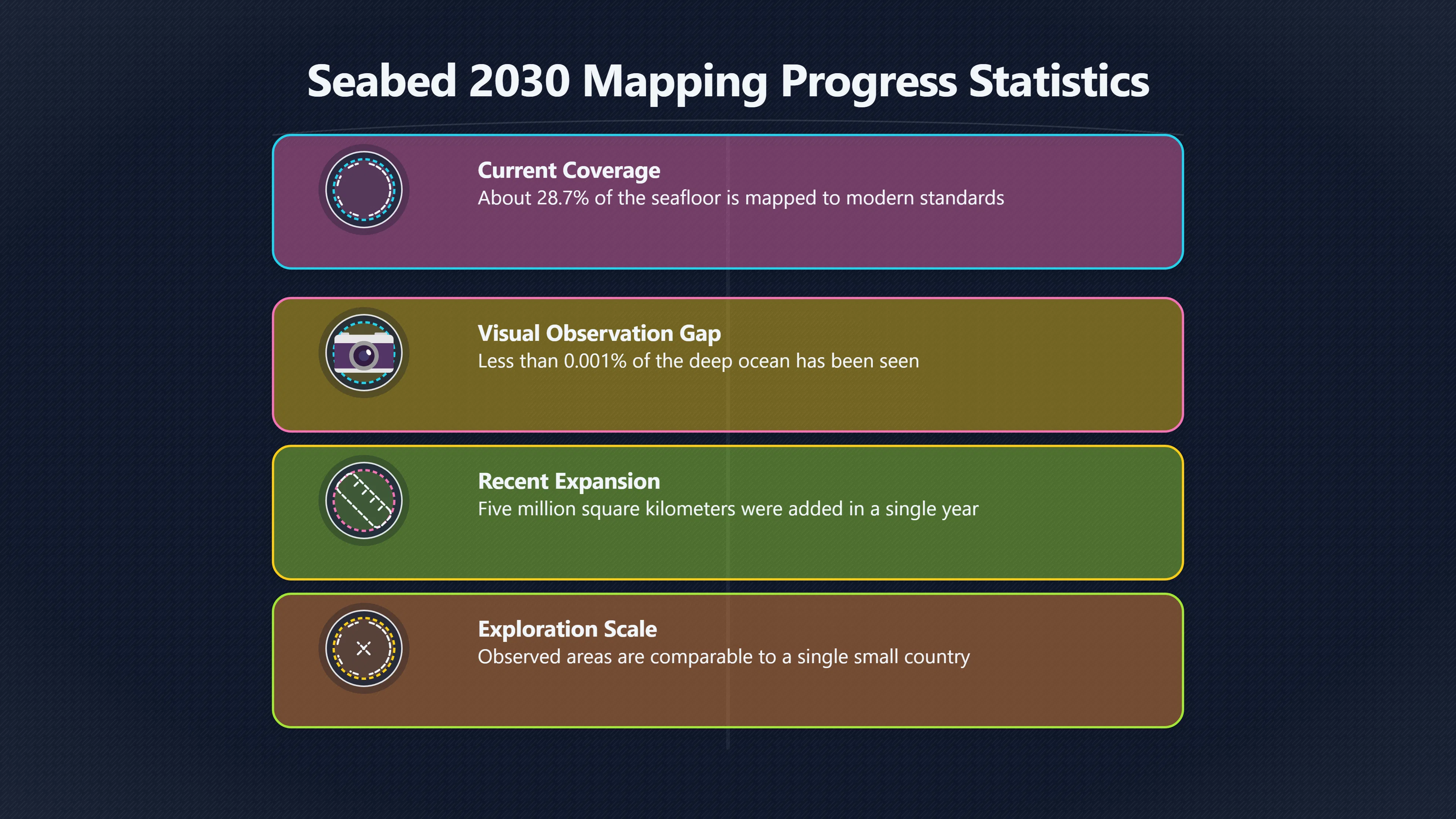
The ocean remains one of the least directly observed environments on Earth. As of 2026, the international Seabed 2030 programme reports that about 28.7% of the world’s ocean floor has been mapped to modern standards, meaning that more than two-thirds still lack comparable high-resolution coverage.[Seabed 2030]seabed2030.orgSeabed 2030Global seabed mapping reaches new milestone as five…20 Apr 2026 — London, 20 April 2026 – The Nippon Foundation-GEBCO Seabe…
At first glance, that sounds like a vast hidden realm where almost anything could be lurking. Yet even this figure requires interpretation.
A modern seafloor map is primarily a topographic product. Using sonar, researchers can identify trenches, ridges, seamounts and plains. A map reveals the shape of the environment, not necessarily its inhabitants. A newly mapped seamount may still never have been visited by a camera, remotely operated vehicle or biological survey team. Conversely, scientists can collect biological samples from a region without possessing a complete high-resolution map of the surrounding seabed.[NOAA Ocean Exploration+2NOAA Ocean Exploration]oceanexplorer.noaa.govNOAA Ocean ExplorationSeafloor Mapping5 Jun 2023 —… ocean is permanently dark, cold, and incredibly difficult to observe. Only slightl…
Visual exploration is even more limited. A 2025 analysis of roughly 44,000 deep-sea dives estimated that humans have directly observed less than 0.001% of the deep ocean floor. The area visually examined over decades of exploration is comparable to a small region of a single country, despite the deep ocean covering most of the planet.[Science+2PMC]science.orgHow little we've seen: A visual coverage estimate of the…by KLC Bell · 2025 · Cited by 34 — Our data show that we have visually…
For cryptozoology, this means the statement”we have barely seen the deep ocean” is substantially true. The mistake is assuming that unseen space and unknown animals are equivalent categories.
Mapping Is Not the Same as Biological Exploration
One reason cryptid debates become confused is that several different forms of knowledge are often merged together.
Seafloor mapping answers questions such as:<div class="content-enhancement content-enhancement--insight-grid" markdown="1">
- Where are underwater mountains and canyons?
- How deep is a trench?
- What is the shape of the seabed?</div>
Visual exploration answers questions such as:<div class="content-enhancement content-enhancement--phrase-pills" markdown="1">
- What organisms are present?
- How abundant are they?
- How do they behave?</div>
Biological description goes further:<div class="content-enhancement content-enhancement--insight-grid" markdown="1">
- Is the organism a known species?
- Does it represent a new species?
- How does it fit into the evolutionary tree of life?</div>
These activities overlap but are not interchangeable. A region may be unmapped yet biologically sampled. It may be mapped but biologically unknown. It may even contain photographed organisms that still lack formal scientific description.[NOAA Ocean Exploration+2NOAA Ocean Exploration]oceanexplorer.noaa.govNOAA Ocean ExplorationHow much of the ocean has been explored?We can't say we've explored the seafloor until we've seen it, and explorers…
This distinction matters because cryptid claims frequently rely on mapping statistics that do not directly address whether large animals could remain undiscovered. A missing bathymetric survey does not imply the presence of unknown megafauna; it merely indicates incomplete knowledge of seafloor shape.
What Unseen Habitat Can and Cannot Imply
Unexplored habitat does increase the probability that undiscovered species exist. Marine science repeatedly confirms this.
New species continue to be found in deep trenches, seamounts, hydrothermal vents and abyssal plains. Many are small, geographically restricted, difficult to collect or rarely encountered. Exploration campaigns routinely discover unfamiliar worms, crustaceans, corals, fishes and other organisms.[NOAA Ocean Exploration]oceanexplorer.noaa.govNOAA Ocean ExplorationHow much of the ocean has been explored?We can't say we've explored the seafloor until we've seen it, and explorers…
However, the type of discovery matters.
The ecological requirements of a giant animal differ dramatically from those of a small invertebrate. Large vertebrates require energy sources, breeding populations and enough individuals to maintain genetic diversity over long periods. Such populations tend to leave multiple traces: carcasses, photographs, environmental DNA, fisheries interactions, acoustic detections or repeated observations.
This creates an important asymmetry in cryptozoology:
- Unseen habitat strongly supports the likelihood of undiscovered small and medium-sized species.
- Unseen habitat provides much weaker support for undiscovered giant animals.
The larger and more conspicuous the proposed creature, the more evidence would normally be expected even before formal scientific discovery.
Why the Deep Sea Still Produces Surprises
The deep ocean nevertheless provides legitimate reasons for caution before dismissing every unusual report.
Many species once thought improbable were eventually confirmed because their habitats were difficult to access. Some deep-sea animals possess unusual body plans, bioluminescence, transparency or extreme fragility. Others are rarely encountered because they occupy narrow ecological zones or spend much of their lives far from human activity.[NOAA Ocean Exploration]noaa.govOcean Exploration Deep-Ocean Bites: Challenges of Deep-Sea Exploration To explore the deep ocean, underwater robots must overcome crushinNOAA Ocean ExplorationDeep-Ocean Bites: Challenges of Deep-Sea ExplorationTo explore the deep ocean, underwater robots must overcome crus…
There is also a strong observational bias in exploration. Studies of deep-sea survey records show that visual observations are concentrated around a small number of countries and research regions. Vast areas receive little attention compared with waters near technologically advanced nations.[Science]science.orgHow little we've seen: A visual coverage estimate of the…by KLC Bell · 2025 · Cited by 34 — Our data show that we have visually…
For cryptozoology, this means that genuine biological surprises should be expected. What it does not mean is that any specific legendary creature becomes likely merely because unexplored areas exist.
The discovery of a new deep-sea fish supports the proposition that unknown fishes remain to be found. It does not automatically support the existence of a giant sea serpent reported in folklore.
How Evidence Narrows Monster Claims
The strongest test of marine cryptid plausibility is not whether the ocean contains unknown areas but whether a proposed creature fits the available evidence.
Consider three increasingly demanding claims:
- An undescribed deep-sea invertebrate exists.
- An undescribed deep-sea shark exists.
- A giant breeding population of sea-serpent-like animals exists.
The first claim is highly plausible because similar discoveries occur regularly.
The second is plausible but requires more evidence because large vertebrates are harder to overlook.
The third faces a much higher evidential burden. A widespread population of large animals would likely generate multiple independent lines of evidence beyond eyewitness reports alone.
The Governance Question Behind the Unknown Ocean
The significance of mapping gaps extends beyond curiosity. Governments and international organisations increasingly need ocean knowledge for conservation, fisheries management, climate research and decisions about activities such as deep-sea mining. Large unmapped or poorly surveyed regions represent scientific uncertainty that affects policy choices.[Seabed 2030]seabed2030.orgSeabed 2030Home — Seabed 2030Seabed 2030 is a pioneering initiative accelerating ocean mapping efforts. We are a global community working…
From a cryptozoological perspective, this creates a useful lesson. The unknown ocean is real, measurable and important. Programmes such as Seabed 2030 exist precisely because humanity lacks complete information about the seafloor. Yet these initiatives treat uncertainty as something to be investigated through data collection rather than as evidence for specific creatures.[Seabed 2030]seabed2030.orgSeabed 2030Home — Seabed 2030Seabed 2030 is a pioneering initiative accelerating ocean mapping efforts. We are a global community working…
That approach provides the most reliable framework for evaluating marine cryptids. Mapping gaps justify scientific openness. They do not, by themselves, validate particular monster traditions.
What the Mapping Gaps Really Tell Us
The modern ocean presents a nuanced picture. More than two-thirds of the seabed remains unmapped to modern standards, and less than 0.001% of the deep seafloor has been directly observed. Those figures confirm that enormous portions of the ocean remain physically unseen and biologically under-sampled.[Seabed 2030+2Science]seabed2030.orgSeabed 2030Global seabed mapping reaches new milestone as five…20 Apr 2026 — London, 20 April 2026 – The Nippon Foundation-GEBCO Seabe…
For cryptozoology, the most defensible conclusion is neither sceptical certainty nor monster optimism. The unexplored ocean makes continued discovery inevitable, especially for poorly known deep-sea organisms. At the same time, the existence of unexplored space is not evidence for any named cryptid. As mapping improves and biological surveys expand, the unknown shrinks unevenly: it continues to reveal new life, but it also places increasingly strict limits on which sea-monster claims remain plausible.
eBay marketplace picks
Marketplace Samples
Live-tested eBay searches with available results related to this page.



Endnotes
1.
Source: oceanexplorer.noaa.gov
Link:https://oceanexplorer.noaa.gov/ocean-fact/explored/
2.
Source: seabed2030.org
Link:https://seabed2030.org/2026/04/20/global-seabed-mapping-reaches-new-milestone-as-five-million-square-kilometres-added-in-a-year/
3.
Source: seabed2030.org
Link:https://seabed2030.org/
4.
Source: oceanexplorer.noaa.gov
Link:https://oceanexplorer.noaa.gov/explainers/mapping/
5.
Source: oceanexplorer.noaa.gov
Title: why exploration matters
Link:https://oceanexplorer.noaa.gov/why-exploration-matters/
6.
Source: pmc.ncbi.nlm.nih.gov
Link:https://pmc.ncbi.nlm.nih.gov/articles/PMC12057672/
7.
Source: oceanexplorer.noaa.gov
Link:https://oceanexplorer.noaa.gov/multimedia/edu-multimedia-resources-deep-ocean-bites-[media
8.
Source: iocm.noaa.gov
Title: seabed 2030 status
Link:https://iocm.noaa.gov/seabed-2030-status.html
9.
Source: oceanexplorer.noaa.gov
Link:https://oceanexplorer.noaa.gov/explainers/
10.
Source: oceanexplorer.noaa.gov
Title: 22 national ocean month
Link:https://oceanexplorer.noaa.gov/exploration-extras/22-national-ocean-month/
11.
Source: iocm.noaa.gov
Title: seabed 2030
Link:https://iocm.noaa.gov/seabed-2030.html
12.
Source: oceanexplorer.noaa.gov
Link:https://oceanexplorer.noaa.gov/
13.
Source: seabed2030.org
Link:https://seabed2030.org/2025/06/21/seabed-2030-announces-millions-of-square-kilometers-of-new-seafloor-data-on-world-hydrography-day/
14.
Source: seabed2030.org
Title: seabed 2030 announces latest progress on world hydrography day
Link:https://seabed2030.org/2024/06/21/seabed-2030-announces-latest-progress-on-world-hydrography-day/
15.
Source: seabed2030.org
Title: our mission
Link:https://seabed2030.org/our-mission/
16.
Source: science.org
Link:https://www.science.org/doi/10.1126/sciadv.adp8602
17.
Source: ioc.unesco.org
Link:https://www.ioc.unesco.org/en/seabed-2030-reveals-millions-square-kilometers-newly-mapped-seafloor-world-hydrography-day
18.
Source: ioc.unesco.org
Title: seabed 2030 announces latest progress world hydrography day
Link:https://www.ioc.unesco.org/en/articles/seabed-2030-announces-latest-progress-world-hydrography-day
Additional References
19.
Source: smithsonianmag.com
Link:https://www.smithsonianmag.com/smart-news/humans-have-seen-only-0001-percent-of-the-worlds-deep-seas-leaving-most-of-the-planet-a-vast-mystery-180986597/
20.
Source: spacedaily.com
Link:https://spacedaily.com/n-less-than-a-third-of-the-worlds-ocean-floor-has-been-mapped-to-modern-standards-meaning-humanity-currently-knows-more-about-the-surface-of-mars-than-about-the-seabed-covering-two-thirds-of-its-ow/
21.
Source: facebook.com
Title: mapping to ocean floor 101reposting theeconomist as of today only 27 of the seab
Link:https://www.facebook.com/BlueNomadsOrg/videos/mapping-to-ocean-floor-101reposting-theeconomist-as-of-today-only-27-of-the-seab/982305854546026/
22.
Source: oceannews.com
Title: sea exploration, humans have observed less than 0.001% of the deep seafloor
Link:https://oceannews.com/news/science-technology/only-0-001-of-the-deep-seafloor-visually-observed-in-seventy-years/
23.
Source: spacedaily.com
Link:https://spacedaily.com/n-scientists-have-directly-observed-less-than-0-001-percent-of-the-deep-ocean-floor-an-area-comparable-to-the-state-of-rhode-island-despite-spending-decades-and-billions-of-dollars-e/
24.
Source: thepublicsradio.org
Title: (NOAA humans have seen less than 0.001% of the globe’s
Link:https://thepublicsradio.org/npr/humans-still-havent-seen-99-999-of-the-deep-seafloor/
25.
Source: facebook.com
Title: Only around 20% of the deep seafloor has been mapped
Link:https://www.facebook.com/conservation.intl/posts/only-around-20-of-the-deep-seafloor-has-been-mappedwere-working-to-change-that-/1119092290252486/
26.
Source: news.mongabay.com
Link:https://news.mongabay.com/2025/05/only-a-tiny-of-the-deep-seafloor-has-ever-been-visually-observed-study/
27.
Source: facebook.com
Link:https://www.facebook.com/newscientist/posts/the-first-comprehensive-analysis-of-deep-sea-dives-has-revealed-that-humans-have/1102132075288742/
28.
Source: spatialsource.com.au
Title: almost 30 of the ocean floor has been mapped
Link:https://www.spatialsource.com.au/almost-30-of-the-ocean-floor-has-been-mapped/
Topic Tree