Within Field Basics
Why witnesses should write before talking
Separate first accounts can preserve what each witness noticed before the sighting turns into a shared story.
On this page
- What a first account should capture
- How group discussion changes memory
- Comparing accounts without forcing agreement
Page outline Jump by section
Introduction
In responsible cryptid investigations, one of the simplest and most valuable safeguards is to obtain independent witness accounts before witnesses discuss what they think they saw. Strange animal reports often rely heavily on human recollection, yet decades of memory research show that memories can change after people exchange information. Once a group begins comparing impressions, details that were uncertain, overlooked or never observed can spread from one witness to another and become part of a shared narrative. Studies of eyewitness memory repeatedly find that post-event discussion can alter later recollections, sometimes causing people to report details that originated with another witness rather than from their own observation.[Digital Commons+2Aberdeen Research Portal]digitalcommons.unl.eduMore than a century of psychology research has shown that memory is fallible. People's memory can be influenced by information encountere… For cryptozoology, where unusual claims frequently depend on a small number of observations and where independent verification is often limited, preserving separate first accounts is not a bureaucratic formality. It is a practical way to distinguish what each person actually noticed from what the group later came to believe happened.
What a first account should capture
A first account should be recorded as soon as practical, before witnesses compare memories, photographs, theories or online reports. The goal is not to force certainty but to preserve each observer’s original perception.
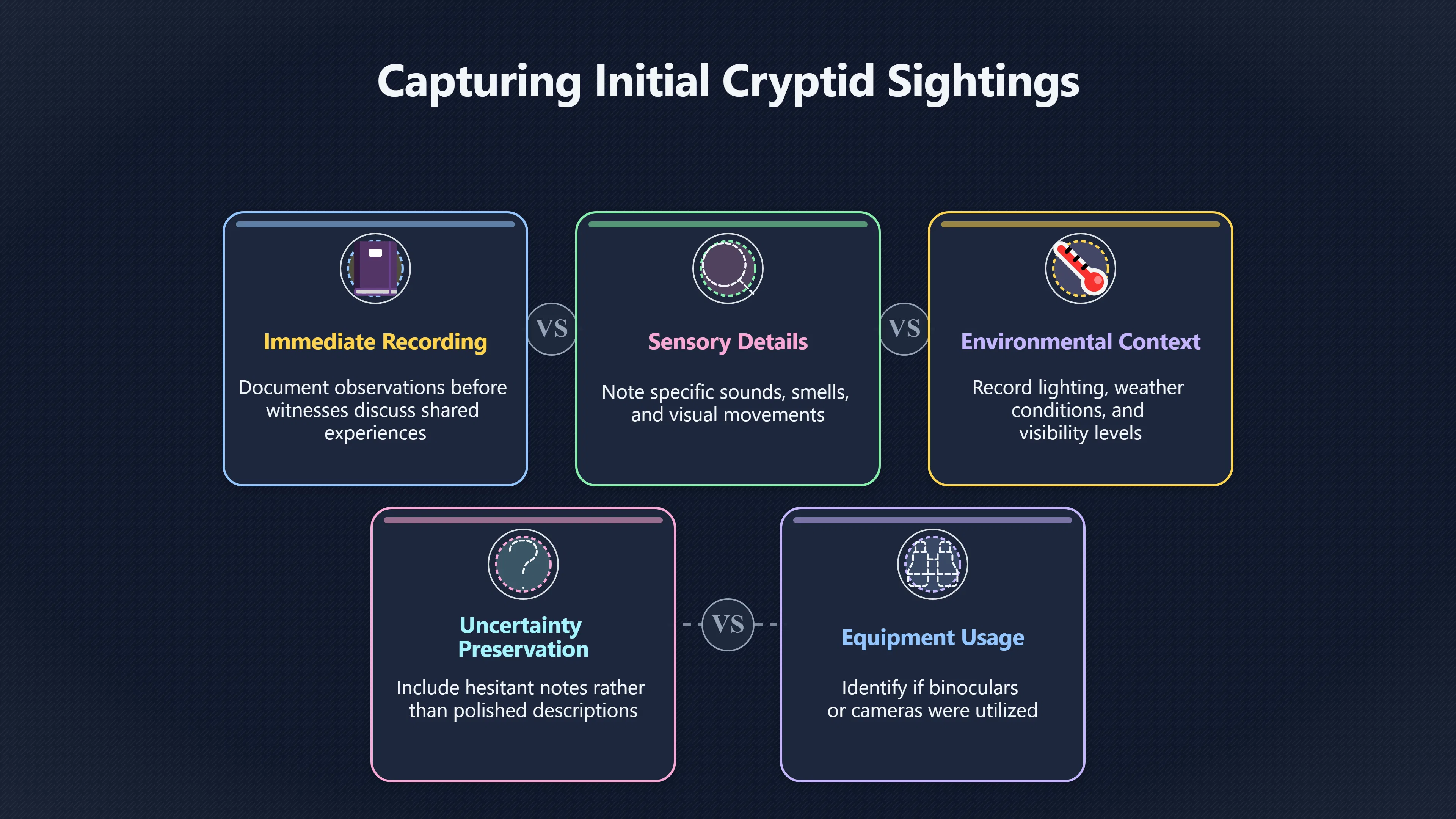
Useful first statements typically include:
- The exact sequence of events as remembered.
- What first drew the witness’s attention.
- Estimated distance, viewing angle and duration.
-
Lighting, weather and visibility conditions.<div class="content-enhancement content-enhancement--insight-grid" markdown="1">
- The animal’s apparent size, colour, shape and movement.
- Sounds, smells or other sensory observations.
- Features the witness is unsure about.
- Whether photographs, videos or binoculars were used.
- Whether the witness heard another person’s comments before writing the account.</div>
Importantly, uncertainty should be recorded rather than edited out. A note such as “I think the animal was dark brown, but the light was poor” is often more useful than a polished description that presents every detail as certain. Early uncertainty can help later investigators understand which observations were clear and which were inferred afterwards.
How group discussion changes memory
The main risk is known as memory conformity: the tendency for people who witnessed an event to influence one another’s recollections after discussing it. Researchers have repeatedly demonstrated that witnesses can absorb information from other observers and later remember it as part of their own experience.[Goldsmiths, University of London+2Digital Commons]sites.gold.ac.ukmemory conformity between eyewitnessesIt occurs because people accept, and later report, information that is suggested to them in the…Read more…
One influential experiment by Fiona Gabbert and colleagues showed participants slightly different versions of the same event. After discussion, many witnesses incorporated details that they could only have learned from another participant. In that study, 71% of witnesses who discussed the event later reported information acquired during the discussion rather than from their own observation.[Aberdeen Research Portal]abdn.elsevierpure.commemory conformity can eyewitnesses influence each others memoriesAberdeen Research PortalMemory conformity: can eyewitnesses influence each…by F Gabbert · 2003 · Cited by 636 — A significant proporti…
Several mechanisms contribute to this effect:
Memory gaps are filled socially. When people are uncertain about a detail, another witness’s confidence can seem like evidence. A witness may adopt the new information without realising its source.[Digital Commons]digitalcommons.unl.eduMore than a century of psychology research has shown that memory is fallible. People's memory can be influenced by information encountere…
Confidence can outweigh accuracy. Individuals often assume that someone who sounds certain had a better view or a better memory. This can cause witnesses to defer to the most confident member of the group even when that person is mistaken.[PMC]pmc.ncbi.nlm.nih.govThe effects of perceived memory ability on memory conformity…by LA Monds · 2019 · Cited by 19 — The present study investigated the…
Source confusion develops over time. People may remember a detail but forget whether they observed it themselves, heard it from another witness or encountered it later in conversation.[BPS Psych Hub]bpspsychub.onlinelibrary.wiley.comBPS Psych Hub The history of an idea: The misinformation effectBPS Psych HubThe history of an idea: The misinformation effect - Loftus24 Dec 2025 — Once it was established that memory could be contami…
Shared storytelling encourages coherence. Group discussions naturally push toward a single narrative. Contradictions are often resolved informally, and unusual details may be dropped while dramatic details become reinforced.[Goldsmiths, University of London]sites.gold.ac.ukmemory conformity between eyewitnessesIt occurs because people accept, and later report, information that is suggested to them in the…Read more…
For cryptid reports, these effects can be particularly significant because sightings are often brief, surprising and emotionally memorable. The very factors that make an encounter seem extraordinary can also make witnesses more vulnerable to later reconstruction.
Why this matters for unusual animal claims
A responsible investigation is not trying to create agreement. It is trying to discover what was actually observed.
Consider a hypothetical report involving three hikers who glimpse an unidentified animal crossing a clearing. One witness notices the gait, another focuses on the colour, and a third mainly remembers the location. If they immediately discuss the sighting, the final account may become a blend of all three perspectives. The resulting story might appear detailed and internally consistent, but investigators can no longer tell which details came from which observer.
By contrast, separate written accounts preserve valuable differences. Those differences are not necessarily weaknesses. In fact, they may reveal:<div class="content-enhancement content-enhancement--insight-grid" markdown="1">
- Different viewing positions.
- Different levels of visibility.
- Which features were clearly observed.
- Which details appeared only after discussion.
- Whether a later consensus emerged from independent observations or social influence.</div>
In cryptozoology, where many claims ultimately turn on a small number of descriptive details, preserving those distinctions can be more informative than obtaining immediate agreement.
Comparing accounts without forcing agreement
Once independent statements have been collected, they can be compared systematically.
The objective is not to identify a single “correct” witness. Instead, investigators should look for patterns:
Areas of convergence
Details reported independently by multiple witnesses deserve particular attention. If separate accounts consistently describe the same movement, location, sound or physical characteristic, confidence that the feature was genuinely observed increases.
However, convergence is most meaningful when it existed before discussion occurred. Agreement reached only after witnesses exchanged views carries less evidential weight.[Digital Commons]digitalcommons.unl.eduDigital CommonsMemory Conformity Between Eyewitnessesby F Gabbert · 2012 · Cited by 38 — 15 Although it is best practice for the police t…
Areas of divergence
Differences between accounts should be documented rather than treated as failures.
A witness who reports a long tail while another does not may simply have had a different viewing angle. One observer may have concentrated on movement while another focused on shape. Divergence can reveal observational limitations that help reconstruct the event more accurately.
Forcing witnesses to reconcile disagreements risks replacing original observations with negotiated memories.
Later interviews
The practical takeaway
For responsible cryptid fieldwork, the rule is straightforward: record first, discuss later. Independent written statements preserve evidence that can never be recovered once witnesses begin shaping a common story.
The value of these first accounts lies not in proving that an unknown creature exists, but in protecting the integrity of the observation itself. Separate statements allow investigators to examine what each person actually perceived, identify where memories overlap, and recognise where later discussion may have altered the record. In a field where extraordinary claims often depend on fragile eyewitness evidence, that distinction can be one of the most important parts of the entire investigation.
Amazon book picks
Further Reading
Books and field guides related to Why witnesses should write before talking. Use these as the next step if you want deeper reading beyond the article.
The Seven Sins of Memory
Rating: 3.5/5 from 5 Google Books ratings
Explains how memories change and become distorted.
eBay marketplace picks
Marketplace Samples
Live-tested eBay searches with available results related to this page.



Endnotes
1.
Source: assets.college.police.uk
Title: Obtaining initial accounts from victims and witnesses
Link:https://assets.college.police.uk/s3fs-public/2020-11/Initial_Accounts_REA.pdf?v=1606213205
2.
Source: pmc.ncbi.nlm.nih.gov
Link:https://pmc.ncbi.nlm.nih.gov/articles/PMC6762151/
3.
Source: pmc.ncbi.nlm.nih.gov
Link:https://pmc.ncbi.nlm.nih.gov/articles/PMC9225701/
4.
Source: youtube.com
Link:https://www.youtube.com/watch?v=m6aY9Wr-xjI
5.
Source: digitalcommons.unl.edu
Link:https://digitalcommons.unl.edu/ajacourtreview/382/
6.
Source: abdn.elsevierpure.com
Title: memory conformity can eyewitnesses influence each others memories
Link:https://abdn.elsevierpure.com/en/publications/memory-conformity-can-eyewitnesses-influence-each-others-memories/
7.
Source: web-archive.southampton.ac.uk
Link:https://web-archive.southampton.ac.uk/cogprints.org/639/1/memon.cognitive_interview.html
8.
Source: sites.gold.ac.uk
Title: memory conformity between eyewitnesses
Link:https://sites.gold.ac.uk/psychology/2020/05/22/memory-conformity-between-eyewitnesses/
9.
Source: onlinelibrary.wiley.com
Link:https://onlinelibrary.wiley.com/doi/abs/10.1002/acp.885
10.
Source: bpspsychub.onlinelibrary.wiley.com
Title: BPS Psych Hub The history of an idea: The misinformation effect
Link:https://bpspsychub.onlinelibrary.wiley.com/doi/10.1111/lcrp.70020
11.
Source: digitalcommons.unl.edu
Link:https://digitalcommons.unl.edu/cgi/viewcontent.cgi?article=1385&context=ajacourtreview
12.
Source: pubmed.ncbi.nlm.nih.gov
Title: Pub Med Are two interviews better than one?
Link:https://pubmed.ncbi.nlm.nih.gov/24098471/
13.
Source: pmc.ncbi.nlm.nih.gov
Link:https://pmc.ncbi.nlm.nih.gov/articles/PMC10829763/
14.
Source: pmc.ncbi.nlm.nih.gov
Link:https://pmc.ncbi.nlm.nih.gov/articles/PMC9451081/
15.
Source: bpspsychub.onlinelibrary.wiley.com
Link:https://bpspsychub.onlinelibrary.wiley.com/doi/10.1111/lcrp.12097
16.
Source: Wikipedia
Title: Memory conformity
Link:https://en.wikipedia.org/wiki/Memory_conformity
Additional References
17.
Source: simplypsychology.org
Link:https://www.simplypsychology.org/cognitive-interview.html
18.
Source: sru.soc.surrey.ac.uk
Link:https://sru.soc.surrey.ac.uk/SRU50.html
19.
Source: senecalearning.com
Link:https://senecalearning.com/en-GB/revision-notes/a-level/psychology/aqa/2-1-18-cognitive-interview
20.
Source: web-archive.southampton.ac.uk
Link:https://web-archive.southampton.ac.uk/cogprints.org/646/1/memon.memory.html
21.
Source: haraldmerckelbach.nl
Title: Witnesses’ Failure To Detect Covert Manipulations In Their Written Statements
Link:https://haraldmerckelbach.nl/artikelen_engels/2017/Witnesses%27%20Failure%20To%20Detect%20Covert%20Manipulations%20In%20Their%20Written%20Statements.pdf
22.
Source: wrap.warwick.ac.uk
Title: WRAP eyewitness memory distortion following discussion countries Wade 2018
Link:https://wrap.warwick.ac.uk/id/eprint/108300/7/WRAP-eyewitness-memory-distortion-following-discussion-countries-Wade-2018.pdf
23.
Source: psychologicalscience.org
Title: when eyewitnesses talk justice is distorted
Link:https://www.psychologicalscience.org/news/releases/when-eyewitnesses-talk-justice-is-distorted.html
24.
Source: researchgate.net
Link:https://www.researchgate.net/publication/227602548_Memory_Conformity_Exploring_misinformation_effects_when_presented_by_another_person
25.
Source: frontiersin.org
Title: Frontiers Online misinformation can distort witnesses’ memories
Link:https://www.frontiersin.org/journals/psychology/articles/10.3389/fpsyg.2023.1239139/full
26.
Source: tandfonline.com
Title: Eyewitnesses are highly persuasive and are heavily relied upon
Link:https://www.tandfonline.com/doi/full/10.1080/1068316X.2026.2637901
Topic Tree