Within Cryptozoology
Why Honest Cryptid Sightings Can Mislead
Eyewitness reports can be honest and still unreliable because distance, stress, darkness, and expectation distort perception.
On this page
- How perception changes under stress
- Distance, darkness, and scale errors
- Separating testimony from proof
Page outline Jump by section
Introduction
Eyewitness sightings are the lifeblood of cryptozoology and also its weakest evidential foundation. Most cryptid reports are not obvious lies: they are often sincere accounts from people who saw something briefly, at a distance, in poor light, under surprise or fear, and then tried to make sense of it afterwards. That is precisely the problem. Human perception is not a camera, and memory is not a stored video file. It is a reconstruction shaped by attention, expectation, stress, lighting, distance, later discussion and cultural templates.
For cryptozoology, this matters because the typical sighting is a fleeting encounter with an alleged animal that leaves no body, tissue, clear DNA, repeatable observation or unambiguous photograph. The witness may be honest, frightened and consistent, yet still have misidentified a bear, bird, otter, eel, wake, floating log, human figure or ordinary animal seen in extraordinary conditions. Research on eyewitness error in legal settings is useful here because it shows the same general lesson: confidence and sincerity do not guarantee accuracy. The National Academies identify lighting, distance, stress, trauma, exposure duration and other viewing conditions as variables that can affect eyewitness reliability, while the Innocence Project reports that eyewitness misidentification has been involved in a large share of DNA exonerations in the United States.[National Academies]nationalacademies.orgNational AcademiesChapter: 5 Applied Eyewitness Identification ResearchEstimator variables include factors operating either at the time o…
Why honest witnesses can still be wrong
The most important distinction is between deception and error. A hoax is an invented or staged event. A mistaken sighting is different: the witness genuinely encountered something, but the interpretation attached to it is wrong or unsupported. Cryptozoology often becomes confusing because the emotional force of a report is treated as though it were the same thing as its evidential strength.
A person may be entirely truthful about the experience: “I saw a large dark shape cross the road,” “I saw a long neck on the water,” or “I heard heavy movement in the trees.” The leap comes when that perception becomes “therefore it was Bigfoot”, “therefore it was Nessie”, or “therefore it was an unknown species”. In that leap, the raw observation is mixed with inference, memory, expectation and local folklore.
Eyewitness research gives this problem a useful vocabulary. Legal scholars and psychologists often distinguish between factors outside the investigator’s control, such as lighting, distance, stress and duration of exposure, and factors that happen after the event, such as suggestion, repeated questioning or contaminated memory. The National Academies describe these as issues that affect visual experience, memory encoding and later recall; the same framework translates well to cryptid reports, even though the object is an alleged animal rather than a suspect.[National Academies]nationalacademies.orgNational AcademiesChapter: 5 Applied Eyewitness Identification ResearchEstimator variables include factors operating either at the time o…
This does not mean witnesses are foolish. It means ordinary human perception is optimised for quick survival judgements, not zoological documentation. In a forest at dusk, the brain’s first task is to decide whether the dark movement is relevant or threatening. It is not measuring shoulder width, gait, height, distance and species identity with scientific precision.
How perception changes under stress
Stress can sharpen some immediate reactions while degrading other kinds of detail. A sudden encounter with a large moving shape on a remote road or beside a lake often produces the conditions most likely to generate a vivid but incomplete memory: surprise, arousal, narrow attention and a strong need to explain what happened.
The psychology literature is careful here. It does not say that stress always makes memory useless. It does show that stress is one of the major variables experts consider when evaluating eyewitness reliability, especially when a person must later identify or describe what they saw. A survey of expert and lay beliefs about stress and eyewitness memory found broad recognition that high stress can harm accuracy, while the National Academies list stress and trauma among the estimator variables relevant to reliability.[PMC]pmc.ncbi.nlm.nih.govOpen source on nih.gov.
Cryptid sightings often add two extra pressures. First, the encounter is usually unexpected: the witness is not conducting a controlled wildlife survey but driving, walking, camping or looking across water. Secondly, the possible meaning of the sighting may arrive almost instantly. A large upright figure in North American woodland can be interpreted through the Bigfoot template; an ambiguous hump in Loch Ness can be interpreted through the Nessie template. Once that label appears, it can guide what the witness attends to and what later becomes memorable.
A useful comparison is the “weapon focus” effect in eyewitness research. Studies of crime scenes have found that a threatening or unusual object can capture attention and reduce memory for other details. In cryptid settings, the “weapon” is not literal, but the same attention problem can occur: the witness fixes on the most startling feature — height, eyeshine, a long neck, a dark hump, a foul smell — while distance, lighting, scale cues and alternative explanations receive less attention.[PMC]pmc.ncbi.nlm.nih.govPMCRevisiting the role of attention in the “weapon focus effect”PMCRevisiting the role of attention in the “weapon focus effect”
The result can be a report that is psychologically powerful but evidentially thin. A witness may remember the fear with absolute clarity while being wrong about the size, distance, duration or identity of the thing that caused it.
Distance, darkness and scale errors
Many cryptid reports happen under exactly the conditions in which humans are poor measuring instruments. A dark shape at the edge of a headlight beam, a moving form across a lake, a silhouette in trees or a wake on calm water gives the eye too little information and the mind too much room to complete the picture.
Research on eyewitness identification shows how quickly distance and lighting degrade accuracy. One study of unfamiliar-person identification reported that accuracy declined as viewing distance increased, and that under very low light accuracy could be reduced to guesswork at much shorter distances. Although that work concerns human identification rather than cryptids, the underlying point is directly relevant: if people struggle to identify familiar kinds of targets under poor viewing conditions, claims about unknown animals under similar conditions deserve caution.[ResearchGate]researchgate.netOpen source on researchgate.net.
Darkness adds a specific problem. Human night vision depends heavily on rod cells, which are sensitive in low light but poor at colour and fine detail. Medical and vision sources describe scotopic vision as a dim-light system that relies on rods and takes time to adapt; it is useful for detecting movement and contrast, but it is not well suited to confident species identification.[Cleveland Clinic]my.clevelandclinic.orgCleveland Clinic Scotopic Vision (Night Vision): How Does It Work?Cleveland Clinic Scotopic Vision (Night Vision): How Does It Work?
Scale is especially treacherous. To judge an animal’s size, the observer needs reliable cues: distance, background objects, known landmarks, depth, lighting and a stable view. Remove those cues and a small object nearby can look like a large object far away, or a normal animal in an odd posture can look like something unknown. On water, this becomes worse because waves, reflections and wakes distort the perceived size and movement of an object.
That is one reason lake monsters are so persistent. A bird, seal, otter, eel, floating branch, boat wake or line of waves can become a neck, hump or serpentine body when seen briefly and at uncertain range. The claim may begin as a real perception — something really did move — but the scale and identity assigned to it may be wrong.
Bigfoot sightings and the bear problem
Bigfoot reports show how an ordinary animal can become extraordinary when posture, distance and expectation align. In North America, one of the strongest natural explanations for many sightings is the black bear. Bears are large, shaggy, common across many reported Bigfoot regions, and capable of standing or moving briefly on their hind legs. A bear glimpsed through trees, in poor light, or from a moving car can present a dark upright silhouette with broad shoulders and no obvious neck.
This is not just a casual sceptical guess. A 2024 analysis in the Journal of Zoology examined whether reported Bigfoot or Sasquatch sightings could be related to black bear populations, explicitly testing the idea that some reports are misidentified upright-walking bears. The paper’s framing is cautious, but it reflects a serious mechanism: when a known animal and an alleged cryptid overlap in geography, size, colour, habitat and brief visual appearance, misidentification becomes a strong competing explanation.[zslpublications.onlinelibrary.wiley.com]zslpublications.onlinelibrary.wiley.comBigfoot: If it's there, could it be a bear?Bigfoot: If it's there, could it be a bear?
Recent reporting on Sasquatch sightings in Ontario illustrates the same tension. Witnesses described large ape-like figures, earthy smells and knocking sounds — details that fit modern Sasquatch lore — while sceptics pointed again to misidentification, especially black bears, and to the absence of physical evidence such as bones or DNA. The interesting point is not that every witness must have seen a bear. It is that the sighting pattern is compatible with several ordinary causes, while the cryptid interpretation requires a breeding population of large undiscovered primates leaving no confirmed remains.[The Guardian]theguardian.comThe Guardian Sasquatch 'sightings' reignite fervour and scepticism about ape-like beastSasquatch has long fascinated both believers and sceptics. While some see it as a symbol of the unknown or a spiritual being tied to Indi…
The bear explanation also shows why sincere reports can cluster. If people in bear country are primed by local stories, television, online maps or recent reports, ambiguous bear encounters are more likely to be described in Bigfoot language. A witness who might once have said “a huge dark animal stood up” may now say “it looked like Sasquatch”. The experience is real; the category may be culturally supplied.
Loch Ness and the problem of water sightings
Loch Ness is a classic case study in how honest observation, local expectation and difficult viewing conditions can combine. The loch is long, deep, dark, wind-affected and visually dramatic. Objects on its surface are often seen at a distance, with few reliable scale cues. A hump, wake or bird can be difficult to judge, especially when the observer already knows the place as the home of a famous monster.
The modern Nessie tradition has produced many kinds of reports: humps, long necks, wakes, dark masses, photographs, sonar claims and webcam sightings. Yet scientific investigation has not produced confirming biological evidence for a large unknown animal. A major environmental DNA survey led by researchers from the University of Otago took hundreds of water samples and found no evidence for large reptiles or other monster-like animals, while detecting eel DNA widely enough to keep ordinary or unusually large eels in the conversation as one possible contributor to sightings.[University of Otago]otago.ac.nzotago scientist reveals loch ness monster could be a giant eelotago scientist reveals loch ness monster could be a giant eel
This does not mean every Loch Ness witness saw an eel. It means that the strongest evidence available from the water itself does not support the famous monster image. Meanwhile, more ordinary explanations remain plentiful: eels, birds, seals or otters entering the loch, floating debris, wave patterns, boat wakes and photographic scale errors. Reports may be sincere but still underdetermined — there is not enough information in the observation to justify the extraordinary conclusion.
Loch Ness also demonstrates the power of image framing. The famous “Surgeon’s Photograph” became iconic partly because it appeared to show a long-necked creature, but later scrutiny and historical investigation undermined it as evidence. Cropping, scale ambiguity and the desire to see the expected shape all contributed to its power. Even without deliberate hoaxing, a small object photographed without context can be visually promoted into a monster.
Expectation turns ambiguity into a creature
A cryptid sighting rarely begins in a blank cultural space. People know the stories before they see the shape. A camper in the Pacific Northwest may know what Bigfoot is supposed to look and sound like. A tourist at Loch Ness may be actively watching for a dark hump. Someone hearing screams in woodland may already have heard local accounts of unknown animals.
This matters because perception is partly predictive. The brain uses past knowledge to interpret incomplete sensory input. That is normally helpful: it lets people recognise faces, animals and hazards quickly. But it can also make ambiguous stimuli feel meaningful. Research on pareidolia describes the tendency to perceive familiar forms in ambiguous or meaningless patterns; the same broad mechanism helps explain why shadows, branches, waves and partial animal views can become creature-like in the right context.[PMC]pmc.ncbi.nlm.nih.govPMCPareidolia in a Built Environment as a ComplexPMCPareidolia in a Built Environment as a Complex
Cryptid expectation does not have to create a hallucination. More often, it supplies a label for something genuinely seen but poorly resolved. A dark form becomes “ape-like”. A line of waves becomes “serpentine”. Eyeshine becomes “glowing eyes”. A bear’s brief bipedal posture becomes “a man-beast”. Once the label is attached, the witness may unconsciously organise later memory around it.
This is one reason repeated local sightings can be both socially meaningful and evidentially risky. A community story gives people a shared vocabulary for unusual encounters. It also increases the chance that ambiguous experiences will be sorted into the same familiar legend.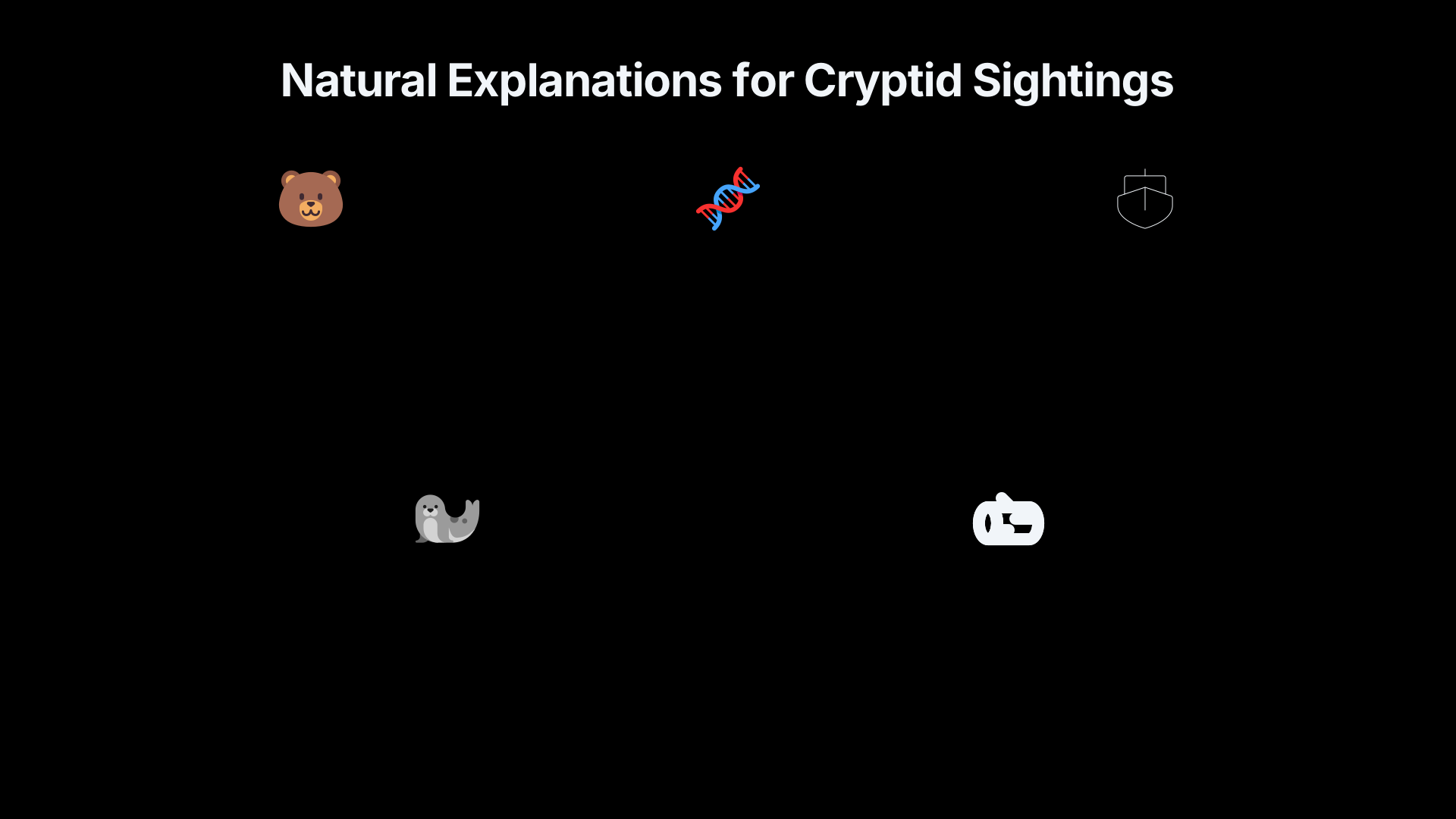
Memory changes after the sighting
The moment of perception is only the first stage. A cryptid report usually becomes more detailed through retelling: to family, friends, investigators, journalists, online forums or local enthusiasts. Each retelling can stabilise the story, but stabilisation is not the same as accuracy. Memory can become more coherent, more confident and more dramatic while moving further from the uncertain original perception.
Eyewitness research repeatedly warns that memory is malleable. The National Academies note that memory can be contaminated by influences including interactions after the event, and the Innocence Project emphasises that pressure, suggestive practices and time can make accurate recall harder. In cryptozoology, the equivalent influences may be less formal but still powerful: leading questions, comparison with famous cases, online validation, group excitement, and the witness’s own desire to make sense of an unsettling event.[National Academies]nationalacademies.orgOpen source on nationalacademies.org.
A witness may begin with uncertainty — “I don’t know what it was” — and later become more certain after seeing similar reports. Details that were inferred can feel remembered. A rough estimate can become a precise height. A second or two can become “several minutes”. A shape glimpsed between trees can become a full-body description. None of this requires dishonesty; it is a normal risk of reconstructive memory.
Multiple witnesses do not automatically solve the problem. Groups can help when independent accounts are recorded separately and immediately. But groups can also contaminate one another’s memories. If one person says “it had a long neck” or “it was walking like a man”, others may reinterpret their own fragmentary perceptions through that statement.
Separating testimony from proof
Eyewitness testimony can be valuable in cryptozoology, but only when treated as a starting point rather than a conclusion. A sighting can indicate where to look, what conditions to examine, what known animals are present, and whether further evidence might be collected. It cannot, by itself, establish an unknown species.
A useful sighting report preserves uncertainty. It separates what was directly observed from what was inferred. “A dark object moved from left to right for about five seconds at an estimated 80 metres” is more useful than “I saw a monster.” “The animal appeared upright, but I saw it through trees at dusk” is more useful than “It was definitely not a bear.” The best reports make alternative explanations easier to test, not harder.
For cryptid claims, the key questions are practical:
- What exactly was seen? Shape, movement, duration, distance, lighting, weather, sound and direction matter more than the cryptid label.
- What known animals or objects were present? Bears, deer, humans, dogs, birds, seals, otters, eels, logs and wakes should be considered before unknown species.
- Were scale cues reliable? Without landmarks, distance estimates and size estimates are weak.
- Was the account recorded before discussion? Early, independent notes are stronger than later group retellings.
- Is there physical evidence? Tracks, hair, scat, tissue, clear photographs, video with scale, environmental DNA or repeatable observations matter more than confidence.
- Can the event be repeated or independently checked? A one-off sighting is weaker than a pattern supported by verifiable evidence.
This distinction is not anti-witness. It protects witnesses from being overused. A person can honestly report an extraordinary experience without being forced into the role of proving a new species.
What sincere sightings are good for
Eyewitness reports are not worthless. In mainstream zoology, local observations can help researchers locate rare, elusive or poorly studied animals. Reports from fishers, hunters, farmers, Indigenous communities and local residents have sometimes guided scientific investigation. The difference is that such reports become scientifically persuasive only when they lead to verifiable evidence.
In cryptozoology, sightings are best understood as leads. They can show where people are encountering ambiguous animals, where folklore is active, where environmental conditions produce recurring illusions, or where a known species is being seen in an unusual way. They can also reveal how people experience wild places: fear, wonder, uncertainty and the sense that not everything has been fully mapped.
But testimony becomes risky when it is treated as proof because it feels sincere. The more extraordinary the proposed animal, the more the claim needs evidence that does not depend on a single human perception under poor conditions. A breeding population of large unknown primates, lake monsters or surviving prehistoric animals should leave traces beyond stories: remains, DNA, feeding signs, clear images, ecological impact or repeated observations under controlled conditions.
The fairest position is neither to mock witnesses nor to accept every report at face value. Honest people can misperceive. Memory can harden around a wrong interpretation. Darkness, distance, stress and expectation can turn ordinary animals or objects into extraordinary encounters. Cryptozoology becomes more credible when it admits this openly: sightings may tell us that something happened, but only stronger evidence can tell us what it was.
eBay marketplace picks
Marketplace Samples
Live-tested eBay searches with available results related to this page.


Endnotes
1.
Source: pmc.ncbi.nlm.nih.gov
Link:https://pmc.ncbi.nlm.nih.gov/articles/PMC8024237/
2.
Source: pmc.ncbi.nlm.nih.gov
Title: PMCRevisiting the role of attention in the “weapon focus effect”
Link:https://pmc.ncbi.nlm.nih.gov/articles/PMC10545598/
3.
Source: researchgate.net
Link:https://www.researchgate.net/publication/342378804_Witnessing_an_Unfamiliar_Person_The_Effects_of_Distance_Lighting_Age_Line-up_Type_and_Line-up_Position_on_Eyewitness_Accuracy
4.
Source: zslpublications.onlinelibrary.wiley.com
Title: Bigfoot: If it’s there, could it be a bear?
Link:https://zslpublications.onlinelibrary.wiley.com/doi/10.1111/jzo.13148
5.
Source: pmc.ncbi.nlm.nih.gov
Title: PMCPareidolia in a Built Environment as a Complex
Link:https://pmc.ncbi.nlm.nih.gov/articles/PMC9103170/
6.
Source: researchgate.net
Title: 355670645 The Reliability of Eyewitness Testimony
Link:https://www.researchgate.net/publication/355670645_The_Reliability_of_Eyewitness_Testimony
7.
Source: researchgate.net
Title: 371071064 The Weapon Focus Effect in Eyewitness Memory
Link:https://www.researchgate.net/publication/371071064_The_Weapon_Focus_Effect_in_Eyewitness_Memory
8.
Source: researchgate.net
Link:https://www.researchgate.net/publication/401076924_Nessie_and_Noctilucent_Clouds_A_Meteorological_Explanation_for_Some_Loch_Ness_Monster_Sightings
9.
Source: researchgate.net
Link:https://www.researchgate.net/publication/326123552_The_Role_of_Estimator_Variables_in_Eyewitness_Identification
10.
Source: researchgate.net
Link:https://www.researchgate.net/publication/380290380_A_behavioral_advantage_for_the_face_pareidolia_illusion_in_peripheral_vision
11.
Source: researchgate.net
Title: 390620130 The Loch Ness Monster If It’s Real Could It Be an Eel
Link:https://www.researchgate.net/publication/390620130_The_Loch_Ness_Monster_If_It%27s_Real_Could_It_Be_an_Eel
12.
Source: researchgate.net
Link:https://www.researchgate.net/publication/38050357_THE_DARK_ADAPTATION_OF_THE_HUMAN_EYE
13.
Source: researchgate.net
Link:https://www.researchgate.net/publication/402160377_Nocturnal_neighbors_exploring_residents%27_perceptions_of_urban_wildlife_related_to_animal_traits_identified_by_camera_traps_and_literature
14.
Source: besjournals.onlinelibrary.wiley.com
Title: 1365 2656.13338
Link:https://besjournals.onlinelibrary.wiley.com/doi/10.1111/1365-2656.13338
15.
Source: youtube.com
Title: The New Science of Eyewitness Memory | John Wixted | TED
Link:https://www.youtube.com/watch?v=93ocNhHyGVo
16.
Source: youtube.com
Link:https://www.youtube.com/watch?v=m6aY9Wr-xjI
17.
Source: nationalacademies.org
Link:https://www.nationalacademies.org/read/18891/chapter/7
18.
Source: my.clevelandclinic.org
Title: Cleveland Clinic Scotopic Vision (Night Vision): How Does It Work?
Link:https://my.clevelandclinic.org/health/articles/24309-night-vision
19.
Source: theguardian.com
Link:https://www.theguardian.com/world/2026/jun/11/sasquatch-[bigfoot-sightings
20.
Source: otago.ac.nz
Title: otago scientist reveals loch ness monster could be a giant eel
Link:https://www.otago.ac.nz/news/newsroom/otago-scientist-reveals-loch-ness-monster-could-be-a-giant-eel
21.
Source: theguardian.com
Title: loch ness monster could be a giant eel say scientists
Link:https://www.theguardian.com/science/2019/sep/05/loch-ness-monster-could-be-a-giant-eel-say-scientists
22.
Source: frontiersin.org
Link:https://www.frontiersin.org/journals/psychology/articles/10.3389/fpsyg.2022.1067985/full
23.
Source: nationalacademies.org
Link:https://www.nationalacademies.org/news/report-urges-caution-in-handling-and-relying-upon-eyewitness-identifications-in-criminal-cases-recommends-best-practices-for-law-enforcement-and-courts
24.
Source: Wikipedia
Link:https://en.wikipedia.org/wiki/Bigfoot
25.
Source: innocenceproject.org
Title: dna exonerations in the united states
Link:https://innocenceproject.org/dna-exonerations-in-the-united-states/
26.
Source: nationalacademies.org
Title: using science to improve eyewitness testimony
Link:https://www.nationalacademies.org/news/using-science-to-improve-eyewitness-testimony
27.
Source: ncbi.nlm.nih.gov
Link:https://www.ncbi.nlm.nih.gov/books/NBK621592/
28.
Source: pubmed.ncbi.nlm.nih.gov
Link:https://pubmed.ncbi.nlm.nih.gov/29389161/
29.
Source: pmc.ncbi.nlm.nih.gov
Link:https://pmc.ncbi.nlm.nih.gov/articles/PMC2041963/
30.
Source: pmc.ncbi.nlm.nih.gov
Link:https://pmc.ncbi.nlm.nih.gov/articles/PMC5544328/
31.
Source: pmc.ncbi.nlm.nih.gov
Link:https://pmc.ncbi.nlm.nih.gov/articles/PMC9582234/
32.
Source: frontiersin.org
Link:https://www.frontiersin.org/journals/psychology/articles/10.3389/fpsyg.2021.666724/full
33.
Source: frontiersin.org
Link:https://www.frontiersin.org/journals/psychology/articles/10.3389/fpsyg.2019.00703/full
Additional References
34.
Source: innocenceproject.org
Title: how eyewitness misidentification can send innocent people to prison
Link:https://innocenceproject.org/news/how-eyewitness-misidentification-can-send-innocent-people-to-prison/
35.
Source: youtube.com
Title: Scott Fraser: The problem with eyewitness testimony
Link:https://www.youtube.com/watch?v=buhMdC7MO0U
36.
Source: youtube.com
Title: Why eyewitnesses fail | Thomas Albright | TEDx San Diego
Link:https://www.youtube.com/watch?v=l05NGp_z6TI
37.
Source: nij.ojp.gov
Title: stronger memory perpetrator may attenuate effects identification procedure
Link:https://nij.ojp.gov/library/publications/stronger-memory-perpetrator-may-attenuate-effects-identification-procedure
38.
Source: instagram.com
Link:https://www.instagram.com/p/DTEm_cGEnvB/
39.
Source: judicature.duke.edu
Link:https://judicature.duke.edu/articles/a-clearer-view-the-impact-of-the-national-academy-of-sciences-report-on-eyewitness-identification/
40.
Source: facebook.com
Link:https://www.facebook.com/KHON2News/posts/a-scientist-who-collected-dna-from-scotlands-loch-ness-suggests-the-lakes-fabled/10156807325566379/
41.
Source: dokumen.pub
Link:https://dokumen.pub/abominable-science-origins-of-the-yeti-nessie-and-other-famous-cryptids-9780231526814.html
42.
Source: Wikipedia
Link:https://en.wikipedia.org/wiki/Adaptation_%28eye%29
43.
Source: skepticalinquirer.org
Link:https://skepticalinquirer.org/2013/09/bigfoot-lookalikes-tracking-hairy-man-beasts/
Topic Tree