Within Hidden Mammals
Camera traps changed forest mysteries forever
Modern camera trapping raises the bar for cryptid claims by making remote forests more observable than they once were.
On this page
- Why passive cameras matter
- What camera days reveal and miss
- How big cryptids face a higher burden
Page outline Jump by section
Introduction
Why passive cameras matter
What camera-days reveal and miss
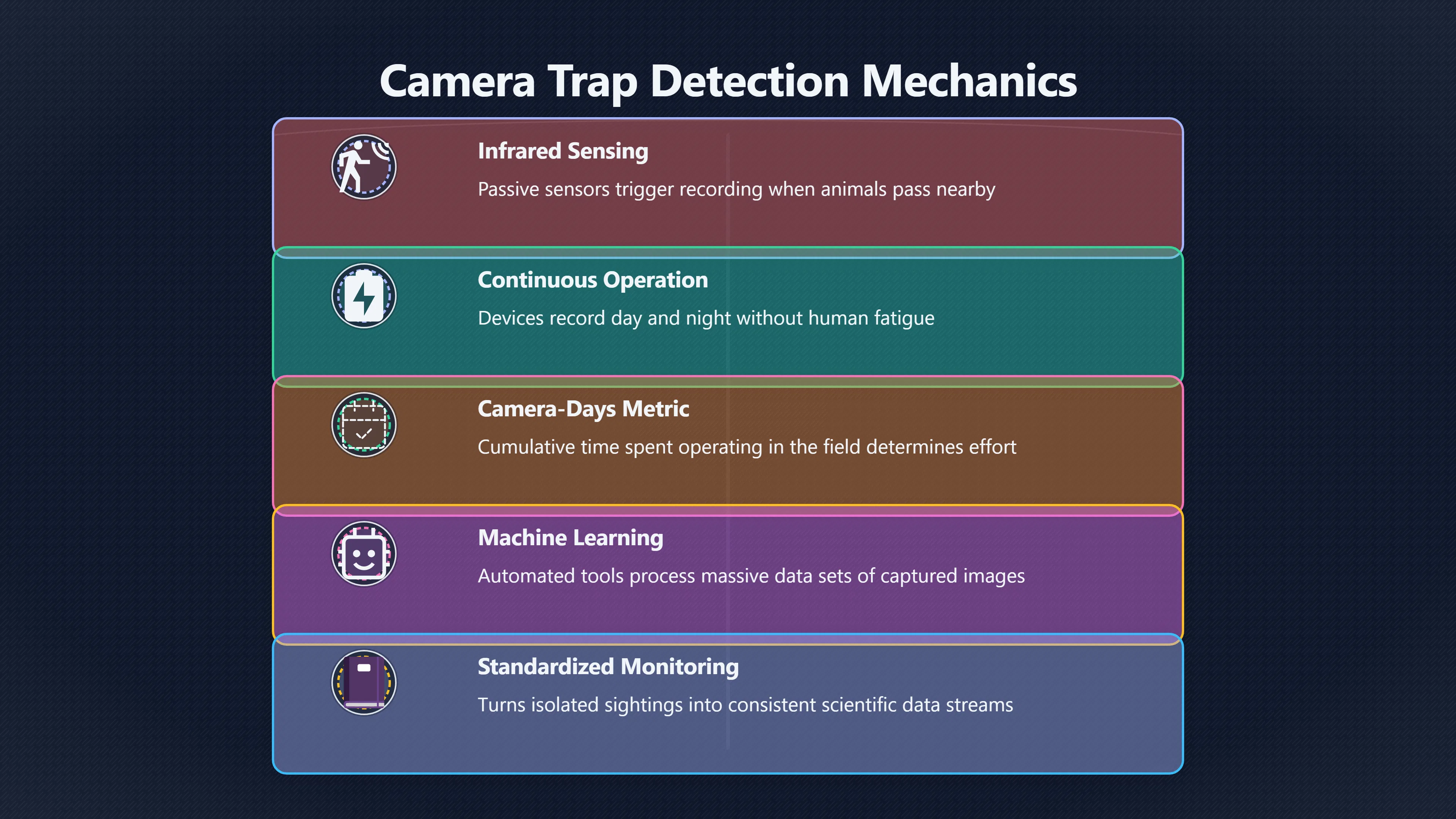
The most important unit in camera-trap studies is often not the number of cameras but the number of camera-days: the cumulative time cameras spend operating in the field. Ten cameras running for 100 days generate 1,000 camera-days of observation effort. This metric helps researchers estimate how thoroughly an area has been surveyed and how likely it is that rare species would have been detected if present.[PMC]pmc.ncbi.nlm.nih.govPMCHow long is enough to detect terrestrial animals?X Si · 2014 · Cited by 158 — Other studies using camera trap to monitor wildlife had various MTEs. Seki (2010) found 36…
Large camera-trap projects routinely generate tens of thousands or even hundreds of thousands of camera-days. Modern programmes also increasingly use automated image classification and machine-learning tools to process enormous datasets that would once have overwhelmed researchers.[ZSL Publications+2arXiv]zslpublications.onlinelibrary.wiley.comZSL PublicationsCamera traps and deep learning enable efficient large‐scale…by M Henrich · Cited by 7 — Automated detectors such as ca…
However, camera traps are not magic. Their limitations explain why some genuinely rare mammals can remain difficult to find:
- Cameras only observe the locations where they are placed.
- Arboreal species may avoid ground-level cameras.
- Extremely low-density populations can remain undetected for long periods.
- Dense vegetation, equipment failure and environmental conditions can reduce effectiveness.
- Survey coverage is still uneven across the world’s forests.[PMC]pmc.ncbi.nlm.nih.govPMCHow long is enough to detect terrestrial animals?X Si · 2014 · Cited by 158 — Other studies using camera trap to monitor wildlife had various MTEs. Seki (2010) found 36…
These limitations help explain why rediscoveries continue to occur. The existence of camera traps does not mean every elusive mammal has already been documented. Instead, it means that claims can increasingly be evaluated against known survey effort. A species surviving in a small, remote mountain range remains plausible; a large breeding population occupying extensively monitored forests without producing consistent photographic evidence becomes harder to defend.[Nature+2Oxford University]nature.comAttenborough's echidna rediscovered by combining…by G Morib · 2025 · Cited by 3 — In 2022 and 2023, we deployed camera-traps in…
How big cryptids face a higher burden
The lasting change in forest mysteries
Perhaps the most important legacy of camera trapping is methodological rather than technological. The question is no longer simply whether an animal could be hiding in a forest. The question is whether it could remain hidden despite thousands of camera-days, repeated surveys, local ecological knowledge and increasingly sophisticated image analysis.
In that sense, camera traps have changed forest mysteries forever. They continue to reveal rare and remarkable mammals, but they do so by converting uncertainty into datasets. For cryptozoology, that means the strongest future discoveries are likely to resemble the saola, the silver-backed chevrotain or Attenborough’s long-beaked echidna: elusive species confirmed through accumulated evidence rather than creatures sustained primarily by anecdote.[Nature+2Nature]nature.comCamera-trap evidence that the silver-backed chevrotain…by A Nguyen · 2019 · Cited by 38 — Here, we provide evidence that the sil…
Amazon book picks
Further Reading
Books and field guides related to Camera traps changed forest mysteries forever. Use these as the next step if you want deeper reading beyond the article.
Abominable Science!
Addresses the evidential burden facing claims about large hidden animals.
The Sixth Extinction
Discusses modern biodiversity research and evidence-based wildlife science.
Among the Great Apes
Highlights field research and observation of difficult-to-study animals.
The Lost World of the Kalahari
Connects to the theme of finding elusive animals and transforming mystery into evidence.
eBay marketplace picks
Marketplace Samples
Live-tested eBay searches with available results related to this page.




Endnotes
1.
Source: nature.com
Link:https://www.nature.com/articles/s41559
2.
Source: pmc.ncbi.nlm.nih.gov
Title: PMCHow long is enough to detect terrestrial animals?
Link:https://pmc.ncbi.nlm.nih.gov/articles/PMC4017883/
3.
Source: fv-berlin.de
Title: rediscovery of the silver backed chevrotain
Link:https://www.fv-berlin.de/en/research/research-highlight/rediscovery-of-the-silver-backed-chevrotain
4.
Source: nature.com
Link:https://www.nature.com/articles/d41586-019-03467-7
5.
Source: nature.com
Link:https://www.nature.com/articles/s44185-025-00086-6
6.
Source: arxiv.org
Link:https://arxiv.org/abs/2408.14348
7.
Source: arxiv.org
Link:https://arxiv.org/abs/2606.20223
8.
Source: youtube.com
Title: Candid Creatures Sneak Peak
Link:https://www.youtube.com/watch?v=STiyeYouhb4
9.
Source: youtube.com
Title: Camera Traps
Link:https://www.youtube.com/watch?v=aZZ53GWzPE0
10.
Source: wwf.org.uk
Title: WWFCAMERA-TRAPPING PAGE 1
Link:https://www.wwf.org.uk/sites/default/files/2019-04/CameraTraps-WWF-guidelines.pdf
11.
Source: zslpublications.onlinelibrary.wiley.com
Link:https://zslpublications.onlinelibrary.wiley.com/doi/full/10.1002/rse2.70030
12.
Source: ox.ac.uk
Link:https://www.ox.ac.uk/news/2023-11-10-found-last-bizarre-egg-laying-mammal-finally-rediscovered-after-60-years
13.
Source: pmc.ncbi.nlm.nih.gov
Link:https://pmc.ncbi.nlm.nih.gov/articles/PMC12069574/
14.
Source: pubmed.ncbi.nlm.nih.gov
Link:https://pubmed.ncbi.nlm.nih.gov/31712696/
15.
Source: ncbi.nlm.nih.gov
Title: research news
Link:https://www.ncbi.nlm.nih.gov/search/research-news/7504/
16.
Source: sciencenews.org
Title: Nature Ecology and Evolution
Link:https://www.sciencenews.org/article/silver-backed-chevrotains-have-been-rediscovered-science-after-29-years
17.
Source: moit.gov.bt
Link:https://www.moit.gov.bt/wp-content/uploads/2025/03/4.-Appendix-I-I.7-i.pdf
Additional References
18.
Source: rewild.org
Link:https://www.rewild.org/lost-species/silver-backed-chevrotain
19.
Source: forbes.com
Link:https://www.forbes.com/sites/scotttravers/2026/01/23/meet-the-silver-backed-chevrotain—a-mouse-deer-that-vanished-for-25-years-rediscovered-by-a-camera-trap/
20.
Source: cris.tau.ac.il
Link:https://cris.tau.ac.il/en/publications/attenboroughs-echidna-rediscovered-by-combining-indigenous-knowle/
21.
Source: linkedin.com
Link:https://www.linkedin.com/posts/rewildorg_world-first-silver-backed-chevrotain-conservation-activity-7343943617742270465-u4KU
22.
Source: rewild.org
Link:https://www.rewild.org/press/found-chevrotain-miniature-fanged-deer-rediscovered-tiptoeing-through-vietnams-coastal-forests
23.
Source: ox.ac.uk
Link:https://www.ox.ac.uk/news/2023-11-10-found-last-bizarre-egg-laying-mammal-finally-rediscovered-after-60-years-1
24.
Source: news.mongabay.com
Link:https://news.mongabay.com/short-article/camera-traps-and-indigenous-knowledge-help-confirm-presence-of-lost-echidna-species/
25.
Source: ctpublic.org
Link:https://www.ctpublic.org/2019-11-11/silver-backed-chevrotain-with-fangs-and-hooves-photographed-in-wild-for-first-time
26.
Source: en.vietnamplus.vn
Link:https://en.vietnamplus.vn/worlds-smallest-ungulates-spotted-in-vietnam-after-nearly-30-years-post163537.vnp
27.
Source: abcnews.com
Link:https://abcnews.com/US/scientists-confirmed-existence-200-million-year-species-thought/story?id=122773046
Topic Tree