Within New Species
How Museums Still Hide New Species
Some new species are found years after collection because old specimens need specialist comparison before they can be named.
On this page
- Why collected specimens remain unnamed
- How re examination turns old samples into new species
- Why this does not rescue weak cryptid claims
Page outline Jump by section
Introduction
One of the least appreciated sources of biological discovery is not a remote jungle, deep-ocean trench or unexplored mountain range. It is the museum storeroom. Around the world, natural history collections contain millions of preserved plants, animals, fossils and tissues, many of which have never been studied in detail by the specialists needed to identify them. As a result, species can remain unnamed for decades after they were collected, only becoming recognised when someone re-examines an old specimen, compares it with related material, or applies newer analytical techniques. This backlog is a real and well-documented source of species discovery, but it also illustrates an important point for discussions of cryptozoology: genuinely unknown species are usually revealed through physical specimens and careful taxonomy, not through long-running folklore, ambiguous photographs or eyewitness reports. Undark Magazine+2American Museum of Natural History[undark.org]undark.orgdiscovered in collections many new species are already goneUndark MagazineDiscovered in Collections, Many New Species are Already…29 May 2023 — Scientists have identified new species of bats, b…
Why Collected Specimens Remain Unnamed
Natural history museums hold vast collections assembled over centuries. The collections of major institutions contain millions of specimens, and only a small proportion can be displayed publicly. The rest are preserved as research material for future study.[Natural History Museum]nhm.ac.ukNatural History MuseumCollectionsUncover colourful stories behind the specimens, meet collectors and curators past and present and read a…
The existence of unnamed specimens is not evidence of neglect so much as a consequence of scale. Several factors create a backlog:
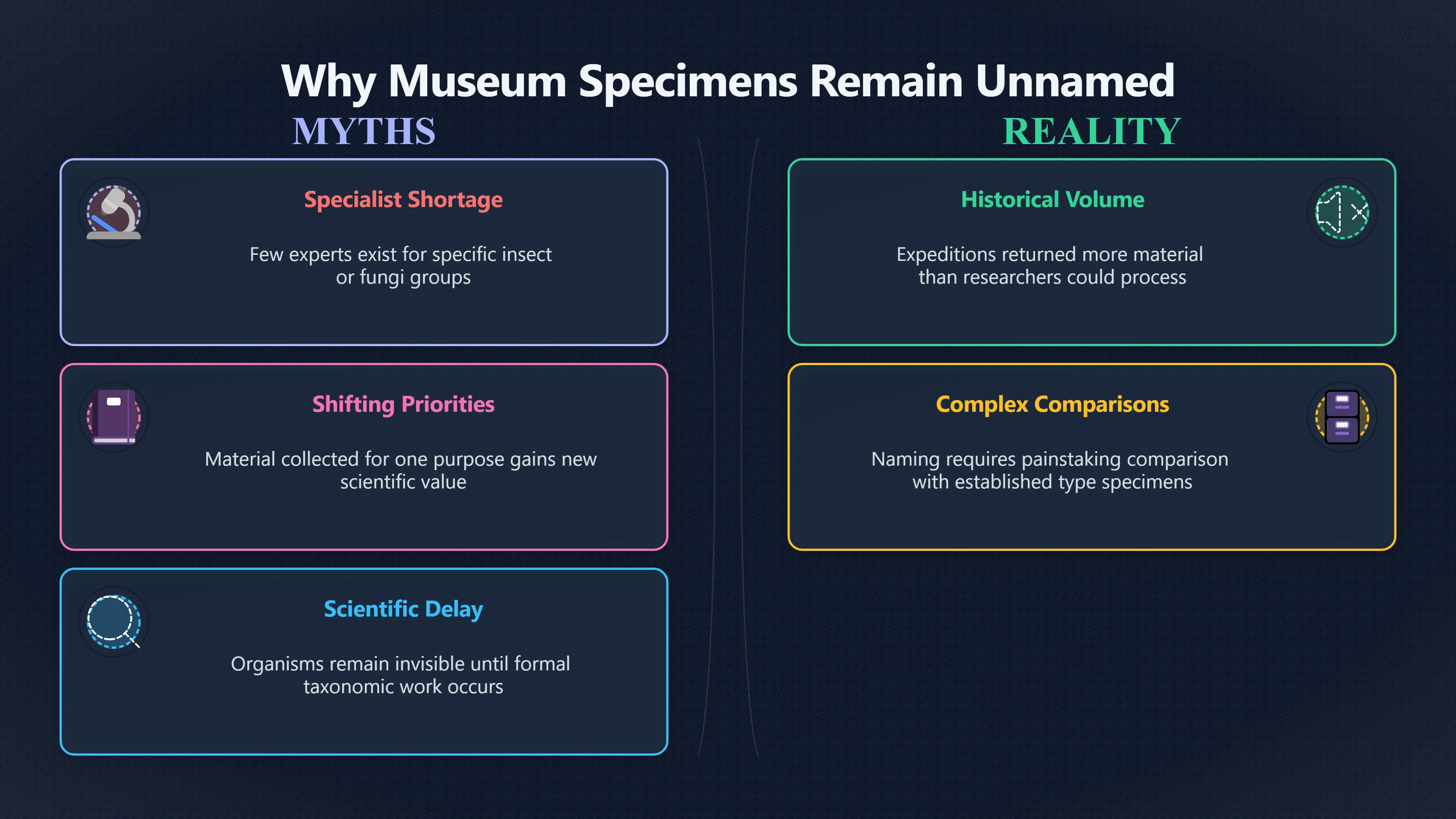
- Too many specimens, too few taxonomists. Many groups of organisms have only a handful of specialists worldwide. Large collections of insects, mites, fungi, marine invertebrates or tropical plants may wait years before experts can examine them.
- Historical collecting expeditions. Expeditions often returned with far more material than researchers could immediately process. Some specimens entered collections with basic labels and awaited detailed study.
- Changing scientific priorities. Material collected for one purpose may later prove valuable for another. A specimen initially filed under a known species may only later be recognised as something distinct.
- Complex comparisons. Naming a species requires comparison with previously described specimens, including type specimens that define existing names. This work can be painstaking and time-consuming.[naturalsciences.be]naturalsciences.beHow do we describe a new species?Comparative Analysis: The new species is compared to its closest relatives using type specimens from mus…
The result is a form of scientific delay: an organism may have been physically collected decades ago, yet remain scientifically invisible until a specialist undertakes the necessary taxonomic work.
How Re-examination Turns Old Samples into New Species
Better Comparisons Reveal Hidden Differences
Many specimens were originally identified using the best knowledge available at the time. Later researchers may have access to larger comparative collections, improved microscopes, digital imaging or more complete geographic data.
When multiple specimens from different regions are compared side by side, subtle differences in anatomy, colour patterns, skeletal features or reproductive structures can reveal that what was thought to be one species is actually several. Museum collections make these comparisons possible because they preserve material collected across long periods and wide geographic areas.[naturalsciences.be+2Blog |]naturalsciences.beHow do we describe a new species?Comparative Analysis: The new species is compared to its closest relatives using type specimens from mus…
New Technology Changes Old Specimens
Modern techniques have expanded the scientific value of old collections.
DNA sequencing from preserved material, high-resolution CT scanning, digital microscopy and other methods can uncover distinctions that earlier researchers could not detect. Recent work has shown that museum specimens continue to yield new information even many decades after collection.[Blog |+2MDPI]blog.pensoft.netthe role of taxonomy and natural history collections in saving lost biodiversityForgotten species: the crucial role of taxonomy and natural…2 Oct 2024 — Museum specimens allow scientists to re-examine old cla…
In some cases, re-analysis corrects historical misidentifications. A recent study of historical specimens found numerous discrepancies between older identifications and modern assessments when morphology and genetic evidence were re-examined together.[MDPI]mdpi.comIntegrated Taxonomy and Species Diversity of the…by MV Iacovelli · 2025 · Cited by 1 — Of these, 288 specimens were identified to…
Cases That Show the Backlog Is Real
Several well-known discoveries demonstrate how species can remain hidden in collections for surprisingly long periods.
One of the most famous examples is the olinguito, a small carnivorous mammal from the Andes. Researchers recognised it as a distinct species by studying museum specimens that had been collected decades earlier and stored in collections. Only after detailed comparison did scientists realise that these specimens represented a species previously unknown to science.[American Museum of Natural History]amnh.orgThe specimens here in the American Museum of Natural History wereAmerican Museum of Natural HistoryOlinguito: From Specimen to a New Species | AMNHPINTO: The olinguito is a new species that was discover…
The Natural History Museum in London has repeatedly reported discoveries arising from historical collections. In one case, specimens of a moth had been present in the museum since the nineteenth century before being recognised as a distinct species. The museum also regularly highlights new fossil and living species identified from material already held in its collections.[Natural History Museum]nhm.ac.ukNatural History MuseumNew speciesA new species of extinct lizard has been described from the Museum's collections…. Researchers have d…
Recent examples continue to appear. A parasitic wasp collected in Chile in 1983 remained unnoticed in a museum drawer until detailed examination revealed characteristics distinct enough to justify a new genus and species. Likewise, a coelacanth fossil collected roughly 150 years ago was recently re-evaluated with modern imaging techniques and recognised as a previously unknown species.[The Guardian]theguardian.comThe wasp, Attenboroughnculus tau, measures just 3.5mm in length and is notable for a distinctive T-shaped mark on its abdomen. Though col…
These discoveries are noteworthy precisely because they involve physical specimens that can be examined, compared and re-examined by other researchers.
The Conservation Twist: Some Species Are Found Too Late
An unexpected consequence of the museum backlog is that species may be formally recognised only after they have become rare, endangered or even extinct.
Why This Does Not Rescue Weak Cryptid Claims
The museum backlog is sometimes invoked as an argument that famous cryptids might eventually be validated. The reasoning sounds plausible: if museums can hide unknown species for decades, perhaps Bigfoot, lake monsters or other legendary creatures are also waiting to be confirmed.
The actual pattern of discovery points in a different direction.
Museum-based discoveries almost always involve tangible evidence. Researchers possess specimens, tissues, fossils or other physical material that can be repeatedly examined. The uncertainty concerns classification, not existence. Scientists are asking whether a specimen belongs to a known species or represents a new one.[naturalsciences.be]naturalsciences.beHow do we describe a new species?Comparative Analysis: The new species is compared to its closest relatives using type specimens from mus…
Cryptid claims generally reverse that situation. The problem is not deciding how to classify a specimen; it is the absence of a specimen altogether. The evidence often consists of sightings, stories, tracks, photographs or disputed biological samples. Without a verifiable physical specimen, the taxonomic process that resolves museum mysteries cannot begin.
The backlog therefore supports a modest conclusion: biodiversity is incompletely catalogued, and collections still contain genuine scientific surprises. It does not support the stronger claim that large, widely reported cryptids have escaped collection, documentation and physical verification despite decades of attention. The lesson of museum drawers is that unknown species are commonly found through preserved evidence and specialist comparison, not through the accumulation of anecdotal reports. Undark Magazine+2American Museum of Natural History[undark.org]undark.orgdiscovered in collections many new species are already goneUndark MagazineDiscovered in Collections, Many New Species are Already…29 May 2023 — Scientists have identified new species of bats, b…
Amazon book picks
Further Reading
Books and field guides related to How Museums Still Hide New Species. Use these as the next step if you want deeper reading beyond the article.
The Species Seekers: Heroes, Fools, and the Mad Pursuit of Li...
Shows how specimens and collections contribute to new species recognition.
The Museum of Other People
Provides broader museum context relevant to collections and archives.
eBay marketplace picks
Marketplace Samples
Live-tested eBay searches with available results related to this page.



Endnotes
1.
Source: undark.org
Title: discovered in collections many new species are already gone
Link:https://undark.org/2023/05/29/discovered-in-collections-many-new-species-are-already-gone/
2.
Source: naturalsciences.be
Link:https://www.naturalsciences.be/en/discover-join/discover—taxonomy-what-why-and-how/how-do-we-describe-a-new-species
3.
Source: mdpi.com
Link:https://www.mdpi.com/2079-7737/14/9/1129
4.
Source: mdpi.com
Link:https://www.mdpi.com/2076-2615/13/6/1078
5.
Source: amnh.org
Title: The specimens here in the American Museum of Natural History were
Link:https://www.amnh.org/explore/videos/shelf-life/olinguito-skull-species-discovery
6.
Source: blog.pensoft.net
Title: the role of taxonomy and natural history collections in saving lost biodiversity
Link:https://blog.pensoft.net/2024/10/02/the-role-of-taxonomy-and-natural-history-collections-in-saving-lost-biodiversity/
7.
Source: nhm.ac.uk
Link:https://www.nhm.ac.uk/discover/collections.html
8.
Source: pubmed.ncbi.nlm.nih.gov
Link:https://pubmed.ncbi.nlm.nih.gov/21238186/
9.
Source: pmc.ncbi.nlm.nih.gov
Title: PMCNatural history collections as windows on evolutionary
Link:https://pmc.ncbi.nlm.nih.gov/articles/PMC4755843/
10.
Source: nhm.ac.uk
Link:https://www.nhm.ac.uk/discover/new-species.html
11.
Source: theguardian.com
Link:https://www.theguardian.com/tv-and-radio/2026/may/07/tiny-parasitic-wasp-named-after-david-attenborough-100th-birthday-attenboroughnculus-tau
12.
Source: facebook.com
Link:https://www.facebook.com/groups/24591460123/posts/10152596858005124/
13.
Source: nhm.ac.uk
Title: museum published over 700 new pieces of research in 2023
Link:https://www.nhm.ac.uk/discover/news/2023/december/museum-published-over-700-new-pieces-of-research-in-2023.html
14.
Source: zookeys.pensoft.net
Link:https://zookeys.pensoft.net/article/2916/
Additional References
15.
Source: naturalis.nl
Link:https://www.naturalis.nl/en/collection
16.
Source: timesofindia.indiatimes.com
Link:https://timesofindia.indiatimes.com/world/rest-of-world/palaeontologists-identify-a-new-coelacanth-species-from-a-150-year-old-fossil-in-london/articleshow/130464008.cms
17.
Source: instagram.com
Link:https://www.instagram.com/p/DSYRjlnDJ73/
18.
Source: merriam-webster.com
Title: NE W Definition & Meaning4 days ago — 1
Link:https://www.merriam-webster.com/dictionary/new
19.
Source: naturalhistorycollections.org
Title: Natural Science Collections: Home Specimens are Historical Records
Link:https://www.naturalhistorycollections.org/
20.
Source: researchgate.net
Link:https://www.researchgate.net/publication/285275751_Assessing_the_Value_of_Natural_History_Collections_and_Addressing_Issues_Regarding_Long-Term_Growth_and_Care
21.
Source: youtube.com
Link:https://www.youtube.com/watch?v=vckmhXmBg08
22.
Source: youtube.com
Link:https://www.youtube.com/watch?v=dfTxZBUTzU8
23.
Source: youtube.com
Title: What new species have been discovered this year? | Natural History Museum
Link:https://www.youtube.com/watch?v=KWBcYHmM1Ko
24.
Source: youtube.com
Link:https://www.youtube.com/watch?v=4Eide_FMmEA
Topic Tree