Within Folklore
Why Cryptids Live in the Maybe
Cryptid stories let people share doubtful experiences without choosing between full belief and full disbelief.
On this page
- Eyewitness form and the feeling of a report
- Ambiguous evidence as storytelling fuel
- Belief, doubt, jokes and community use
Page outline Jump by section
Introduction
Cryptid stories survive because they occupy a social space between certainty and uncertainty. Most reports of Bigfoot, Nessie, Mothman or similar creatures do not begin with clear proof. They begin with something incomplete: an unusual track, a distant shape, an unexpected sound, a blurred photograph or a witness who is not entirely sure what was seen. Rather than ending discussion, that uncertainty often becomes the story’s greatest strength. Folklore scholars have long noted that legends thrive in situations where people are trying to interpret ambiguous experiences. Contemporary legends are especially powerful because they allow communities to discuss unusual events without requiring universal agreement about what happened. A person can tell a cryptid story, question it, laugh about it, investigate it or defend it, all while participating in the same conversation. In that sense, cryptid legends make uncertainty socially useful: they turn doubt into a shared activity rather than a problem that must be solved immediately.[ISCLR]contemporarylegend.orgISCLRInternational Society for Contemporary Legend Research…Contemporary (“urban”) legends are one of the most pervasive forms of folk…
Eyewitness Reports and the Social Value of”Maybe”
One reason cryptid stories remain popular is that they are usually framed as reports rather than as obvious fiction. Someone claims to have seen something unusual. The audience is then invited to evaluate the account.
This structure creates a distinctive social role. If a witness says,”I definitely saw a giant unknown animal,” listeners may reject the claim. If they say,”I saw something I cannot explain,” the conversation stays open. The uncertainty becomes part of the narrative.
Legend researchers describe contemporary legends as narratives through which people negotiate anomalous experiences. Instead of delivering certainty, the story creates a space where different interpretations can coexist. The witness may believe one thing, sceptics another, and curious observers something in between. The legend survives because it can accommodate all three positions simultaneously.[ISCLR]contemporarylegend.orgISCLRInternational Society for Contemporary Legend Research…Contemporary (“urban”) legends are one of the most pervasive forms of folk…
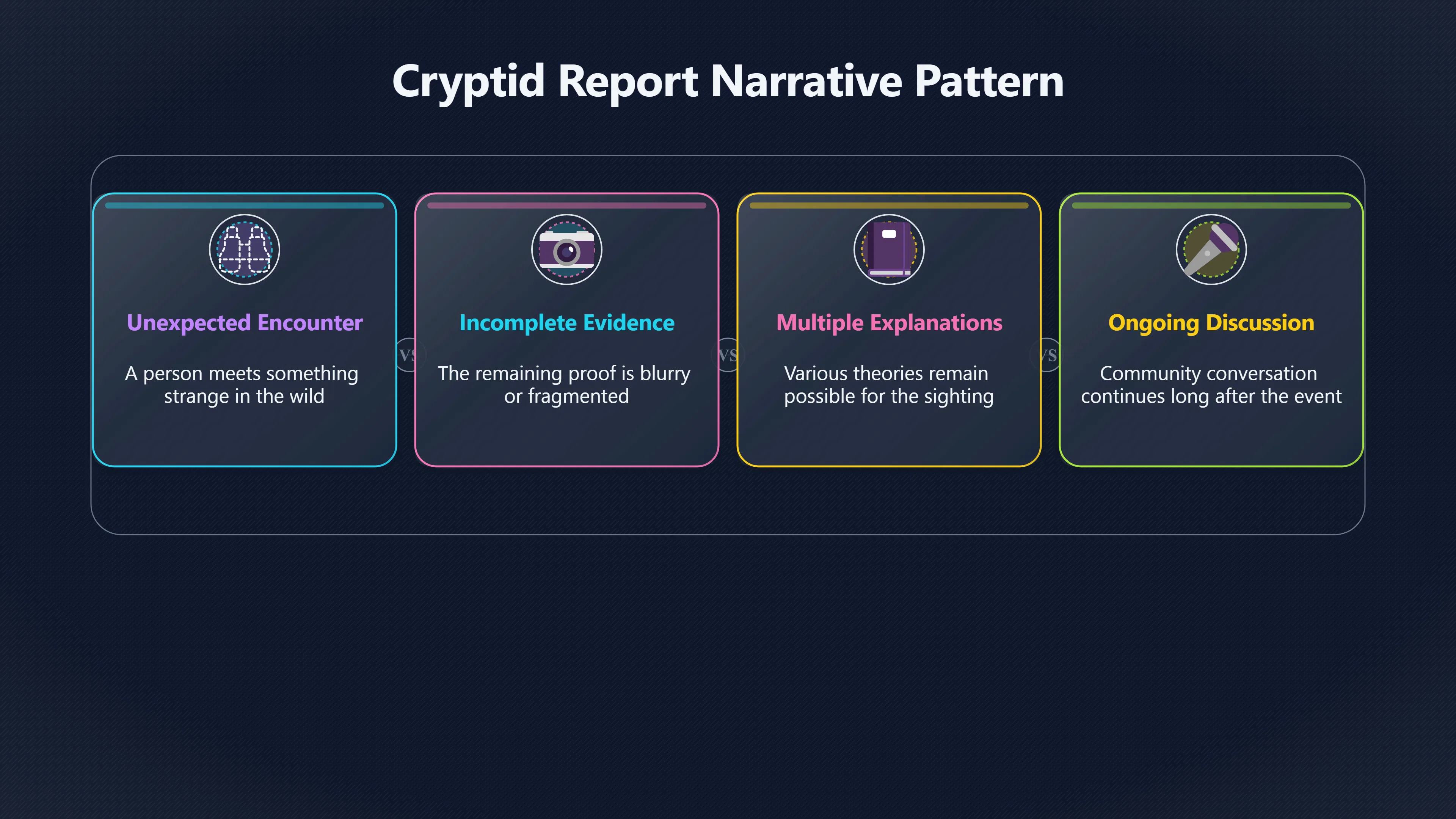
Cryptid reports often follow this pattern:<div class="content-enhancement content-enhancement--insight-grid" markdown="1">
- A person encounters something unexpected.
- The evidence is incomplete.
- Multiple explanations remain possible.
- Discussion continues long after the event itself.</div>
The social benefit is that communities can discuss mystery without demanding consensus. Participation matters more than agreement.
Why Ambiguous Evidence Keeps Stories Alive
Strong evidence can end an argument. Ambiguous evidence can sustain one.
Many famous cryptid cases rely on material that is suggestive rather than conclusive: footprints, eyewitness sketches, fleeting photographs, unusual carcasses or unexplained sounds. Such evidence rarely settles the question, but it provides enough material to keep discussion active.
Folklore scholars note that legends often flourish in precisely these circumstances. When evidence remains incomplete, people continue comparing explanations, evaluating witnesses and retelling the story. The uncertainty becomes renewable. Each new photograph, track or alleged encounter can be interpreted in different ways, generating fresh conversation.[Revenant Journal]revenantjournal.comIntroductionContemporary legends are a reflection of the uncertainties, societal fears, anxieties, moral concerns, and threats that peopl…
This helps explain why cryptid stories can survive repeated failures to produce definitive proof. From a scientific perspective, lack of confirmation weakens a claim. From a folklore perspective, unresolved questions may actually help sustain interest. The mystery remains available for discussion because it has not been fully closed.
Bigfoot reports illustrate this mechanism particularly well. A blurry image or disputed footprint may have little scientific value, but it can produce years of storytelling, debate, documentaries, podcasts and local discussion. The cultural life of the evidence often lasts much longer than the original event.
Belief and Doubt Are Not Opposites
A common misconception is that people either believe cryptid stories or reject them. In practice, many occupy a middle position.
Folklorists have argued that legends frequently operate in a zone where truth remains negotiable. People may repeat a story because it is interesting, meaningful or entertaining without committing themselves to its literal accuracy. The question is not always”Is it true?” but”Could it be true?” or”What would it mean if it were true?”[SHURA]shura.shu.ac.ukSHURAContemporary Legend Special Issue: Editor'sIntroductionMarch 3, 2026 — by D Rodgers · 2026 — Prior to the 1960s, folklorists defined legends as stories believed to be true 'that fo…
This middle ground serves several social purposes.
It reduces conflict. Communities can discuss unusual claims without forcing members into rigid camps.
It encourages participation. People who are uncertain can still contribute observations, memories and local knowledge.
It preserves curiosity. The mystery remains open rather than being dismissed immediately.
It creates shared identity. Residents of a region can enjoy a cryptid tradition regardless of whether they believe the creature exists.
The result is a social environment where uncertainty becomes productive rather than paralysing.
Cryptids as Safe Debates About Knowledge
Cryptid stories also provide a way to discuss larger questions about evidence and authority.
When people debate a cryptid sighting, they are often debating more than the creature itself. They may be discussing:
- How reliable eyewitness testimony is.
- Whether experts should always be trusted.
- How much evidence is enough to justify belief.
- Whether personal experience outweighs official explanations.
- How people should respond to the unknown.
These questions appear repeatedly in folklore studies because legends often emerge where certainty is difficult to achieve. Folklore researchers have observed that legends help communities process uncertainty, risk and competing interpretations of reality.[Revenant Journal+2MUN DAI]revenantjournal.comRevenant JournalIntroductionContemporary legends are a reflection of the uncertainties, societal fears, anxieties, moral concerns, and threats that peopl…
Cryptid stories therefore act as informal exercises in evidence evaluation. Participants weigh testimony, compare explanations and negotiate standards of proof. Even when no conclusion is reached, the process itself has social value.
Jokes, Scepticism and Community Belonging
Another reason uncertainty remains useful is that cryptid culture does not require solemn belief.
Many communities engage with cryptids through humour, festivals, souvenirs, local mascots and storytelling events. A person may buy a Bigfoot sticker, attend a Mothman festival or share a Nessie joke while remaining uncertain about the creature’s existence.
Because the legends are not fully resolved, they support multiple forms of participation. Enthusiasts, sceptics and casual observers can all interact with the same story for different reasons. The uncertainty acts as a bridge between groups that might otherwise have little in common.
Researchers of folklore frequently emphasise that stories are social practices as much as factual claims. Their importance often lies in what people do with them: telling them, debating them, adapting them and using them to express identity.[What is Folklore?+2MDPI]whatisfolklore.orgWhat is Folklore?What is Folklore?A project of the American Folklore SocietyFolklore is our cultural DNA. It includes the art, stories, knowledge, and practices of a peo…
Cryptid legends demonstrate this principle clearly. The creature may never be found, yet the conversations, traditions and relationships created around the mystery remain real.
Why Cryptids Live in the Maybe
The enduring power of cryptid legends comes from their ability to keep uncertainty active rather than eliminate it. A cryptid story begins with incomplete evidence, but instead of treating that incompleteness as a failure, folklore turns it into a social resource.
People compare accounts, evaluate clues, challenge assumptions, tell jokes, express local identity and explore questions about knowledge itself. The creature at the centre of the story may be uncertain, but the social functions are not. The legend gives communities a way to talk about mystery, possibility and evidence without demanding a final answer.
That is why cryptids often thrive in the realm of”maybe”. The uncertainty is not a flaw in the story. It is the mechanism that keeps the story alive.[ISCLR+2Revenant Journal]contemporarylegend.orgISCLRInternational Society for Contemporary Legend Research…Contemporary (“urban”) legends are one of the most pervasive forms of folk…
Amazon book picks
Further Reading
Books and field guides related to Why Cryptids Live in the Maybe. Use these as the next step if you want deeper reading beyond the article.
The Mothman Prophecies
Rating: 4.5/5 from 6 Google Books ratings
Built around ambiguous sightings and unresolved interpretations.
eBay marketplace picks
Marketplace Samples
Live-tested eBay searches with available results related to this page.



Endnotes
1.
Source: contemporarylegend.org
Link:https://contemporarylegend.org/
2.
Source: shura.shu.ac.uk
Title: SHURAContemporary Legend Special Issue: Editor’s
Link:https://shura.shu.ac.uk/37088/1/0.-revenant_introduction_FINAL_Jun_25-1.pdf
3.
Source: dai.mun.ca
Link:https://dai.mun.ca/pdfs/clegend/ContemporaryLegendVol.102007.pdf
4.
Source: mdpi.com
Link:https://www.mdpi.com/2076-0787/13/1/1
5.
Source: mdpi.com
Link:https://www.mdpi.com/2076-0787/7/1/17
6.
Source: folklore.ee
Link:https://www.folklore.ee/rl/fo/konve/2016/legend/abstracts.pdf
7.
Source: revenantjournal.com
Title: Revenant Journal
Link:https://www.revenantjournal.com/contents/introduction-7/
8.
Source: whatisfolklore.org
Title: What is Folklore?What is Folklore?
Link:https://whatisfolklore.org/
9.
Source: shu.ac.uk
Link:https://www.shu.ac.uk/centre-culture-[media
Additional References
10.
Source: researchgate.net
Link:https://www.researchgate.net/publication/387693546_Perspectives_on_Contemporary_Legend_International_Society_for_Contemporary_Legend_Research_26th_International_Conference_Dublin_Ireland_July
11.
Source: academia.edu
Link:https://www.academia.edu/Documents/in/Contemporary_legends/MostCited
12.
Source: americanfolkloresociety.org
Link:https://americanfolkloresociety.org/about/
13.
Source: facebook.com
Title: a regional guide to american folklore 1961the life treasury of american folklor
Link:https://www.facebook.com/Uyghursbookshelf/posts/-a-regional-guide-to-american-folklore-1961the-life-treasury-of-american-folklor/1369125458350229/
14.
Source: researchgate.net
Title: 389513849 Urban Legends their Role in Cultural Identity and Social Norms
Link:https://www.researchgate.net/publication/389513849_Urban_Legends_their_Role_in_Cultural_Identity_and_Social_Norms
15.
Source: researchgate.net
Title: 323281563 The Challenge of American Folklore to the Humanities
Link:https://www.researchgate.net/publication/323281563_The_Challenge_of_American_Folklore_to_the_Humanities
16.
Source: esiculture.com
Title: Contemporary folklore reflects old psych
Link:https://esiculture.com/index.php/esiculture/Contemporary-folklore-reflects-old-psych
17.
Source: scholarworks.iu.edu
Title: Scholar Works Contemporary Legend
Link:https://scholarworks.iu.edu/journals/index.php/cl/index
18.
Source: dokumen.pub
Link:https://dokumen.pub/american-folk-legend-reprint-2020nbsped-9780520313217.html
19.
Source: facebook.com
Title: Out of curiosity. What separates a cryptid from
Link:https://www.facebook.com/groups/3238587069499399/posts/7692169047474490/
Topic Tree