Within e DNA
What Happens to Sightings After DNA?
DNA surveys do not end folklore, but they narrow which animal explanations still fit alongside sightings, wakes and misidentifications.
On this page
- Why eyewitness reports still matter differently
- Which explanations survive biological testing
- How folklore adapts to scientific limits
Page outline Jump by section
Introduction
Environmental DNA (eDNA) does not make eyewitness lake-monster reports disappear, but it changes how they are interpreted. Before eDNA surveys, a sighting of an unidentified shape, wake or animal in a lake could be linked to a wide range of biological possibilities, including undiscovered large creatures. After eDNA sampling reveals which animals are actually leaving genetic traces in the water, many of those possibilities become much harder to defend. The result is not the end of eyewitness testimony; rather, sightings are filtered through a narrower set of biologically plausible explanations. In famous cases such as Loch Ness, eDNA has shifted discussion away from prehistoric-survivor theories and towards explanations involving known animals, optical effects and misidentifications.[The Guardian]theguardian.comloch ness monster could be a giant eel say scientistsThe GuardianLoch Ness monster could be a giant eel, say scientists5 Sept 2019 — Loch Ness monster could be a giant eel, say scientists ·…
What Happens to Sightings After DNA?
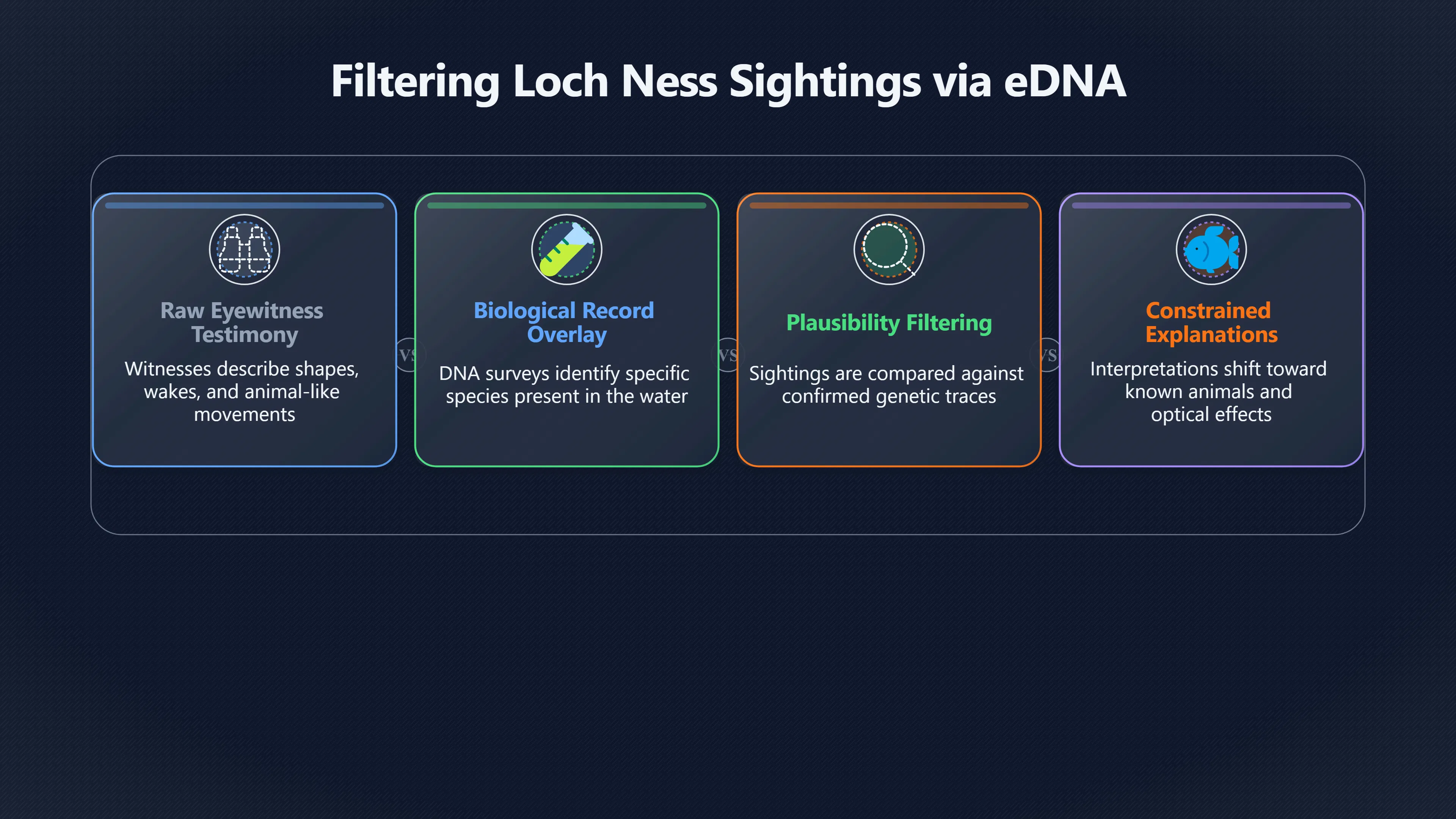
The most important change introduced by eDNA is that sightings are no longer evaluated in isolation. A witness may still report a long neck, humps, a large wake or an animal-like shape, but investigators can compare those reports against an independently collected biological record of the lake.
In Loch Ness, the 2018 eDNA survey found genetic traces from thousands of organisms but did not find evidence supporting popular candidates such as large reptiles, sharks, catfish or sturgeon. It did, however, detect abundant eel DNA. That finding did not prove that every sighting was an eel, but it changed the balance of probabilities. Explanations involving animals known to inhabit the loch remained viable, while explanations requiring an undetected population of large reptiles became much harder to reconcile with the available evidence.[The Guardian+2Genome BC]theguardian.comloch ness monster could be a giant eel say scientistsThe GuardianLoch Ness monster could be a giant eel, say scientists5 Sept 2019 — Loch Ness monster could be a giant eel, say scientists ·…
As a result, eyewitness accounts increasingly function as descriptions of observed phenomena rather than direct evidence for a specific unknown species. The sighting remains real as an experience, but the biological interpretation becomes more constrained.
Why Eyewitness Reports Still Matter Differently
eDNA cannot tell researchers what a witness saw at a particular moment. It cannot reconstruct weather conditions, viewing angles, distance estimation errors or unusual animal behaviour. For that reason, eyewitness reports still provide information that DNA sampling cannot.
What changes is the role of the testimony.
Instead of asking, “Did someone see a monster?”, investigators increasingly ask:
- What physical event produced the observation?
- Which known species present in the lake could match the description?
- Could the sighting involve waves, wakes, birds, floating objects or multiple animals?
- Does the report require a species that should have left detectable genetic traces?
This shift moves eyewitness evidence from the centre of the argument to part of a larger evidential framework. A dramatic report can still inspire investigation, but it no longer stands alone against biological surveys.
The distinction is important because many classic lake-monster reports describe shapes, movements and impressions rather than clear anatomical details. eDNA encourages researchers to interpret those descriptions alongside ecological evidence rather than treating them as direct zoological observations.
Which Explanations Survive Biological Testing?
eDNA does not identify the exact cause of a sighting. Instead, it eliminates some explanations and leaves others standing.
Explanations weakened by eDNA
Theories requiring large populations of unknown reptiles, surviving plesiosaurs or other conspicuous animals become less persuasive when repeated DNA surveys fail to detect traces consistent with those groups. In Loch Ness, the absence of reptilian DNA was widely viewed as a serious challenge to the classic plesiosaur model of Nessie.[The Guardian]theguardian.comloch ness monster could be a giant eel say scientistsThe GuardianLoch Ness monster could be a giant eel, say scientists5 Sept 2019 — Loch Ness monster could be a giant eel, say scientists ·…
Similarly, explanations involving large catfish or sturgeon lose force when surveys do not detect evidence that such animals are present in meaningful numbers.[The Guardian]theguardian.comloch ness monster could be a giant eel say scientistsThe GuardianLoch Ness monster could be a giant eel, say scientists5 Sept 2019 — Loch Ness monster could be a giant eel, say scientists ·…
Explanations that remain plausible
Some hypotheses survive because they involve animals already known to inhabit the lake.
The best-known example is the eel hypothesis. Abundant eel DNA demonstrates that eels are present. Since some historical reports describe elongated bodies, dark colouring and serpentine movement, proponents argue that unusually large eels could account for at least a subset of sightings. Researchers studying the idea have noted similarities between certain eyewitness descriptions and eel characteristics, although evidence for truly gigantic eels remains limited.[ResearchGate]researchgate.netResearchGate(PDF) The Loch Ness Monster: If It's Real, Could It Be an Eel?The Monsters of Loch Ness. London, UK. Macdonald and Jane's; 19…
Importantly, eDNA cannot determine the size of an animal from a species-level DNA match alone. Finding eel DNA confirms eel presence, not monster-sized eels. This means eDNA narrows explanations without completely resolving them.[Napier]napier.ac.ukHave scientists finally killed off the Loch Ness Monster?Sep 6, 2019 — Plenty of eel DNA doesn't confirm that Nessie is a giant eel…
How DNA Changes Misidentification Debates
One of the most significant effects of eDNA is its influence on discussions of misidentification.
Historically, sceptics often proposed that witnesses confused ordinary animals with extraordinary ones. Supporters of monster theories could respond that an unknown creature was equally possible because the lake had not been fully explored.
eDNA alters that balance. Once a survey provides a reasonably detailed inventory of local wildlife, investigators gain a stronger basis for comparing reports with known species. A dark shape at the surface is more likely to be interpreted in relation to animals confirmed by DNA evidence than to an entirely undocumented species.
This does not mean witnesses are dismissed. Instead, their observations are reclassified. A report may be treated as evidence that something unusual was seen, while the biological explanation is sought among organisms already known to inhabit the environment.
The debate therefore shifts from “monster versus no monster” to “which known phenomenon best fits the observation?”
How Folklore Adapts to Scientific Limits
Lake-monster traditions have proved remarkably resilient. eDNA has changed scientific discussions more than it has changed folklore.
Legends are not maintained solely by zoological claims. They are also sustained by local identity, tourism, storytelling and the human attraction to mystery. Even after the Loch Ness survey reduced support for several biological theories, public interest in Nessie remained strong and new sightings continued to be reported.[University of Otago]otago.ac.nzfirst edna study of loch ness points to something fishyUniversity of OtagoFirst eDNA Study Of Loch Ness Points To Something Fishy5 Sept 2019 — The “monster-factor” has provided Professor Gemme…
What tends to change is the content of the legend. Older versions often imagined a prehistoric survivor hidden in deep water. More recent discussions increasingly incorporate eels, unusual fish, optical illusions and environmental conditions alongside traditional monster imagery. The folklore adapts rather than disappears.
A New Relationship Between Sightings and Science
The most lasting contribution of eDNA to lake-monster investigations may be methodological rather than biological. It changes the relationship between anecdote and evidence.
In earlier eras, eyewitness reports often drove the search for hidden animals. Today, DNA surveys provide an independent check on those interpretations. Sightings still matter because they record human experiences and sometimes point researchers towards interesting events. However, the range of explanations that can reasonably accompany those sightings becomes increasingly constrained by what the lake’s genetic record reveals.
For cryptozoology, this represents a significant shift. eDNA does not settle every mystery, but it forces eyewitness accounts to coexist with ecological data. The result is a narrower, more evidence-based set of explanations for what people may be seeing when they report a lake monster.[The Guardian+2Genome BC]theguardian.comloch ness monster could be a giant eel say scientistsThe GuardianLoch Ness monster could be a giant eel, say scientists5 Sept 2019 — Loch Ness monster could be a giant eel, say scientists ·…
Amazon book picks
Further Reading
Books and field guides related to What Happens to Sightings After DNA?. Use these as the next step if you want deeper reading beyond the article.
The United States of Cryptids
Demonstrates how communities continue to tell monster stories.
eBay marketplace picks
Marketplace Samples
Live-tested eBay searches with available results related to this page.
Endnotes
1.
Source: genomebc.ca
Title: loch ness monster may be a giant eel
Link:https://www.genomebc.ca/blog/loch-ness-monster-may-be-a-giant-eel/
2.
Source: researchgate.net
Link:https://www.researchgate.net/publication/390620130_The_Loch_Ness_Monster_If_It%27s_Real_Could_It_Be_an_Eel
3.
Source: theguardian.com
Title: loch ness monster could be a giant eel say scientists
Link:https://www.theguardian.com/science/2019/sep/05/loch-ness-monster-could-be-a-giant-eel-say-scientists
4.
Source: napier.ac.uk
Link:https://www.napier.ac.uk/about-us/news/loch-ness-monster-theory
5.
Source: otago.ac.nz
Title: first edna study of loch ness points to something fishy
Link:https://www.otago.ac.nz/news/newsroom/first-edna-study-of-loch-ness-points-to-something-fishy
6.
Source: nypost.com
Title: New York Post’Fantastic’ Loch Ness Monster sighting reported
Link:https://nypost.com/2025/03/04/lifestyle/loch-ness-monster-sighting-reported-first-in-2025-fantastic/
7.
Source: nypost.com
Link:https://nypost.com/2026/01/04/us-news/longtime-loch-ness-monster-hunter-turns-skeptic-with-down-to-earth-explanation-for-sightings/
8.
Source: nypost.com
Title: New York Post Is this the’answer’ to the Loch Ness Monster mystery?
Link:https://nypost.com/2024/12/19/science/scientists-simple-explanation-for-loch-ness-monster-mystery/
9.
Source: Wikipedia
Link:https://en.wikipedia.org/wiki/Loch
10.
Source: dictionary.cambridge.org
Link:https://dictionary.cambridge.org/dictionary/english/loch
11.
Source: bg.pons.com
Link:https://bg.pons.com/%D0%BF%D1%80%D0%B5%D0%B2%D0%BE%D0%B4/%D0%B0%D0%BD%D0%B3%D0%BB%D0%B8%D0%B9%D1%81%D0%BA%D0%B8-%D0%B1%D1%8A%D0%BB%D0%B3%D0%B0%D1%80%D1%81%D0%BA%D0%B8/loch
12.
Source: merriam-webster.com
Link:https://www.merriam-webster.com/dictionary/loch
Additional References
13.
Source: forthriverstrust.org
Link:https://forthriverstrust.org/rivers-wildlife/learn/habitats/lochs/
14.
Source: visitscotland.com
Link:https://www.visitscotland.com/things-to-do/landscapes-nature/lochs
15.
Source: ndtv.com
Title: loch ness monster a mystery but scientists have new evidence for theory 2096443
Link:https://www.ndtv.com/science/loch-ness-monster-a-mystery-but-scientists-have-new-evidence-for-theory-2096443
16.
Source: youtube.com
Link:https://www.youtube.com/watch?v=6MiiwSuhk8k
17.
Source: sciencefocus.com
Title: loch ness monster dna study reveals plausible explanation for sightings
Link:https://www.sciencefocus.com/news/loch-ness-monster-dna-study-reveals-plausible-explanation-for-sightings
18.
Source: illumina.com
Link:https://www.illumina.com/content/illumina-marketing/amr/en_US/company/news-center/feature-articles/loch-ness-edna.html
19.
Source: emea.illumina.com
Link:https://emea.illumina.com/company/news-center/feature-articles/loch-ness-edna.html
20.
Source: reddit.com
Title: a bit of a misconception ive seen going around
Link:https://www.reddit.com/r/Cryptozoology/comments/1t59ei2/a_bit_of_a_misconception_ive_seen_going_around/
21.
Source: rabbies.com
Link:https://www.rabbies.com/en-gb/blog/loch-vs-lake
22.
Source: oldsaltblog.com
Title: using edna to search for nessie in scotland and angel sharks off corsica
Link:https://oldsaltblog.com/using-edna-to-search-for-nessie-in-scotland-and-angel-sharks-off-corsica/
Topic Tree