Within Field Basics
How to photograph a mystery track
A footprint photo becomes more useful when it shows scale, surrounding ground and the whole trackway rather than one dramatic print.
On this page
- Wide, mid range and close up shots
- Scale objects and camera angle mistakes
- Why the whole trackway matters
Page outline Jump by section
Introduction
When a claimed cryptid track is photographed, the most important question is often not whether the print looks unusual but whether anyone else can evaluate it. A dramatic close-up of a single footprint may look impressive, yet it often lacks the information needed to judge size, shape, direction of travel, substrate conditions or possible misidentification. Wildlife trackers, forensic investigators and field researchers all emphasise the same principle: document the track in context before focusing on detail. A useful track photograph shows not only the print itself but also its scale, position and relationship to other tracks in the sequence. Without that context, even a genuine animal track can become difficult or impossible to interpret.[forensicsciencesimplified.org]forensicsciencesimplified.orgThe purpose of crime scene photography is to document what is there and where it is in.Read more… For responsible cryptid investigation, track photography should therefore be treated as a documentation exercise rather than a search for the most dramatic image.
Wide, mid-range and close-up shots
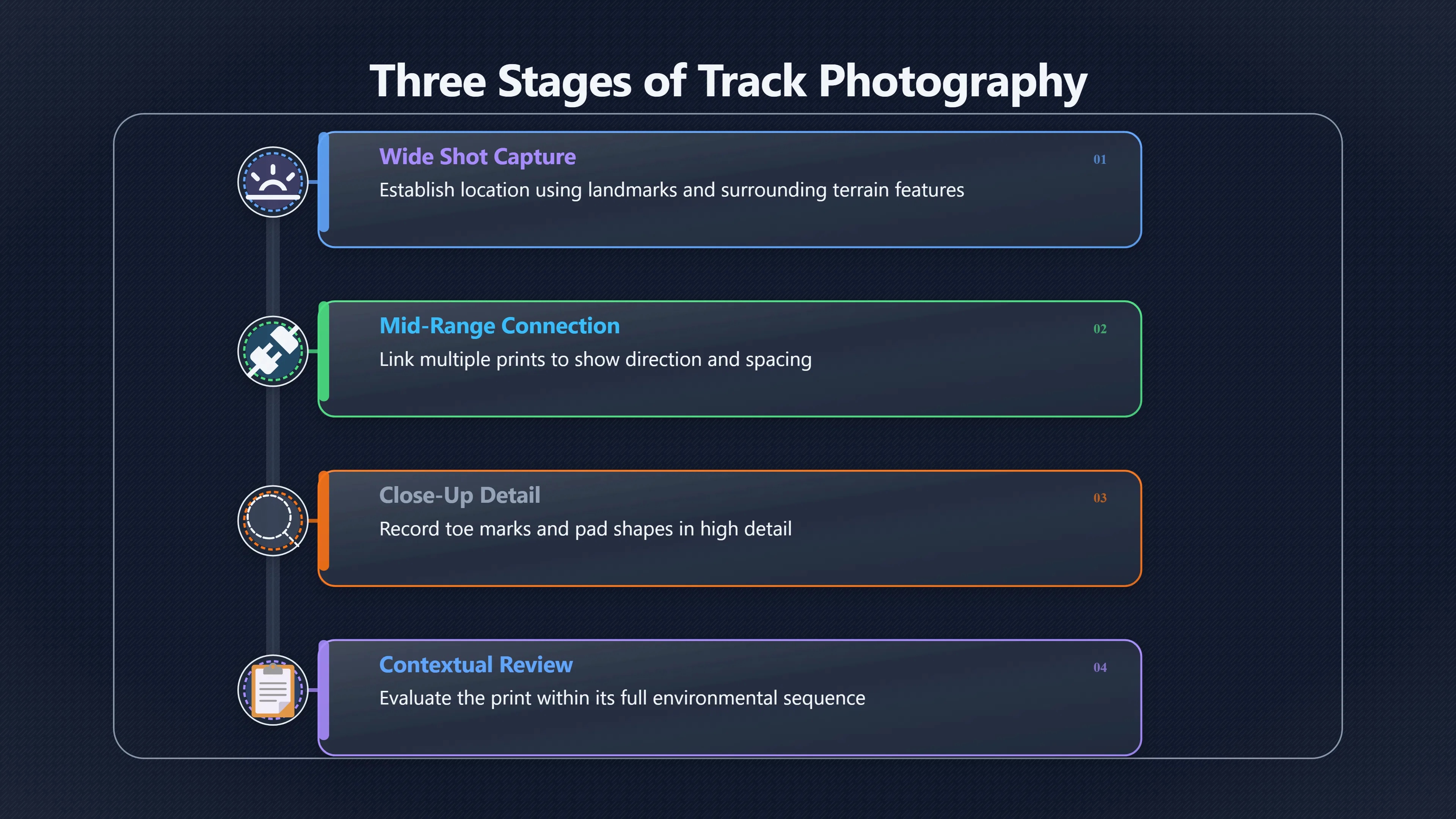
The most useful track records are usually made in three stages. Each photograph answers a different question.
Wide shots show where the track was found. These images include landmarks, vegetation, trails, stream banks, roads or other features that establish location and terrain. They help later investigators understand the environment and verify where the tracks occurred. In remote areas where landmarks are limited, recording orientation and location data becomes especially important.[crime-scene-investigator.net]crime-scene-investigator.netfootwear and tire track photographyKeep the film plane parallel to the plane of the impression…
Mid-range shots connect the track to its surroundings. These photographs show several prints together, the direction of travel and the relationship between tracks and nearby features. A mid-range image can reveal whether tracks form a consistent trail, cross another trail, emerge from water, follow a road edge or abruptly stop. For investigators, this information is often more valuable than a single detailed footprint.[NIST]nist.govGuide for the Forensic Documentation and Photography of…26 Oct 2016 — • A rigid scale should be included in every photograph. • Pl…
Close-up shots capture the details of individual impressions. Toe marks, claw impressions, pad shapes, depth variations and edge definition are recorded at this stage. Close-ups should fill most of the frame while still including a scale. The goal is not artistic composition but accurate documentation.[wisdoj.gov]wisdoj.govLack of a proper scale will limit our conclusions! 3. PositionFootwear Impression Preservation, Documentation and…February 28, 2020 — Scaling at the same depth, and correct angle of the impression…
A useful rule is simple: never take only the close-up. If the wider context is lost, later reviewers may be unable to determine whether the print was isolated, part of a trackway or simply a distorted impression among many ordinary tracks.
Scale objects and camera angle mistakes
One of the most common weaknesses in cryptid track evidence is the absence of reliable scale.
A photograph without a measurement reference forces viewers to guess the track’s size. A print described as”huge” may prove ordinary when measured. Forensic photography standards therefore recommend placing a ruler or photographic scale beside the impression on the same plane as the track. The scale should not overlap the track or sit at a different height from the impression.[NIST+2American Academy of Forensic Sciences]nist.govGuide for the Forensic Documentation and Photography of…26 Oct 2016 — • A rigid scale should be included in every photograph. • Pl…
Field investigators sometimes use coins, pens, boots or hands as improvised references. While these are better than nothing, a ruler with marked measurements is far more useful because it allows later analysis and accurate size estimation.[y2y.net]y2y.netWho goes there?Three tips to take better animal track photosFebruary 24, 2022 — 24 Feb 2022 — Tip 1: Have a size reference in your photos. Joseph says c…
Another frequent problem is camera angle distortion. If the camera is tilted rather than positioned directly above the track, the print can appear longer, wider or differently shaped than it actually is. Forensic guidance consistently recommends keeping the camera sensor plane parallel to the impression and photographing from directly overhead whenever possible. Even slight angles can affect measurements and shape comparisons.[wisdoj.gov+2crime-scene-investigator.net]wisdoj.govLack of a proper scale will limit our conclusions! 3. PositionFootwear Impression Preservation, Documentation and…February 28, 2020 — Scaling at the same depth, and correct angle of the impression…
Common mistakes include:
- Photographing from knee height at an oblique angle.
- Placing the scale closer to the camera than the track.
- Cropping away the scale during editing.
- Taking only one photograph rather than several from slightly different lighting angles.
- Allowing shadows to hide key features of the impression.[wisdoj.gov+2crime-scene-investigator.net]wisdoj.govLack of a proper scale will limit our conclusions! 3. PositionFootwear Impression Preservation, Documentation and…February 28, 2020 — Scaling at the same depth, and correct angle of the impression…
These errors can make a potentially useful track difficult to assess, regardless of how unusual it originally appeared.
Why the whole trackway matters
A single footprint rarely tells the full story. A trackway—the entire sequence of tracks left by an animal or person—often provides stronger evidence than any individual print.
Stride length, step spacing, gait patterns and direction of movement can all be examined when multiple tracks are documented. A print that appears unusual in isolation may become less mysterious when viewed as part of a normal walking pattern. Conversely, an apparently ordinary print may gain significance if it forms a consistent trail with unusual dimensions or movement characteristics.[Studocu]studocu.com○ Requires both mid-range and close-up photographs. ○ Mid-range shows the…Read more…
Trackways can also reveal environmental effects that distort individual prints. Rain, melting snow, erosion, repeated stepping and substrate collapse can enlarge or reshape impressions. Looking at an entire series often shows whether unusual features repeat consistently or occur only in a single damaged print.
For cryptid claims, this distinction is crucial. Many famous footprint controversies have centred on enlarged, degraded or overlapping tracks. Without photographs of the full sequence, reviewers cannot determine whether a striking footprint was representative of the trail or merely the most dramatic example.
A complete trackway record should ideally show:<div class="content-enhancement content-enhancement--insight-grid" markdown="1">
- The first and last visible tracks.
- Direction of travel.
- Relative spacing between impressions.
- Changes in substrate such as mud, sand, snow or leaf litter.
- Any intersections with known animal or human tracks.
What makes a track photograph genuinely useful?
A useful mystery-track photograph allows another investigator to ask practical questions: How large was it? What was the ground like? Was it part of a continuous trail? Could distortion explain its appearance? Does the trackway match a known animal?
The strongest images therefore combine three elements:<div class="content-enhancement content-enhancement--step-flow" markdown="1">
- Context — where the track occurred and what surrounded it.
- Scale — an accurate measurement reference beside the impression.
- Sequence — documentation of the wider trackway rather than a single print.</div>
When those elements are preserved, later investigators can evaluate the evidence independently. When they are missing, even the most intriguing footprint photograph becomes largely a matter of speculation.[forensicsciencesimplified.org+2Encyclopedia]forensicsciencesimplified.orgThe purpose of crime scene photography is to document what is there and where it is in.Read more…
eBay marketplace picks
Marketplace Samples
Live-tested eBay searches with available results related to this page.

Endnotes
1.
Source: forensicsciencesimplified.org
Link:https://www.forensicsciencesimplified.org/photo/Photography.pdf
2.
Source: studocu.com
Link:https://www.studocu.com/en-us/document/indiana-institute-of-technology/crime-scene-investigation/impression-evidence-notes/16568765
3.
Source: crime-scene-investigator.net
Title: footwear and tire track photography
Link:https://www.crime-scene-investigator.net/footwear-and-tire-track-photography.html
4.
Source: nist.gov
Link:https://www.nist.gov/system/files/documents/2016/10/26/swgtread_09_guide_for_the_forensic_documentation_and_photography_of_footwear_and_tire_impressions_at_the_crime_scene_200603.pdf
5.
Source: wisdoj.gov
Title: Lack of a proper scale will limit our conclusions! 3. Position
Link:https://www.wisdoj.gov/Forensic%20Science/Footwear%20Evidence%20Brochure.pdf
6.
Source: nist.gov
Link:https://www.nist.gov/system/files/documents/2017/05/09/Dimensional-Review-of-Scales-for-Forensic-Photography.pdf
7.
Source: y2y.net
Title: Who goes there?
Link:https://y2y.net/blog/three-tips-to-take-better-animal-track-[photos
8.
Source: crime-scene-investigator.net
Title: photogrammetry simplified
Link:https://www.crime-scene-investigator.net/photogrammetry-simplified.html
9.
Source: encyclopedia.pub
Link:https://encyclopedia.pub/entry/35544
10.
Source: iaaievidenceguide.com
Link:https://www.iaaievidenceguide.com/2-d-impressions
11.
Source: aafs.org
Link:https://www.aafs.org/sites/default/files/[media
12.
Source: adfg.alaska.gov
Link:https://www.adfg.alaska.gov/static/education/educators/curricula/pdfs/tracks.pdf
Additional References
13.
Source: instagram.com
Link:https://www.instagram.com/p/DYKLtJNiPoP/
14.
Source: sirchie.com
Link:https://www.sirchie.com/media/resourcecenter/item/0/7/07_crime_scene_doc_photog_1.pdf
15.
Source: tamron-americas.com
Link:https://tamron-americas.com/blog/wildlife-photography-animal-tracking/?srsltid=AfmBOoqNJWelX1dur_orG81uAcfmpfzoMTQnHDhhTgPLNZQw6zZ_EMtC
16.
Source: facebook.com
Link:https://www.facebook.com/groups/271764596196849/posts/6918518581521384/
17.
Source: dfs.virginia.gov
Link:https://dfs.virginia.gov/wp-content/uploads/Impressions-2021-12-1.pdf
18.
Source: wolfcamp.org
Title: wildlife tracking animals for fun photography and hunting
Link:https://wolfcamp.org/wildlife-tracking-animals-for-fun-photography-and-hunting/
19.
Source: pubmed.ncbi.nlm.nih.gov
Link:https://pubmed.ncbi.nlm.nih.gov/27404626/
20.
Source: iaaievidenceguide.com
Title: Dental stone is the recommended casting medium.Read more
Link:https://www.iaaievidenceguide.com/3-d-impressions
21.
Source: wildlifeact.com
Title: basic wildlife tracking guide
Link:https://www.wildlifeact.com/blog/basic-wildlife-tracking-guide
22.
Source: scribd.com
Link:https://www.scribd.com/document/70577967/Untitled
Topic Tree