Within Field Basics
Why screenshots make weak evidence
Original images and full clips matter because cropped screenshots and shared copies can lose timing, location and context.
On this page
- What metadata can and cannot show
- How copied images lose context
- Keeping untouched files and full video
Page outline Jump by section
Introduction
In cryptid investigations, the most important photograph is often not the image that goes viral but the file that came directly from the camera. Whether a report involves a supposed Bigfoot, lake monster, unknown feline or other alleged cryptid, original photo and video files carry contextual information that can help investigators determine when, where and how an image was created. Screenshots, edited versions, compressed social-media uploads and forwarded copies frequently remove or alter that information. As a result, a dramatic image without an original source file is usually weak evidence, while a less impressive image with intact provenance may be far more useful. This distinction has become increasingly important as sightings are now commonly recorded on smartphones, trail cameras and consumer video devices. Digital-forensics research consistently treats original media files as primary evidence because they can contain metadata, device information and technical signatures that are often lost when media is copied or re-encoded. Investigators examining authenticity therefore routinely seek original files whenever possible.[SCIEPublish+2Magnet Forensics]sciepublish.comForensic Value of Exif Data: An Analytical Evaluation…by N Soni · 2025 · Cited by 6 — ABSTRACT: Exif metadata contained in…
Why screenshots make weak evidence
A screenshot is not the same thing as a photograph. When someone takes a screenshot of an image, the resulting file records the screen display rather than the original camera capture. In most cases, the screenshot contains metadata relating only to the device that created the screenshot and not to the camera that produced the original image. Forensic practitioners frequently note that screenshots usually lack the most useful photographic metadata and therefore provide limited evidential value.[Reddit]reddit.comScreenshot Forensic: r/computerforensicsScreenshot Forensic: r/computerforensicsAugust 4, 2020 — The most useful EXIF data is generally attached to original photos that w…
For cryptid claims, this creates several problems:
- The original capture time may be lost.
-
GPS location data may disappear.<div class="content-enhancement content-enhancement--insight-grid" markdown="1">
- Camera model information may vanish.[blog.ampedsoftware.com]blog.ampedsoftware.comusing exif metadata and jpeg qts for image analysisAmped BlogUsing Exif Metadata and JPEG QTs for Image Analysis11 Feb 2020 — Discover how to leverage Exif metadata and JPEG Quantization T…
- Resolution is often reduced.
- Compression artefacts may be introduced.
- Image-editing history becomes harder to reconstruct.</div>
A screenshot also breaks the chain between the visible image and the original recording device. If an investigator receives only a screenshot of a supposed unknown animal, there may be no reliable way to determine whether the image originated from a trail camera, a mobile phone, an older photograph or an edited composite.
What metadata can and cannot show
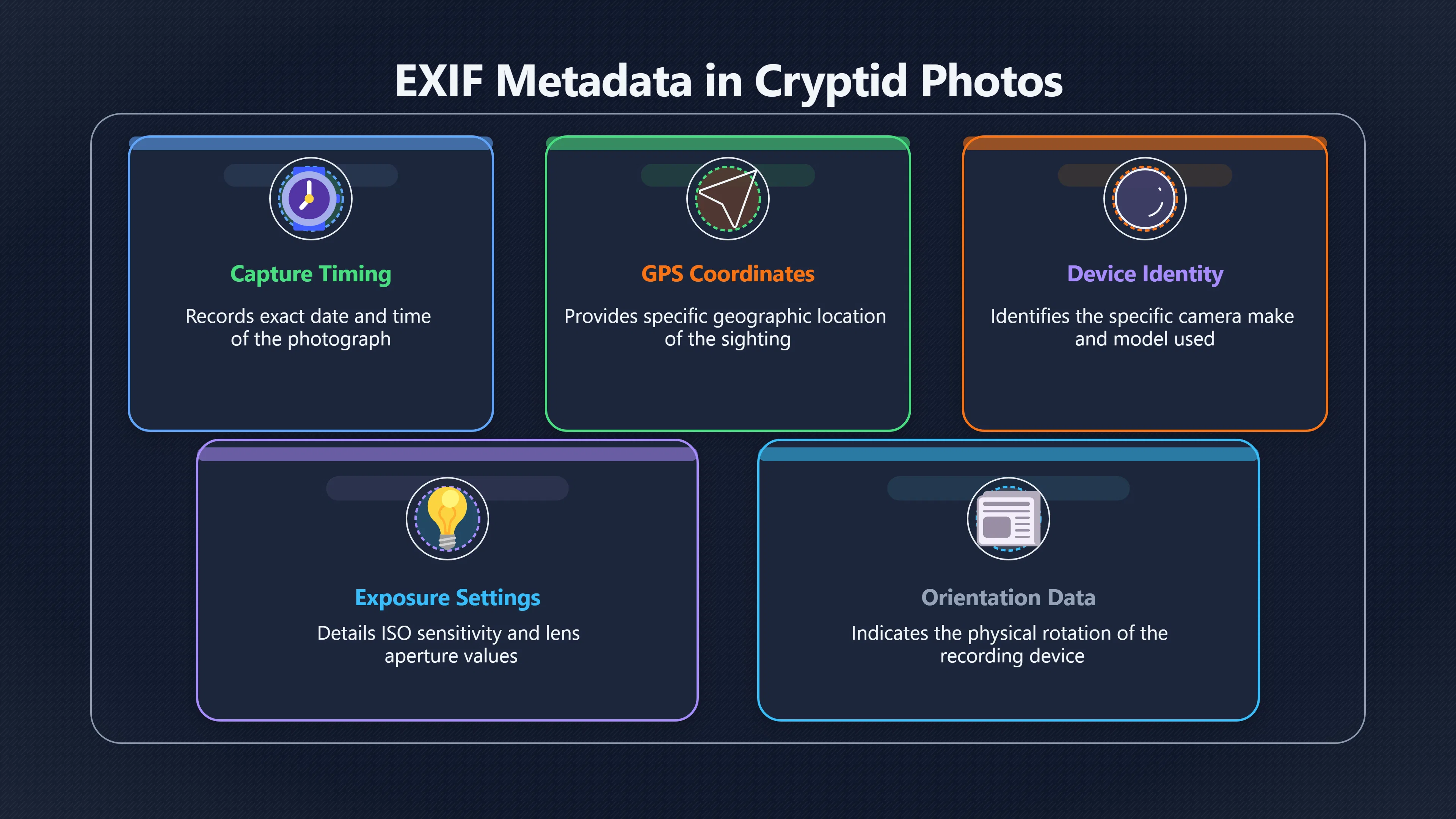
Digital photographs commonly contain EXIF (Exchangeable Image File Format) metadata. Modern smartphones and digital cameras automatically record technical information when a photograph is taken. Depending on device settings, this information may include:<div class="content-enhancement content-enhancement--metric" markdown="1">
- Date and time of capture.
- Camera make and model.[blog.ampedsoftware.com]blog.ampedsoftware.comusing exif metadata and jpeg qts for image analysisAmped BlogUsing Exif Metadata and JPEG QTs for Image Analysis11 Feb 2020 — Discover how to leverage Exif metadata and JPEG Quantization T…
- Lens information.
- Exposure settings.
- ISO sensitivity.
- GPS coordinates.
- Orientation data.
- File creation details.[towerforensics.co.uk+2Ironhack]towerforensics.co.ukwhat is exif data and how can digital forensics aid in image analysisIt is a standard format that includes a variety of metadata tags used by digital cameras…Read more…</div>
For cryptid investigations, metadata can help answer practical questions. If a witness claims a photograph was taken deep in a forest at dawn, metadata may support or contradict that claim by showing capture time, device type or location information. Trail-camera sequences may also reveal whether multiple images were recorded within seconds of one another, allowing investigators to reconstruct animal movement or camera-trigger events.[WILDLABS]wildlabs.netwhat metadata used trail camera imagesWhat metadata is used from trail camera images?31 Jul 2025 — I have found it frustrating that information such as camera name and…
However, metadata should not be treated as proof by itself. Digital-forensics specialists repeatedly caution that metadata can be altered, removed or fabricated. Some editing software allows users to modify timestamps and other fields. Metadata may also become inaccurate because of incorrect camera settings or clock errors. Consequently, metadata is most valuable when cross-checked against other evidence rather than accepted uncritically. Amped Blog+2TrueScreen - Trust as a Service[blog.ampedsoftware.com]blog.ampedsoftware.comusing exif metadata and jpeg qts for image analysisAmped BlogUsing Exif Metadata and JPEG QTs for Image Analysis11 Feb 2020 — Discover how to leverage Exif metadata and JPEG Quantization T…
In a cryptid context, metadata can establish context, but it cannot establish species identification. GPS coordinates do not prove that an unknown creature was present. They simply help verify where a photograph originated. Likewise, a timestamp does not prove authenticity; it only provides a data point that can be compared with witness accounts, weather records and other information.
How copied images lose context
Many cryptid photographs reach the public only after passing through several layers of sharing. A witness may upload a photograph to a social-media platform, download it again, crop it, send it through a messaging application and then repost it elsewhere. Each step can remove information.
Research examining image transmission through social-media and messaging platforms has found that many services strip or modify metadata, often for privacy or technical reasons. GPS coordinates, device identifiers and other EXIF fields are frequently removed. Images may also be resized and recompressed during upload.[LinkedIn+3SCIEPublish+3IPTC]sciepublish.comForensic Value of Exif Data: An Analytical Evaluation…by N Soni · 2025 · Cited by 6 — ABSTRACT: Exif metadata contained in…
For cryptid investigators, this means a viral image may no longer resemble the original evidence file. Several consequences follow:
Loss of location information. A photograph allegedly showing an unknown animal near a remote lake may no longer contain any geolocation data after being uploaded and downloaded from a platform.[Fastio]fast.ioio Which Social Media Platforms Strip Photo Metadata?2026)Signal is the strongest privacy option among messaging apps. It strips all EXIF metadata before transmitting photos: GPS coordinate…
Reduced image quality. Recompression can blur fine details that might help identify a known animal. Fur patterns, limb structure, claws and other distinguishing features may become harder to evaluate.[Hacker News]news.ycombinator.come (scaled to screen size, re-encoded from that reduced screen size).Read more…
Loss of sequence information. A single exported image may hide the fact that it originally belonged to a burst of photographs or a longer video sequence. The surrounding frames often provide crucial context.[WILDLABS]wildlabs.netwhat metadata used trail camera imagesWhat metadata is used from trail camera images?31 Jul 2025 — I have found it frustrating that information such as camera name and…
Difficulty detecting manipulation. Digital-forensics tools frequently compare metadata and image characteristics to identify editing or compositing. When metadata disappears, fewer verification avenues remain available.[Amped Blog]blog.ampedsoftware.comusing exif metadata and jpeg qts for image analysisAmped BlogUsing Exif Metadata and JPEG QTs for Image Analysis11 Feb 2020 — Discover how to leverage Exif metadata and JPEG Quantization T…
These problems explain why experienced investigators generally request original files before attempting detailed analysis.
Original files are often more valuable than the image itself
One of the most overlooked aspects of cryptid evidence is that the surrounding data can be more informative than the visible subject.
Consider a hypothetical trail-camera image showing a dark upright figure. Public discussion may focus entirely on the figure’s appearance. Yet investigators often learn more from the file structure, timestamps and image sequence than from the figure itself. Multiple consecutive frames may reveal an ordinary bear changing posture. Metadata may show a trigger interval consistent with known wildlife movement. Additional images may reveal environmental context excluded from a cropped version.
Wildlife researchers routinely rely on complete image sequences rather than isolated frames because animal behaviour is easier to interpret when viewed in context. The same principle applies to cryptid claims. A single dramatic frame can mislead; a complete dataset often reduces ambiguity.
The history of cryptozoology contains numerous disputed photographs whose evidential value suffered because original files were unavailable, incomplete or released only after extensive copying. In many cases, debate eventually centred less on the creature depicted and more on the inability to examine the original evidence.
Keeping untouched files and full video
Responsible evidence preservation begins immediately after a sighting.
If a witness records a possible cryptid encounter, the original file should be preserved before any editing, cropping or enhancement occurs. Investigators should ideally obtain:<div class="content-enhancement content-enhancement--insight-grid" markdown="1">
- The original photograph or video file.
- The entire video rather than selected clips.
- Consecutive images from the same sequence.
- Information about the recording device.
- Details of any edits already performed.
- Backup copies stored separately.</div>
Digital-forensics guidance commonly emphasises preserving original evidence because later modifications can obscure authenticity assessments. Investigators examining media files often use hashes, metadata extraction and file comparisons to determine whether files remain unchanged. These methods are most effective when original media is available.[Magnet Forensics]magnetforensics.comgetting to the source understanding metadata removal on social mediaMagnet ForensicsGetting to the…
Video evidence deserves particular attention. Short online clips frequently exclude the moments immediately before and after the event. Those omitted sections may reveal camera movement, environmental conditions, witness reactions or alternative explanations. Full-length recordings preserve context that edited highlights cannot provide. Video metadata may also contain technical information useful for authenticity assessment.[Magnet Forensics]magnetforensics.comgetting to the source understanding metadata removal on social mediaMagnet ForensicsGetting to the…
The strongest cryptid image is the one that can be checked
Within responsible cryptid fieldwork, the goal is not merely to collect unusual images but to preserve evidence that others can independently evaluate. Original files support that goal because they retain context that screenshots and reposts often destroy.
Metadata can help establish when and where a photograph was taken, reveal technical details about the recording device and assist forensic examination. At the same time, metadata has limits and must be verified against other evidence. What matters most is that original files provide investigators with opportunities for testing, comparison and validation that copied images cannot offer.
For that reason, when a cryptid claim depends on photographs or video, the first question is often not “What does the creature look like?” but “Where is the original file?” The answer to that question frequently determines how seriously the evidence can be assessed.[towerforensics.co.uk+3SCIEPublish+3Magnet Forensics]sciepublish.comForensic Value of Exif Data: An Analytical Evaluation…by N Soni · 2025 · Cited by 6 — ABSTRACT: Exif metadata contained in…
Amazon book picks
Further Reading
Books and field guides related to Why screenshots make weak evidence. Use these as the next step if you want deeper reading beyond the article.
Abominable Science!
Discusses evaluating photographs and extraordinary claims critically.
Digital Evidence and Computer Crime
Explains why original files and metadata matter as evidence.
Practical Mobile Forensics,
Covers acquisition and preservation of original mobile media.
eBay marketplace picks
Marketplace Samples
Live-tested eBay searches with available results related to this page.

Endnotes
1.
Source: sciepublish.com
Link:https://www.sciepublish.com/article/pii/567
2.
Source: reddit.com
Title: Screenshot Forensic: r/computerforensics
Link:https://www.reddit.com/r/computerforensics/comments/i3s0tg/screenshot_forensic/
3.
Source: reddit.com
Link:https://www.reddit.com/r/cryptids/comments/r17vr8/over_a_year_ago_this_picture_was_taken_by_a_trail/
4.
Source: towerforensics.co.uk
Title: what is exif data and how can digital forensics aid in image analysis
Link:https://www.towerforensics.co.uk/blog/what-is-exif-data-and-how-can-digital-forensics-aid-in-image-analysis/
5.
Source: ironhack.com
Title: metadata forensics when files can speak and reveal the truth
Link:https://www.ironhack.com/us/blog/metadata-forensics-when-files-can-speak-and-reveal-the-truth
6.
Source: wildlabs.net
Title: what metadata used trail camera images
Link:https://wildlabs.net/en/discussion/what-metadata-used-trail-camera-images?language_content_entity=en
7.
Source: truescreen.io
Title: True Screen
Link:https://truescreen.io/insights/exif-metadata-photo-date-court-evidence/
8.
Source: iptc.org
Title: social media sites photo metadata test results 2019
Link:https://www.iptc.org/standards/photo-metadata/social-media-sites-photo-metadata-test-results-2019/
9.
Source: linkedin.com
Link:https://www.linkedin.com/pulse/understanding-metadata-digital-forensics-html-vfsvc
10.
Source: reddit.com
Link:https://www.reddit.com/r/cybersecurity_help/comments/plhqut/is_it_possible_to_extract_metadata_from_images_if/
11.
Source: reddit.com
Link:https://www.reddit.com/r/forensics/comments/cc8fix/examining_exif_datameta_data_of_photographs_and/
12.
Source: magnetforensics.com
Title: getting to the source understanding metadata removal on social media
Link:https://www.magnetforensics.com/blog/getting-to-the-source-understanding-metadata-removal-on-social-media/
13.
Source: blog.ampedsoftware.com
Title: using exif metadata and jpeg qts for image analysis
Link:https://blog.ampedsoftware.com/2020/02/11/using-exif-metadata-and-jpeg-qts-for-image-analysis
14.
Source: fast.io
Title: io Which Social Media Platforms Strip Photo Metadata?
Link:https://fast.io/resources/social-media-photo-metadata-platforms-strip/
15.
Source: news.ycombinator.com
Link:https://news.ycombinator.com/item?id=43804176
Additional References
16.
Source: researchgate.net
Link:https://www.researchgate.net/publication/392920789_Forensic_Value_of_Exif_Data_An_Analytical_Evaluation_of_Metadata_Integrity_across_Image_Transfer_Methods
17.
Source: compress-or-die.com
Link:https://compress-or-die.com/analyze
18.
Source: exifremover.com
Link:https://exifremover.com/
19.
Source: facebook.com
Link:https://www.facebook.com/groups/2586868577995532/posts/9546733268675660/
20.
Source: exifmeta.com
Link:https://exifmeta.com/
21.
Source: 1854.photography
Title: study exposes social media sites that delete photographs metadata
Link:https://www.1854.photography/2013/03/study-exposes-social-media-sites-that-delete-photographs-metadata/
22.
Source: privacystrip.com
Title: Does Instagram, Whats App, Signal, or X Remove EXIF?
Link:https://privacystrip.com/blog/social-media-metadata-policies/
23.
Source: facebook.com
Link:https://www.facebook.com/snopes/posts/we-investigated-the-origins-of-this-picture-which-has-been-endlessly-shared-by-l/2481416468669524/
24.
Source: jimpl.com
Link:https://jimpl.com/
25.
Source: metadataperspective.com
Title: Metadata Matters: Camera Original Photos vs
Link:https://metadataperspective.com/2025/11/04/metadata-matters-camera-original-photos-vs-screenshots-in-court/
Topic Tree