Within Sightings
Why Darkness Makes Monsters Bigger
Poor light and uncertain range can turn ordinary animals, logs or wakes into oversized mystery creatures.
On this page
- How low light reduces useful detail
- Why distance makes scale hard to judge
- Common cryptid mistakes caused by poor viewing conditions
Page outline Jump by section
Introduction
Many cryptid reports occur under the exact conditions most likely to distort perception: at night, at dusk, across a lake, through fog, or at the edge of a vehicle’s headlights. In these situations, witnesses are often reporting something real—a moving shape, a wake, an animal, a floating object—but the lack of visual detail makes accurate identification difficult. Research on human vision and eyewitness reliability shows that both low light and long viewing distance reduce the ability to recognise objects correctly and increase the likelihood of mistaken judgments about size, shape and identity.[ResearchGate]researchgate.netResearch Gate The distance threshold of target identification in low lightThe distance threshold of target identification in low lightJanuary 1, 2019 — Prior research shows that increased distance an… For cryptozoology, this matters because many famous monster reports involve precisely these conditions. A distant otter line may become a lake serpent. A wake may become a series of humps. A bear glimpsed at night may seem far larger than it really is. The witness may be entirely sincere, yet the viewing conditions themselves can manufacture the impression of something extraordinary.[Wikipedia]WikipediaLake monsterLake monster
How Low Light Removes the Details That Identify Animals
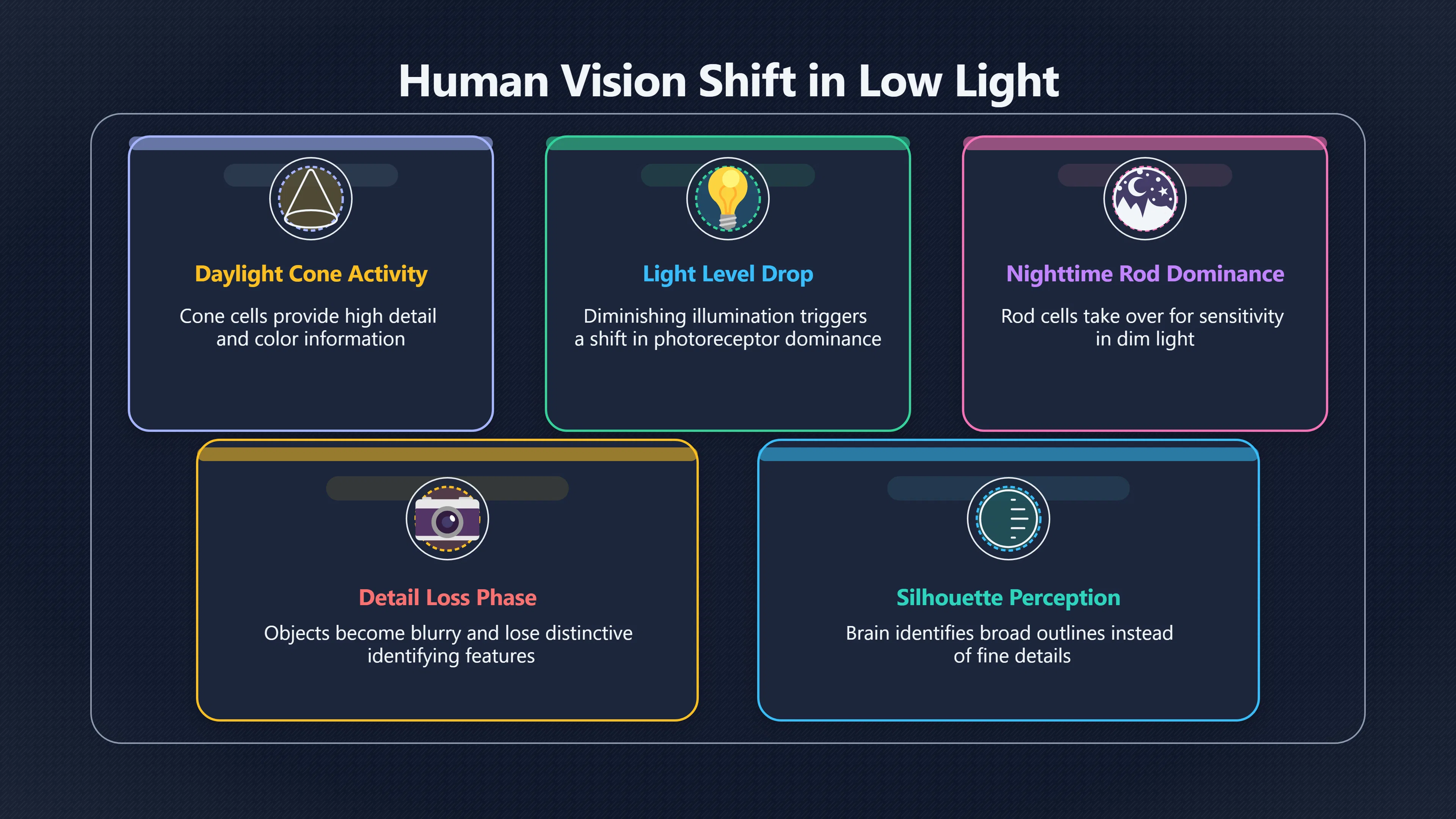
Human vision changes dramatically as light levels fall. During daylight, cone cells in the eye provide colour vision and fine detail. At night, rod cells dominate. Rods are highly sensitive to dim light, but they provide poorer detail and little colour information. As a result, objects become darker, blurrier and more difficult to identify accurately.[Cleveland Clinic+2ResearchGate]my.clevelandclinic.orgCleveland ClinicPhotoreceptors (Rods & Cones): Anatomy & FunctionMay 7, 2024 — 6 May 2024 — Rod photoreceptors are mainly responsible for…
This shift creates ideal conditions for cryptid misidentifications. A witness may accurately perceive movement while losing the visual information needed to determine what is moving. Distinctive features such as fur colour, body proportions, markings or facial characteristics disappear first, leaving only a silhouette or dark mass.[Cleveland Clinic]my.clevelandclinic.orgCleveland ClinicPhotoreceptors (Rods & Cones): Anatomy & FunctionMay 7, 2024 — 6 May 2024 — Rod photoreceptors are mainly responsible for…
Low-light vision also favours broad outlines over fine details. Psychological and vision research shows that object identification depends heavily on high-detail visual information, whereas coarse visual information is often enough only to detect that something is present. In darkness, people may therefore perceive a large shape without being able to identify it confidently.[arXiv]arxiv.orgHow spatial frequencies and color drive object search in real-world scenes: A new eye-movement corpusOctober 22, 2019…
In cryptid reports, this often produces descriptions such as:<div class="content-enhancement content-enhancement--insight-grid" markdown="1">
- A “large black figure” crossing a road.
- A “massive shape” moving between trees.
- A “long neck” visible against water.
- A “dark creature” seen only briefly at the edge of illumination.</div>
These descriptions can be genuine observations while still being too incomplete to support identification of an unknown species.
Why Distance Makes Monsters Seem Larger
Distance creates a second problem: judging scale.
Humans estimate size partly by comparing an object with familiar reference points. When those references are absent or unclear, size estimates become unreliable. Across a lake, in open countryside, or at night, the visual cues normally used to judge distance and scale are often missing or degraded.[FGB+2JOV]personal.fgb.vu.nlFGBPerceived distance, shape and sizeby E Brenner · 1999 · Cited by 206 — If distance, shape and size are judged independently from the r…
The result is a common perceptual trap. If an observer underestimates how far away an object is, the object appears larger than it really is. Conversely, if its distance is overestimated, it may appear unusually large because the brain unconsciously assumes a bigger object would be needed to produce the same apparent image size. Research on size and distance perception shows that these judgments are closely linked and can influence one another.[JOV]jov.arvojournals.orgFamiliar size affects the perceived size and distance of real…by MV Maltz · 2021 · Cited by 27 — We examined the familiar size effe…
This is particularly important in cryptozoology because many sightings occur in environments where depth cues are poor:<div class="content-enhancement content-enhancement--phrase-stack" markdown="1">
- Large lakes and reservoirs.
- Coastal waters.
- Open moorland.
- Forest clearings at night.
- Long roads illuminated only by headlights.</div>
In such settings, estimating whether an object is 30 metres away or 100 metres away can be surprisingly difficult. Small errors in distance estimation can translate into large errors in perceived size.
Water Is a Perfect Generator of Monster Illusions
Many famous lake-monster sightings share a common feature: the observer is viewing an object across water.
Water removes many of the cues humans use to judge distance. Reflections, waves, changing light angles and surface distortions can make ordinary objects appear larger, longer or stranger than they really are. A floating log, a group of swimming animals or an unusual wake may be visible only intermittently as it rises and falls with the water. The brain naturally attempts to connect these fragments into a single coherent object.[Occult World]occult-world.comthe lake monsters we never stopped chasingOccult WorldThe Lake Monsters We Never Stopped Chasing4 May 2026 — Water distorts size, distance, speed, and shape. A floating log can se…
One frequently cited explanation for some lake-monster reports involves groups of otters swimming in a line. At a distance, several animals surfacing sequentially can resemble a single serpentine creature with multiple humps. Investigators of lake-monster claims have repeatedly pointed to this effect as an example of how honest observers can mistake ordinary wildlife for a large unknown animal.[Wikipedia]WikipediaLake monsterLake monster
Long-time Loch Ness investigator Adrian Shine has similarly argued that many Nessie reports can be explained by boat wakes. Under certain conditions, wakes can form a sequence of humps that appears animal-like when viewed from shore, particularly at long range or in poor visibility. He has also suggested that birds on calm water can create impressions of a necked creature.[New York Post]nypost.comThe 76-year-old founder of the Loch Ness Project now attributes reported sightings of "Nessie" to natural phenomena, particularly the wak…
The key point is not that every sighting has been explained, but that water routinely produces visual conditions in which shape, distance and movement become difficult to interpret accurately.
When Distance and Darkness Combine
Distance alone reduces accuracy. Darkness alone reduces accuracy. Together they are especially problematic.
Experimental eyewitness research has found that increasing distance and decreasing illumination both reduce identification reliability. Studies examining low-light observation show that beyond certain distances, correct identification rates fall substantially because observers can no longer obtain enough visual information from the target.[ResearchGate]researchgate.netResearch Gate The distance threshold of target identification in low lightThe distance threshold of target identification in low lightJanuary 1, 2019 — Prior research shows that increased distance an…
For cryptid sightings, this combination is common:<div class="content-enhancement content-enhancement--insight-grid" markdown="1">
- A witness sees a figure across a field after sunset.
- A driver catches a glimpse of movement beyond the headlight beam.
- A boater notices humps on dark water at twilight.
- A camper observes a silhouette moving along a ridgeline at night.</div>
In each case, the observer receives only fragments of information. The brain fills the gaps using assumptions, expectations and prior knowledge. If local folklore already includes stories of Bigfoot, Nessie or another cryptid, those fragments may be interpreted through that existing framework.
Importantly, this process does not require imagination in the sense of invention. It is a normal feature of human perception. The visual system constantly reconstructs incomplete scenes from limited information.
Common Cryptid Mistakes Caused by Poor Viewing Conditions
Several recurring patterns appear throughout cryptozoological literature and investigations.
Ordinary animals appear oversized. Bears, deer, moose and large dogs viewed at night can seem much larger than they really are when their distance is misjudged.[Experimental Psychology Society]eps.ac.ukPoor visualExperimental Psychology SocietyThe Impact of Distance, Lighting, and Disguise on Serious…December 18, 2024 — It is unknown how often e…
Multiple animals become one creature. Swimming otters, seals or birds may appear to be sections of a single long-bodied animal when seen from far away.[Wikipedia]WikipediaLake monsterLake monster
Wakes become bodies. Water disturbances can resemble humps, backs or serpentine movement, especially in low light.[New York Post]nypost.comThe 76-year-old founder of the Loch Ness Project now attributes reported sightings of "Nessie" to natural phenomena, particularly the wak…
Floating objects seem alive. Logs, debris and vegetation can appear animate when partially obscured by waves or darkness.[Occult World]occult-world.comthe lake monsters we never stopped chasingOccult WorldThe Lake Monsters We Never Stopped Chasing4 May 2026 — Water distorts size, distance, speed, and shape. A floating log can se…
Brief silhouettes acquire impossible features. A witness may accurately remember a dark shape while later overestimating its height, length or unusual anatomy because the original visual information was incomplete.[Experimental Psychology Society]eps.ac.ukPoor visualExperimental Psychology SocietyThe Impact of Distance, Lighting, and Disguise on Serious…December 18, 2024 — It is unknown how often e…
Why These Errors Matter in Cryptozoology
Distance and darkness do not prove that every monster sighting is mistaken. What they do show is that some of the most dramatic cryptid reports arise under conditions known to impair accurate visual judgment.
See on Amazon</a></div></div></article><article class="fr-book-card"><a class="fr-book-cover" href="https://www.amazon.com/s?k=Eyewitness+Testimony+by+Elizabeth+F.+Loftus&i=stripbooks&tag=searcht-20" target="_blank" rel="sponsored noopener noreferrer" aria-label="Open Eyewitness Testimony on Amazon"><span class="fr-book-cover-fallback">Book</span><img class="fr-book-cover-thumb" src="https://books.google.com/books/content?id=uBlAU24-qsoC&printsec=frontcover&img=1&zoom=1&edge=curl&source=gbs_api" alt="Cover for Eyewitness Testimony" loading="lazy" decoding="async" fetchpriority="low" referrerpolicy="no-referrer" onerror="this.hidden=true;this.closest('.fr-book-cover').classList.add('fr-book-cover-placeholder');"></a><div class="fr-book-info"><h4 class="fr-book-title"><a href="https://www.amazon.com/s?k=Eyewitness+Testimony+by+Elizabeth+F.+Loftus&i=stripbooks&tag=searcht-20" target="_blank" rel="sponsored noopener noreferrer" title="Eyewitness Testimony">Eyewitness Testimony</a></h4><p class="fr-book-author">By Elizabeth F. Loftus</p><p class="fr-book-desc">Relevant to low-light and distance-based misidentifications.</p><div class="fr-book-actions"><a href="https://www.amazon.com/s?k=Eyewitness+Testimony+by+Elizabeth+F.+Loftus&i=stripbooks&tag=searcht-20" class="fr-amazon-btn" target="_blank" rel="sponsored noopener noreferrer">
See on Amazon</a></div></div></article><article class="fr-book-card"><a class="fr-book-cover" href="https://www.amazon.com/s?k=Abominable+Science%21+by+Daniel+Loxton&i=stripbooks&tag=searcht-20" target="_blank" rel="sponsored noopener noreferrer" aria-label="Open Abominable Science! on Amazon"><span class="fr-book-cover-fallback">Book</span><img class="fr-book-cover-thumb" src="https://books.google.com/books/content?id=kTsgAAAAQBAJ&printsec=frontcover&img=1&zoom=1&edge=curl&source=gbs_api" alt="Cover for Abominable Science!" loading="lazy" decoding="async" fetchpriority="low" referrerpolicy="no-referrer" onerror="this.hidden=true;this.closest('.fr-book-cover').classList.add('fr-book-cover-placeholder');"></a><div class="fr-book-info"><h4 class="fr-book-title"><a href="https://www.amazon.com/s?k=Abominable+Science%21+by+Daniel+Loxton&i=stripbooks&tag=searcht-20" target="_blank" rel="sponsored noopener noreferrer" title="Abominable Science!">Abominable Science!</a></h4><p class="fr-book-author">By Daniel Loxton, Donald R. Prothero</p><p class="fr-book-desc">Many cryptid reports occur in poor viewing conditions.</p><div class="fr-book-actions"><a href="https://www.amazon.com/s?k=Abominable+Science%21+by+Daniel+Loxton&i=stripbooks&tag=searcht-20" class="fr-amazon-btn" target="_blank" rel="sponsored noopener noreferrer">
See on Amazon</a></div></div></article><article class="fr-book-card"><a class="fr-book-cover" href="https://www.amazon.com/s?k=Why+We+See+what+We+Do+by+Dale+Purves&i=stripbooks&tag=searcht-20" target="_blank" rel="sponsored noopener noreferrer" aria-label="Open Why We See what We Do on Amazon"><span class="fr-book-cover-fallback">Book</span><img class="fr-book-cover-thumb" src="https://books.google.com/books/content?id=DStpQgAACAAJ&printsec=frontcover&img=1&zoom=1&source=gbs_api" alt="Cover for Why We See what We Do" loading="lazy" decoding="async" fetchpriority="low" referrerpolicy="no-referrer" onerror="this.hidden=true;this.closest('.fr-book-cover').classList.add('fr-book-cover-placeholder');"></a><div class="fr-book-info"><h4 class="fr-book-title"><a href="https://www.amazon.com/s?k=Why+We+See+what+We+Do+by+Dale+Purves&i=stripbooks&tag=searcht-20" target="_blank" rel="sponsored noopener noreferrer" title="Why We See what We Do">Why We See what We Do</a></h4><p class="fr-book-author">By Dale Purves, R. Beau Lotto</p><p class="fr-book-desc">Explains how the brain constructs visual reality.</p><div class="fr-book-actions"><a href="https://www.amazon.com/s?k=Why+We+See+what+We+Do+by+Dale+Purves&i=stripbooks&tag=searcht-20" class="fr-amazon-btn" target="_blank" rel="sponsored noopener noreferrer">
See on Amazon</a></div></div></article></div><div class="fr-section-footer"><div class="fr-browse-links" aria-label="Browse more on Amazon"><span class="fr-browse-links-label">Browse more on Amazon:</span><a class="fr-browse-more" href="https://www.amazon.com/s?k=The+Invisible+Gorilla&i=stripbooks&tag=searcht-20" target="_blank" rel="sponsored noopener noreferrer">The Invisible Gorilla</a><a class="fr-browse-more" href="https://www.amazon.com/s?k=Eyewitness+Testimony&i=stripbooks&tag=searcht-20" target="_blank" rel="sponsored noopener noreferrer">Eyewitness Testimony</a><a class="fr-browse-more" href="https://www.amazon.com/s?k=Abominable+Science%21&i=stripbooks&tag=searcht-20" target="_blank" rel="sponsored noopener noreferrer">Abominable Science!</a></div><p class="fr-disclosure">As an Amazon Associate I earn from qualifying purchases.</p></div></div></section>
Amazon book picks
Further Reading
Books and field guides related to Why Darkness Makes Monsters Bigger. Use these as the next step if you want deeper reading beyond the article.
The Invisible Gorilla
Shows how visual attention and perception fail under real conditions.
eBay marketplace picks
Marketplace Samples
Live-tested eBay searches with available results related to this page.
Endnotes
1.
Source: researchgate.net
Title: Research Gate The distance threshold of target identification in low light
Link:https://www.researchgate.net/publication/333813631_A_stab_in_the_dark_The_distance_threshold_of_target_identification_in_low_light
2.
Source: digitalcommons.tamusa.edu
Link:https://digitalcommons.tamusa.edu/cgi/viewcontent.cgi?article=1018&context=psyc_faculty
3.
Source: Wikipedia
Title: Lake monster
Link:https://en.wikipedia.org/wiki/Lake_monster
4.
Source: researchgate.net
Link:https://www.researchgate.net/publication/320250718_Molecular_Bases_of_the_Difference_between_Rod-_and_Cone-mediated_Vision
5.
Source: arxiv.org
Link:https://arxiv.org/abs/1910.09904
6.
Source: personal.fgb.vu.nl
Link:https://personal.fgb.vu.nl/~ebrenner/pdfs/VR99.pdf
7.
Source: jov.arvojournals.org
Link:https://jov.arvojournals.org/article.aspx?articleid=2777938
8.
Source: occult-world.com
Title: the lake monsters we never stopped chasing
Link:https://occult-world.com/the-lake-monsters-we-never-stopped-chasing/
9.
Source: psychology.town
Title: duplicity theory vision rods cones roles
Link:https://psychology.town/general/duplicity-theory-vision-rods-cones-roles/
10.
Source: nypost.com
Link:https://nypost.com/2026/01/04/us-news/longtime-loch-ness-monster-hunter-turns-skeptic-with-down-to-earth-explanation-for-sightings/
11.
Source: my.clevelandclinic.org
Link:https://my.clevelandclinic.org/health/body/photoreceptors-rods-and-cones
12.
Source: centaur.reading.ac.uk
Title: A stab in the dark The distance threshold of target identification in low light
Link:https://centaur.reading.ac.uk/118718/1/A%20stab%20in%20the%20dark%20%20The%20distance%20threshold%20of%20target%20identification%20in%20low%20light.pdf
13.
Source: eps.ac.uk
Title: Poor visual
Link:https://eps.ac.uk/wp-content/uploads/2025/01/Thomas-Nyman.pdf
Additional References
14.
Source: cis.rit.edu
Link:https://www.cis.rit.edu/people/faculty/montag/vandplite/pages/chap_9/ch9p1.html
15.
Source: datacolor.com
Link:https://www.datacolor.com/business-solutions/blog/the-role-of-rods-and-cones-in-color-perception/
16.
Source: hyperphysics.phy-astr.gsu.edu
Link:https://hyperphysics.phy-astr.gsu.edu/hbase/vision/rodcone.html
17.
Source: facebook.com
Link:https://www.facebook.com/100085231120558/posts/our-eyes-can-identify-approximately-1-crore-10-million-different-colors-the-rod-/759146846936346/
18.
Source: scispace.com
Link:https://scispace.com/pdf/distance-discrimination-and-observer-strategy-in-judgments-1qfh4qkdl6.pdf
19.
Source: instagram.com
Link:https://www.instagram.com/reel/DZ8qD4vBk9j/
20.
Source: facebook.com
Link:https://www.facebook.com/Facts.Random.Weird/posts/scientists-have-deployed-advanced-sonar-mapping-environmental-dna-sampling-and-u/1336687401937406/
21.
Source: weeklyspooky.com
Title: lake monster legends still refuse to sink
Link:https://www.weeklyspooky.com/blog/lake-monster-legends-still-refuse-to-sink/
22.
Source: pmc.ncbi.nlm.nih.gov
Title: PMCWhy rods and cones?
Link:https://pmc.ncbi.nlm.nih.gov/articles/PMC4763127/
23.
Source: reactormag.com
Title: something in the water surveying lake and river monsters
Link:https://reactormag.com/something-in-the-water-surveying-lake-and-river-monsters/
Topic Tree